Wot 00d the world of rob.., p.1
WoT-00d-The World of Robert Jordan's The Wheel of Time,
p.1
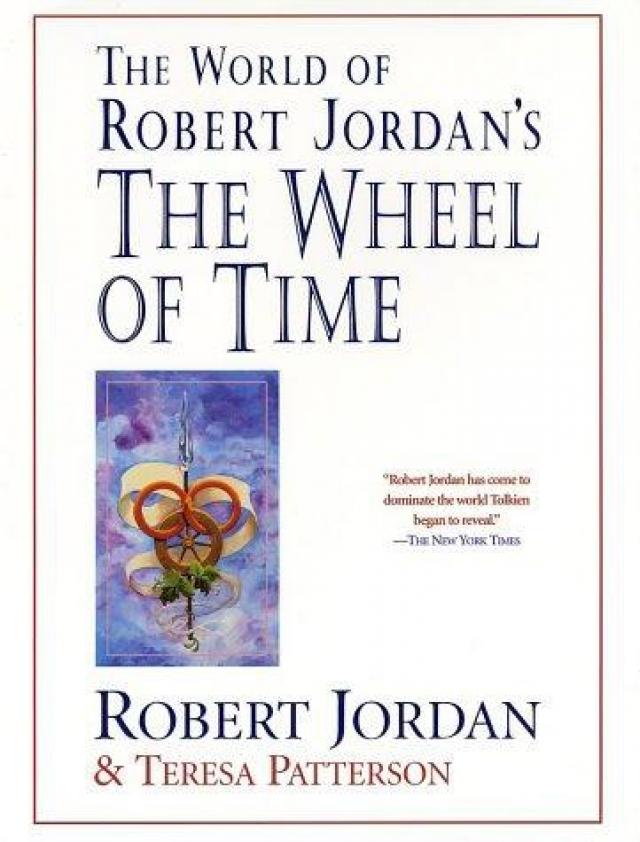


The World of Robert Jordan’s The Wheel of Time
Series: Wheel of Time [1]
Published: 2001
Rating: ★★★
Tags: Fantasy - Epic, Criticism, Illustrations, Epic, Science Fiction, Rand al’Thor (Fictitious character), Science Fiction Fantasy, General, Fantasy, American, Literary Criticism, Jordan; Robert;, Handbooks; manuals; etc, Fantasy fiction; American, Literature - Classics, Fiction, 1948-, Wheel of time, American - General
Fantasy - Epicttt Criticismttt Illustrationsttt Epicttt Science Fictionttt Rand al’Thor (Fictitious character)ttt Science Fiction Fantasyttt Generalttt Fantasyttt Americanttt Literary Criticismttt Jordan; Robert;ttt Handbooks; manuals; etcttt Fantasy fiction; Americanttt Literature - Classicsttt Fictionttt 1948-ttt Wheel of timettt American - Generalttt
*
SUMMARY:
Since the debut of Robert Jordan’s internationally bestselling series in 1990, The Wheel of Time has transported readers to a world so strikingly real, so rich in detail and complexity, it seems to rise from memory rather than a printed page. This essential companion to The Wheel of Time is for the millions interested in the history and the background of this incredible series-never-before-told legends, previously unknown peoples and lands, exotic beasts, and portents of what may come to pass. With more than seventy new full-color paintings that include stunning new world maps, portraits of the central characters, landscapes, objects of Power, and national flags, this comprehensive guide is indispensable to any Robert Jordan fan
The World of Robert Jordan’s
The Wheel
of Time
by Robert Jordan
&
Teresa Patterson
*
Table of Contents
Preface
The Wheel and the Power
The Wheel and the Pattern
The Power and the True Source
The Age of Legends
The Age of Legends
The Fall into Shadow
The Dark One & Male Forsaken
Shai’tan
Dreadlords
The Forsaken
Ishamael
Aginor
Balthamel
Sammael
Rahvin
Be’lal
Demandred
Asmodean
Female Forsaken & Darkfriends
Lanfear
Graendal
Semirhage
Mesaana
Moghedien
Osan’gar and Aran’gar
Friends of the Dark
Shadowspawn
Trollocs
Myrddraal
Draghkar
Darkhounds
Gray Men
The Breaking of the World
The World Since the Breaking
Formation of the White Tower
The Ten Nations
The Rise of Artur Hawkwing
The Reign of the High King
The War of the Hundred Years
The New Era
The Aiel War
The World of the Wheel
The World After the Breaking
The World
The Main Continent
Continent of the Seanchan
Land of the Madmen
Shara
Land of Barriers
Hazardous Trade
Rulers and Government
The Ayyad
Manifest Destiny
Slavery
Seanchan
One Nation
Leashing the Power
Class Structure
Imperial Control
Seanchan Honor
Imperial Security
The Return
The Animals of Seanchan
Torm
Corlm
Lopar
Grolm
Raken
To’raken
The Sea Folk Islands
The Atha’an Miere
Chain of Command
The Ships
The Amayar
The Aiel
The Waste
History of the Aiel
The First Division
The Second Division
The Maidens of the Spear
The Water Gift
Rhuidean
Legacy of Rhuidean
Growth of the Aiel Clans
The Code of Honor and Obligation
The Wise Ones
Aiel Culture
Aiel Kinship
The Lost Ones
The Ogier
Stedding
History
Lifestyle
The Ways
The Gift
The Waygate
Within the Ways
Deterioration of the Ways
Tel’aran’rhiod
The World of Dreams
Entering Tel’aran’rhiod
A Different Reality
Within the Land
The White Tower
Aes Sedai
Political Strength of the Tower
A Breed Apart
Talents
Becoming Aes Sedai
Warders
The Hierarchy of the Tower
The Seven Ajahs
Spies and Informants
The White Tower
The Library
Tar Valon
The Children of the Light
History
Purpose
The Hand of the Light
The Spymasters
Organizational Structure
The Military of the Land
National Armies
Order of Command
The Band of the Red Hand
Andor
History
Succession
National Stability
The Queen’s Guard
Caemlyn
Whitebridge
The Mountains of Mist and Baerlon
The Two Rivers
The Borderlands
Holding Back the Shadow
Shienar
Arafel
Kandor
Saldaea
Cairhien
History
The Game of Houses
The City of Cairhien
The Sun Palace
Foregate
The Other Nations
Amadicia
Altara
Murandy
Arad Doman
Tarabon
Ghealdan
Illian
Tear
Mayene
Holidays and the Calendar
The Prophecies of the Dragon
*
*
This compilation of the world’s geography, sociology, and history uses information dating from the earliest available records of the Age of Legends through the current era.
Reliable sources are limited. Almost all documents from before the War of the Hundred Years survive only as copies, or copies of copies, etc., and thus may well include mistakes made by the scribes. Few complete books or manuscripts of any kind survive from the War of the Hundred Years. The earlier period, from the end of the Trolloc Wars to the end of the War of the Hundred Years, left even less. All information from the time of the Breaking of the World to the end of the Trolloc Wars was pulled from manuscript fragments of varying sizes, sometimes not even consisting of consecutive pages. No books or manuscripts have yet been found dating from before the Breaking. All the information from the Age of Legends is based on documents from the first few centuries after the Breaking, when the writers might have had access to sources that had survived.
Wherever possible, the information has been at least partially verified by writings contemporary with their contents, but the older a document or manuscript, the harder it is to date pages precisely.
Some difficulties arise not from age or verifiability, but from problems of translation, for the older documents were written primarily or completely in the Old Tongue. Within the Old Tongue, as all scholars know, words have variable meanings, and some meanings have shifted to varying degrees over time.
The authors hope that the reader will forgive the occasional inaccuracy that may arise within these pages and relish instead the immense diversity and energy within the legacy of the Pattern and the World of the Wheel.
*
The Wheel and the Power
*
The Wheel and the Pattern
*
“The Wheel of Time turns, and Ages come and go, leaving memories that become legend. Legend fades to myth, and even myth is long forgotten when the Age that gave it birth comes again.” So begins each saga within the World of the Wheel, a universe in which the major controlling factor is the Wheel of Time and the Great Pattern it spins. A pattern in which light and dark, good and evil, male and female, and life and death struggle for balance within the weave of destiny.
What is the Wheel of Time? Imagine a great cosmic loom in the shape of a seven-spoked wheel, slowly spinning through eternity, weaving the fabric of the universe. The Wheel, put in place by the Creator, is time itself, ever turning and returning. The fabric it weaves is constructed from the threads of lives and events, interlaced into a design, the Great Pattern, which is the whole of existence and reality, past, present, and future.
Within the influence of this Lace of Ages are not only the earth and stone of the physical world, but othe
r worlds and universes, other dimensions, other possibilities. The Wheel touches what might be, what might have been, and what is. It touches the world of dreams as well as the world of waking.
In this world there is no one beginning or one end, for each spoke of the great Wheel represents one of the seven Ages, receding into the past and returning in the future as the Wheel spins, the fabric of each age changing only its weave and pattern with each passing. With every pass the changes vary to an increasingly greater degree. For each Age there is a separate and unique pattern, the Pattern of the Age, which forms the substance of reality for that age. This design is predetermined by the Wheel and can only partially be changed by those lives which make up the threads within the weave.
No one knows the length of time it takes for a full turning of the Wheel, nor is there a set time for each Age. There is only the certainty that all will come around again, though surely long past the span encompassed by human memory, or even legend. Yet that knowledge provides the basis for the philosophy and history of the known world. No ending, even death, is necessarily final within the turning of the Wheel. Reincarnation is a part of the way of the world. Prophecies are believed and heeded, since they tell as much of what was as of what will be. The only questions are when and in what manner the prophecies will unfold.
In such a world change is simply a predetermined part of the mechanism. Only a few individuals, special souls known as ta’veren, can cause the fabric of the pattern to bend around them, changing the weave. These ta’veren are spun out as key threads around which all surrounding life-threads, perhaps in some cases all life-threads, weave to create change. These key threads often produce major variations in the Pattern of an Age. Such major changes are called, in the old tongue, ta’maral’alien, or the “Web of Destiny.”
Even the ta’veren and the Web of Destiny woven around them are bound by the Wheel and the Great Pattern; it is believed that the Wheel spins out ta’veren whenever the weave begins to drift away from the Pattern. The changes around them, while often drastic and unsettling for those who must live in the Age, are thought to be part of the Wheel’s own correcting mechanism. The more change needed to bring the Great Pattern into balance, the more ta’veren spun out into the world.
The Great Wheel is the very heart of all time. But even the Wheel requires energy to maintain itself and its pattern. This energy comes from the True Source, from which the One Power may be drawn. Both the True Source and the One Power are made up of two conflicting yet complementary parts: saidin, the male half, and saidar, the female half. Working both together and against one another within the True Source, it is saidin and saidar which provide the driving force that turns the Wheel of Time.
The only known forces outside the Wheel and the Pattern are the Creator, who shaped the Wheel, the One Power that drives it—as well as the plan for the Great Pattern—and the Dark One who was imprisoned outside the pattern by the Creator at the moment of creation. No one inside and of the Pattern can destroy the Wheel or change the destiny of the Great Pattern. Even those who are ta’veren can only alter, but not completely change, the weave. It is believed that if he escapes his prison, the Dark One, being a creature or force beyond creation, has the ability to remake the Wheel and all of creation in his own dark image. Thus each person, especially each of those born ta’veren, must struggle to achieve his or her own best destiny to assure the balance and continuation of the Great Pattern.
*
The Power and the True Source
*
The True Source is made up of two complementary parts: saidin, the male half, and saidar, the female half. Each has separate properties and affinities, working at the same time with and against the other. Only women can touch saidar, and only men saidin. Each is completely unable to sense the other half of the Source, except as an absence or negativity. Even the methodologies by which men and women utilize the One Power that emanates from the True Source are so completely different that no woman can teach a man to use the power, and no man a woman.
In some Ages, such as that called the Age of Legends, men and women used the complementary and conflicting halves of the Power together to perform feats that neither could accomplish separately. In the present Age, part of the Power, the male half, has been tainted, causing any man who channels saidin to go mad eventually and cause Power-wrought havoc unless he is killed or gentled.
Most people cannot sense or touch the True Source, even though its energy may be manifested all around them. Only a tiny portion of the population, about two or three percent, actually have the ability, once taught, to touch and draw on the One Power, and today many of those cannot utilize its power in any effective manner. The act of drawing and controlling the flow of the One Power from the True Source is known as channeling.
Channeling draws on threads of the One Power and uses them singly or in combination in a weave designed to accomplish the particular task at hand. There are five different threads to the One Power, known as the Five Powers. They are named according to the elements their energies manipulate: Earth, Air (sometimes called Wind), Fire, Water, and Spirit. In many cases only one of the Powers is required to accomplish a task. A weave of Fire alone will light a candle or control a fire. But certain tasks necessitate the weaving of flows in more than one of the Five Powers. For instance, one who wishes to affect the weather must weave a flow combining Air, Water, and Spirit.
Anyone who can channel usually has a greater degree of strength with at least one or two of the Powers, yet they may lack any particular ability at all with some of the others. For example, someone strong in Wind may be all but unable to weave Fire, or may be weak in Earth but equally strong in Spirit and Air. Some few rare individuals have been found to be very strong in as many as three, or in very rare cases four, of the Powers. But since the Age of Legends no one has had great strength in all five. Even then, such individuals were very rare.
Levels of comparative strength also vary greatly from one individual wielder of the Power to another, and from men to women. Using records gathered from the Age of Legends (current data have little usable information concerning the use of saidin), it is possible to state certain facts about the strength and distribution of the ability in those men and women who could channel. In general, men were stronger in the use of the Power than women—that is, in the sheer volume of the Power they could handle—though there were certainly individual women who had great strength and individual men who were comparatively weak. By the same token, though some men had great dexterity in the weaving, in general women outstripped men in this regard. Men usually exhibited greater ability with Earth and Fire while women more often excelled in the use of Water and/or Air. Equal numbers of men and women were strong in the use of Spirit. There were, of course, exceptions, but they were rare enough that Earth and Fire came to be regarded as male powers, while Air and Water were considered female powers. Even today women usually exhibit their greatest strength in Air or Water, or both. This probably prompted the popular saying among female channelers: “There is no rock so strong that water and wind cannot wear it away, no fire so fierce that water cannot quench it or wind snuff it out.” Any equivalent witticism among male channelers has been lost.
Of the tiny percentage of the population who have the potential to channel at all, only a small number have the ability inborn. It usually manifests itself in adolescence or early adulthood, though in general women show the ability at a younger age than men, often much younger. These few talented individuals will eventually channel the Power with or without guidance, whether or not they wish to do so. In many cases they are not even aware of what they are doing. For such people, touching and drawing on the True Source is completely natural, and potentially deadly.
As far as is known, the One Power is not alive, but is a force of natural energy limited only by the strength of the channeler and the extent of his/her control. One warning must be emphasized: its use is extremely addictive. One unwary of the danger inherent in channeling can easily be seduced into drawing more than he or she can handle, or drawing on it too often. Such mishandling of this power usually exacts a terrible price on the body and mind.
Drawing saidar and channeling it without benefit of guidance or training results in death for four out of five women born with the ability. This death often takes the form of a lingering sickness that saps the individual of her life energy. Those who first touch the power unintentionally generally feel nothing unusual at the time, but suffer a violent reaction as much as ten days later. This reaction seldom lasts for more than a few hours. Headaches, chills, fever, exhilaration, numbness, dizziness, and lack of coordination are only a few of the most usual symptoms, often occurring simultaneously or in quick succession. These effects return after each incident of touching the Source. Each time, reaction comes closer to the actual act of touching, until the two happen almost simultaneously. At this stage the visible reactions stop, but unless some sort of control has been learned, death becomes a certainty. Some women die within the year, some survive as long as five years, yet without the control that is almost impossible to learn without guidance, all die. Their final days are usually marked by violent convulsions and screams of agony. Once the last stages are entered, there is no known cure, even with the use of the One Power.