Other places other times, p.1
Other Places, Other Times,
p.1
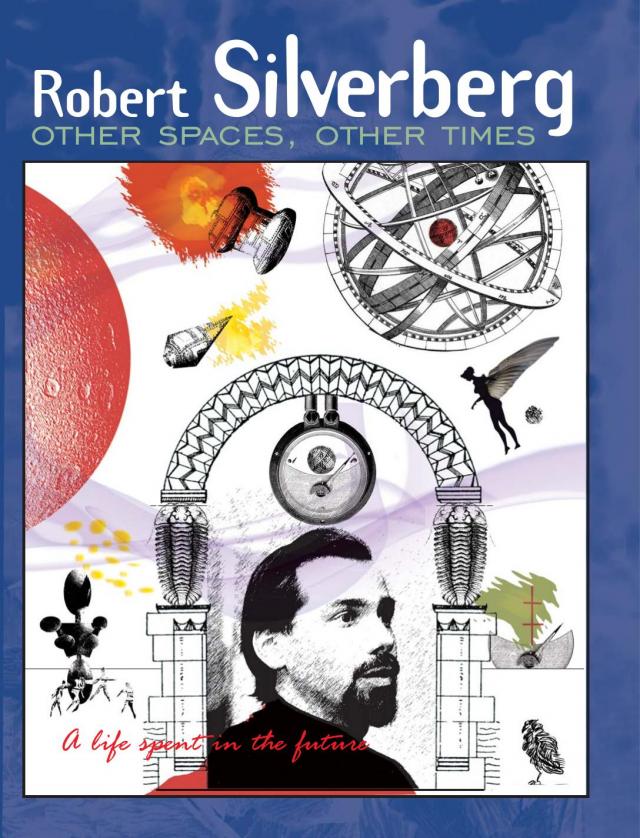


$29.95
“I
other sp
Robert Silverberg
N THE COURSE of my six decades of writing, I’ve witnessed the transition of science-fiction publishing from being a pulp-magazine-centered field to one dominated by mass-market paperback companies, and I’ve known and dealt with virtually every editor who other spaces, other times
played a role in that evolution. For much of that time I was close to the center of the field as writer and sometimes as editor, not only deeply involved in its commercial mutations but also privy to all the personal and professional gossip that it generated. All that special knowledge has left me with a sense of my responsibility to the field’s historians. I was there, I did this and did that, I worked with this great editor and that one, I knew aces, other times
all but a handful of the major writers on a first-name basis, and all of that will
be lost if I don’t make some sort of record of it.Therefore it behooves me
to set down an account of those experiences for those who will find them
of value.” — From Silverberg’s introduction
ROBERT SILVERBERG is one of the most important American
science fiction writers of the 20th century. He rose to prominence
during the 1950s at the end the pulp era and the dawning of a
more sophisticated kind of science fiction. One of the most prolif-
ic of writers, early on he would routinely crank out a story a day.
By the late 1960s he was one of the small group of writers using
science fiction as an art form and turning out award-winning
stories and novels. In 2004 he was named a Grand Master by the
Science Fiction Writers of America. OTHER SPACES, OTHER
TIMES: A LIFE SPENT IN THE FUTURE is the first collec-
tion of his autobiographical writings. Fully illustrated with many rare
photos and ephemera — from Silverberg’s own archives — and also
includes a new Silverberg bibliography.
Rober
"Autobiography. Apparently one should not name the names of those one
has been to bed with, or give explicit figures on the amount of money one has
t
earned, those being the two data most eagerly sought by readers; all the rest
Silver
is legitimate to reveal." — Robert Silverberg
berg
NONSTOP PRESS
978-1-933065-12-0
52995
NONSTOP
ËxHSLJNDy065120zv&:#:*:^:;
A life spent in the future
PRESS
OTHER SPACES, OTHER TIMES
A life spent in the future
Robert Silverberg
Nonstop Press • New York
OTHER SPACES, OTHER TIMES
A LIFE SPENT IN THE FUTURE
First edition
Copyright ©2009 Agberg, Ltd.
Silverberg Bibliography ©2009 Nonstop Press
No part of this publication may be
reproduced or transmitted in any form
or by any means, including photocopy,
recording, or any other information storage
and retrieval system, without prior permission in
writing from the publisher or copyright holders.
For information or a free full-color
newsletter/catalog contact:
nonstop@nonstop-press.com
or: POB 981, Peck Slip Station,
New York, NY 10272-0981
Nonstop Press
www.nonstop-press.com
publisher’s catalog-in-publication
available upon request
Nonstop editor
Luis Ortiz
Copy editor
Beret Erway
Production & Design by Nonstop Ink
Special thanks to: Mike Ashley, Bob Eggleton,
Alex Eisenstein, Carol Emshwiller, Jane Frank,
Phoebe Gaughan, Peter Griffin, David Hartwell,
Earl Kemp, Jay Kay Klein, Karan Ortiz,
John Picacio, Andrew I. Porter, and Tim White
ISBN-13 Cloth 978-1-933065-12-0
ISBN-13 ebook 978-1-933065-13-7
Printed in S. Korea
c o n t e n t s
i n t r o d u c t i o n . . . . . . . . . . . . . . . . . . . . . . . . . . . . . . . . . . . . . . . . . . . 4
O n e : . . . . . . . . . . . . . . . . . . . . . . . . . . . . . . . . . . . . . . . . b e g i n n i n g s 7
t wo : . . . . . . . . . . . . . . . . . . . . . . . . . . . . . . . . . . o n w r i t i n g s f 3 7
t h r e e : . . . . . . . . . . . . . . . . . . . . . . . . . . . . . . . a u t o b i o g r a p h y 9 6
f o u r : . . . . . . . . . . . . . . . . . . . . . . . . . m i s c e l l a n y o f a l i f e 1 4 9
f i v e : . . . . . . . . . . . . . . . . . . . . . . s i lv e r b e r g b i b l i o g r a p h y 1 7 0
l i s t o f i l l u s t r at i o n s . . . . . . . . . . . . . . . . . . . . . . . . . . . . . . . . 1 9 4
I n d e x . . . . . . . . . . . . . . . . . . . . . . . . . . . . . . . . . . . . . . . . . . . . . . . . . . 1 9 6
4
i n t r o d u c t i o n
B Y R O B E R T S I LV E R B E R G
Nietzsche once wrote,“My memory says I did this, my pride says I did not.
My memory yields.”That’s sufficient warning, as though we needed it, that the
autobiographies of writers are not to be trusted as factual documents.
Writers of fiction make stuff up. That’s what the word “fiction” means —
it’s derived from the Latin verb fingere, which means “to imagine,”“to invent,”“to fabricate.” Out of fingere comes the noun fictum, meaning “that which is invented,” and out of fictum comes our English word “fiction.”
Those two Latin words have some secondary meanings that are of some rel-
evance here. Fingere also means “to arrange,” “to put in order.” And fictum can mean “a lie.”
You see where I’m heading here. The fiction-writer makes things up, and
also puts the things he has invented into some sort of rational order so that the
reader can make sense out of them.This is especially true, alas, when the fiction-
writer is talking about his own life. Even people who aren’t fiction-writers tend
to arrange their own memories in a kind of rational order for the sake of having
a coherent view of their past.That involves some editing, which is to say, some
revising, and very often some unintentional modification of the facts. (The mod-
ifications may not be all that unintentional, either. It isn’t at all unusual, of course, for people, writers and non-writers both, to create ficta — downright lies —
about their pasts.) One special problem for fiction writers in this area is that after having applied their particular inventive gifts to their stock of personal memories during the process of putting it in order, they aren’t always sure where a little artistic embellishment may have taken place. We are story-tellers by first
nature, and we want to tell good stories.We usually want them to be truthful sto-
ries, too, but sometimes, after having told the story of our lives often enough, we lose track of the enhancements we have introduced in the interest of artistic
verisimilitude.
I have no doubt I’ve done something of that sort myself from time to time.
I have a very retentive memory, but by now it stores more than three score and
ten years’ worth of events; so it is altogether likely that some of those events,
rolling around in my fiction-writer’s mind for all those decades, have undergone
some modifications all unbeknownst to their custodian.That doesn’t mean I’ve
been telling a lot of lies about my past, but it does mean that I may very well be
serving up fictionalized versions of some events, narratives that have been sub-
5
consciously tinkered with by my inner editor to turn them into better stories.
They aren’t lies, because there’s been no intention to deceive, but they may not
exactly be the truth, either.
I don’t like to lie — about my past, or anything else. (Though I will, if forced
to a choice between lying and revealing something that might cause injury to
someone else.) But if I prefer, on the whole, to tell the truth, I feel under no obligation to tell all of it.There are things I have done — especially in my troubled and troublesome childhood — that I would just as soon forget, though I am
unable to. I have, however, outlived nearly all the witnesses to those relatively trivial but embarrassing things, and those that remain have almost certainly forgotten
them. Fine. I will not, therefore, bring all those sorry episodes back to life by writing about them. (Though I have embedded a good many of them in the lives of
characters in my stories and novels.) Jean-Jacques Rousseau wrote a book that
among other things tells of all the vile and shameful deeds of his life — it is rightfully called The Confessions of Jean-Jacques Rousseau — and though it is a fascinating book that has never lacked for readers in the past two and a half centuries, I
don’t care to emulate it. (I haven’t done very many vile and shameful thin
gs, any-
way, and I’m probably the only one who would think they’re particularly vile.)
So I’ve never written a formal autobiography, and I have no intention of
writing one.This is in part because, for the reasons I’ve just enumerated, I don’t
trust myself to get all the facts entirely straight, and also because some of the facts that I would feel obligated to include, about my childhood, for instance, would
probably make me look like a nastier little boy than I really was.Then, too, a prop-er autobiography would, I believe, require me to describe my interactions over the
span of a long and complicated life with various people who might not care to
have those interactions publicly described.Therefore I have avoided writing any-
thing like a conventional autobiographical book, and I intend to go on avoiding
writing one to the end of my days.The closest I’ve come to it has been the lengthy
essay called “Sounding Brass,Tinkling Cymbal,” first published in 1975 and updat-
ed several times since, but even that leaves out much of the personal data and con-
centrates mainly on my career as a science-fiction writer.
That career, though, has been a long and busy one. I’ve been a significant
player in the science-fiction field for more than half a century.That can be said of very few sf writers, apart from such phenomenal examples of longevity as Jack
Williamson and Frederik Pohl. My timespan as an active writer has already out-
lasted those of Isaac Asimov, Robert A. Heinlein, and Poul Anderson, to name just
a few who maintained notably lengthy and prolific careers, and I’m closing in on
that of Arthur C. Clarke.
I’ve seen a lot of history in all that time. In the course of my six decades of
writing, I’ve witnessed the transition of science-fiction publishing from being a
pulp-magazine-centered field to one dominated by mass-market paperback com-
panies, and I’ve known and dealt with virtually every editor who played a role in
that evolution. For much of that time I was close to the center of the field as
writer and sometimes as editor, not only deeply involved in its commercial muta-
tions but also privy to all the personal and professional gossip that it generated.All that special knowledge has left me with a sense of my responsibility to the field’s historians. I was there, I did this and did that, I worked with this great editor and that one, I knew all but a handful of the major writers on a first-name basis, and
all of that will be lost if I don’t make some sort of record of it. Therefore it behooves me to set down an account of those experiences for those who will find
them of value.
Which I have duly done, piecemeal, in a long series of introductions to many
of my published novels and nearly all of my short stories, and the anecdotal data
out of which I have built those introductions, based on my extensive correspon-
dence file and my own still pretty exceptional memory, form a kind of collective
serial autobiography that will have to do in lieu of a single formally constructed
one. Non-Stop Press has brought much of that material together in this book.
As my initial warning should indicate, all memoirs are open to a certain
degree of suspicion, including mine. I may not have attained perfect factual accu-
racy here. My memory is an excellent one but is not infallible; some of my cor-
respondence files and business records were lost or defaced in a fire that wrecked
my house in 1968; and there is always the unavoidable tendency of any writer to
reshape rough facts into smoothly rounded stories that must be taken into
account. But if I have made free with reality in any of the essays that follow, I urge you to believe me when I say that I did none of it intentionally.You will find here the story of my life in science fiction as I remember it and as I have recorded it, and though I may have unknowingly retouched or misinterpreted some of that
story, I have, at least, not consciously distorted it.Trust me on that, won’t you?
In any case, very few of the people I mention here are still alive to contradict
me. As Frederik Pohl said to me long ago, one big advantage of outliving your
friends is that your version of the story is the only one that counts. Here’s my version, then, of how I spent close to sixty years writing science fiction. It’s as close to being the accurate one as I can produce. And from here on, it’s the only one
that counts.
September, 2008
7
O n e : b e g i n n i n g s
A picture of me at summer
camp, August 1953, reading
what I think is the
September 1953 issue of
GALAXY with a Sturgeon
story in it. —RS
8
M E M O R I E S O F A C U R I O U S C H I L D H O O D
Iam, like some of you, older than I used to be — old enough to remember
when science-fiction magazines cost a quarter, and how to change a typewriter
ribbon, and what Isaac Asimov looked like before he grew those side-whiskers.
I’m old enough, I’m afraid, so that I’ve outlived most of my childhood school-
teachers, some of my childhood friends, even my college roommate.
But one thing I haven’t outlived is my curiosity. Even now, I keep looking
ahead, peering around corners, eager to see what’s coming next. And it’s that
quality of restless curiosity, or what remains of it in me, that keeps me (relatively) youthful of spirit.The powerful desire to know what next month will bring, or
next year, or next century — to learn how things are going to turn out — is a better rejuvenating tonic than Geritol.
Of course, a lot of things that once mattered supremely to me I now don’t
care about at all.Who wins this year’s National League pennant, for example, or
even who wins this year’s Hugo for Best Science Fiction Novel.Talk to me about
baseball next time we’re both in 1948, and I’ll go on and on about the great new
Brooklyn Dodger players like Gil Hodges and Roy Campanella and Duke
Snider, and what wonders they’ll accomplish next season. But these days the
Dodgers play in L.A. and I don’t have a clue to who’s on first.As for Hugos, well,
I still show up at the annual ceremony and I applaud dutifully as my colleagues
collect their shiny trophies, and when I win one myself, as happens now and
then, I am quite sincerely delighted, but the old summertime fascination of spec-
Cover of 20th issue of
ulating on the probable Labor Day winners no longer seems to be there for me.
SPACESHIP , January
It’s a natural process, I guess, this ebbing of the curiosity-libido. Most of us
1953.
past forty can’t manage to keep our waistlines where they were twenty years ago,
our hair undergoes funny changes of color about the same time, and the mind
begins to pull in some of its antennae too, I guess. But I have enough curiosity
left in me, even now, to keep myself revved up about things to come.
No matter what time I’ve gone to sleep the night before, I’m up at six the
next morning without benefit of alarm clock, so avid am I to see what the new
day will bring. I look forward impatiently to the morning mail, to the day’s tele-
phone calls, to the unfolding of my day’s writing stint. I find myself wondering
where I’ll have dinner that night — a Thai restaurant? Ethiopian? Indian? — and
what new and unfamiliar things I’ll find on the menu.
It goes beyond that, of course. I want to last long enough to find out what
it will feel like to date a letter “January 4, 2001.” I want to hang in there until the exploration of space starts up again, so I can hear astronauts describing their jaunts across the sands of Mars. I want to be around when the Chinese finally excavate
the gigantic mound that covers the tomb of the Emperor Ch’in Shi Huang Ti.
And I have all sorts of travel plans in mind — Australia, Portugal, the Galapagos
Islands, the heights of Macchu Picchu, the reconstructed museums of reunited
Berlin, a list that goes on and on into my dotage.