Schwartz between the gal.., p.3
Schwartz Between the Galaxies,
p.3



Suddenly he cannot breathe.
“Get me out of here,” Schwartz mutters hoarsely, choking.
Dawn, with stewardess efficiency, chops a path for him through the mob. The sponsors, concerned, rush to his aid. He is floated swiftly back to the hotel in a glistening little bubble-car. Dawn helps him to bed. Reviving, he reaches for her.
“You don’t have to,” she says. “You’ve had a rough day.”
He persists. He embraces her and takes her, quickly, fiercely, and they move together for a few minutes and it ends and he sinks back, exhausted, stupefied. She gets a cool cloth and pats his forehead and urges him to rest. “Bring me my drugs,” he says. He wants siddharthin, but she misunderstands, probably deliberately, and offers him something blue and bulky, a sleeping pill, and, too weary to object, he takes it. Even so, it seems to be hours before sleep comes.
He dreams he is at the skyport, boarding the rocket for Bangkok, and instantly he is debarking at Bangkok—just like Port Moresby, only more humid—and he delivers his speech to a horde of enthusiastic Thais, while rockets flicker about him carrying him to skyport after skyport, and the Thais blur and become Japanese, who are transformed into Mongols, who become Uighurs, who become Iranians, who become Sudanese, who become Zambians, who become Chileans, and all look alike, all look alike, all look alike.
The Spicans hovered above him, weaving, bobbing, swaying like cobras about to strike. But their eyes, warm and liquid, were sympathetic: loving, even. He felt the flow of their compassion. If they had had the sort of musculature that enabled them to smile, they would be smiling tenderly, he knew.
One of the aliens leaned close. The little translating device dangled toward Schwartz like a holy medallion. He narrowed his eyes, concentrating as intently as he could on the amber words flashing quickly across the screen.
“… has come. We shall …”
“Again, please,” Schwartz said. “I missed some of what you were saying.”
“The moment … has come. We shall … make the exchange of sacraments now.”
“Sacraments?”
“Drugs.”
“Drugs, yes. Yes. Of course.” Schwartz groped in his pouch. He felt the cool, smooth leather skin of his drug case. Leather? Snakeskin, maybe. Anyway. He drew it forth. “Here,” he said. “Siddharthin, learitonin, psilocerebrin, acid-57. Take your pick.” The Spicans selected three small blue siddharthins. “Very good,” Schwartz said. “The most transcendental of all. And now—”
The longest of the aliens proffered a ball of dried orange fungus the size of Schwartz’s thumbnail.
“It is an equivalent dose. We give it to you.”
“Equivalent to all three of my tablets, or to one?”
“Equivalent. It will give you peace.”
Schwartz smiled. There was a time for asking questions and a time for unhesitating action. He took the fungus and reached for a glass of water.
“Wait!” Pitkin cried, appearing suddenly. “What are you—”
“Too late,” Schwartz said serenely, and swallowed the Spican drug in one joyous gulp.
The nightmares go on and on. He circles the Earth like the Flying Dutchman, like the Wandering Jew, skyport to skyport to skyport, an unending voyage from nowhere to nowhere. Obliging committees meet him and convey him to his hotel. Sometimes the committee members are contemporary types, indistinguishable from one another, with standard faces, standard clothing, the all-purpose new-model hybrid unihuman, and sometimes they are consciously ethnic, elaborately decked out in feathers and paint and tribal emblems, but their faces, too, are standard behind the gaudy regalia, their slang is the slang of Uganda and Tierra del Fuego and Nepal, and it seems to Schwartz that these masqueraders are, if anything, less authentic, less honest, than the other sort, who at least are true representatives of their era. So it is hopeless either way. He lashes at his pillow, he groans, he wakens. Instantly Dawn’s arms enfold him. He sobs incoherent phrases into her clavicle and she murmurs soothing sounds against his forehead. He is having some sort of breakdown, he realizes: a new crisis of values, a shattering of the philosophical synthesis that has allowed him to get through the last few years. He is bound to the wheel; he spins, he spins, he spins, traversing the continents, getting nowhere. There is no place to go. No. There is one, just one, a place where he will find peace, where the universe will be as he needs it to be. Go there, Schwartz. Go and stay as long as you can. “Is there anything I can do?” Dawn asks. He shivers and shakes his head. “Take this,” she says, and gives him some sort of pill. Another tranquilizer. All right. All right. The world has turned to porcelain. His skin feels like a plastic coating. Away, away, to the ship. To the ship! “So long,” Schwartz says.
Outside the ship the Capellans twist and spin in their ritual dance as, weightless and without mass, they are swept toward the rim of the galaxy at nine times the velocity of light. They move with a grace that is astonishing for creatures of such tremendous bulk. A dazzling light that emanates from the center of the universe strikes their glossy skin and, rebounding, resonates all up and down the spectrum, splintering into brilliant streamers of ultra red, infraviolet, exoyellow. All the cosmos glows and shimmers. A single perfect note of music comes out of the remote distance and, growing closer, swells in an infinite crescendo. Schwartz trembles at the beauty of all he perceives.
Beside him stands the seal-slick Antarean. She—definitely she, no doubt of it, she—plucks at his arm and whispers, “Will you go to them?”
“Yes. Yes, of course.”
“So will I. Wherever you go.”
“Now,” Schwartz says. He reaches for the lever that opens the hatch. He pulls down. The side of the starship swings open.
The Antarean looks deep into his eyes and says blissfully, “I never told you my name. My name is Dawn.”
Together they float through the hatch into space.
The blackness receives them gently. There is no chill, no pressure at the lungs, no discomfort at all. He is surrounded by luminous surges, by throbbing mantles of pure color, as though he has entered the heart of an aurora. He and Dawn swim toward the Capellans, and the huge beings welcome them with deep, glad, booming cries. Dawn joins the dance at once, moving her sinuous limbs with extravagant ease; Schwartz will do the same in a moment, but first he turns to face the starship, hanging in space close by him like a vast coppery needle, and in a voice that could shake universes he calls, “Come, friends! Come, all of you! Come dance with us!” And they come, pouring through the hatch, the Spicans first, then all the rest, the infinite multitude of beings, the travelers from Fomalhaut and Achernar and Acrux and Aldebaran, from Thuban and Arcturus and Altair, from Polaris and Canopus and Sirius and Rigel, hundreds of star-creatures spilling happily out of the vessel, bursting forth, all of them, even Pitkin, poor little Pitkin, everyone joining hands and tentacles and tendrils and whatever, forming a great ring of light across space, everyone locked in a cosmic harmony, everyone dancing. Dancing. Dancing.
About the Author
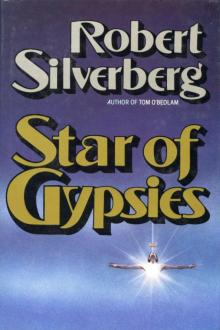
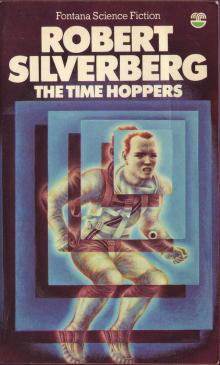
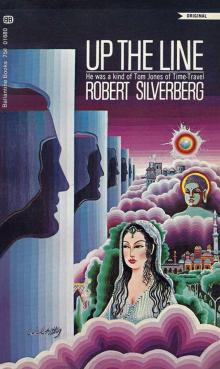
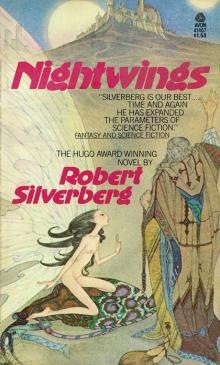
Robert Silverberg (b. 1935) sold his first science fiction stories to the lower-grade pulps in the mid-fifties, moved swiftly to the three prestigious magazines (Astounding, Galaxy and The Magazine of Fantasy & Science Fiction) and as his style deepened and themes expanded in through the next reached the first rank of science fiction writers. He is regarded as the greatest living writer of science fiction, an SFWA Grandmaster, ex-President (in the 1960’s) of that organization, winner of five Nebulas, four Hugos and many other domestic and foreign awards. Among his famous novels are Dying Inside, The Book of Skulls, Downward to the Earth, A Time of Changes; his novella Born with the Dead (1974) is perhaps the finest work of that length published within the genre. Shifting to a predominating fantasy in the late 1970’s (Lord Valentine’s Castle and the attendant Majipoor Series), Silverberg continued to write science fiction and won a Nebula in 1986 for the novella Sailing to Byzantium, and Hugos for the novelettes Gilgamesh in the Outback and Enter a Soldier: Later, Enter Another. He was editor of the long-running original anthology series New Dimensions and of important reprint anthologies such as The Science Fiction Hall of Fame, Alpha, and The Arbor House Treasury of Modern Science Fiction.
All rights reserved, including without limitation the right to reproduce this ebook or any portion thereof in any form or by any means, whether electronic or mechanical, now known or hereinafter invented, without the express written permission of the publisher.
This is a work of fiction. Names, characters, places, events, and incidents either are the product of the author’s imagination or are used fictitiously. Any resemblance to actual persons, living or dead, businesses, companies, events, or locales is entirely coincidental.
Copyright © 1973 by Robert Silverberg
Cover design by Mauricio Díaz
ISBN: 978-1-5040-8649-3
This edition published in 2023 by Open Road Integrated Media, Inc.
180 Maiden Lane
New York, NY 10038
www.openroadmedia.com
ROBERT SILVERBERG
FROM OPEN ROAD MEDIA
Find a full list of our authors and titles at www.openroadmedia.com
FOLLOW US
@ OpenRoadMedia
Robert Silverberg, Schwartz Between the Galaxies