The road to amber, p.2
The Road to Amber,
p.2


Another important element of Roger’s life became apparent as we corresponded. Roger loved his three kids. Hardly a letter would go by without a passing mention of one or the other. Sometimes it was just that he was back from dropping someone at school. Sometimes it was going to a soccer game or some other school event. Often it would include what kid’s friend was sleeping over that night.
A great deal has been said about how Roger’s productivity slowed in the eighties, and how maybe some of what he wrote then wasn’t as good or ambitious as his earlier works had been. This is one of those blanket statements which should be made with care.
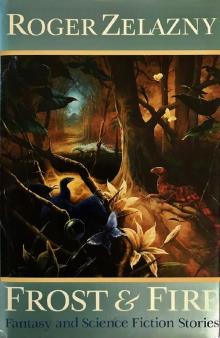
The novel Eye of Cat, which is very ambitious and stylistically creative, was published in 1982. The novella “24 Views of Mount Fuji, by Hokusai,” which, by Roger’s own admission in the story’s introduction in the collection Frost & Fire was written in part in an effort to stretch his own limits, was published in 1985. It won a Hugo. The Hugo Award-winning novella “Permafrost” was published in 1986.
Yet Roger did have a new, complex, creative endeavor to occupy him during this “slower” time, an endeavor that influenced his interests as well as his writing. Their names are Devin, Trent, and Shannon, his three children, born 1971, 1976, and 1979.
Roger wrote a lot of sword and sorcery during the years his kids were young. However, sword and sorcery—and Burroughs’s Tarzan books, which he told me he had read to Trent—and other such works were what had hooked Roger on the field as a child. Is it a coincidence that Roger’s writing became more experimental once again as his kids began to get older and might understand those experiments? I don’t think so. Nor do I think Roger regretted anything he wrote during that time.
After all, Roger was diverse. He would read Proust and follow it up with Calvin and Hobbes. He loved Amber so much he named his corporation after it. He returned to sword and sorcery characters like Shadowjack and Dilvish the Damned for several projects. He loved those “lighter works” as much as he loved Lord of Light or Creatures of Light and Darkness or the novellas that brought him more critical acclaim. They were all part of him, even if fans and critics wanted to have him write solely one thing or another.
Okay. Back to those intertwined lives. Time passed. By the mid-nineties my marriage to my college beau began to fragment and then to break.
On the day I decided that I was going to leave that marriage at the end of my current teaching contact, find work elsewhere, start a new life, I called Roger to tell him. After all, he was my best friend. Hard as it may be to believe, we’d never discussed getting together permanently. We both believed firmly in commitments, and we both had them.
So I was shocked when Roger asked me to move out to New Mexico to be with him, “Because I realize I don’t want you going anywhere else.”
I thought about staying solo—after all, I was pretty burnt on relationships by then. I realized I didn’t want to just run and hide if Roger was willing to take a chance. So I agreed. I’d sold a few—four, I think—novels by then, although, due to quirks of publishing, none were yet out. I had a few short stories published. Hardly much on which to base a career, but at least I had a track record.
We started making plans for my move. I even considered giving notice at my job earlier than planned. Then Roger called to tell me he had just learned he had cancer. He offered me an out. I told him he was crazy, that if he was sick, I needed to be there.
But we delayed my arrival until the end of the term. This gave Roger time to start chemo, to inform his family of changes to come, to deal with a lot of things that arise at such times. We talked daily. We still wrote letters, pretty much daily. And June of 1994 came, and I went south.
Roger met me in North Carolina. We drove west in my sedan with my six cats. He’d always been thin, but I was shocked at how much weight he’d lost since I’d last seen him. I’d brought a bunch of recorded books and old radio dramas, but we didn’t listen to a single one. We talked steadily for days. We’d keep talking for the next eleven months and a bit.
I’m not sure what we talked about. The same old stuff, I guess: history, biography, mythology, theology, science, poetry, our lives together and apart, and writing, always writing. Roger read me the Bunnicula books while I did cross-stitch beadwork. I introduced him to role-playing games. We both wrote.
I taught him how to make crepes. He insisted on learning how to flip them, rather than turning them with a spatula. We bought a guinea pig. She had babies. Roger was thrilled and insisted we keep all three. When Roger was strong enough, we went touring locally. We went to conventions. We went to New Zealand.
Somewhere in there, the chemo stopped working. I was at his side when Roger stopped breathing. And stopped talking. And was finally quiet.
Except that Roger’s stories are still there making beautiful noise. Those stories are all his—the silly ones and the serious ones, the poetic and the crass, the science fiction and the fantasy. Altogether they are a complex body of work that, when taken in total, come close to reflecting a complex and fascinating man.
—Jane Lindskold
Remembering Roger
by Gerald Hausman
When Roger and I were collaborating on the novel Wilderness, he would have dinner at our home and secretly sign several of his books in my living room bookshelf—never more than a couple at time—and always leave a little message for me to find at some later date. Just the other day I found one of these with Roger’s tight, neat script adorning the title page. He’d written: “Finally finished the one I told you about.”
There were many Rogers—but the one I began to know best was the elusive Roger. The one who left messages in books like messages in bottles, little threads that were tied to conversations. These were not inscriptions but rather encryptions, and Roger expected me to remember as much as he did. He remembered everything: names, dates, people, plots. A mathematical mind in the soul of a mage.
In each of these small inscriptions I found some earthly or ethereal wisdom, an epiphany that uplifted me for days, weeks or months. Roger was instinctive about the needs of his friends, and he lavished this largesse of love, giving each and every one of us, his friends and extended family, something that we needed.
For one man who played musical instruments in a band, Roger told all of his friends about this musical buddy, and, more importantly, he was there in the flesh to applaud when his friend performed. He met folksinger and sci-fi writer Will Sundown Sanders at a city coffeehouse where Will was playing, and Roger made sure all of his other friends knew about Will, his riffs, and his writing.
In my case, Roger was clear and definite. “You need an agent,” he said one day, and he found me one. Shortly thereafter, I found myself with a top flight editor, a major publisher, and a contract—all of which might not have happened without Roger’s help. He also wrote a comment for my new book, comparing me to Carlos Castaneda and Philip K. Dick. Over the top, but what the heck…friends.
When I thanked him for all of his help, Roger said, “All you need now is a notebook to put down your expenses and a Tax Pac to file your receipts, the rest will take care of itself.”
Another time he gave me some future advice—“From one family man to another, write one book for each of your children.”
“Why?” I asked.
“For the sake of legacy, for what you leave behind, write one book for each child. So, for me, a book each for Devin, Trent, Shannon. That should cover their needs…afterwards.”
I thought it was an odd thing to think about at a time when I was just getting started, but then I didn’t know that our time was growing short. Roger had the keen eyes of a hawk—he could see things that were not yet, things forthcoming. Much later, I realized that Roger meant more than “just a book”—he meant, in effect, write a “big” book for each of your children.
Once Roger had a dream, and he told me it was a plot outline for a book that he wasn’t going to write.
“Why not?”
“Well,” he answered, “I saw you as the author. This is your book, I’m giving you the outline.” I guess he wanted me to move along in the bestseller business. I was writing books, one after another, but they were more poetry books, children’s titles, and academic texts.
Roger’s dream novel seemed a bit hazy to me, as it involved James Bond, Dr. No, a bizarre murder, various timescapes and reality warps, and all of it set on the island ofJamaica in the late 1960s. He was quite specific about these things as he dictated the summary, and I wrote it down over the phone.
“So who’s the main character?” I queried when he was done.
Chuckling, he said—“You. But in the novel you’re an old man, a bookish old stickfighter from the hills of the North Coast.”
That summer, while working in Jamaica, I discovered that there were still a few ancient cudgelists—stickfighters—on the island. This nearly unknown martial art goes back to the days of Robin Hood. I sketched the outline Roger dictated and put it in my desk drawer where it still resides more than fifteen years later, untouched.
Am I waiting for a sign from Roger? Or just afraid that without him the novel won’t be what he wanted me to write? Roger taught me so many things, but perhaps the greatest gift of all was his ability to give someone a book that cut to the very core of their thinking.
There are three books that come to my mind, books that changed my life. These, more than any others, inspired me to write specific books of my own that, miraculously, many years after publication are still in print. All part of Roger’s great and generous plan.
Roger’s kindness really had no boundary. Once, when I was struggling to make ends meet, he gave me his unused, early model Apple computer that was still in the box it came in and with it a month’s rent, and he told me, “Help another writer when you’re able to. Pass it along.” He was the original believer of forwarding goodness. You could say he invented “the writer’s guild of guided saints.” And, if, in fact, writers have such providers, Roger is still moving manuscripts along, lifting them out from under the piles on editors’ desks, and letting them see the light of day.
Curiously, he once said he had actually done this; metaphysically, of course.
“How?” I asked him.
“With intention,” he replied.
I have talked to more than a dozen writers whose careers were boosted or even charmed by Roger, and each one of these people speaks in the same manner in which I’m writing, with a measure of awe, love, and wonder.
I don’t want to forget the three arcane books that Roger gave me, for they are a pivotal part of this friendship story.
Black Gods, Green Islands by Geoffrey Holder with Tom Harshman.
Peter Whiffle: His Life and Works by Carl Van Vechten.
Griffin & Sabine: An Extraordinary Correspondence by Nick Bantock.
Indeed, these are as special to me as they were to Roger. The first two nearly forgotten as literary art, the third, a classic in its genre—and who knows what that genre is, exactly. Roger liked all three and gifted them to me. Black Gods, Green Islands, if you don’t know it, is a return to the Garden of Eden, the garden of evil. I had an awakening when I read it—so this is how you merge mythology an fantastic fiction. The book was just what I was looking for. And it taught me how to utilize my Caribbean experiences and shape them into a book of my own. The book was almost a how-to on the art of doing this. Thus I did Duppy Talk: West Indian Tales of Mystery and Magic, which was used by the History Channel in their series Haunted Caribbean.
The Life and Times of Peter Whiffle amused me, fascinated me. I remember Roger saying that he read it aloud to his family. “We’ve had a lot of fun with this story,” he said. I drank in the Whiffle tale and saw that it was full of Rogerisms.
Roger loved the Whiffly picaresque voice of Van Vechten. I did, too, and especially when I saw that some of Van Vechten’s wisps of historical narrative resurfaced in one or two of the Amber novels.
In Griffin & Sabine, Roger’s fascination with telepathy, letters, islands (of the mind as well as geography) is abundantly and pleasurably clear. This was the book he inscribed to my wife Lorry, for whom he also brought a scone each morning when he brought his children to Santa Fe Prep School. Lorry worked in the front office of Prep, and she would look up and see Roger, gift scone in hand, smiling. So Griffin & Sabine was for both of us, Lorry and me. Not surprisingly, this book would inspire a number of collaborative story collections that Lorry and I wrote and compiled during the 1990s. Somehow, I think, Roger effected a kind of alchemy, and it all started with the gift of this book Griffin & Sabine. Roger wrote in Lorry’s copy—“They don’t write them like this very often.” By which he meant not at all.
I once asked him how he did it, how he made so much invention so down-to-earth real. He tapped his forehead, “Right here,” he said in his deceptively simple way. I was reminded of that the other day when I saw this Bob Marley quote: “I live in my head.”
Roger was “miracle cat” as one of his books intimates. I saw him practice his martial art skills at our dinner table one time—pinning my hand like a butterfly with his two fingers. And this when he was sick from cancer but still strong as a bull. That one move of his sent me to a master with whom I studied for years, never achieving Roger’s catlike grace, but learning how to stand, how to sit, and curiously, how to hold a pen.
In addition to all his other gifts, Roger was a voracious reader, devouring some seven or eight books each week. I joined him in that rapacious pursuit for a while. But I couldn’t keep up. It doesn’t matter; he taught me to read fast and well and to zero in on the thing or things I was looking for. Book done, you move on. William Saroyan also read like this, calling it reading around. Roger’s pursuit was more fox and hound. Harrying not hurrying. Before I met Roger, it took me months to read a single book. Roger suggested I throwaway my reading glasses—but that is another story.
In writing this, I am suddenly reminded that I have left out the last and most eccentric of Roger’s gift books. How did I miss The Pink Motel by Carol Ryrie Brink? Roger presented this skinny little novella to me one day. The novel’s not that good, as Roger himself confessed, but he knew I would find a message within the hard boards of the book and left it at that.
The Pink Hotel had a further effect on my psyche, and it went beyond the borderland of writing. Sometime after I read it, we moved to Florida. This little tale that Roger put in my hand was a roadmap to the sandspur back woods of Southwest Florida where an old saltwater collection of oddly painted cabins loomed in my future.
Dreams of conch shell pink.
I’m still here, writing amidst the herons and eagles.
And as I think of Roger’s legacy and the books of his that have altered my life, I wonder if he—if anyone—can be summed up in this casual, reminiscent way.
If so—Roger loved books, exotica, ideas, food. (reverse the order)
Above all, Roger loved people. (reverse the order again)
—Gerald Hausman
Bokeelia, Florida
The Trickster
by Gardner Dozois
It was difficult to follow the science fiction genre in the late ’60s without becoming aware of Roger Zelazny. Unlike his great contemporary Samuel R. Delany, whose early novels (published with maximum obscuriry as bottom-of-the-line pulp paperbacks) I had been following for several years before he even published his first short story, Zelazny was at the beginning of his career almost entirely known for his short fiction. I still associate him with the colorful covers of magazines such as The Magazine of Fantasy & Science Fiction, Worlds of If, and Fantastic—magazines which, if you look at old copies today, give off when handled that unique pulp-magazine smell that for an old-time fan can instantly evoke sense-impressions of exactly where you were and what you were doing when you bought them. I dimly remember (this was forty-seven years ago, after all, while I was still in high school, so give me a break!) that I had run across a few stories by Zelazny in 1962 in Fantastic or Amazing (I was a loyal reader of Cele Goldsmith’s Fantastic in particular, mostly for Fritz Leiber’s “Gray Mouser” stories, so it’s quite likely), perhaps “Horseman!” or “Passion Play.” To tell the truth, they hadn’t impressed me much.
All that was to change, for me and for everyone else, with the publication of Zelazny’s ”A Rose for Ecclesiastes” in the November 1963 F&SF. I remember standing in front of the newsstand shelf in Eaton’s Drugstore in Salem, Massachusetts, listening to the metallic clanking and whirring of the milk-shake machine (except that we called them frappes in New England in those days) and staring at the lovely wrap-around cover by Hannes Bok, which I believe was the only wrap-around cover I’d ever seen. It was the exotic evocativeness of the Bok cover that hooked me and drew me in (although, truth be told, I’d have bought the magazine anyway, no matter what the cover was), but back in my room I soon found that the story inside the covers was equally exotic and evocative, with a lyricism, fluidity, and playfulness of language that was rare in the SF of the day and which was to become one of Zelazny’s trademarks.
Here, in the words of the hoary old cliché, was a writer to watch—and even as a grotty high-school kid, I knew it as soon as I put the magazine down.
By the time I began trying to sell my own early stories, it had become nearly impossible not to have heard of Roger Zelazny, who seemed to be everywhere with amazing stories, and whose name was on everyone’s lips—although in those days almost nobody knew how to pronounce it.
By the time I actually met Roger Zelazny, I had progressed to being a very small-time neo-pro with three or four sales under my belt. I think it was in 1970, probably at a Disclave in Washington, D.C., possibly at a Balticon in Baltimore, Maryland. I was in a crowded room party when I became aware of a tall, thin man sitting quietly by himself in one corner of the room. “That’s Roger Zelazny,” somebody whispered in a hushed voice. I was too shy to actually approach him, but I watched him for a while. Although he spoke very little, his hands were constantly busy making intricate cat’s-cradles with string. When he finished a particularly complex one, he would raise it up to show it to someone, and his solemn face would break suddenly into a delighted smile, a smile of childlike pleasure that transformed his entire countenance. After you watched him for a while, you realized that, although he was very quiet, he was not isolated or detached from the party taking place around him, was in fact intently aware of everything. His eyes missed nothing.