Sergeant smack, p.10
Sergeant Smack,
p.10
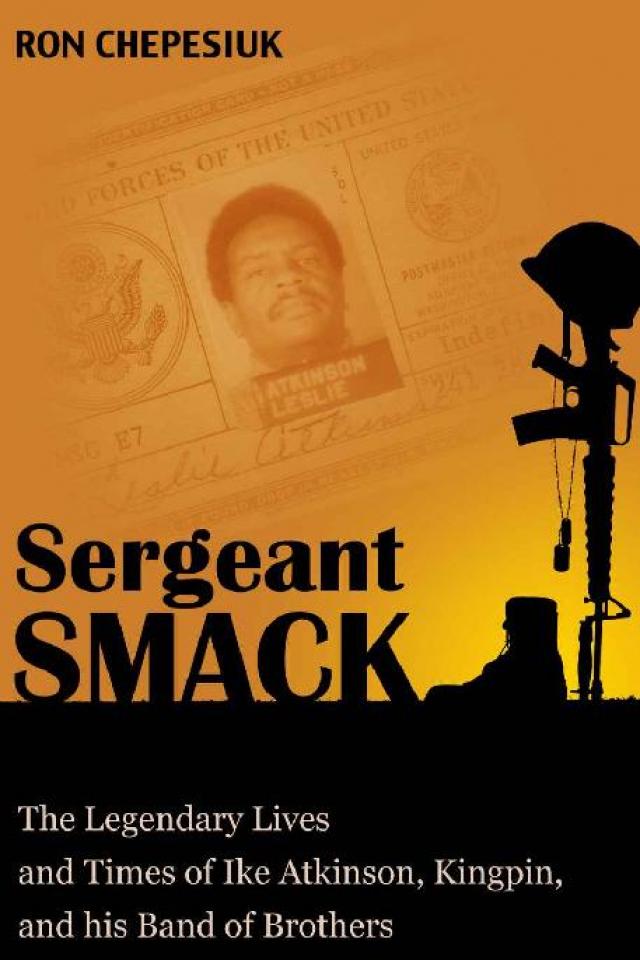


Later, as their drug operation grew and expanded, Jack would recruit couriers in Jack’s American Star Bar. But in the beginning, plenty of brothers were willing to smuggle a few kilos of heroin to the U.S. They didn’t even have to be actual members of the military. Military uniforms were easy to come by, as were medals, stripes and badges. Travel orders or leave papers could be counterfeited to perfection, and Ike knew how to make fake military IDs. The false orders would often identify emergencies as a reason for the leave, which gave the bearer high priority status for travel. The DEA later identified some of the couriers that it believed were using false papers: Herman Gaillard (Peter Rabbit), Ernest Jackson, Jr., Curtis Reid, Gregory Purnell, Norman Wendell Young, Thomas Hart, Thomas Southerland and Larry Drake Atkinson (Ike’s nephew). Ike identified his first couriers as Peter Rabbit, Thomas Southerland, Eddie Wooten, and Howard Scott, an associate from the Washington, DC area.
FOR THE FIRST smuggling trip in early August 1968, Ike chose a route that took him from Bangkok to the continental U.S. via Anchorage, Alaska. It was a regular military route, and when the plane landed in Anchorage, it invariably arrived at night. All the Customs officials would ever do was question the arriving passengers, asking them if they had anything to declare. Eventually, the Atkinson-Jackson drug ring used every conceivable method in their courier smuggling system, including film canisters and individuals wearing leg casts, but on the test run, Ike kept it simple. He just packed four kilos of heroin and eight pounds of “Thai stick,” at the time the best marijuana on the planet, in a duffle bag and locked it. Ike was taking the marijuana to his brother Dallas’ close friend who lived in the Baltimore area and had asked Ike to bring him some. The plan, if it could be called that, was to throw the duffle bag in the corner of the C-141, and if the authorities wanted to check it, Ike could say that the duffle bag was not his. The trip involved some risk, but it was a lot like shooting dice. As a courier, Ike could roll snake eyes (the losing combination when the dice are rolled), so to speak, but the situation was weighted in his favor, given the laxness in military security in those days.
With Ike was Thomas Southerland, dressed in military uniform and carrying official looking papers, who came to Bangkok from Wilmington to make some money. The test run proceeded like a charm, and Ike and Southerland had no problem getting through. Ike marveled at how easy the operation had been, given the long trip and many landings. Now it was time to get down to business and put a plan into operation.
The next trip occurred later in August 1968, and involved a courier that Ike recruited. The courier got through just as easily as Ike and Southerland did. The next trip, also successful, occurred shortly afterwards and involved smuggling about five to six kilos of heroin. The courier on this trip looked like a real patriot. He was carrying propaganda leaflets for the Special Warfare Center. The third trip after the test run occurred prior to December 17, 1968, and consisted of a shipment of seven or eight kilos of heroin that Eddie Wooten smuggled into the U.S. in a duffle bag. On the next trip, Ike had his couriers use six duffle bags, three of which contained heroin and three without. The military aircraft was scheduled to arrive in Elmendorf, Alaska, where, if no cargo was offloaded, the couriers knew there would be no Customs clearance other than an official boarding the plane and asking the passengers which duffle bags belonged to them, and maybe making a cursory search. If a search was made, then the duffle bags without the heroin would be declared as theirs. As with the previous trips, the heroin was successfully smuggled into the continental U.S. and onto the on-going flight to McGuire Air Force Base, located in south central New Jersey, about 15 miles from Trenton.
AFTER BEING DEPORTED from Bangkok in June 1968, Daniel Burch went back to West Germany where he stayed several months before returning to the U.S. Burch traveled to New Jersey to look up Pratt Benthall, an old friend of Ike’s. Burch and Benthall were two inveterate gamblers, and they got into a heavy craps game in which Burch took $11,000 from Benthall. “It was not hard taking money from Pratt,” Burch recalled. “He liked cocaine and that occupied his attention. He’d carry little vials around with him that contained cocaine.”
Burch then returned to his hometown of Akron, Ohio, to think about his future now that, thanks to old “buddy” Jack, the dream of using the MPC system to build a nest egg had become a house of cards. Burch heard that Ike had followed through on establishing a Bangkok-based heroin smuggling network, and he decided to go to Goldsboro to see if this new venture was something that might interest him. He was surprised to learn that Ike was using duffle bags to smuggle the contraband. “Duffle bags are too risky,” Burch told Ike. “What if a Customs agent looks inside. Why don’t you use AWOL bags?”
Burch showed Ike how a false bottom could be sewn into an AWOL bag where the heroin could be hidden and showed him how to pack the heroin and then stitch the bags with a crochet needle so it looked as if the re-stitching was sewn in the factory. Later, Ike would buy the AWOL bags from the American PX in Bangkok, five or six at a time, for about $15 or $16 each.
Ike asked Burch to come back to Thailand and oversee the job of sewing and fitting the AWOL bags, but Burch declined. Still, the job took some skill, so Ike asked Burch to teach the procedure to Rudolph Jennings, a boyhood friend from Goldsboro, who was eager to go to Bangkok. Jennings became an expert at the job; no Rudolph stitched bag being carried by a courier was ever confiscated because the authorities suspected that it contained heroin.
BURCH NOW DECIDED to enter the drug trade with eyes wide open. “People around Akron didn’t have quality dope, so when I started to traffic Ike’s China White to the city, it became very popular. My plan was to make enough money so I could get out of drug dealing by 1975.”
Burch was still determined to get his “MPC” money back from Jack. He had sent his girlfriend, Claudia, to Goldsboro with a tape-recorded message for Jack: “I want the money you stole from me.” But Jack did not respond. While in New Jersey, breaking Benthall in the craps game, Benthall had told Burch that he had seen Jack with a suitcase full of money, but he did not know where he was now. After teaching Jennings how to stitch AWOL bags, Burch returned to Akron. A few weeks later, he heard that Jack was back in Goldsboro. Burch, packing a gun and accompanied by two friends, headed to Goldsboro in search of Jack and his money.
In Goldsboro, they eventually found Jack parked on Neuse Circle about to pay Ike a visit. Burch sat in the back seat of his car, his gun ready, not really knowing what he would do. When Jack started to get out his car, Burch told one of his friends in the front seat to call out to Jack: “Yo, Jack, come over here. Sanchez from Fort Bragg wants to ask you some question about Thailand.” Sanchez was a mutual friend of both Jack and Burch. Jack turned around, smiled, and started to walk towards Burch’s car. When Jack got close to the driver’s side of Burch’s car, Burch jumped out and in a threatening voice, said: “Come on Jack, we are going for a ride.”
Startled, Jack’s gray eyes got big, and he had the look of panic on his face. Seeing that Burch held a gun, Jack pushed the door toward him and took off a like an Olympic 100-meter sprint champion. Burch and his two friends watched Mr. Thailand scamper away. Realizing that Jack believed he was running for his life, the three friends burst out laughing. Not too long afterward, Jack began to pay Burch the money he owed him. Life among the band of brothers was starting to return to normal.
CHAPTER FIVE
The Investigation Begins
DANIEL BURCH BECAME a regular customer of the Atkinson-Jackson drug ring, and by the early 1970s the DEA had identified him as one of Ohio’s biggest drug dealers. The DEA learned that he had traveled several times to Bangkok to make heroin buys. A Burch associate told the DEA that she, along with two other women, met with Burch at the Taft Hotel in New York City to develop a plan to smuggle heroin from Bangkok. In June 1972, Burch, using the alias, “Daniels,” together with a male associate and the three women, traveled to Bangkok to make a heroin buy. Using U.S. Army uniforms, false military orders and a combination of military and commercial travel, the ring smuggled the heroin to the U.S. via Europe.
On November 16, 1973, Burch, after arriving at the port of New York City aboard the Queen Elizabeth II, had his first run-in with the law over drugs. U.S. Customs arrested him for possession of hashish. “When I got off the boat, I had a smoking pipe on me,” Burch recalled. “ It was not even a hash pipe, but it tested slightly positive for hashish. Customs decided it wasn’t enough dope to detain me, so they let me go. I went through Customs and down the steps to a warehouse to get my green Cadillac. I had spent a couple of months in Europe traveling all over in that car. Some DEA agents got wind of a passenger who had a pipe on him that tested positive for hashish. Two agents came down to the warehouse and interrogated me. The agents wanted to take me back through Customs, but a Customs official was watching the interrogation and told them they could not do it. They argued; the DEA agents got mad and arrested me. I was put in lock up overnight. The next morning, I got out on bond and found a lawyer. He couldn’t understand why I was arrested and got the case dropped. The incident never affected me but, truthfully, one of the women I was with in Europe had used the pipe to smoke some hashish.”
BY THIS TIME Burch was one of the major buyers of heroin supplied by the Atkinson-Jackson drug ring. Ike dealt strictly with Black dealers, and he had no contact with La Cosa Nostra which had dominated the U.S. heroin trade since the end of World War II. “I considered myself a Lone Ranger,” Ike recalled. “I was the source of all my action. Many people in Southeast Asia had the capability to smuggle heroin to the U.S., but none had my connections. When I was on U.S. turf, I never had any problem with the Mob trying to muscle in on my action.”
Initially, La Cosa Nostra used Italian refineries to manufacture heroin but when the Italian government cracked down, the Mafia and Corsican gangsters established a new trafficking route known infamously as the French Connection. Morphine base was smuggled from Turkey to the Marseilles area where it was refined into heroin and then shipped to the United States via Sicily and Montreal. According to the President’s Commission on Organized Crime, the French Connection gave La Cosa Nostra a monopoly on the U.S. heroin trade from the late 1940s to the late 1960s, allowing the Mob to control an estimated 95 percent of the heroin being smuggled into the U.S.
But by the early 1970s, U.S. President Richard Nixon had launched his “War on Drugs.” The U.S. began pressuring key countries involved in the international heroin trade, and law enforcement began having greater success against the French Connection. By 1973, Turkey, supported by $35.7 million in U.S. aid, had eradicated all illicit opium production in the country, and the French government had closed most of the country’s heroin refineries. Within months, the street price of heroin in the New York City area tripled and the purity dropped by half, both indicators of a serious heroin shortage.
Still, this development had unintended consequences. The “success” against the French Connection did nothing more than create the market conditions that boosted the expansion of the illicit heroin supply elsewhere and made Southeast Asia a much more important players in the international drug trade. During the 1970s, Southeast Asian heroin from the Golden Triangle rose from single digits to between 25 to 30 percent of the total heroin supply in the U.S.
GIVEN THE TURBULENCE and uncertainty in the international heroin trade, the Atkinson-Jackson ring was able to find more than enough contacts eager to buy their high-grade China White heroin, and Goldsboro, North Carolina, emerged as an unlikely major center for heroin trafficking. By the early 1970s, automobiles with out-of-state license plates began arriving in the rural hamlet. Given his networking skills, Ike had established contacts in New York City, Baltimore, Philadelphia, Pittsburgh, Washington, DC, and many other major cities along the eastern seaboard. Using Travis Air Force Base in the San Francisco area, the Atkinson-Jackson network expanded to California, truly making Ike Atkinson a kingpin.
Initially, once the couriers smuggled the heroin into the U.S., Ike would give it to his nephew Buster Jack, who would take the heroin to a farmhouse near Goldsboro where it was kept with a friend whom Ike trusted. As the money from the sale of dope accumulated, it would also be stashed at the farmhouse. Ike eventually stopped using Buster Jack after finding out that he was stealing from the stash. Ike would now deliver the loads to the farm himself. Only Ike and Herman Jackson knew where the stash was located, but Jackson told a girlfriend, a rash move that would eventually cause Ike problems.
IKE SUPPLIED MANY of the major Black drug traffickers of the day, including such enterprising gangsters as his pal from Germany, Eddie Wooten, who operated out of Okinawa and in the Washington DC area; Martin Trowery of Pittsburgh, Pennsylvania; William “Dog” Turner, another major dealer from the DC area; New Jersey based Frank Lucas, who, in his golden years, would achieve fame as Hollywood’s version of the so-called “American Gangster;” Ellis Sutton, Ike’s old acquaintance from his GI days in Germany in the late 1950s and early 60s; and Zack Robinson and the legendary Frank Matthews of New York City, two of the biggest dealers.
In the early 1970s, DEA intelligence identified Dog Turner as the top narcotics dealer in the Washington, DC-area. He conducted part of his operation out his apartment located on upper 16th Street Northwest in DC and was suspected of trafficking significant quantities of heroin between DC and Pittsburgh. Turner first appeared on the DEA’s Southeast Asia radar screen in January 1970 when the DEA determine that he traveled to Bangkok to buy heroin directly from the Atkinson-Jackson ring. Arriving in Bangkok with two associates, Turner headed to Jack’s American Star Bar where he learned from James Goodwin, a bar bouncer, that both Atkinson and Jackson were in the U.S. Still, according to information the DEA received, Goodwin was able to help Turner buy about four kilograms of heroin.
An informant told the DEA that the Peace of Mind Wig Shop and a basement club at 10th and U Streets Northwest DC were the Turner organization’s major distribution centers. Turner’s luck ran out in 1975 however, when he was convicted on a Federal charge of income tax invasion and began serving a six-year sentence in Lewisburg Federal Penitentiary. In that same year, “Dog” also was indicted on a Federal conspiracy charge in the Southern District of New York. “In my drug-dealing days, I knew of ‘Dog’ as a big-time drug dealer, but I did not know him personally,” Ike recalled. “I met him later in Petersburg (Federal Penitentiary) and we became friends.”
Wooten used Okinawa as a heroin transshipment point because of reports that the Okinawa government was not overly concerned with the smuggling of illicit drugs internationally, so long as it did no harm to Okinawa. Given Okinawa’s ineffective immigration and Customs controls and the large number of flights arriving and leaving the territory, it was tough to monitor drug trafficking in Okinawa.
Ike did not know Frank Matthews, the so-called “Black Caesar” of the New York City drug scene, or Zack Robinson, who owned a bar around 56th Street and 7th Avenue in the Big Apple called “The Turntable.” But they were two of the biggest drug dealers in the emerging period of the big Black drug kingpin. Robinson worked with Matthews, who became a legend after he disappeared in 1974 with a reported $15 million, never to be seen again. Born in 1944 in Durham, North Carolina, Frank Matthews arrived in New York City, barely out of his teens, settling in Brooklyn and then moving to New Jersey where he established himself as a major drug dealer. By the early 1970s, Matthews was handling multi-ton shipments in at least 21 states. His major supply likely came from Europe via Venezuela, but he was willing to buy heroin from any source, provided it was a quality product. “I don’t believe Matthews bought heroin directly from Atkinson,” said Don Ashton, a retired DEA agent who headed the administration’s Wilmington, North Carolina office in the mid-1970s. “ More likely, it was people who worked with Matthews who did. But it shows how fluid the drug trade became after the breakup of the French Connection.”
In early September 1974, Ike met with Martin Trowery and his associate Richard Golden at Ike’s Bangkok residence to arrange the purchase of heroin. On September 11th, Trowery and Golden arrived from Bangkok at the San Francisco International Airport. Golden made it through U.S. Customs, but Trowery, for an unknown reason, aroused suspicion and was detained. Customs officials arrested Trowery when they found about one kilogram of heroin hidden in the false bottoms of his two black AWOL bags. About a half-hour later, Customs arrested Golden when he returned to the Customs area to inquire about Trowery’s whereabouts. Officials also found a kilogram of heroin in one of Golden’s two AWOL bags.
“I can’t recall where I met Marty (Trowery), but we became buddies,” Ike recalled. ”He was about two or three inches taller than me but had my build. I had a guy named Jesse Paul who would go to Pittsburgh and deliver heroin to him. Once I knew Marty was okay, I told him he could come to Bangkok and pick his dope up, if he wanted. He came to Bangkok once and returned to the U.S. with no problems. The second time, he brought a White guy (Golden) with him, but they were arrested in San Francisco. Liz, Marty’s sister, came to Goldsboro to tell me her brother got busted. I helped Marty and his friend pack the bags, but I don’t know what had happened to them in San Francisco. It was a real surprise.”
Ellis Sutton used his connection with Ike to supply heroin to buyers in eastern North Carolina. He traveled frequently to Bangkok to gamble. Ike and many of the brothers became drug dealers, but the passion for gambling that dominated the early history of their association still seared. A poker game, in which Ike participated when in Bangkok, took place practically every weekend at Smedley’s house in Bangkok. It began on a Saturday, early in the afternoon, continued into the night and on into Sunday.