Toxic people a gripping.., p.1
Toxic People: A Gripping and Unputdownable Irish Psychological Thriller,
p.1
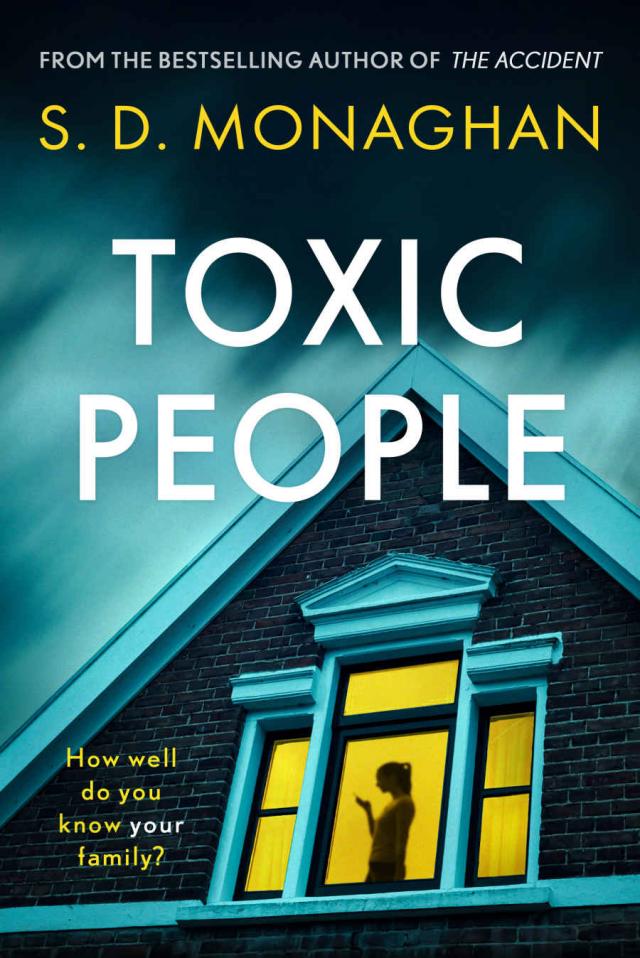


Toxic People
SD Monaghan
First published by Lume Books in 2023
Copyright © SD Monaghan 2022
This edition published in 2023 by Lume Books
The right of SD Monaghan to be identified as the author of this work has been asserted by them in accordance with the Copyright, Design and Patents Act, 1988.
All rights reserved. No part of this publication may be reproduced, stored in a retrieval system, or transmitted in photocopying, recording or otherwise, without the prior permission of the copyright owner.
To Anne – the arc of my story
Table of Contents
1
2
3
4
5
6
7
8
9
10
11
12
13
14
15
16
17
18
19
20
21
22
23
24
25
26
27
28
29
30
31
32
33
34
35
36
37
38
39
40
41
42
43
44
45
46
47
48
49
50
51
1
Friday Night
It was after 11.00 pm when everything started to unravel.
The warm summer night ensured that the pavements of Clareville were still bustling. It was like that for a few months, when the area filled with blow-ins turned on by being near true wealth. Then it would go quiet again for the rest of the year, when there was little noise except for the hush of luxury and money.
Although Shane liked the summer evenings, his neighbours considered the descending crowds to be like children dragging muck in along the carpet. He found the Clareville residents to be generally untrusting, anxious, pompous and wary of strangers. It wasn’t their fault, really. It just seemed to be something that happened when people made a fortune every year.
Walking by Pellicci’s, the local Italian eatery, Shane looked through the glass. He almost expected to see the diners staring out, their retinas in sudden, dazzling whiteout, examining him, curious as to what had gone wrong in his life. Instead, he saw the truth of himself within his translucent reflection: the settled, attentive husband, the researcher, the writer, the oarsman, the Xbox gamer. Being forty-four suited him. Shane had a swimmer’s body, dark mussed-up hair – dusted at the sides – and full lips. He was one of those men who could still wear black jeans and trainers and not look ridiculous.
But in the glass of Pellicci’s, he also saw the man who was no longer an easy sleeper. He saw the loving, interested father that he’d never become. ‘Not just yet,’ Jenny used to say – as if, should she ever change her mind, they’d be able to order one, like a table from a catalogue. He’d always known that she had never wanted a child. He’d just hoped that one day she would change her mind.
Up ahead was their house: a sturdy, three-storey Victorian end of row terrace. Among their neighbours were a businessman, a famous actor and a widower judge who still referred to England as ‘the mainland’; all splitting their time between town and country estates. Assessing the strip of lit-up front rooms, Shane saw that most were spending the evening in their studies, decaying away with their private art collections. None of the people living in this wedge of homes socialised together. This made Shane’s neighbours feel even more important, even more special, as if they had all that space to themselves.
Living in a nice neighbourhood, near the city centre, did have the odd limitation. Shane and Jenny had no garden, just a decked-out yard. There was no driveway, only a garage around the back leading to a dark, grey laneway. However, pros and cons did not matter anymore because, just a few months previously, they’d received a year’s notice to vacate. The notice had come from his mother-in-law.
Shane had always told himself that it didn’t matter where they lived, that a house was just a geographical location, that as long as Jenny and he were together, they’d be happy. However, Shane was also aware of how much he was going to miss the area. Money… Shane pictured his boat. He pictured a better one. I’m not above it.
He wondered if it wasn’t just because of Jenny’s mother; if somehow, he was the real cause of Jenny losing the house. Could Shane have done more? Perhaps, unconsciously, he was dispensing retribution on Jenny for her refusal to give him children?
Taking out his phone, he texted his wife:
Home early.
Scanning the screen of emoticons, he chose a straightforward red heart.
They had been barely talking before they’d gone out – he to meet a student researcher and she to give a talk on interior design. His wife wanted to stake all their savings on a daydream, the fantasy being that a particularly clever and opportune investment would turn their four-hundred-thousand savings into over one million euros in a year. Then, with that incredible return, Jenny would anonymously buy their Clareville house from her mother, using the funds for both the mighty deposit and leverage for the mortgage. To Jenny, it all made perfect sense. Which it did, as long as the investment performed; or, in other words, as long as her horse won.
It infuriated him how Jenny persisted with her belief that, unlike her, he did not really understand money. It was as if she actually believed that unless you came from a particular class, then you couldn’t possibly know what to do with substantial sums of cash. It was an innate snobbery that supposed that only people from a certain rank were trained to be wealthy. But Shane knew that money was not confusing – being poor was.
Despite the frustration, the disillusionment, the disappointment, part of him still wished that he could make the investment. How surprised Jenny would be. But Shane knew that he was 100% correct in turning it down. Cars, houses, Breitling watches – they were all just more accumulated trash that people hauled with themselves towards the grave. Shane also understood why Jenny had found it impossible to let the house go. For her eighteenth birthday she’d been given a silver Mercedes – Shane had received one hundred old Irish pounds for his, and he’d spent it on books. That had pleased his father and that in turn had made his father’s incredibly generous gift even more special.
But Jenny came from a family that had everything, had once promised her everything – and had then unfairly snatched it all away. Now, Jenny wanted it back. She wanted it back before she was too old to enjoy it. She didn’t even want her fair share. Her sister could get the majority of it. But she did want something. If her mother wasn’t going to give it to her, then she’d try and take the only thing she could – Clareville.
Most people started off with a sports-car vision of their future. Then they hit thirty and realised that wasn’t going to happen. But even though Jenny was forty-three, everything she wanted was still in the future. That was why she had to try and force him to gamble everything away for the chance of quick money – for the opportunity to claim this precious, precious house; to show her mother that she had underestimated her youngest and that she was so much better than the golden child, Joan. Her mother would finally see just why Jenny had been her father’s most prized favourite.
Shane was about to run up the steps to the front door but found the best he could do was walk fast. Time slowed. It was like he was trying to build a tower to the moon; the more progress he made, the more he realised just how far away it truly was. He hated lying to his wife and that was what he was about to do, when she got back from her own meeting. Jenny would ask, ‘Have you been drinking?’ He had. Four pints. But he would reply, ‘Just the one.’
He thought of the last time they’d made love. It had been over a month ago. When had they last gone to the movies? A month ago. To a restaurant? For a walk? A month ago. The thought flashed through his brain like a bullet: All of this wouldn’t matter if we’d had kids. People can lose trust in each other but stay in love – when they have kids. People can fall out of sex but stay in love – when they have kids.
The moment Shane stepped through the front door he knew something was wrong. The hall led past the study and the drawing room, proceeding into the kitchen, where the back door was open. He looked about at the island, the range, the closet-sized fridge, the coffee machine which fed his habit, and shouted, ‘Jenny?’ – making it sound like a question because he wasn’t expecting her back yet.
There was a thud upstairs. Suddenly, Shane was very aware that he was an unarmed forty-four-year-old man who weighed under twelve stone, with no real fighting skills. He considered going back outside. Or should he just call the police?
A wave of territorial aggression surged over him. Most of the furniture had once been Jenny’s father’s – from the big brass bed to the cutlery. Don’t let that little prick ruin your day, week, year. Because that’s what Shane pictured the intruder as – a young, skinny, teenage creep, who had no idea of the value of the things he was stealing, of the emotional vacuum he
was about to create in Jenny’s life.
Shane shouted, ‘Hey!’ and ran up the stairs.
He rounded the landing on the first floor and went straight to the master bedroom. Everything was as he’d left it three hours ago. Entering the en suite, Shane turned on the light and scanned from the claw-footed tub to the frosted door of the step-in shower.
The sound of boots again. Thump. Thump. Thump. Running down the stairs.
Shane exited the bedroom, gripped the top banister pole, swung around onto the staircase and began a rapid descent. He knew there were rules as to how you were supposed to play this game – run, call the police, even hide until it was safe to check what had been lost. Yet, it was a conveniently ignored reality that those who always followed the rules were always punished. Eventually.
That was not going to happen to him.
Sprinting through to the kitchen where the back door remained ajar, he hit it with an outstretched palm. Then, Shane was running across the decking towards the garage door, which was closing after being swung open seconds before. Instinctively, he entered the storage area in a non-sensible half-crouch, as if there was a sniper waiting to pick him off.
‘You fucking dick,’ Shane shouted and could only picture which of his late father-in-law’s personal items the thief was carrying, rather than whether he was armed or how big and violent he might be.
The garage entrance was a rolling metal sectional door, like a shutter, which had already been raised two feet, to let the burglar escape into the laneway. With a furious heave, Shane raised the clunking metal all the way into the roof.
The night air was stagnant, out on the laneway. Nearby, in one of the back gardens, someone beat a rug. From somewhere nearby, an engine revved in the darkness. It was not over yet.
A car accelerated and Shane knew that the thief was driving in the wrong direction. He was going east, where the laneway ended in a T-junction – both options abrupt dead-ends.
The idiot has trapped himself. I can block him.
Without Shane even noticing that he had extracted them, his car keys were clutched in his fist. A moment later, he was sitting in his chunky, ten-year-old, second-hand Land Rover, his body on autopilot, starting up the engine like he was about to pop down to Lidl. Beside him, one of Jenny’s jackets was carelessly scrunched up into a ball, and with the car being a dump bin between home and wherever she was working, the back seats were covered in interior design magazines, material samples and colour charts.
Reversing out into the laneway, he nosed the Land Rover in a direction it had never driven before – east. Shane went to turn the lights on and instead the wipers sprang to life, dragging caked grit across the dry glass in a half-moon of stained strata.
Jenny, you should’ve seen me. You should’ve been there. He needed to make himself confident. He needed to turn this into an adventure.
The burglar was a few hundred feet away, at the end of the lane, caught in a snare. Shane watched him as though his prey was a dumb nocturnal animal lacking the cunning to undo the clamp. Trying to turn the brightly lit red Ford Focus about the T-junction, the burglar awkwardly reversed and then moved impatiently forwards until, finally, his car faced Shane’s.
Its lights went off.
The laneway was in darkness. The engine of the Focus revved histrionically as it sped in the wrong gear. Out of the shadows, it accelerated straight at him. Expecting to hear the squeal of brakes, Shane grimaced – but it didn’t come.
Shane’s body was about to break. Glass and metal would tear his face apart. This end would please so many people. Jenny’s mother. Jenny’s sister. The blur of red metal spread across his line of vision. His heart clenching, he closed his eyes and waited and… his life didn’t flash before his eyes.
That was just a lie, just more bullshit he had believed in. Instead, he remembered the two rabbits he’d had as a boy. One died in the jaws of a cat. A week later, two magpies killed the other one. His rabbits had taught him that you can never anticipate the end, until it arrives in any of its surprising ways.
2
As Jenny walked home, the moonlight pressed down hard upon her, making her feel like she was in a painting. After giving a talk on contemporary lighting at the Shelbourne Ladies’ Club, she was worn out – but in a good way. There was pleasure in being too busy to think.
While strolling along, Jenny’s bleached-blonde head bent to check her emails. There were nervous queries from a few clients having second thoughts about a dining room colour scheme, doubting the stone she’d chosen for a kitchen island, worrying about the height of an imported Japanese hand basin. Her job frequently revealed how the wealthier a person became and the better the stuff they procured, the more anxious they became about everything.
She checked her Instagram, Facebook and Twitter notifications. Her accounts were pre-set with updates she’d written that morning, to be revealed periodically throughout the day, as if she was writing them on the go. The last one would soon be automatically posted. It was effortless for her to keep track of, because she found social media compulsive. Shane was always amazed at how she kept up with the inexorable hot lava flow of online discussion. ‘Infobesity’ he called it.
Much of Jenny’s interior design business came from her online presence. She was so expert at marketing herself that Home Designs Magazine had recently referred to her as an ‘influencer’. Upon noticing that she had fifteen new followers, the warmth from the online numbers radiated out from her phone to the surroundings of the Clareville neighbourhood. Thumbing her phone off, Jenny had almost no awareness of getting from the Shelbourne Ladies’ Club to her own road. No smells. No sights. No sounds. She had been in her phone.
Now that she was almost home, she inhaled deeply, as if her neighbourhood had a fine aroma. There was a moneyed hush in the air – like she’d entered the innermost sanctuary of a private members’ club. She loved Clareville, even though outsiders considered it pretentious, arrogant, up itself. But once you were in, you were in. Clareville was a safe, quiet neighbourhood and home to a great many interesting people, who would acknowledge each other with a courteous nod or wave, as a familiar frisson of satisfaction sizzled between them all. These were the executives of multinationals, airlines, communication networks and the bankers who advised them. Jenny knew their type – her father had dined with enough of them. But these people were not like her dad, who had never forgotten where he’d come from. These people were the kind that went out of their way not to socialise with normal people. Civilians with real jobs bored them.
She passed Pellicci’s. That was where Jenny had often said hallo to someone she recognised – only to realise that she did not, in fact, know them. They were just famous. Inside, the Clareville locals loved to gather informally in that searing atmosphere that pervades a room full of couples who have inherited their families’ boom-time businesses – those riches-to-ultra-riches magnates. There, they would all get excited over the same thing: property. They could also moan about the trying issue they all faced – being property millionaires. Just a week ago, a house in nearby St Catherine’s Hill went for over three million and now everyone was wondering what their taxes would be the next time one sold in Clareville. The most salacious news was when someone had to downsize. ‘Downsize’ – the most wounding expletive in the neighbourhood’s vocabulary. It meant divorce, financial ruin, legal woes; probably all three.
She checked her texts and saw Shane’s message. She replied:
Cool. Home in 2 mins.
Scanning the screen of emoticon items, she chose an exploding champagne bottle – the sexual connotations obvious. Jenny didn’t mean it, but she was trying. Shane and she were at the tail end of their biggest fight in years. She wanted to invest in a sure thing. He didn’t. And just like that, their marriage had hairline fractured down the centre.
Her husband’s naivety about money was excruciating. It was like he didn’t realise how the bank notes in his wallet were worth so much more than the loaded weight of the coins in his jeans. Instead, he seemed to believe that the heaviness in his trouser pocket was what made a person powerful and free. Shane also insisted that she’d always known that he had never been driven by money, had never been very interested in it… Yet any time we’ve had some, he’s always found new and fun ways to get rid of it. Anyway, it didn’t matter that he’d never misrepresented himself. People do evolve. People are supposed to change. They grow together.