Final beat of the drum, p.11
Final Beat of the Drum,
p.11
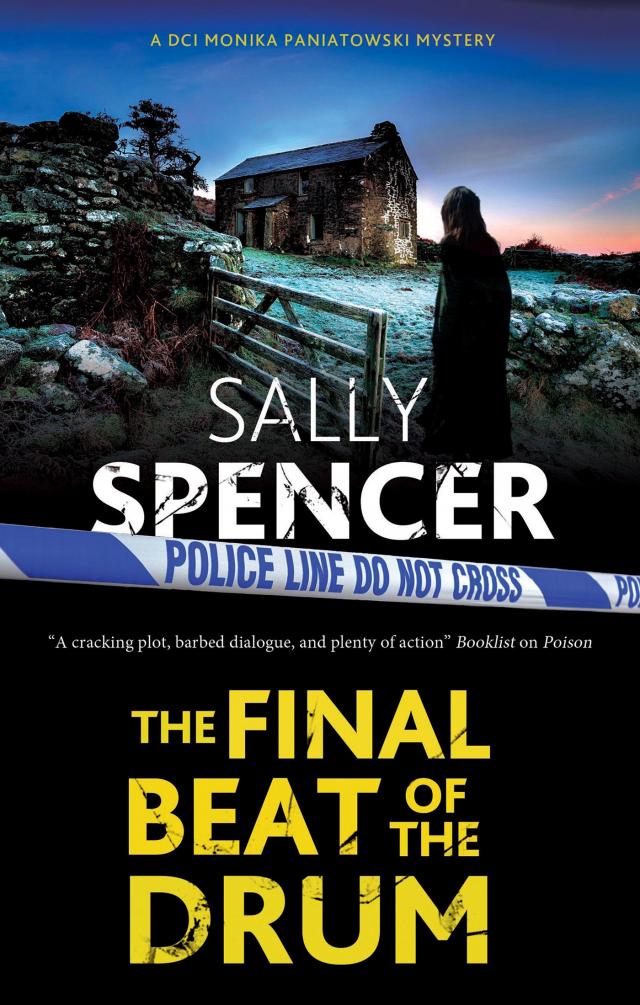


‘It’s only like this for about eight hundred metres,’ Monika promised the car, and then, remembering how ancient it was, she added, ‘that’s about half a mile in old money.’
The old house she was approaching was made of dressed stone blocks, and hunkered close to the ground under the pressure of a heavy slate roof. It was surrounded by other stone buildings, all of them too small to presume to call themselves barns, and it was towards one of these that the woman carrying two enamel pails was heading as Paniatowski pulled into the yard.
The woman placed one of the pails on the ground, and waved. She was a good-looking blonde in her late fifties, and had what, in Central Lancs, was often referred to as ‘a pair of prize-winning knockers’. The rest of her figure was in good shape, too, and if Paniatowski hadn’t known it for a fact, she would never have believed that the woman had given birth to five children.
‘If you’re looking for my lord and master, he’s repairing the fence in the upper field,’ the woman said.
Paniatowski grinned. The idea that Colin Beresford should be the ‘lord and master’ of Lynn Beresford was beyond funny.
When they’d first met, she had been a murder suspect, and ‘Shagger’ had been a man who leapt from woman to woman as if they were nothing but stepping stones in the hedonistic journey which was his life. And now here he was, a married man with five kids, repairing the fence in the top field.
‘If you want to see him, we’d better take the tractor, because driving up there in your Dinky car could just about rupture it,’ Lynn added.
‘OK,’ Paniatowski agreed.
‘I’ll just feed the pigs first, if you don’t mind,’ Lynn said, picking up the pails again.
‘I don’t mind at all,’ Paniatowski told her.
Kate Meadows was sitting in her office – doing her best to pretend that this was just a normal day – when Ruby Watkins, the midwife, tapped lightly on her door, and said, ‘Could you spare a few minutes to talk to Lizzie?’
‘Is anything wrong?’ Meadows asked, feeling a prickle of alarm.
‘Not wrong exactly,’ Mrs Watkins replied, ‘but Lizzie is a little upset, and I thought it would be better if you handled it.’
‘What’s she upset about, exactly?’ Meadows asked.
‘As you know, I’ve arranged for her to give birth in the maternity wing of Whitebridge General,’ Mrs Watkins said. ‘Up until now, she’s been perfectly happy with the idea, but when I mentioned it today, she became hysterical.’
‘Do you know why?’
‘She says she wants to have the baby here. She won’t even discuss the possibility of going into hospital.’
Meadows sighed. ‘Then I had better go and talk to her,’ she said.
The residents’ rooms in Overcroft House had a standard layout – brown carpet, pale walls and white bathroom suite – but Meadows had established a small fund which allowed each guest to accessorize her room to suit her personality. Some of the guests chose pastel fabrics and pictures of pastoral idylls, the better to blend in with the already muted style of the room. Others, seeking a complete break from the life they’d known, selected tasselled scatter cushions in bright sumptuous colours, like the Hollywood idea of a Turkish harem.
Lizzie had gone in neither of these directions, preferring instead to be guided by the principle that pink was good, and pink and fluffy even better. Thus she had pink curtains, a pink bedspread and a pink nightdress. The cuddly toys she had bought for her expected child were all pink, too. And since she had been crying, her eyes, when she looked up, matched her surroundings perfectly.
‘I won’t go to hospital, Mrs Maybe,’ she said. ‘I won’t! I won’t! If I can’t have my baby here, I’ll kill myself.’
‘If you killed yourself, you’d be killing the baby, too – and you wouldn’t want that, would you?’ Meadows asked softly.
‘I’ll kill myself. I swear I will,’ Lizzie said, as if she hadn’t heard. She held out her arm. ‘I’ll slash my wrists and bleed to death.’
‘Please excuse us for a moment, Lizzie,’ Meadows said, signalling to the midwife that they should step out into the corridor.
‘I’ve never seen her like this before,’ Mrs Watkins said.
‘Neither have I,’ Meadows said. ‘She’s normally so calm and sensible.’
‘And cooperative,’ the midwife said.
‘And cooperative,’ Meadows agreed. ‘Is there any reason she couldn’t have the baby here?’
‘Not really. There are obvious advantages to a hospital birth, of course – there’s a team of medics available to instantly deal with anything that’s going wrong – but I’ve delivered scores of children at home. The mother has to be reasonably strong, but after a few months of being built up in here, Lizzie is certainly that.’
‘Then given her obvious mental fragility – at least on this matter – I think we should give her what she wants.’
‘Agreed,’ Mrs Watkins said.
They went back into Lizzie’s bedroom.
‘If you want to give birth here, then that’s what we’ll do,’ Meadows said.
Lizzie sniffed. ‘Thank you, Mrs Maybe.’
‘Is there anything else I can do for you at the moment?’
‘I want the wardrobe,’ Lizzie said.
Not a wardrobe, but the wardrobe, Meadows noted.
‘Which wardrobe are we talking about?’ she asked.
‘The one I saw in the basement.’
‘What were you doing in the basement?’ Meadows wondered.
Lizzie shrugged. ‘Just looking around,’ she said unconvincingly. ‘I wasn’t doing anything wrong, was I?’
She seemed as if she was about to cry again.
‘No, you weren’t doing anything wrong,’ Meadows assured her, ‘but I’d still like to know why you went down there.’
Like a wild animal that realizes it’s been trapped, Lizzie glanced frantically around the room, as if looking for an escape.
‘Gary!’ she gasped with relief.
‘What about him?’
‘That’s why I went down to the basement. To find a hiding place in case Gary came looking for me. So can I have the wardrobe?’
It was a monstrous thing, huge and clumsy, with a walnut veneer which was chipped away at the edges. It would have fitted in – maybe – in the offices of an old-fashioned undertaker, but anywhere else it would look distinctly – and uncomfortably – out of place, and it was no great surprise that its previous owner had left it behind when he moved out. Meadows had tried to sell it at first, and when that failed, to give it away. But no one would have it – not even as a gift. And so it sat there in the basement, waiting for the warden to find the time to arrange for it to be taken to the dump.
‘That old wardrobe would take up far too much of your living space,’ she said looking around the room. ‘You’d be banging into it all the time.’
‘I don’t care,’ Lizzie told her.
‘And you really haven’t got enough clothes to need a wardrobe of that size.’
‘I will have – eventually.’
‘Listen, if you want another wardrobe, I’ll buy you a nice light modern one – one that will blend in with this room.’
‘Don’t want a new one – I want the one in the basement,’ Lizzie persisted.
‘But why are you so keen on it?’
‘It reminds me of when I was growing up,’ Lizzie said. ‘I had one just like it my bedroom.’
Meadows, who had read Lizzie’s social worker’s notes, didn’t believe for a second that Lizzie would want to have anything that reminded her of her childhood, and if this situation had cropped up a few days earlier, she would have stuck at it until she’d learned what was really on Lizzie’s mind. But this wasn’t a few days earlier, and she wasn’t the conscientious warden she’d been back then. Now, she was a woman drowning – exhausted and consumed by fear for her future – and she did not have the energy to pursue the matter any further.
‘Please, Mrs Maybe, can I have it?’ Lizzie said.
Meadows sighed. ‘Yes, you can have it.’
‘Thank you, Mrs Maybe. If my baby’s a girl, I’ll call her after you.’
Despite the nip in the air, Colin Beresford was stripped to the waist, and was holding a sledgehammer which he was using to drive a wooden post further into the ground. His naked torso was not as impressive as it had been twenty-five years earlier, but it was still impressive enough, and it was clear that farming – albeit part-time – was suiting him.
Lynn brought the tractor to a halt a few yards from where he was working. ‘I’ve got a lot to do, so I’ll leave the pair of you to it,’ she said.
Paniatowski climbed down. Her bones were still vibrating from the ride, and she wondered how anyone ever managed to stay on a tractor for more than half an hour.
‘Well, look what the cat dragged in,’ Colin Beresford said cheerily. ‘It’s good to see you, Monika.’
He squatted down, picked a bottle which was leaning against the fence, and poured some of its contents into a mug, which he offered to Paniatowski. ‘I’ve only got the one mug, so we’ll have to share,’ he said. ‘Sorry about that.’
Paniatowski peered into the mug. The liquid inside was a sort of muddy green. She took a tentative sip.
‘Well, tell me what you think of it,’ Beresford said.
Paniatowski grimaced. ‘It tastes like a diabetic tomcat has peed on a dead hedgehog,’ she said. ‘What is it?’
‘Nettle beer,’ Beresford said. ‘I make it myself.’
‘I’m not surprised. I certainly can’t see anyone else having the nerve to give it to you,’ Paniatowski replied.
The old Colin had been a drinker and a womanizer, but he had always been discriminating in both areas. There were men who would have sex with any woman who had a pulse (and a few who would even waive that qualification) but Colin had been choosy about his amorous encounters, even if they were only a one-night stand (as they invariably were). And he’d been even pickier with his beer: he drank only pints of Thwaites’ Best Bitter, and would send them back to the bar if he decided that whoever had pulled them did not have sufficient expertise to serve up a really good pint. And just look at him now. He was monogamous for a start (and Paniatowski was sure of that, because if he hadn’t been, Lynn would have killed him long ago), and drank a nettle beer which it would have been charitable to describe as toilet fluid.
Was there any point in asking this new Colin to sail with her on the good ship Probably End Badly?
Beresford took a gulp of his nettle beer, and wiped his mouth with the back of his hand.
‘You’ve never been one to mess about, so why don’t you tell me what’s on your mind,’ he suggested.
Paul Mason and Michael O’Casey were well aware that other people called them Casey and Masey – as if they were a pair of old-fashioned, end-of-the-pier comedians. It didn’t bother them at all. In fact, they could be said to have earned the name by their habit of delivering their oral reports as if they were enacting comedy routines which were sometimes so old and feeble that they should never have been allowed to leave the intensive care unit. Occasionally, a new detective might rebuke them for their frivolity, but he would soon learn that they were the hardest working, most competent SOCOs in central Lancashire, and decide that their corny humour was well worth tolerating because of the information it carried within it.
On this, day two of the investigation into the death of Andrew Lofthouse, the team were lifting prints in the master bedroom when Mason looked at his watch and said, ‘When are we expecting the other teams to arrive?’
‘What other teams?’ O’Casey asked.
‘The other teams that Sergeant Boyd promised us would be shouldering some of the workload,’ Mason said.
‘Oh, them,’ O’Casey said. ‘They won’t be coming. DCI Dawson phoned me and said something else had come up, and he couldn’t spare anybody else.’
‘You could have told me that earlier,’ Mason said.
‘I could,’ O’Casey agreed, ‘but I so hate to see you disappointed.’
‘So there’s just the two of us,’ Mason mused.
‘Why would you want more people around?’ O’Casey asked in a mock-offended voice. ‘Aren’t I enough for you, anymore? Have you stopped loving me?’
‘Of course I haven’t stopped loving you,’ Mason said scornfully. ‘How could I, when you have everything a man could want – dandruff, bad breath, varicose veins, bunions—?’
‘That’s a dirty rotten goddam lie,’ O’Casey interrupted him in a fake American accent which would have been embarrassing if it hadn’t been deliberately bad. ‘I do not have varicose veins.’
‘Seriously, though, why are there only the two of us?’ Mason asked. ‘I could understand it if we were working in a terraced cottage – put more than two of us in a place like that and we’d be forever getting in each other’s way – but this house is big enough to keep three or four teams busy.’
‘Ours not to reason why, ours just to dust and pry,’ O’Casey said whimsically. ‘If I were you, I’d let the matter drop.’
But Mason was not prepared to do that.
‘Just what case have they put the other teams on?’ he demanded. ‘Has there been another murder?’
‘Not that I’ve heard about,’ O’Casey admitted.
‘So this case should be given top priority. We all know that the first forty-eight hours on an investigation are the most crucial, so why are they pissing us about?’
‘It is a bit concerning when you put it like that,’ O’Casey admitted.
‘It’s almost as if they didn’t want this case solving,’ Mason said.
‘Yes, it is,’ O’Casey agreed, suddenly sounding rather worried.
ELEVEN
The University of Central Lancashire had been established in the 1960s. In its youth, the campus had seethed with excitement and a belief that here was a place in which radical new ideas could be discussed, and previously hidden truths uncovered. But many newer institutions had sprung up since then, elbowing it out of its avant-garde position, and now it had entered a more sedate middle age – not quite a grandmother yet, but at least a maiden aunt.
Paniatowski walked across the main piazza (why couldn’t they call the bloody thing a square, she wondered) to the lecture hall where she had been told she would find the man she was looking for.
The lecture was already underway, and she slid quietly into a seat at the back of the hall. The lecturer was a tall man in his mid-forties. He was handsome in a dashing romantic sort of way, and this impression was only heightened by the black patch which covered his left eye.
‘So here we have Scene Two of Shakespeare’s Twelfth Night,’ Jack Crane was saying. ‘What do you make of it?’ He looked around his audience. ‘You, Miss Bains, what’s your opinion?’
‘I think it’s good, professor,’ the girl said confidently.
She was the sort of girl who wouldn’t exactly make an effort to trade on her looks, since she’d know she had no need to, Paniatowski thought sourly. She had that kind of gentle, almost characterless beauty which made boys hang around her like dogs on heat, and men treat her as if she were a combination of favourite daughter and approachable deity. And from the way she said ‘professor’, it was plain she thought she had Jack Crane exactly where she wanted him.
‘Good?’ Crane repeated, incredulously. ‘You think it’s good?’
‘It’s very good,’ the girl amended,
‘We have read the same scene, you and I, haven’t we?’ Crane asked, sounding genuinely puzzled.
‘Er … yes … we …’
‘Viola asks the sea captain what country they’ve been shipwrecked in, and he says it’s Illyria,’ Crane said. ‘Now they’ve been there for quite some time, so you’d have thought she might have asked that earlier, but we’ll overlook that for the moment. She says her father once told her it was ruled by a Count Orsino, and that he was unmarried then. He’s unmarried now, the captain tells her, although he is wildly in love with a lady called Olivia. Does that strike you as a normal conversation – one with a natural flow – Miss Bains?’
‘No, not exactly,’ the girl said, stumbling over her words. ‘But it is Shakespearean.’
‘Ah, that explains it then,’ Jack Crane, ‘Is there anything else about the scene we should discuss? Oh, yes! Viola says, I think my brother, Sebastian, died in the storm. I wonder why she hadn’t mentioned that before? And the captain replies that he doesn’t think he is dead, because before the ship went down, he saw Sebastian tie himself to the mast – another fact it’s been rather insensitive of him to hold back for so long.’ He paused, ‘Still think it’s good, Miss Bains?’
‘Well, er …’
‘Am I saying Shakespeare’s rubbish?’ Jack asked, speaking to the hall in general. ‘No, I’m saying some of what he wrote is rubbish. Let me read you the opening of a play that isn’t – the first scene of Othello.’
He read through the whole scene, playing all the parts himself. Paniatowski found it magical. He took her on a journey through the dark, damp streets of Venice. He made her shiver at the evil in Iago’s words and share in Brabantio’s anger and fear over his daughter’s fate, and when he’d reached the end of the scene, she was exhausted.
‘I could marry him,’ a girl sitting close to her whispered to her friend. ‘I’d do it tomorrow.’
‘In case you haven’t noticed, he’s an old man,’ her friend replied. ‘But I know what you mean.’
An old man! Paniatowski thought.
Jesus, what did that make her?
‘I wonder what happened to his eye,’ one of the two whisperers said.
‘I heard he lost it in a bar fight in Tangiers – over a woman,’ the other girl told her.
Paniatowski chuckled softly to herself. Lost it in a bar fight in Tangiers! How much more romantic that was than the truth – that it had been gouged out with a screwdriver by a woman who was out of her mind on drugs.