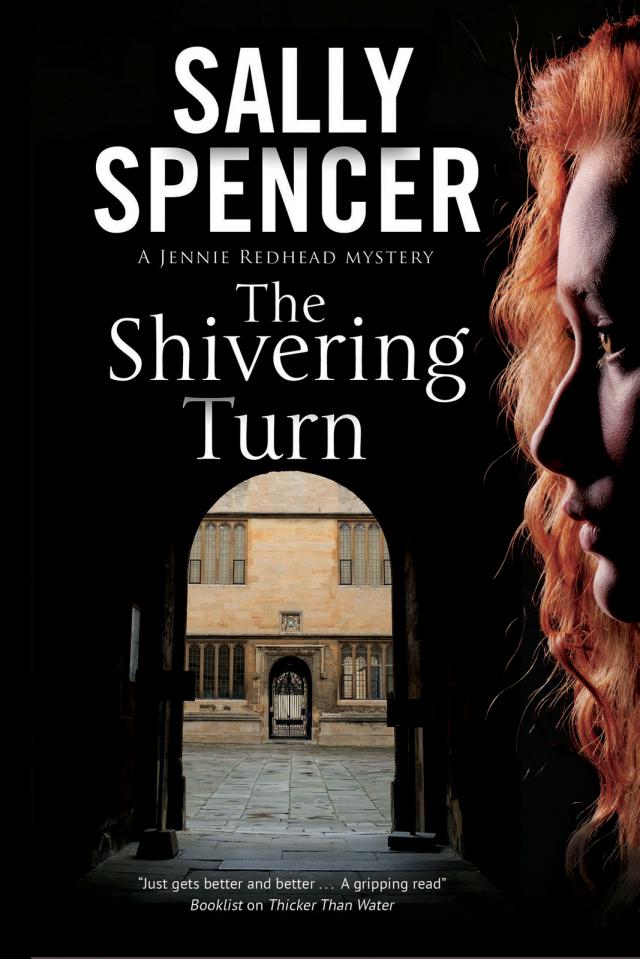
The shivering turn, p.17
The Shivering Turn,
p.17


And although I once had great hopes for you, I’m not convinced you’re anything more than a myopic Scottish git, I think.
But always the diplomat (hah!), what I actually say is, ‘I really think you should reconsider, sir.’
‘And I think you should pay more attention to the words I use, and the way I use them, Miss Redhead,’ he says. ‘I told you I was “not entirely convinced”, which leaves plenty of room for me to be “not entirely unconvinced” as well.’
‘So do you think …?’
‘I think we should go and pay the landlord of the Blind Beggar a surprise visit.’
The Blind Beggar is three-quarters full by the time we get there. Most of the customers are young, and the fact that Suzi Quatro’s ‘Devil Gate Drive’ is being blasted out of the juke-box speakers at a volume which would probably be deemed cruel and unusual punishment under English law doesn’t seem to bother them at all.
Macintosh strolls up to the bar, and signals to a podgy balding man in his early forties.
‘Are you the landlord?’ the DCI bawls.
The podgy balding man nods.
Macintosh produces his warrant card. ‘I’d like to have a little talk to you,’ he half-says, half-mimes.
‘Am I being arrested?’ the landlord mouths.
Macintosh shakes his head, and the landlord replies with something obviously much too complicated to be understood using any of the means of communication thus far successfully employed.
And then the music stops, and while one record is removed from the turntable and other slotted into position, a blessed peace descends on the pub.
‘What did you just say?’ Macintosh asks.
‘I said if I’m not under arrest, then you’ll just have to wait till later for our little talk – when we’re a lot less busy than we are right now.’
The air is filled with the opening chords of David Bowie’s ‘Rebel, Rebel’ and, now that he can no longer be heard, the landlord says something else which I suspect may be on the lines of, ‘So stick that up your arse, copper!’
Macintosh turns around and walks over to the juke box. He studies it for a moment, then reaches behind it and pulls out the plug.
‘Here, what the bloody hell’s going on?’ the landlord demands.
Ignoring him, Macintosh ambles over to one of the tables, where seven young men are sitting.
‘Evening, lads,’ he says jovially, while holding out his warrant card for them to see.
The young men, looking down at the table, all mumble something which just possibly might be, ‘Evening, officer.’
‘It’s an offence in this country to drink in a pub unless you’re eighteen or over,’ Macintosh says. ‘Are all you lads eighteen or over?’
None of the young men seems particularly willing to be the first to provide an answer.
‘I’ll tell you what I’m going to do, lads,’ Macintosh says, in an almost avuncular manner. ‘I’m going to walk slowly over to the bar and, once I get there, I’m going to count to ten. Then I’m going to come back to this table. Any of you still here are going to have to prove to my satisfaction that you’re old enough to drink, and if you can’t prove it, I’m going to haul your arses down to the station and keep you there until it’s established – by some form of documentation – exactly how old you are. That’s fair enough, isn’t it?’
As he walks towards the bar, the young men get up from their seats and head quickly for the exit. And they are not alone in doing that – drinkers at several other tables also seem to have considered it advisable.
Macintosh reaches the bar, then turns around in a leisurely manner to inspect the room. Covered with drinks, but devoid of drinkers, several of the tables look as if they’ve just been tele-transported from the Marie Celeste.
‘Well, things do seem to have quietened down a bit, don’t they?’ Macintosh asks the landlord. ‘And I suspect that if we stay any longer, they’ll quieten down even more.’
‘You’d better come into the office,’ the landlord says, defeated.
It’s not so much an office as a storeroom with a battered desk crammed into it, but at least there is a window, looking out on to the car park.
The office only contains one chair – which is behind the desk – and Macintosh takes it for himself.
‘What’s your name?’ the chief inspector asks the landlord, amiably.
‘Mr Harris,’ the landlord tells him.
‘Oh, come come, we’re all friends here, what’s your first name?’ Macintosh cajoles.
‘It’s William.’
‘Well, Billie Boy, I’d like to see the reservations book for your functions room,’ Macintosh says.
‘Have you got a search warrant?’ Harris growls.
‘No, I haven’t got a search warrant – and if you make me waste my time by going to the magistrate and getting one sworn out, that will probably put me in a very bad mood.’
Harris reaches across Macintosh, slides open the desk drawer, takes out a ledger, and hands it to the chief inspector.
Macintosh flicks through it.
‘You don’t seem to have had many bookings over the last year or so,’ he comments.
‘It’s been a very quiet time,’ the landlord says.
‘Look, Bill, I’m not in the least bit interested in shopping you to the Inland Revenue – I just want to know who’s used the room,’ Macintosh says.
‘It’s all in the book.’
‘Didn’t you say the lads from the university booked the room for last Friday?’ Macintosh asks me.
‘Yes.’
‘And yet that’s not in the book,’ Macintosh says, holding it up for Harris to see.
‘I must have forgotten to write it down.’
‘Did these lads – who probably paid cash – book the room any other time that you’ve forgotten to write down?’
‘No.’
‘You haven’t got the measure of me yet, have you, laddie?’ Macintosh asks. ‘I’m not just any copper, I’m a Glaswegian copper – and if you piss me off, I’ll head-butt you through that window as soon as think about it.’
‘It’s true, he will,’ George Hobson says. ‘I’ve seen him do it a couple of times.’
‘You wouldn’t dare,’ Harris says.
‘And after I’ve done that, I’ll ask DS Hobson and Miss Redhead to sign statements saying that you attacked me and I was only defending myself.’ Macintosh looks at the two of us. ‘You will sign them, won’t you?’
‘Yes,’ George Hobson says.
‘Absolutely,’ I agree. ‘I’ll even say in mine that, in the circumstances, you exercised remarkable restraint.’
‘And when we’ve picked you up off the tarmac, and cleared the glass out of your wounds, I’ll arrest you for assaulting an officer. But it really doesn’t have to come to that, Bill,’ Macintosh says in a much softer, almost seductive voice. ‘All you have to do to avoid the Glasgow kiss is to tell me if these lads have used the function room before.’
‘Yes, they have,’ Harris mumbles.
‘How often?’
‘Twice!’
‘More detail, man – and be damned quick about it!’ Macintosh says, back in anger mode.
‘Once last November, and once in February,’ Harris says in a rush.
‘Now you’re surely not going to tell me that the February booking was for the fourteenth of the month, are you?’ Macintosh asks.
‘It was the fourteenth,’ Harris admits.
‘Valentine’s Day,’ Macintosh says to Hobson. ‘Is it any wonder that we Scots think you English have a sick sense of humour?’
‘I think the sick sense of humour in this case belongs to the Shivering Turn, sir,’ Hobson says.
‘You’re probably right,’ Macintosh agrees. He turns his attention back on Harris. ‘You must have a clear view of the people going to the function room from this office, Bill.’
‘I’m hardly ever in the office. Customers like to see the landlord standing behind the bar.’
‘I’m sure they do,’ Macintosh agrees, ‘especially when they’re as personable as you are.’ He stands up. ‘A policeman’s lot is not a happy one, but when we get people like you, Bill, who are prepared to do everything they can to help us, well, it certainly makes that lot a little easier.’
We are in DCI Macintosh’s car, driving back to the centre of Oxford. None of us has said much since we left the Blind Beggar, but there’s no doubt that we’ve all been having intense conversations in our own heads.
‘You didn’t press Harris about what he might have seen through his office window,’ I say, breaking the silence.
‘That’s right, I didn’t,’ Macintosh agrees.
‘Is that because you believed him when he said he was hardly ever in the office?’
‘No, it’s because even if he had seen something, he’s too canny to admit it. As things stand, he’s in the clear, the innocent landlord who had no idea what was going on; but if he so much as hints there were grounds for him to be suspicious, he’ll land himself right in the shit. So he’s made up his mind to keep quiet, and even somebody who’s as good at intimidation as I am – and I am very good at being intimidating – isn’t going to break his resolve.’
The traffic light ahead of us turns amber. Most drivers would put on a burst of speed, but Macintosh changes down and glides to a halt exactly behind the white line.
‘They’ve had three meetings so far that we know about,’ Macintosh says. ‘One last Friday, one in November, and one in February.’
‘Yes,’ I agree.
‘Do you think that means two other girls have been put through the same humiliation as Linda Corbet?’
‘I do.’
‘And what happened to those girls? Were they both packed off to London, too?
‘I have no idea,’ I say, because that’s the simple truth.
The lights change, and Macintosh eases his vehicle forwards.
‘I believe you now,’ he says. ‘I really do. But all your evidence is circumstantial.’
‘I know,’ I admit.
‘And even if we could put Linda Corbet in that room – even if we could demonstrate, without a shadow of a doubt, that she had sex with all those men – we still can’t prove it was rape.’
‘I know,’ I repeat – there doesn’t seem to be much point in saying anything else.
‘The only way we can put any kind of case together is if they incriminate themselves,’ Macintosh continues. ‘If they don’t, their parents will come down on us like a ton of bricks – and they’ll have the support of the university, which is very important to this town.’
‘Yes,’ I say, for the sake of variety.
‘Anyone who tries to make the case, and fails, will be ruined,’ Macintosh says. ‘He might not lose his job – at least not initially – but he’ll still be a walking dead man as far as the Thames Valley Police is concerned.’
He is talking about an impersonal somebody being ruined, but we both know he really means himself.
A promising career could be ruined, the force could lose a good copper, and it would be all my fault, I think.
‘You have a lot to lose, and the odds are stacked against you,’ I say. ‘If you choose not to push this any further, I’ll understand.’
‘You’ll understand – but will you still respect me?’ Macintosh asks.
‘Yes, I will, because Linda Corbet is not the only person you have a duty and responsibility to,’ I say, honestly.
‘So what will you do if I decide to drop it?’ he asks.
‘I’ll find another way to get justice for Linda,’ I say – with more confidence than I actually feel.
‘What other way?’
I shrug. ‘I have no idea at the moment, but I’m sure that something will occur to me.’
‘You have no back-up – no proper resources to draw on,’ Macintosh points out.
‘I’ve got this far on my own,’ I tell him. ‘It’s remarkable what you can achieve when you really want to.’
He signals, and pulls up at the side of the road. It’s illegal to stop there, but hell, he’s the police.
‘I have three daughters of my own—’ he begins.
‘Please, there’s no need for that,’ I interrupt him. ‘I’ve already said that I understand you have other responsibilities.’
‘I have three daughters of my own,’ Macintosh repeats, turning to face me, ‘and it could have been any one of them ending up in that function room. Let’s do all we can to try to nail these bastards.’
FIFTEEN
As we drive along George Street, it starts to rain, but it is not one of those glorious full-bodied downpours which clears the air and sends streams of water gurgling madly down the drains.
No, this is nothing more than drizzle – the sort of rain which hardly justifies turning on the windscreen wipers – yet, when it persists, depresses the spirit and sets the nerves on edge.
‘The whole trick will be to take the Shivering Turn completely by surprise,’ DCI Macintosh says. ‘We need to pick them all up at the same time, so they don’t have any opportunity to confer. And, by then, I’ll already have search warrants sworn out, so the second they’re safely in custody, I’ll send some of my lads round to give their rooms a thorough turning-over.’
He sounds confident, but I don’t think he is.
None of us is.
We reach the corner of the Broad, and I say to Macintosh, ‘You can let me out here.’
‘It’s raining,’ he points out.
‘I know.’
‘I can drive you home, if you like. I thought that was where you wanted to go.’
So did I, but the idea of being alone in my box of a flat is suddenly not very appealing.
‘Here will be fine,’ I say.
He pulls up at the kerb. ‘Do you want to be there when I make the arrests?’ Macintosh asks.
‘Yes.’
‘Then ring the station later, and they’ll give you the details.’
I watch as he drives away. The drizzle has already begun to penetrate my defences. I turn up my collar, and walk quickly in the direction of the Oxford Union.
It is generally acknowledged that the Oxford Union (founded in 1823) is only one of the world’s five or six premier debating chambers, but most of its members (and I include myself in that number) see it as standing head and shoulders above any of its rivals.
It is completely independent of the university, though to become a member of the Union you must first be an Oxford University student (and if you are, it’s your absolute right to join – there is no blackballing here!)
Winston Churchill has spoken at Union debates, as have Robert Kennedy, Albert Einstein and Malcolm X.
But it is much more than just a debating chamber. It has an extensive library exclusively for members’ use, a large snooker room and a full silver service dining room.
It also has a bar, which is not only cheaper than most watering holes in the city, but is open (on debating nights) long after all the pubs have closed – and since there is a debate tonight (and all the pubs will soon be closing), it will provide me with the sanctuary I need.
The place is full, but, as chance would have it, a space at the bar becomes vacant just as I walk in, and I grab it.
As I sip at my G&T, I find myself thinking about the Russian generals – in both world wars – who ignored the fact there were not enough rifles to go around, and sent half their men into battle unarmed.
For a moment, I wonder why such a thought should come into my head now – and then I see it. I am doing to Macintosh and his team what the Russian generals did to their men – I have shown him where the battle is, told him he should engage in it, and failed to provide him with the tools necessary to do the job.
‘Aren’t you going into the debate tonight, Jennie?’ says Arthur, the bar steward.
I hadn’t really thought about it.
‘What’s the subject?’ I ask.
‘“This house believes that democracy is no longer fit for purpose”.’
Ah, that old chestnut. Every few years, a president of the Union thinks it would be a bold, bohemian move to question democracy, conveniently ignoring the fact that whether democracy is a good thing or bad thing will be decided on by a democratic vote.
‘Who’s speaking?’ I ask, more for something say than because I’m really interested.
‘Take a wild guess,’ Arthur says.
I think about it. ‘For the “ayes”, a government minister and an opposition shadow minister,’ I guess.
‘Spot on,’ Arthur says. ‘And now, for the major prize, who’s speaking for the “nays”?’
‘That’s trickier,’ I admit. ‘How about a committed communist who’s found an ingenious way of explaining how he can be both a millionaire and a follower of Marx, and a right-wing nutter who accepts that Adolf Hitler was a very bad man, but still thinks that some of his ideas were very sound?’
‘Not bad,’ Arthur concedes. ‘Actually, it’s a millionaire anarchist and a member of the National Front.’
I wish tomorrow could be as predictable as that, I think, as I take another swig of my drink.
‘So are you going to watch them jump through their hoops or not?’ Arthur asks.
‘Might as well,’ I say – because if nothing else, it might distract me from thoughts of my own failure.
The moment I enter the chamber, I see Crispin Hetherington across the room – and he sees me!
For a moment, I wonder if he deliberately engineered this, as he seems to have engineered so many other events, but then I remind myself that until a few minutes ago, even I didn’t know I was coming here, and the fact that the idea has even entered my head is a sign of just how paranoid I’m becoming.
The principal speakers have already made their arguments, and the question has been thrown open to the floor. For twenty minutes or so, I half-listen – at best – to these earnest young men and women who are so eager to make a name for themselves as debaters, and am almost on the point of returning to the bar when Crispin Hetherington is called on to speak.
Hetherington shows none of the nervousness of some of those who have preceded him. He stands there, a small – almost frail – figure, and surveys the chamber as if it were his personal domain.