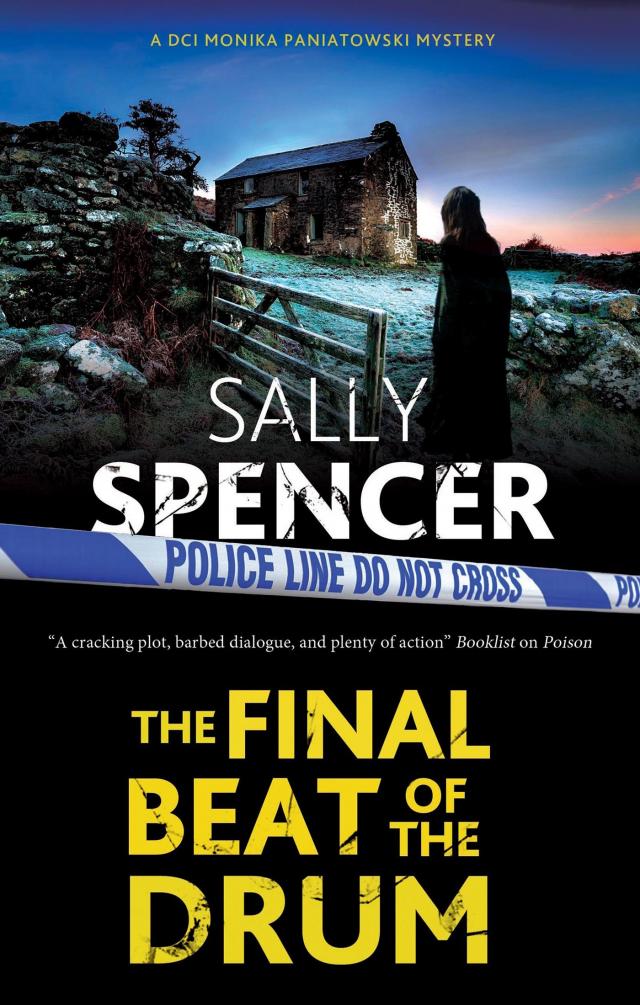
The final beat of the dr.., p.6
The Final Beat of the Drum,
p.6


‘I suppose not.’
‘I thought so,’ Horlick said. ‘You’ve got what I call “beginner’s enthusiasm,” an urgent desire to get all the answers immediately. Does the nature of the blow tell us anything?’ he mused. ‘Well, it might tell us that his attacker was a very strong man. On the other hand, he may merely have been a very angry man. Then again, he might just have been pretending to be an angry man to throw you off the scent.’
Two ambulance men appeared in the doorway. One of them was pushing a stretcher from the back, the other guiding it from the front.
‘Ah, the cavalry has arrived,’ Horlick said. ‘Tell me, boys, can you spot the dead man?’
The lead ambulance man, who was obviously used to his banter, grinned. ‘I’d say it was the feller without a head,’ he said.
‘Excellent!’ Horlick exclaimed. He sounded pleased. ‘You have listened to my words of wisdom, and have learned much. And this,’ he continued, holding up the head for them to see, ‘completes the picture. If you want to do this by the book, we will require two stretchers – one for the trunk and one for the head – but if you’re willing to cut corners, I’m more than willing to look the other way.’
‘So when can you do the PM, doc?’ Dawson asked.
‘Well, aren’t we an eager beaver today,’ Horlick replied. ‘I suppose I could do it as soon as I get him back to the mortuary. Will you be observing it yourself, or will you be sending one of your minions?’
‘I’ll come myself,’ Dawson said, without a great deal of enthusiasm.
‘That’s a date, then,’ the doctor replied, as he waddled after the stretcher. ‘Be there in half an hour. I’ll be the one holding the nasty sharp scalpel.’
‘Pillock,’ Dawson said, when Horlick was out of earshot.
The longer Clara Frisk sat in the back of the patrol car, the more her sense of injustice grew.
‘Is there a reward?’ she’d asked the uniformed bobby who’d opened the door of the car and gestured she should climb inside.
‘I wouldn’t know about that,’ the bobby had replied.
‘I was the one who found the body and phoned the police, you know,’ Clara had said. ‘If it hadn’t been for me, who knows how long it would have been before he was found? If that doesn’t deserve a reward, I don’t know what does.’
‘Just get into the car, madam,’ the constable had said, guiding her gently but firmly on to the back seat.
‘I demand to see your superior officer,’ she said.
‘You will, madam,’ the constable had promised. ‘But it may be a while, because he’s quite busy at the moment.’
After ten minutes, Clara began drumming her fingers on the seat in front. After twenty minutes, she tried the door, and was disgusted to discover that it was locked. After thirty minutes, she reminded herself that she had something in her bag which would help her deal with the boredom.
DCI Dawson took his packet of cigarettes out of his pocket, then remembered that the latest decree from on high was that there should be no smoking at crime scenes. As he returned the cigarettes to his pocket, he noticed that Sergeant Boyd had been watching the whole manoeuvre.
‘Stupid bloody regulation,’ Dawson said.
‘I think the idea is to avoid contaminating the crime scene, sir,’ Boyd said mildly.
Bloody smart-arsed sergeant!
‘We haven’t seen Mrs Lofthouse. Don’t you know where she is?’ Dawson asked, sulkily.
‘I do know, actually, sir,’ Boyd replied. ‘According to the station, she’s registered as living in a shelter for battered women called Overcroft House.’
‘So he was a wife beater, was he? He had a bit of a temper – and then he lost his head completely.’ Dawson chuckled, because now he meant it, it was funny, and Boyd did his best to create the impression that he was joining in. ‘Still, battered wife or not, I suppose she’d better be told he’s dead,’ Dawson continued.
‘Do you want me to do that, sir?’ Boyd asked.
Did he? Dawson wondered.
It was often a good idea to have a trained observer there when the news was broken to the nearest and dearest, because a lot could be learned from their reactions. But if Lofthouse’s missus had been living in terror of him, it did not take much thought to work out what her reaction was likely to be. She’d probably be useless as a witness too, since anything she told them would be so coloured by her own bias that at best it would be a waste of time, and at worst it could send them up a real blind alley.
‘You’ve got better things to do with your time,’ he said. ‘Get a couple of uniforms to do the job.’
Boyd nodded. ‘At least we’ve had one lucky break, sir,’ he said.
‘And what might that be?’ Dawson asked.
Does he really not know, or is he just testing me? Boyd wondered.
‘Well, the fact that he was decapitated,’ he said.
‘And how is that a lucky break?’
‘It will be very useful when we come to interrogating a possible suspect.’
‘Go on.’
‘If it becomes obvious during the course of the interrogation that the suspect has no idea how the victim actually died, then we can rule him out. Conversely, if you have a suspect who admits to knowing that Lofthouse was decapitated, then he’s our man.’
‘Assuming we can keep that fact to ourselves,’ Dawson said.
‘Exactly, sir.’
‘I think your chances of keeping a decapitation secret are approximately nil,’ Dawson said.
‘The paramedics won’t dare talk about it because it would cost them their jobs, and our lads won’t do it because that would open them up to criminal prosecution,’ Boyd said. ‘And even if the newspapers got a whiff of it, they wouldn’t run the story, because they know that if they did, we’d never cooperate with them again.’
‘And what about the cleaner – this Clara Cluck?’ Dawson jeered. ‘How are you going to shut her up?’
‘I’ll find a way,’ Boyd said, sounding more confident than he actually felt.
Clara Frisk had polished off her little bottle of Bacardi and was attacking the gin when she heard the door click open, and saw the lanky streak of wind and piss slide in beside her.
‘How d’you manage to get the door open? It wouldn’t budge for me,’ she said, and on hearing herself speak she realized that she was – at the very least – tipsy.
‘What’s that you’re drinking, Clara?’ Boyd asked. He took the bottle off her, and held it up to the light. ‘Eau-de-Cologne? You shouldn’t go drinking scent. It’s not good for you.’ He held the bottle under his nose. ‘Actually, it smells more like gin than scent.’
‘It’s cold in this car,’ Clara said. ‘You have to do something to keep warm.’
‘But why put it in a scent bottle?’ Boyd wondered. ‘Do you mind if I take a look in your bag, Clara?’
‘Yes, I bloody do mind,’ the cleaner said, clutching the bag close to her scrawny chest.
‘Fair enough,’ Boyd said philosophically. ‘We can always leave it till we’re down at the station.’
‘What do you mean?’ Clara demanded.
‘Well, if you don’t let me look inside, I’ll just have to arrest you,’ Boyd explained.
‘Here, take the bloody bag,’ the cleaner said, thrusting it into his hands.
Boyd discovered two more bottles, and looked especially pleased when he found the funnel.
‘Naughty, naughty!’ he said.
‘I should think you’ve got more important things to worry about than me enjoying a few perks of the job,’ Clara said petulantly.
‘Is that what you call them, “perks of the job”?’ Boyd said. ‘I’d be more inclined to call them stolen property.’ He paused. ‘But you’re right, I do have more important things to worry about – so I’ll make a deal with you.’
‘What kind of deal?’ Clara asked suspiciously.
‘When people ask you what you found in the house, what will you tell them?’ Boyd asked.
‘I’ll tell them I saw Mr Lofthouse, with his head in one place and his body in another,’ Clara said.
‘No, you won’t,’ Boyd said, wagging his finger. ‘You’ll tell them that you found him hanging by a noose from the gallery.’
‘And if I do that …’
‘If you do that, then I’ll forget I ever saw these bottles. But if you tell one person – and I mean just one – what you really found, then my memory will start coming back. Do we understand each other?’
‘Yes,’ Clara agreed, ‘we do.’
‘There is one more proviso though,’ Boyd said. ‘You have to promise me you’ve learned your lesson and you’ll never steal again.’
‘I’ve learned my lesson, and I’ll never steal again,’ Clara told him.
‘Good, then that’s settled,’ Boyd said.
He didn’t believe her and she knew it, but she also knew that he didn’t give a toss whether she kept her promise or not, as long as he got what he wanted. And that was the kind of language she could understand.
SIX
It was bloody cold outside, and nobody knew that better than PC Janice Robinson, who had been filling in for a lollipop lady off work with the flu. But now she was back in police headquarters, and it was going to be an almost indescribable pleasure to hang up her coat and allow the central heating system to run wild over her chilled bones.
It was not to be. She had not even reached her coat peg when the duty sergeant, Arnold Collins, called out, ‘Have you got anything on at the moment, Robinson?’
She stopped dead in her tracks. ‘Well, I was hoping to take a few minutes warming up again,’ she confessed.
‘Keeping busy, that’s the key to keeping warm,’ the sergeant said, his voice thick with genial encouragement. ‘There’s a fatality notice needs delivering, and that’s just up your street, isn’t it?’
‘Is it?’ Robinson asked bleakly.
‘It certainly is,’ the sergeant confirmed. ‘I always prefer a woman to a man for that kind of job, because women are much more sympathetic.’
More sympathetic! Robinson thought with contempt.
It wasn’t that at all. The truth was that men simply didn’t have the stomach for unpleasantness – their delicate nerves simply wouldn’t take it – so as usual, it was a case of sending the woman to do the dirty work.
‘Who is it, and where do I go?’ she asked, giving in to the inevitable.
‘The dead man is Andrew Lofthouse,’ the sergeant said. ‘Have you heard of him?’
‘No.’
The sergeant shook his head despairingly. ‘You young girls,’ he said. ‘You’ve no awareness of the world around you. All you care about is putting on a show for the fellers.’
Robinson, who was the Mid Lancs female javelin champion, had a sudden vision of the next police sports’ day, in which a javelin might accidently go off course and score a bulls’ eye through Collins’ navel.
‘What are you grinning about?’ the sergeant asked.
‘Nothing,’ Robinson said. ‘So what should I know about this Lofthouse feller?’
‘He’s becoming something of a local big wheel. There’s talk of him becoming mayor in two or three years,’ Collins said. ‘Well, there was anyway, but I don’t suppose there’s much chance of that now that he’s bloody well dead. Anyway, his cleaner found him hanging from the banister.’
‘Suicide or murder?’ Robinson asked.
‘Nobody’s saying – but from the number of bobbies involved in the investigation, I’d put my money on murder,’ Collins said. He glanced down at the work sheets on his desk. ‘PC Charnley is free at the moment. Take her with you for company.’
Take her with you in case the widow turns hysterical and needs restraining, Robinson translated.
‘You never said where we’ll find Mrs Lofthouse,’ Robinson pointed out.
‘Didn’t I?’ the sergeant asked. ‘You’ll find her at Overcroft House.’
‘The battered wives’ shelter,’ Robinson mused. ‘Well, it doesn’t look like Mr Lofthouse is going to be much of a loss.’
Michael O’Casey and Paul Mason were SOCOs. The acronym stood for Scene of Crime Officer, and while it was true that they did work at the scene of the crime, the word ‘officer’ was misleading, because they were not policemen at all, but civilians employed to collect data. Generally speaking, their relationship with the force was based on amiable contempt. The CID officers view the SOCO staff in much the same way as they might view migrant fruit pickers – folk who did a valuable job they couldn’t be bothered to do themselves. For their part, the SOCOs regarded the detectives as Flash Harrys who lacked the necessary brain power for forensics. And since each side acknowledged that it needed the other, it all worked out rather well.
The two men had begun their work in the entrance hall of the Lofthouse home, taking samples from the blood splashes on the floor, and then searching – to no avail – for fingerprints.
‘Looks like our man’s been very careful,’ Mason said.
‘He’ll have made a mistake somewhere or other,’ O’Casey replied cheerfully. ‘They nearly always do.’
Yes, but the key words there were nearly always, Mason thought, and he had a nasty feeling that this could turn out to be one of the exceptions.
They dusted the gallery rail for prints, and found none.
‘Wiped clean,’ O’Casey said.
‘Wiped clean,’ Mason repeated gloomily.
They entered the bedroom. It was a large room, with double French doors which opened on to a terrace. Hanging over the bed was an elaborate chandelier.
‘How the rich live!’ O’Casey said, his voice an uncomfortable blend of disgust and envy. ‘Looking at that chandelier, you’d think you were in the Palace of Versailles.’
He could see his partner’s point, Mason thought. The chandelier, with scores – possibly even hundreds – of crystal pendulums, was extreme, and might even have been described as gaudy. And yet, at the same time, there was something beautiful about it.
‘Do you think we need to dust that bastard for prints?’ O’Casey asked.
Mason made no reply. In fact, it was doubtful if he even heard his partner, because he seemed absorbed in a study of the chandelier.
‘I said, do you think we need to dust it for prints?’ O’Casey repeated, louder this time.
‘What?’ Mason asked, startled.
‘Do we need …?’
‘… to dust it for prints? I don’t think so, unless you can come up with a reason for the murderer standing on a chair to deliberately leave his prints.’
‘So what’s the big attraction then? Were you picturing in your front parlour?’
‘No, I was wondering about the hook.’
‘What hook?’
‘The one on the ceiling. It’s right there, in the middle of the chandelier, but if you don’t look at it from the right angle, you don’t even notice it.’
‘A hook on the ceiling,’ O’Casey mused. ‘Now why would they put a hook there?’ He chuckled. ‘I know – it’s because they got tired of holding the chandelier up by hover power, and decided to anchor it to the ceiling instead.’
‘I was always worried about being lumbered with a comedian as a partner – but fortunately, it hasn’t happened yet,’ Mason countered.
O’Casey pretended to look hurt. ‘Your cruel words cut me to the quick,’ he said.
‘The thing is, the hook’s quite separate from the chandelier’s mounting, so why is it there at all?’
‘Maybe it was part of a previous fitment,’ O’Casey suggested. ‘Do you want to go up there and have a look, or should we … you know … search for clues and things?’
Mason grinned. ‘Let’s look for clues and things.’
They found brown stains on the carpet near the French windows.
‘Blood!’ O’Casey said, in his best horror movie voice.
‘Blood,’ Mason agreed.
So this, in all probability, was the spot at which the murder actually happened. It wouldn’t take them long to ascertain whether it really was blood, Mason thought, pushing all thought of the hook to the back of his mind.
Arthur Cox, the operations manager at the Whitebridge Bottling and Distribution was wearing a smart suit, but looked as if he’d be much more comfortable in overalls, DS Boyd thought. Cox’s hands, too – hardened by years of manual work – proclaimed that a collar-and-tie environment was not his natural habitat.
They met in the operations manager’s office, high above the factory floor. From here, they had a bird’s-eye view of the thousands of bottles being marshalled like well-trained soldiers along the conveyor belt. Boyd was surprised to find that he was fascinated by the whole process, and it was only by an effort of will that tore his eyes away from it and focussed on Cox, who was sitting at the other side of the desk.
‘I’m afraid I’ve got some bad news for you,’ he said, gravely. ‘Your boss, Mr Lofthouse, has been murdered.’
‘That’s terrible,’ Cox said – but though his face registered surprise, there was very little evidence of distress.
‘Didn’t you like him?’ Boyd prodded.
Cox shrugged. ‘As bosses go, he was all right,’ he said. ‘And now, apparently, as bosses go, he went.’
It was an attempt to use humour as a diversionary tactic, Boyd thought, but he was not about to be sidetracked.
‘So you didn’t like him,’ he persisted.
For a few seconds, Cox seemed to be struggling for a short, sharp answer, but then he gave up.
‘The way I feel won’t make any sense to you unless you know a little bit about the history of this place,’ he said.
‘Then give me a history lesson,’ Boyd suggested. ‘I’m all ears.’
‘I was here even before Miss Bright arrived …’ Cox began.
‘Miss Bright?’
‘Mrs Lofthouse – but she wasn’t married back then. Anyway, when she bought the business off Mr Hardcastle, it was on its last legs, because we’d lost a couple of important contracts, and it didn’t seem likely we’d ever win any new ones. The first thing Jane did was to call us all together and tell us there’d be no pay rise that year, or the next year, but if you could stick it out three years – and things worked out as she planned – she’d give us a massive bonus. Well, there were some staff that left then and there, but the rest of us stayed on, and over the next few months we really started to believe the business had a future – and that was mainly down to the fact that we had faith in Jane. And, to tell you the truth, several of the younger lads had more than just faith – they’d fallen in love with her. So anyway, we—’