Knife, p.2
Knife,
p.2
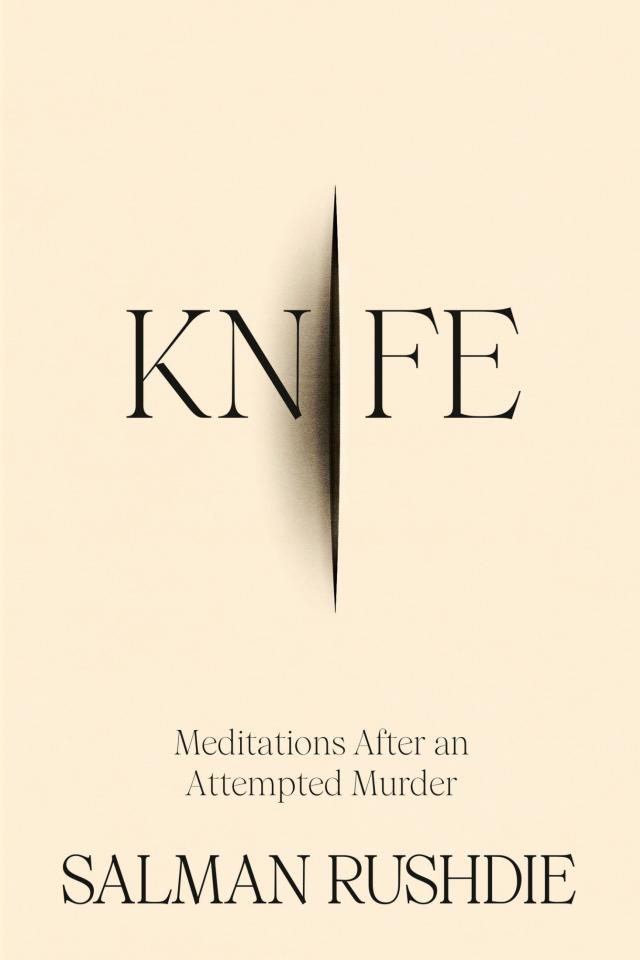


At first I thought I’d just been hit by someone who really packed a punch. (I learned later that he had been taking boxing lessons.) Now I know there was a knife in that fist. Blood began to pour out of my neck. I became aware, as I fell, of liquid splashing onto my shirt.
A number of things then happened very fast, and I can’t be certain of the sequence. There was the deep knife wound in my left hand, which severed all the tendons and most of the nerves. There were at least two more deep stab wounds in my neck—one slash right across it and more on the right side—and another farther up my face, also on the right. If I look at my chest now, I see a line of wounds down the center, two more slashes on the lower right side, and a cut on my upper right thigh. And there’s a wound on the left side of my mouth, and there was one along my hairline too.
And there was the knife in the eye. That was the cruelest blow, and it was a deep wound. The blade went in all the way to the optic nerve, which meant there would be no possibility of saving the vision. It was gone.
He was just stabbing wildly, stabbing and slashing, the knife flailing at me as if it had a life of its own, and I was falling backward, away from him, as he attacked; my left shoulder hit the ground hard as I fell.
* * *
Some members of the crowd—unwilling to abandon their picture of the world and look at what was actually happening—thought the attack might be some kind of performance-art stunt intended to highlight the issues of writer safety we had come to discuss.
Even Henry Reese, sitting in his chair, took a moment to adjust his own reality. Then he saw that the man was “all over” me, and he saw my blood.
What happened next was pure heroism.
Henry says that he acted “instinctively,” but I’m not so sure about that. Henry, like me, is in his seventies, and the A. was twenty-four, armed, and bent on murder. Yet Henry rushed across the stage at him and grabbed him. In my view a better way of putting it would be to say, He acted according to his best nature. In character, in other words. His courage is a consequence of who he is.
And then audience members, too, acted according to their best natures. I don’t know exactly how many people rushed forward to help, but from my position on the floor I was aware of a heap of bodies struggling to hold down my would-be murderer, even though he was young and strong and held a bloodied knife and was not easily subdued. If it hadn’t been for Henry and the audience, I wouldn’t be sitting here writing these words.
I didn’t see their faces and I don’t know their names, but they were the first people to save my life. And so that Chautauqua morning I experienced both the worst and best of human nature, almost simultaneously. This is who we are as a species: We contain within ourselves both the possibility of murdering an old stranger for almost no reason—the capacity in Shakespeare’s Iago which Coleridge called “motiveless Malignity”—and we also contain the antidote to that disease—courage, selflessness, the willingness to risk oneself to help that old stranger lying on the ground.
And eventually, I believe, an officer of the law showed up and took my would-be assassin into custody. I knew nothing about that. I had other fish to fry.
* * *
A gun can be used from far away. A bullet can fly a long way to form a lethal bridge between the killer and the killed.
A gunshot is action at a distance, but a knife attack is a kind of intimacy, a knife’s a close-up weapon, and the crimes it commits are intimate encounters. Here I am, you bastard, the knife whispers to its victim. I’ve been waiting for you. You see me? I’m right in front of your face, I’m plunging my assassin sharpness into your neck. Feel that? Here’s some more, and some more after that. I’m right here. I’m right in front of you.
According to news reports, the A. had twenty-seven seconds with me. In twenty-seven seconds—if you happen to be in a religious frame of mind—you can recite the Lord’s Prayer. Or, eschewing religion, you could read aloud one of Shakespeare’s sonnets, the one about the summer’s day, perhaps, or my own favorite, number 130, “My mistress’ eyes are nothing like the sun.” Fourteen lines of iambic pentameter, octave and sestet: that’s how long we had together in the only moment of intimacy we will ever share. An intimacy of strangers. That’s a phrase I’ve sometimes used to express the joyful thing that happens in the act of reading, that happy union of the interior lives of author and reader.
There was nothing happy about this union. Or perhaps there was for the A. He had reached his target, after all; his blade was entering his target’s body, over and over again, and he had every reason to think he had succeeded in his endeavor and was standing on the stage of history, having become the one who had fulfilled an antique threat.
Yes. I believe he might have been happy during our time of intimacy.
But then he was dragged off me and pinned down. His twenty-seven seconds of fame were over. He was nobody again.
* * *
I remember lying on the floor watching the pool of my blood spreading outward from my body. That’s a lot of blood, I thought. And then I thought: I’m dying. It didn’t feel dramatic, or particularly awful. It just felt probable. Yes, that was very likely what was happening. It felt matter-of-fact.
It’s rare for anyone to be able to describe a near-death experience. Let me say first what did not happen. There was nothing supernatural about it. No “tunnel of light.” No feeling of rising out of my body. In fact, I have rarely felt so strongly connected to my body. My body was dying and it was taking me with it. It was an intensely physical sensation. Later, when I was out of danger, I would ask myself, who or what did I think the “me” was, the self that was in the body but was not the body, the thing that the philosopher Gilbert Ryle once called “the ghost in the machine.” I have never believed in the immortality of the soul, and my experience at Chautauqua seemed to confirm that. The “me,” whatever or whoever it was, was certainly on the edge of death along with the body that contained it. I had sometimes said, half-humorously, that our sense of a noncorporeal “me” or “I” might mean that we possessed a mortal soul, an entity or consciousness that ended along with our physical existence. I now think that maybe that isn’t entirely a joke.
As I lay on the floor, I wasn’t thinking about any of that. What occupied my thoughts, and was hard to bear, was the idea that I would die far away from the people I loved, in the company of strangers. What I felt most strongly was a profound loneliness. I would never see Eliza again. I would never see my sons again, or my sister, or her daughters.
Somebody tell them, I was trying to say. I don’t know if anyone heard me, or understood. My voice sounded far away from me, croaky, halting, blurry, inexact.
I could see as through a glass darkly. I could hear, indistinctly. There was a lot of noise. I was aware of a group of people surrounding me, arching over me, all shouting at the same time. A rackety dome of human beings, enclosing my prone form. A cloche, in food-world terminology. As if I were the main course on a platter—served bloody, saignant—and they were keeping me warm—keeping, so to speak, the lid on me.
I need to talk about pain, because on this subject my own recollections differ considerably from the memories of those around me, a group which contained at least two doctors who had been in the audience. Members of this group said to journalists that I was wailing with pain, that I kept asking, What’s wrong with my hand? It hurts so much! In my own memory, strangely, there’s no record of pain. Maybe shock and bewilderment overpower the mind’s perception of agony. I don’t know. It’s as if a disconnect had appeared between my “outward,” in-the-world self, which was wailing, et cetera, and my “inward,” within-myself self, which was somehow detached from my senses and was, I now think, close to delirious.
Red Rum is murder backward.—Red Rum, a horse, won Grand National Steeplechase three times.—’73, ’74, ’77.—This is the kind of random nonsense that was cropping up between my ears. But I did hear some of what was being said above my head.
“Cut his clothes off so we can see where the wounds are,” somebody shouted.
Oh, I thought, my nice Ralph Lauren suit.
Then there were scissors—or maybe a knife, I really have no idea—and my clothes were being torn off me; there were things that people really needed to attend to urgently. There were also things I needed to say.
“My credit cards are in that pocket,” I mumbled to whoever might be paying attention. “My house keys are in the other pocket.”
I heard a man’s voice saying, What does it matter.
Then a second voice, Of course it matters, don’t you know who this is.
It was probable that I was dying, so what did it matter, indeed. I didn’t expect to need house keys or credit cards.
But now, looking back, hearing my broken voice insist on those things, the things of my normal everyday life, I think that a part of me—some battling part deep within—simply had no plan to die, and fully intended to use those keys and cards again, in the future, on whose existence that inner part of me was insisting with all the will it possessed.
Some part of me whispering, Live. Live.
* * *
For the record, I got everything back—the cards, the keys, my watch, some cash, all of it. Nothing was stolen. I didn’t get back the check that had been in my inside pocket. It was bloodstained, and so the police kept it as evidence. For the same reason, they also held on to my shoes. (People have asked me why I’m so surprised that none of my possessions went astray. Why would anyone want to steal anything in such a terrible moment? I guess I’m sometimes more disenchanted about human nature than these questioners. I’m happy to have my suspicions proved wrong.)
* * *
There was a thumb pressing against my neck. It felt like a big thumb. It was pressing against the biggest wound, preventing my lifeblood from pumping out. The owner of the thumb kept introducing himself to anyone who would listen. He was a retired fireman, he said. His name was Mark Perez. Or it might have been Matt Perez. He was the next of the many people who saved my life. But in that moment I didn’t think of him as a retired fireman. I thought of him as a thumb.
Somebody—probably a doctor—was saying, Raise his legs up. We need the blood to flow to his heart. Then there were arms lifting my legs. I was on the floor with my clothes cut off me and my legs waving in the air. I was, like King Lear, “not in my perfect mind,” but I had enough consciousness left to feel…humiliated.
In the next months there would be many more such bodily humiliations. In the presence of serious injuries, your body’s privacy ceases to exist, you lose autonomy over your physical self, over the vessel in which you sail. You allow this because you have no alternative. You surrender the captaincy of your ship so that it won’t sink. You allow people to do what they will with your body—to prod and drain and inject and stitch and inspect your nakedness—so that you can live.
* * *
I was hauled onto a stretcher. The stretcher was lifted onto a gurney. Then I was being moved rapidly out of the backstage area into the open air, toward the waiting helicopter. Throughout this process, the thumb called Matt or Mark Perez remained in position, pressing down on the wound in my neck. At the helicopter, however, the thumb and I had to part.
What’s your weight.
I was beginning to fade, but I understood that the question was aimed at me. Even in my awful condition, I was embarrassed to answer. In recent years my weight had ballooned out of control. I knew I needed to lose maybe fifty or sixty pounds, but that was a lot, and I hadn’t been doing a good job of it. And now I had to tell anyone within earshot the shameful number.
I managed to speak in single syllables. Two. Four. Zero.
The helicopter was a small yellow-and-black bumblebee with no doors and a strict maximum weight limit. There was no room on board for the thumb called Mark or Matt Perez. Another thumb, or something else, took its place. I was no longer perceiving anything at all clearly.
We were flying. I knew that. I felt the air beneath us, the movement, the urgent activity all around me. The landing was so soft that I didn’t realize we were on the ground again. An impression of people running. I’m guessing an anesthetic mask was put over my nose and mouth. And after that…nothing.
* * *
Four days later, the Chautauqua Institution issued a statement which read, in part: “There will be a substantially increased law enforcement presence throughout the Institution. In addition, there will be extensive security protocols activated, many of which will not be noticeable to visitors and residents. The Institution is working with our professional security consultants and multiple law enforcement agencies on additional security enhancements and risk management considerations.” (Ten months later, on June 15, 2023, the promised new security precautions were unveiled to the press.)
Stable door closed, one may think, after horse bolted.
However, as the attentive reader will have guessed, I survived. In Machado de Assis’s wonderful Brazilian novel The Posthumous Memoirs of Brás Cubas, the eponymous hero confides that he is telling his story from beyond the grave. He doesn’t explain how, and this is a trick I haven’t learned.
So, having survived—and there’s much more to say about that—I’m unable to escape my mind’s fondness for free association.
Knives. Knives in favorite movies, Polanski’s Knife in the Water, a fable about violence and infidelity. Knives in favorite books. Philip Pullman’s “subtle knife” that can cut openings between worlds and allow the bearer to traverse multiple realities. And of course the butcher’s knife with which the protagonist of Kafka’s The Trial is killed on the book’s last page. “ ‘Like a dog,’ he thought. It was as if he wanted the shame of it to outlive him.”
And two more personal knives.
First: In 1968, after graduating from Cambridge, I went to stay with my parents in Karachi, Pakistan, while trying to figure out what to do with my life. In those days the relatively new local TV station might run one English-language program a night, usually something like an episode of Bonanza. The gentleman who was running Karachi TV then, Aslam Azhar, was a friend of my aunt Baji’s (Begum Amina Majeed Malik, a distinguished educator and my mother’s older sister). She got me an appointment with him, and I made my pitch. If he was willing to run a little English-language programming, I said, why not occasionally make some original material, instead of all the Hawaii Five-O reruns? I proposed a production of Edward Albee’s one-act play The Zoo Story. “Fifty minutes long,” I said, “which is the same length as Columbo, so it would fit in the same slot. A cast of only two characters, and the set is nothing more expensive than a park bench. So it would be cheap, too.” The pitch worked. I directed and starred in the production. It was a lamentably bad piece of work, and mercifully has not been preserved.
At the climax of the play my character had to impale himself on a knife held by the other character. The knife they gave me was not a prop. The blade didn’t collapse into the handle. It was a real, no-nonsense knife with a sharp six-inch blade. “What am I supposed to do with this?” I asked the props manager.
“Act,” he replied.
Second: Twenty years ago, the novel that became Shalimar the Clown was born out of a single image that I couldn’t get out of my mind, the image of a dead man lying on the ground while a second man, his assassin, stood over him holding a bloodied knife. In the beginning that was all I had: the bloody act. It was only later that I understood who the two men were and what their story was. When I think about that now, I’m shaken. I don’t usually think of my books as prophecies. I’ve had some trouble with prophets in my life, and I’m not applying for the job. But it’s hard, thinking back to the genesis of that novel, not to see the image as—at the very least—a foreshadowing. The imagination sometimes works in ways that even the imagining mind can fail fully to understand.
And the opening line of The Satanic Verses also returned to haunt me. “To be born again,” sang Gibreel Farishta tumbling from the heavens, “first you have to die.”
* * *
When The Satanic Verses was published, in 1988, I was forty-one years old. It was my fifth published book. On August 12, 2022, I was seventy-five years old and looking forward to the publication of my twenty-first book, Victory City. More than three-quarters of my life as a writer has happened since—as I used to say—the excrement hit the ventilation system. People who are curious about my work have much more of it to choose from than they did back then, and I tell such people that maybe they should start with a different book rather than “that” one (as people often referred to The Satanic Verses).
For many years I felt obliged to defend the text of “that” novel and also the character of its author. It was fashionable in some literary quarters to describe the book as unreadable, a book in which it is impossible to get past page 15. In such quarters people spoke of a “Page 15 Club.” A play about the so-called Rushdie Affair called Iranian Nights was produced at the Royal Court Theatre in London, and it contained the recurring refrain “It was a book that was impossible to read.” I felt the need to defend the text. In addition, many prominent and non-Muslim people had joined forces with the Islamist attack to say what a bad person I was, John Berger, Germaine Greer, President Jimmy Carter, Roald Dahl, and various British Tory grandees among them. Commentators such as the journalist Richard Littlejohn and the historian Hugh Trevor-Roper said they wouldn’t mind at all if I was attacked. (I’ve outlived Trevor-Roper, but I assume Littlejohn is feeling pretty satisfied now, wherever he is.)