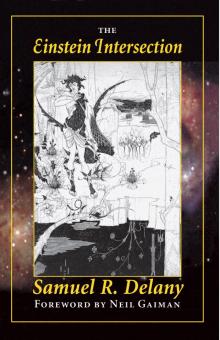
Flight from neveryon, p.1
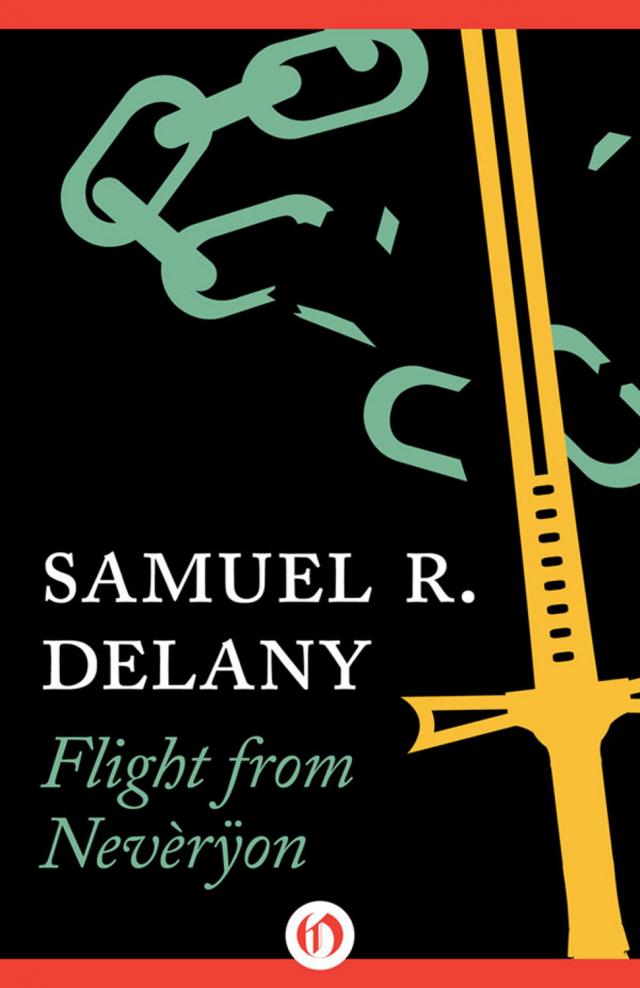
Flight from Nevèrÿon,
p.1


PRAISE FOR THE WRITING OF SAMUEL R. DELANY
“I consider Delany not only one of the most important SF writers of the present generation, but a fascinating writer in general who has invented a new style.” —Umberto Eco
“Samuel R. Delany is the most interesting author of science fiction writing in English today.” —The New York Times Book Review
Dhalgren
“Dhalgren’s the secret masterpiece, the city-book-labyrinth that has swallowed astonished readers alive for almost thirty years. Its beauty and force still seem to be growing.” —Jonathan Lethem
“A brilliant tour de force.” —The News & Observer (Raleigh)
“A Joyceian tour de force of a novel, Dhalgren … stake[s] a better claim than anything else published in this country in the last quarter-century (excepting only Gass’s Omensetter’s Luck and Nabokov’s Pale Fire) to a permanent place as one of the enduring monuments of our national literature.” —Libertarian Review
The Nevèrÿon Series
“Cultural criticism at its most imaginative and entertaining best.” —Quarterly Black Review of Books on Neveryóna
“The tales of Nevèrÿon are postmodern sword-and-sorcery … Delany subverts the formulaic elements of sword-and-sorcery and around their empty husks constructs self-conscious metafictions about social and sexual behavior, the play of language and power, and—above all—the possibilities and limitations of narrative. Immensely sophisticated as literature … eminently readable and gorgeously entertaining.” —The Washington Post Book World
“This is fantasy that challenges the intellect … semiotic sword and sorcery, a very high level of literary gamesmanship. It’s as if Umberto Eco had written about Conan the Barbarian.” —USA Today
“The Nevèrÿon series is a major and unclassifiable achievement in contemporary American literature.” —Fredric R. Jameson
“Instead of dishing out the usual, tired mix of improbable magic and bloody mayhem, Delany weaves an intricate meditation on the nature of freedom and slavery, on the beguiling differences between love and lust … the prose has been so polished by wit and intellect that it fairly gleams.” —San Francisco Chronicle on Return to Nevèrÿon
“One of the most sustained meditations we have on the complex intersections of sexuality, race, and subjectivity in contemporary cultures.” —Constance Penley
Stars in My Pocket Like Grains of Sand
“Delany’s first true masterpiece.” —The Washington Post
“What makes Stars in My Pocket Like Grains of Sand especially challenging—and satisfying—is that the complex society in which the characters move is one … which contains more than 6,000 inhabited worlds and a marvelously rich blend of cultures. The inhabitants of these worlds—both human and alien—relate to one another in ways that, however bizarre they may seem at first, are eventually seen to turn on such recognizable emotional fulcrums as love, loss and longing.” —The New York Times Book Review
“Delany’s forte has always been the creation of complex, bizarre, yet highly believable future societies; this book may top anything he’s done in that line.” —Newsday
Nova
“As of this book, [Samuel R. Delany] is the best science-fiction writer in the world.” —Galaxy Science Fiction
“A fast-action far-flung interstellar adventure; [an] archetypal mystical/mythical allegory … [a] modern myth told in the SF idiom … and lots more.” —The Magazine of Fantasy & Science Fiction
“[Nova] reads like Moby-Dick at a strobe-light show!” —Time
The Motion of Light in Water
“A very moving, intensely fascinating literary biography from an extraordinary writer. Thoroughly admirable candor and luminous stylistic precision; the artist as a young man and a memorable picture of an age.” —William Gibson
“Absolutely central to any consideration of black manhood … Delany’s vision of the necessity for total social and political transformation is revolutionary.” —Hazel Carby
“The prose of The Motion of Light in Water often has the shimmering beauty of the title itself … This book is invaluable gay history.” —Inches
Flight from Nevèrÿon
Samuel R. Delany
For
Frank Romeo,
and Robert Bravard, Camilla Decarnin,
Mike Elkins, Gregory Frux, Robert Morales, & Michael Peplow, and,
of course,
Iva,
who print up file ‘i’
Publisher’s note: Ten years ago a young black American mathematician and cryptographer, K. Leslie Steiner, published a comparative translation from several ancient languages of a brief narrative text (c. 900 words) known both as the Culhar’ Fragment and the Missolonghi Codex. That work has prompted several archeological expeditions to find the historical location from which that ancient text most likely originated, most recently one headed by Wellman, Kargowsky, and Kermit. It sets out just as this volume goes to press. In the same ten years Steiner’s ingenious translation methods (highly speculative and mathematically based) have inspired several volumes of stories and novels by Samuel R. Delany about Nevèrÿon, of which this volume—now that the site grows less and less imaginary, more and more real—is the third.
Contents
The Tale of Fog and Granite
1
2
3
4
5
6
7
8
9
10
11
The Mummer’s Tale
1
2
3
4
5
The Tale of Plagues and Carnivals, or: Some Informal Remarks Towards the Modular Calculus, Part Five
Appendix A: Postscript
Appendix B: Buffon’s Needle
Preview: Return to Nevèrÿon
A Biography of Samuel R. Delany
There is no such thing as an absolutely proper meaning of a word, which is not made possible by the very impropriety of metaphorical displacement it seeks to exclude. The impropriety of displaceability of meaning and of infinite openness of syntactic reference beyond that circumscribed by proper meaning is a material force. The imposition of a conclusive, self-identical meaning that transcends the seriality of displacement is therefore metaphysical or idealist. Its political equivalent is the absolute state (be it dictatorial or liberal) that imposes order on the displaceability of power through sedition. The political equivalent of displacement—that force deconstruction foregrounds against absolutist philosophies of identity—is continuous and plural revolutions, the openness of material forces which exceeds the imposition of power.
—MICHAEL RYAN
Marxism and Deconstruction
The Tale of Fog and Granite
It can hardly be an accident that the debate proliferates around a crime story—a robbery and its undoing. Somewhere in each of these texts the economy of justice cannot be avoided. For in spite of the absence of mastery, there is no lack of effects of power.
—BARBARA JOHNSON,
The Critical Difference
1
LATER, THE BIG MAN slept—peacefully for a dozen breaths. Then, under the moon, a drop, three drops, twenty drops broke on his face. Inside the nostrils loud air snagged. Lashes shook. His head rocked on stone. Dragging a heel back, he raised a hand, first to rub at his cheek, then to drop at his chest. ‘Get away! One-eyed beast! Get away, you little…’ His hand rose again—to beat at something. But the fingers caught in chain.
Curled with his back against the big man’s side, the little man—either because of the big one’s rocking or the neck chain’s rattle or the barkings out of sleep like shouts from a full-flooded cistern—rolled over and was on his knees.
Green eyes beat open.
The little man grabbed the great wrist, while heavy fingers, untangling from brass, caught the small shoulders.
‘Calm yourself, master!’ the little one whispered. ‘You are my breath, my light, my—’
‘I was dreaming, Noyeed—’
‘—my love, my lord, and my life!’
‘No, Noyeed! I was only dreaming—’
‘Of what, master? What dream?’
‘I was dreaming of…’
The little man’s skull blocked the moon, leaving only the lunar halo by which farmers predict rain in three days—though one out of five such predictions brings only overcast.
‘I was dreaming of you, Noyeed!’
‘Me, master?’
‘But I was where you are, now, leaning above me. And you—a much younger you, a boy, Noyeed, with your blind eye and your dirty hair—you lay on the ground where I am, like this, terrified. And, with the others, I…’
‘Master?’
‘Noyeed—’ Holding the man, no taller than a boy, up against the night, Gorgik’s arms relaxed; the small face fell—‘either you know something I can never understand and you will not tell me. Or I know something that, for all my struggles toward freedom, I’m still terrified to say.’
‘Master…’ Noyeed turned his forehead against Gorgik’s chest.
Gorgik’s fingers slid to the little man’s neck, touching iron. ‘Just a moment.’ He slipped his forefingers under the collar, centimeters too big for the one-eyed man against him. ‘You needn’t wear this any longer.’ He pulled open the hinge. ‘It’s time to give it back to me.’
Noyeed grappled the heavy wrists. ‘No!’ Through thin skin and thick, bone
felt bone.
‘What is it?’ Gorgik moved his chin in Noyeed’s hair. It smelled of dogs and wet leaves.
‘Don’t take it from me!’
‘Why?’
‘You told me you or I must wear it…?’
‘Yes. Here, yes.’ The night was cool, dry. ‘But by day only I need to, as a sign of the oppression throughout Nevèrÿon—’
‘Don’t!’
Gorgik looked down, moving Noyeed to the side.
The single eye blinked.
A breeze crossed the moonlit roof, while a crisp leaf beat at the balustrade as if, after an immense delay, it would topple the stone onto someone below, who even now might be gazing up. ‘Don’t what?’
The little man thought: He looks at me as if he were hearing all the others who have begged him for his collar.
The big man thought: I could leap up, seize that leaf from the wind, and wrest it from its endless, minuscule damages.
Noyeed said: ‘Don’t encumber yourself with such ornaments, master.’ (The leaf turned, blew back, then up and over the wall.) ‘Let me wear your collar! Let me be your lieutenant and the bearer of your standard! And this…?’ Noyeed reached across Gorgik’s chest to rattle the chain on which hung a verdigrised astrolabe. ‘You go to meet with Lord Krodar tomorrow at the High Court. Why wear something like this?’ He reached down to touch the knife at Gorgik’s side. ‘Or this. Go naked, master. Your bare body will serve much better than armor or ornament to speak of who you are.’
‘Why do you say—?’
‘Look, master!’ The little man rolled to his belly. ‘Look!’
Turning to his side, Gorgik pushed up on an elbow.
Part of the crenellation near their heads had fallen. Between broken stones, by craning, they could see down into the yard. Near an outbuilding armed and unarmed figures stood at a small, flapping fire.
‘Here we are on the roof of your headquarters. There are your supporters. After today’s victory you are only a shadow away from being the most powerful man in all Nevèrÿon.’
‘No, Noyeed.’ Gorgik chuckled. ‘No. My power is nothing in Kolhari, in Nevèrÿon. It was a precarious victory, and I would be the most unfortunate of rebels if I let such delusion take hold.’
‘But you may become the most powerful man in Nevèrÿon. And if you would, to further your cause, someone—perhaps me—must think it possible. Go naked, master. Let your fearlessness be your protection. In the meantime, let me carry your—no, let me be your sign!’
‘Noyeed, I don’t understand.’
‘Look, master.’ The little man elbowed forward, staring through the break. ‘Just look!’ He pointed, not at the milling men and women below but at the horizon’s hills black under moon-dusted dark. ‘Already you can see fog gathering in the mountain peaks outside the city. By dawn it will roll down over all Kolhari, where it will lie till sunlight burns it off. Naked, you will ascend into that fog, meet it, become one with it. Abandon the signs by which men and women know you, and you will become invisible—or at least as insubstantial to them as that mist. Your power—now small, but growing—will, at whatever degree, be marked at no limit. Without clear site, it will seem everywhere at once. That’s what such invisibility can gain you. That’s what you can win if you shrug off all signs. You will be able to move into, out of, and through the cities of empire like fog, without hindrance, while I—’
‘What nonsense, Noyeed!’ Gorgik laughed. Has your harried childhood and hunted youth wounded you to where you can only babble—’
‘Not babble, master! Listen! Unencumbered, you can be as the all-pervasive fog. And if you need now or again to be at a specific place and time, use me! Wearing your collar as the mark of your anger and authority, I can stand on the city’s stones wherever you would place me, leaving you free for greater movement, while I serve you, visible to all, your incorporated will. Oh, among slaves the collar will make me invisible to their masters as it has already made you. Among nobles, it will make me at least as much a reminder of injustice as you were. And among the good men and women who do their daily work it will transform me into the oddity and outrage intruding on them the reality of evils they would rather forget. Though, master—’ and Noyeed laughed—‘with my missing eye and skulking ways have I ever been anything else? You wear the collar because you were once a slave. Well, so was I. You require the collar to motivate the engines of desire. Well, as you have seen, for me it’s much the same. We are much alike, master. Why not let me stand in your place? Why not move me as you would move a piece in the game of power and time, sending me here and there, your servant and marked spy? Let me be your manifestation in the granite streets of the cities, leaving you free for all unencumbered missions. I will be your mark. You will be my meaning. I will be your sign. You will be my signification. You will be the freer, relieved of the mark I carry, to move more fully, further, faster.’
‘Noyeed, I’m afraid to—because I know what I know, and you are in ignorance of it. Or because you know what you know—and I am the deceived.’
‘Oh, master, I will always be your finger and your foot, your belt and your blade, your word and your wisdom, made real in the open avenue and the closed courtyard. Only I beg you, let me do it wearing your sign—’
‘I say no, Noyeed! I say nonsense!’
‘As you have seen how I love your body, master, your hand, your mouth, your ear, your eye, your knee, your foot, what I speak is a bandit’s, a wanderer’s, a one-eyed murderer’s long-thought wisdom—’
‘You babble! And yet…as I visit the court tomorrow, perhaps there’s something in what you say about the way I should go. Perhaps for just a little I might…’
And still later, when the big man and the one-eyed man came from the dark mansion into the yard among the men and women at the fire, Noyeed still wore the collar, while Gorgik no longer wore either the chain with the astrolabe, nor any sword, nor clout, nor dagger—as if all had been discarded or given away during the descent through the empty building.
2
SOME YEARS LATER, AT the ear of his ox, ahead of his half-empty provisions cart, a young smuggler walked through the outer streets of Kolhari.
A gibbous moon still shone.
Call him stocky rather than thin. At some angles he looked even loutish: there’d been little enough in his life to refine him since he’d first run away from the farm for the city. At others, however, he was passably handsome, if you ignored the healed-over pockmarks from an acne that, though now long finished with, had been more severe than most and whose traces still roughened his forehead and marred his cheeks above the thinner hairs edging his beard. Peasant or prince could have had that face as easily, but the hard hands, the cracked feet, and the cloth bound low on a belly already showing its beer were trustable signs, in those days, he was not the latter.
The cart wheels rumbled onto the road generally considered the division between Sallese, a neighborhood of wealthy merchants and successful importers, lucky businessmen and skillful entrepreneurs, and Neveryóna, a neighborhood of titled estates and hereditary nobles with settled connections—though lately the boundary had become blurred. Today there were any number of business families who’d dwelt in the same mansion for three generations, some of whom had even acquired a title or two by deft marriage of this youngest daughter to that eldest son; and more than one noble family had been forced by the times to involve itself in entrepreneurial speculation.
The young smuggler squinted.
Moonlight leached all green from the leaves, all brown from the trunks.
Was it two hours till dawn?
Something moved by an estate wall’s turning, way along the crossroad. Something pale, something slow, something huge as a dragon coiled the suburban avenue.
Overspilling the hills above the city, fog had crawled down through wide streets and narrow alleys, till, across the whole town, it kissed the sea with an autumn kiss.
The cart rolled; the smuggler looked left.
Certainly the last time he’d come to Neveryóna by moonlight, he’d been able to see three times as many mansion roofs, even to the High Court of Eagles. Ordinarily such a moon would light the black peaks, which till an hour ago had held back the mist. But now both mansions and mountains were over-pearled, moondusted, veiled.