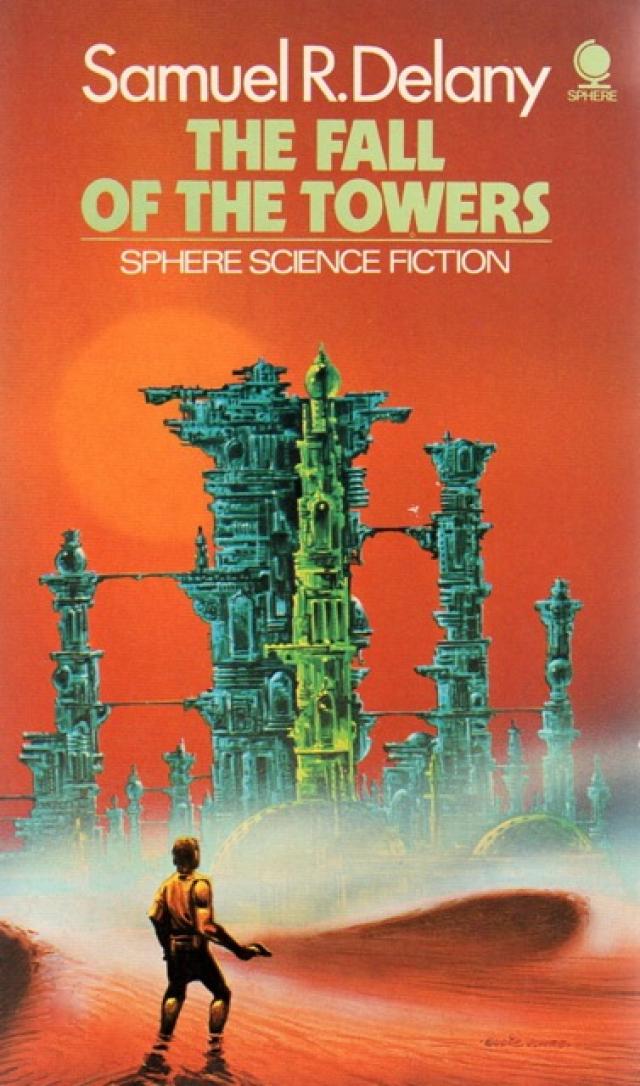
The fall of the towers, p.39
The Fall of The Towers,
p.39


'Bet you can't prove it,' someone called.
'You know what we do to — malis.'
'Come on, let's show them what we do to malis!'
Seconds later, he and Alter, their arms held tight behind them, were marched through the tents. One man had gratuitously socked Jon's jaw, and it throbbed. But he was thinking, meticulously and quickly. The man guiding him once jerked him as they passed several mounds of earth.
'That's what you townies do to us malis,' Raye hissed, then pushed them violently past the graves.
'What makes you think we're from town,' Jon got out.
'I don't care where you're from.'
Jon heard Alter draw a quick breath at some injury he could not see, since she was behind him.
A fallen carpet of yellow canvas spread over the grass in the ivory stain of moonlight. They were approaching the line of aquarium wagons, locked end to end. There was talk behind him that Jon tried to correlate:
'Which one do you think'll try to save the other? Which one do you think'll run?'
'I say flip: heads we tie him up and let the girl try to save him, tails we tie the girl and see what he does.'
'Don't leave it to chance. I want to see a good show. Tie up the girl and throw him in with the knife."
'Hell, he'll run. How much you want to bet he's a coward and runs.'
'Tie him up, and the girl is sure to bolt.'
'We'll still have some fun. She won't get very far.'
Now Lyn's more forceful voice settled it. 'Put your money away. We tie her and give him the knife. He won't let them at her without putting on some sort of show."
Alter was pushed on to the canvas. Someone brought a rope and her arms were bound. Once they exchanged glances, neither imploring nor despairing, but rather looks of desperate concentration as each tried to find the flaw in the net of action and movement carrying them to unnamed doom. Now Jon was pushed forward on the collapsed tent.
They were shoved towards the row of aquariums. Moonlight through the misted water caught sailing shadows that darkened window after window. The water was green with algae. The tanks had not been cleaned for a long time. The great octopus that had been exhibited there had probably been the first to die from the impurities. The dolphins must have gone next, poisoned by the unfiltered water. The mama ray, a scavenger by nature, might well have survived the longest in the foul drink, but at last it, too, must have succumbed and floated belly upward on the scummy surface. The only large creatures left were the sharks. Great and gaunt, they would be the last to die of filth. Now they swam lazily back and forth nosing the glass and the corners of the tanks.
A platform with a wooden ladder had been built by one wagon's edge. Jon and Alter were man-handled to its foot, and then up on the platform at the tank's rim. What happened next—it happened inside Jon's mind—was a marshalling of dispersed bits of information, of learning and fragments of learning, of conjecture, action, and random chance. He was still afraid, but suddenly there was a bright line leading across the glistening sands of panic.
The tanks had once been separated by a system of locks so that individual tanks could be emptied and cleaned. But as the beasts died the six-foot walls between the wagons had been removed, and more water had been let in till the tank was full to the brim once more. Opened and connected, they formed a single trough twelve feet wide and a hundred and fifty feet long. Green rippled under the moon with the movement of shapes beneath. Each shark—Tritin had collected them for size—was a good four hundred, four hundred and fifty pounds. Jon held each fact in his mind as, below him, water lapped the end of the tank.
The sides were raked to prevent anything in the tank from getting out. Raye shoved Alter, still bound, into the water. Jon took a breath and dived as she went off the edge. Water hit him, of indifferent temperature. He curled up, sinking from momentum, and tore off one sandal. The pressure on his ears was lessening, which meant he was rising towards the surface again. He tore off the other sandal, broke surface, and threw his head back, to shake the water from his face. He took a last look at what was happening on the surface: to balance and separate the relevant from the irrelevant. Alter near the end of the tank was bobbing rhythmically. With a controlled scissor kick, a good swimmer can tread water a fair amount of time, even with hands tied: Alter was a good swimmer (relevant).
'Hey there!' one of the malis called from the platform—it was a girl (irrelevant)—she jammed something into the air, a knife (relevant), then flung it into the water. He dived for it, following its glittering spiral to the depths of the tank as a shadow passed over him, thinking, Should I cut the ropes that bind Altec's hands so--The thought became an irrelevancy as he grabbed the blade from the gravel flooring: the edge of his ' hand nicked! The knife was so sharp that with himself moving and Alter moving, there would be no way to avoid a few cuts and scratches. Blood in the water meant death.
Was that how the others thrown bound and free here had perished (irrelevant)? He started swimming underwater, and broke surface forty feet down the tank, took another breath and drove forward again. How long would it take for the beasts to become curious. Seconds, minutes? The farther apart he and Alter were, the greater the shark's indecision. He put the blade between his teeth to free his hands for swimming. Moving beneath the surface attracted less attention than splashing over the top. He shot forward, through water like rutilant glass.
A shark nosed so close his glaucous flesh gleamed. To the surface for three breaths; he dived again, muscles electric and alert, and silently thanked Alter for her patient training (pushing down the thought of banked teeth raking those muscles; and Alter was bound).
Another dive brought him to the far end of the aquarium (which of the beasts had turned and turned in the central flood, deciding between the two figures, and chosen her, legs scissoring in green fog, white hair awash about her face). He grabbed the knife from his teeth and would have used his own flesh, his own blood to bait his plan; but something moved at the edge of his blurred, submarine vision, and he whirled and plunged the blade into it, catching it against the glass. It was a fair-sized fish, over a foot long, but grown sluggish in the diseased water. Now it flipped and squirmed in veils of blood. Jon seized the fish and ripped the knife upward towards the blood-rich gills and pressed the bleeding carcase against the glass. He reversed himself in the water (remembering her words, 'Put your head back. Now bring your knees up and roll backwards,' realizing this was the same motion) and swiped the blood meat down the side of the glass, leaving a dissolving track of red.
One instant he felt himself in blind subjection to all the factors he could not control, all that was desperate and jagged in both inner and outer environment; as he perceived it, it turned over in his mind, like a spinning coin dropping with him through the water. The other side was a sense of total control that came with the extent of his perception. He shot to the bottom of the tank, leaving a column of blood. The coin spun.
Sound travels faster in water than in air. He heard them coming, flung the fish away, then jammed himself from the glass wall, pushing with his feet. His palms scraped over the gravel and the water darkened with thunderous shapes.
Crash!
He rolled over, away from the pain in his scarred hands.
Crash! Crash!
Two more struck the wall separately. Then-
—Cruuuummm!-
—two struck at once, and tide jerked him upwards. His head jammed through the surface at the same time he heard the three-inch glass plates crack. He was flung into foaming air. It had worked!
With the locks removed and the extra water the pressure in the aquariums was almost five times what it was intended to be, and well over what theoretically it could be. Some chance structuring had kept the walls together. But a few blows from a couple of four-hundred-and-fifty-pound, hungry sharks barol-ling down a hundred-and-fifty-foot run had done it.
He struck the ground on wet grass. Remembering his falls, he flipped over and sprung open to a standing position. He staggered in the streaming weeds, panting for the agonizing breath he had held. The knife was still in his hand. Droplets became pearls as they ran down the blade in the gibbous moon.
Three of the grounded sharks twisted and flopped on the grass. He turned to the shattered wall of the aquarium. Raye, for whatever random reason, had run to this end of the tanks to watch. When the wall exploded he had been nearly severed by a shard of glass that gleamed in his ruined belly.
Jon ran to the wagon, vaulted up the waterfall, and splashed down the gravel flooring of the tanks. Alter lay face down twenty feet from the end, washed there before the level became too low to carry her farther. It couldn't have been more than diirty seconds since the wall first broke! But he was aware howmaccelerated his time sense was. Even so, she couldn't have-- He was already beside her. He pulled her from the water.
Alter opened her eyes and her mouth at the same time and sucked in air. Then her eyes closed again, but she kept on gasping. Jon sawed the ropes from her arms. He scratched her a couple of times, but the ropes fell away, and she hunched her shoulders and spread her elbows (and he remembered the exercise she had taught him to get the blood back into your arms) and staggered to her feet.
He pulled her to the jagged rim, jumped out, and helped her down.
Malis were running along the side of the wagons: recovered from their shock at the explosion (an aquarium is not supposed to explode; but it did—the paralysis had lasted nearly three-quarters of a minute), they were coming to recover their prey.
Jon and Alter ran through the wet meadow, strewn with glass, avoiding the long, frantic shapes flopping about them.
Alter was exhausted. Jon felt it as her wrist shivered in his hand. He himself was moving on energy left in the glowing ends of burned-out nerves. Their running became a fast walk. When they were halfway to the forest someone screamed behind them; panting, they turned to look.
One of the malis had passed too close to a shark. The animal had flipped and caught her by the leg. The others were trying to help. Jon filled his raw lungs with one more breath, and stumbled forward. He kept stumbling until leaves were striking him in the face, and the screaming had stopped.
They reached a clearing five minutes into the wood where the rocks sloped up for twenty feet. Halfway across the granite rise, Jon turned.
A quarter of the sky had gone grey with dawn. Each tree about him cast a double shadow with the glow of the old moon and the new rouge of the sun. Alter sank to the rock and ran her hands back over her forehead, smoothing her wet white hair into a helmet. Suddenly she hunched over, as if to hold what little strength was left in the cave of her body.
At the same time Jon felt the emergency catches that had tautened his body into a survival machine start to release, one after the other: his shoulders, the back of his hips, his calves; his bruised palms began to sting. He lowered himself beside her, each muscle like a metal weight dropping into the acid of fatigue. She raised her head and said, softly and wonderingly, 'We're safe!'
Jon pressed his head against her shoulder, as she had done at a similar moment in the City, relaxing in the reality of wet skin against wet skin. She put her hand on the back of his neck, and after a moment he raised his head and looked at her.
The breeze hesitated in the branches, quivering among the leaves before it rolled on.
'I can see your eyes,' Jon whispered. 'There's enough light now so that I can see your eyes."
CHAPTER VIII
Each person moves towards whatever maturity he is seeking in a definite direction. He approaches each observed incident from that direction, sees it from that one side; but it may not be the same side someone else sees. In Toron, when Alter cried to the Queen, 'Won't you do one decent thing in your life!' a young mali who had come upon them minutes before, at that point, turned and splashed off through the night. It was Kino.
We cannot trace here the experiences that brought the gutter youth to the point where this sentence, out of the whole exchange, struck him, tripped something in his mind that brought him up short, stayed with him when the rest of the incident had joined the many inexplicable things he had seen on the streets. He did not recognize Jon. He made no connection between the maundering sp6ech and the hospital clothing. But for his own reasons, this hysterical imperative was what he contemplated as he fled from the blocked-off section, slipped past the guards, and came to the waterfront.
Pondering, he took a piece of chalk from his pocket and wrote over a peeling war poster: You Are Trapped in That-
'Kino?'
'Jeof?'
Kino turned.
"You the one writing that stuff all over the walls?'
'Some of it,' Kino said, frowning into the shadows.
The neo-neanderthal emerged into the livid moonglow. On the wharf cobbles a breeze tugged at a piece of paper stuck there by the damp.
Kino wondered if he should stay or go. 'What are you doin' out here, Jeof?' he asked to avoid the decision.
'My territory,' Jeof grunted. 'You gonna say I can't walk around in it?'
'No, Jeof. I didn't mean nothin' like that.'
'Fall out, Kino,' Jeof said. 'I'm in deep water.'
'I'm going,' Kino said. He put the chalk in his pocket. Then he stopped. 'Jeof, have you ever done one decent thing in your statement, question, and speculation. ... well, done something you could be proud of?'
'I'm proud,' Jeof said, his voice lowering. Both hands rose, open palmed, then snapped to fists in the foggy light. 'I'm proud.'
Kino drew back, but went on: 'Proud of what, Jeof?'
'You better fall out.'
'In a minute, in a minute. No, really Jeof, what the hell are you proud of?' Features readjusted themselves on the neanderthal face: brows flattened, cheeks sunk, the bar of muscle at the back of his jaw contracted. 'Nobody else is proud of you. After that business with Nonik's wife, you think fish around here think you're big? Naw. You're a very small ape. And maybe you're so small, they think you shouldn't even be around. Maybe there's a group of them right now sitting down somewhere trying to figure out how they can get you and tear you in little pieces, like you did her. And maybe they're gonna start looking for you at about ten o'clock tonight. And maybe they'll be coming over from the Inn, where they're planning it now, to hunt you out of your little hole in the ground so they can stomp on you, ape.' The last paragraph was total fabrication. Kino, having started talking, had seen the chance to revenge his friend.
'Why are you telling me, then?'
Kino shrugged. 'I just like to warn people. I do it all the time.' He felt his ability to keep up the bluff begin to fail. 'See you around—I hope,' he added, and turned away. The same fear that had caused him to fabricate the vendetta had crushed the delicate concern for Alter's sentence. Now he hurried down the street thinking, Well, I scared him some! Bet he walks around a little more carefully now!
We cannot trace the experiences that bring a man to observe a given phenomenon from a given side. Relative to our limited perception, much of his reaction is random.
Jeof stood alone on the cobbles. The paper, stuck to the ground, ripped in the breeze and flapped up the alley. Once more he clenched his fists and let Kino's words pick their way through his mind. 'I'm proud,' he mumbled, and then, 'At least I'm proud.' He looked up, and suddenly his frown twisted all out of shape into an expression with no name. 'They'll never find me,' he whispered, and lurched forward. What routes rage followed in his brain, what directions and misdirections it took, what caused him to judge and misjudge, also we cannot trace here.
Two blocks later he stopped, panting, in front of a small door at the bottom of three stones steps. He dropped down all three and landed with his fist pounding.
There were several secret shops in the Devil's Pot where thieves could pick up illegal powerblades heisted from a guard transport; stolen government explosives; much of the intricate equipment, made for an unfought war, had gone astray as it moved from storehouse to storehouse. These shops disappeared often and did much of their business at night. When the door was opened a crack Jeof pushed inside.
Five minutes later he took all three steps in one motion and started back down the street. In one stubby hand he held a brass sphere with a stud on one end. It was a small, powerful grenade. He had once lobbed its twin through the window of a crematorium whose manager hadn't wanted to pay protection. The burst of flame and glass, the brightness and glory, hung in his mind divorced from the destruction, a protected instant of light.
At the cellar mouth he halted. They would look first for him there. The alleys where he often slept on lean evenings were not safe. Other malis were constantly poking around in them, and he would be found out. He turned up the waterfront street where the mercury-lights hung in shields of fog.
A gate to one of the piers had been left open by accident. He crossed the street and went through There was only one boat at the dock. Jeof hesitated. At the gangplank the chain had also been left off. The small inter-island launch was dingy and un-painted. Its captain had been careless, gone off without closing up anything. Probably nothing worth stealing on it anyway, thought Jeof as he climbed on to the deck.
The boat rose and settled in the sludge that licked the city. Jeof rubbed the grenade against his hip. Another night he might have broken the windows, or found a bucket of paint and messed up the deck; tonight he was just going to hide.
As he reached the hatch a whining sound overhead made him look up. Then, beyond the buildings of the wharf, he saw a distant explosion. Jeof sucked disgustedly at his lower lip and started down into the musty hole. Another freak bombing. Keep on and blow up the whole damn city, he thought, between explosions. Maybe it would distract the pack hunting him—give them something to go loot. He sat in the damp corner and put the grenade in his lap. Let them come after him here. He wondered where the explosion was. The boat's movement made the darkness about him shift and sag like a half-jelled solid.