Without you, p.30
Without You,
p.30


ACKNOWLEDGMENTS
A huge thank you to the team at Little, Brown and Piatkus. I count myself very lucky to have Emma Beswetherick as my editor. Thank you so much, Emma, for your continued belief in me. It means more than I can say. Also thanks to Lucy Icke who held my hand through the process of publishing a first novel. And to Eve White, my agent, who has given me friendship, support and advice; and of course to Jack Ram for all his help.
I am grateful to Andrew Warren, late of the Royal Fusiliers, for giving me an insight into the army in Northern Ireland. The Fusiliers completed 37 tours of duty in N.I.–more than any other infantry regiment.
Thank you to Tony Booth for his sharing his in-depth knowledge of popular music with me, in particular the gothic movement.
Thank you Alex Sarginson for putting me right about sailing terminology and boats.
Thanks Kinnetia Isidore for advice about using French.
I am indebted to my first readers who, in some cases, read several drafts–thank you all so much for giving me your time and invaluable feedback: Alex Marengo, Sara Sarre, Karen Jones and Ana Sarginson; and to the post-MA writing group that workshopped sections of the book with me: Viv Graveson, Mary Chamberlain, Cecilia Ekback, Laura McClelland and Lauren Trimble.
Love and thanks to my family and friends, in particular Alex, Hannah and Olivia, Sam and Gabriel for being there.
These books were helpful in my research:
A Long War by Ken Wharton, Helion & Company Ltd (2010)
Love Child by Sue Elliott, Vermillion (2005)
The Baby Laundry for Unmarried Mothers by Angela Patrick with Lynne Barrett-Lee, Simon & Schuster (2012)
ABOUT THE AUTHOR
Alex Sarginson
Saskia Sarginson grew up in Suffolk, in the middle of a forest. She has four children and lives in London. This is her second novel.
By Saskia Sarginson
The Twins
Without You
Praise for The Twins:
“A perfect R&J summer read, a psychological thriller of sisters and a dreadful childhood incident, the details of which are drip fed to us throughout the book, building layers of complexity to the story at each revelation… Highly compulsive.”
—The Bookseller
“Beautifully done.”
—Publisher’s Weekly
“[O]utstandingly good. Part-thriller, part-love story, I guarantee you will not be able to put it down.”
—The Sun (UK)
“Everybody has an opinion about twins and the bond between them. Well this novel has two sets of twins and will make you curious to know more. The competition, the struggle for power but also the loyalty between them are extraordinary… This novel reads like a modern fairy tale, I loved it.”
—Pages & Pages, Sydney
“Gripping.”
—Marie Claire
“Thumpingly good.”
—Good Housekeeping
“This book got its hooks into us and wouldn’t let go. Hypnotic, with real emotional punch.”
—Star, 4 star review (UK)
“This debut novel by Saskia Sarginson reveals a stunning writer with deep insight into people, their thoughts and behaviour. It is a beautifully crafted and compelling story that won’t disappoint.”
—NZ Women’s Weekly
Author Q & A
The Twins was such a successful debut; was it difficult to follow that success with a second novel?
Because I wrote Without You in the year before The Twins came out, I managed to avoid most of the stress of ex pectation that I might have encountered if I’d waited. I was so incredibly happy to have the opportunity to write a second book for my publisher that I just got on with it, and didn’t think too much about how it would be compared to the first book.
How did you come up with the premise for Without You?
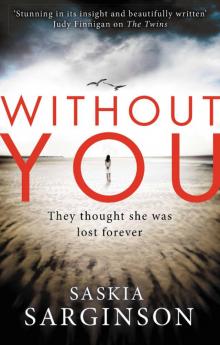
I knew that I wanted to write about a family, and I felt strongly that I hadn’t finished exploring the fictional possibilities of the Suffolk landscape that I love. I wanted to invent an island based on a real place called Orford Ness–a wild strip of land dotted with deserted concrete bunkers used by the military–the perfect setting for a novel with thriller overtones. With the island came the sea and boats and the idea of a drowning.
What attracts you to writing novels with a nostalgic quality?
I find the recent past a fascinating place, and anything set in an era that contains memories is already resonant with emotion. Retro novels also trigger a kind of dramatic irony–‘If only we’d known then what we know now…’–which adds an extra twist to fiction, I think.
How difficult did you find writing from multiple viewpoints?
I really love multiple viewpoints, whether it’s in fiction or film. Comparing different individuals’ perspectives on the same thing is always revealing, and gives a fascinating insight into being human. It seemed natural to write several points of view in this book, as the plot focused on one event that affected four family members in different ways, but I wrote Max and Clara in the third person as they were distanced from themselves through grief and anger. Both Eva and Faith needed to be written in the first person because I wanted the reader to feel their stories from the inside, in a raw, truthful way.
To you, what are the central themes in this story?
Loss. Love. Belonging. Belief. Faith. It’s also a rites of passage book and it’s about strangers–the stranger that enters our life to change it, but also the strangers inside the people we think we know best, and the stranger in ourselves.
In The Twins we had Viola and Isolte, and now we have Eva and Faith. Are strong sibling bonds important to you?
Yes, absolutely. I’m very close to my own sister and I think sibling relationships can be full of the passionate feelings that feed fiction: conflict, jealousy, betrayal, but also unspoken understanding, loyalty and love that comes rooted in the bonds of blood.
The relationship between Eva and Billy goes on a fascinating journey. Was this deliberate? Did you enjoy writing this relationship?
I loved writing this relationship! I fell in love with Billy. His character really did start to write itself and I just went along with it.
Can you tell us a little more about the island in Without You? Does it stand for anything?
Islands in fiction are often magical places. Just think of The Tempest. They provide intense environments where life is lived in a heightened way, as in Lord of The Flies. I think all of this is relevant to the island in Without You. It’s a place where the rules and timings of normal life cease to exist, where the unexpected can happen. Once Eva leaves the island, she ceases to be a prisoner but she also loses something that she can never reclaim. I based the island on a real spit of land, an eerily beautiful place shrouded in secrets, littered with the crumbling remains of military buildings and yet sculpted out of water and shingle and light–a place of contrasts and contradictions, like the fictional island, and like the relationship that Eva and Billy form.
Is the ending deliberately ambiguous?
Yes, I like endings with a hint of ambiguity. They offer readers a chance for individual interpretation.
What are you writing now?
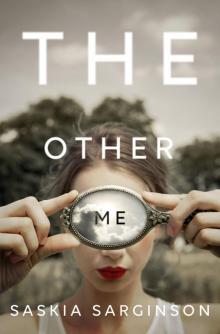
I’ve just started to work on a novel called The Other Me. It’s another retro book, set in London in 1993 with flashbacks to India. Its heroine, Klaudia, is haunted by the guilt she believes she’s inherited from her strict German, WW2 veteran father, so she creates another, secret identity to escape into: Eliza–a carefree English girl who works behind the bar in a burlesque club. Juggling two lives isn’t easy, particularly when she falls in love with someone who only knows her as Eliza. But her two worlds collide when her father makes a terrible request of her… and Klaudia discovers that she’s not the only one living a double life.
READING GROUP GUIDE
1. The story quickly establishes that Max and Clara’s marriage has been failing since the loss of their daughter. What did you think of the development of their relationship as the novel progressed?
2. What is the significance of Faith’s obsession with nature and dead things?
3. Why do you think that Faith, aptly named, is the only one who truly believes Eva is still alive?
4. Who changes the most throughout the story and how?
5. We get to see the characters’ lives through the eyes of several different narrators. Whose narration did you connect with the most and why?
6. What is the central theme of the book and how did it resonate with you?
7. Which character did you feel the most sympathy for and why?
8. Which revelation did you find the most surprising?
9. What did you think of Eva’s feelings toward her captor throughout the book?
10. Saskia Sarginson’s first novel, The Twins, also deals with themes of family and loyalty—how does Without You compare or contrast with that novel?
If you enjoyed
WITHOUT YOU
look out for
THE TWINS
by Saskia Sarginson
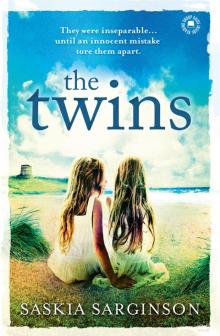
They were inseparable until an innocent mistake tore them apart.
Growing up, Viola and Issy clung to each other in the wake of their mother’s eccentricity, as she dragged them from a commune to a tiny Welsh village. They thought the three of them would be together forever.
But an innocent mistake one summer set them on drastically different paths. Now in their twenties, Issy is trying to hold together a life as a magazine art director, while Viola is slowly destroying herself, consumed with guilt over the events they unknowingly set into motion as children.
When it seems that Viola might never recover, Issy returns to the town they haven’t seen in a decade, to face her own demons and see what answers, if any, she can find.
1
We weren’t always twins. We used to be just one person.
The story of our conception was the ordinary kind they tell you about in biology lessons. You know how it goes: an athletic sperm hits the egg target and new life forms.
So there we were, a single ho-hum baby in the making. Then comes the extraordinary part, because that one egg split, tearing in half, and we became two babies. Two halves of a whole. That’s why it’s weird but true—we were one person first, even if only for a millisecond.
Mummy always said that having twins was the last thing she’d expected, except she knew there had to be a good reason why she couldn’t fit through doors at four months, let alone do her jeans up. Mummy was beautiful. Everyone said so. She looked like an ice queen from the pages of a fairy tale. A queen who wore flip-flops and Indian skirts with tassels dangling down, and whose fingers were stained nicotine yellow. She wouldn’t tell us who our father was. Not that it really mattered. We just pretended it did, because it felt exciting to try and guess who he might be, as if we could invent the story of our own birth.
There’s a Greek myth that says if a woman sleeps with a god and a mortal on the same day she’ll have two babies: one child from each father. Even our mother wouldn’t do anything as slutty as that. But when we climbed the branches of the lilac tree to sit on the roof of the shed, sharing an apple and discussing possible paternal options, the idea of being fathered by a god was satisfying.
The obvious choice was a rock god. Our mother played The Doors obsessively. She looked at Jim Morrison’s picture on the album cover and sighed. The only thing we knew about our father was that our mother met him at a festival in California. Bingo. It had to be Morrison. We didn’t want our dad to be one of the creeps and weirdos we lived with at the commune in Wales. Lanky Luke or smelly Eric. Mummy didn’t love any of them. We wrote Mr Morrison a letter once, secretly, signing it from Viola and Isolte Love. We never got a reply.
On 3 July 1971 Jim Morrison was found dead in his bath in Paris. Cause of death: heart failure brought on by heavy drinking. He’d planned to stop being a rock god and become a poet. He’d been waiting for his contract to run out. The day the news broke we came home from school to find our mother playing ‘Hello, I Love You’ over and over and weeping into her glass of red wine. We cried too, up in our bedroom, howling into our pillows. At first it was a kind of show; but then fake turned to real. You know how sometimes when you laugh really hard you can trip some emotional switch and start crying instead? This was a bit like that. Except pretend crying tripped the real thing, and suddenly we were drowning in tears, taking shuddering gasps, snot smearing our cheeks. We had no idea what we were crying about. Later, when Mummy was sober and we were all hiccuping and squinting through swollen eyes, she told us that Jim Morrison definitely wasn’t our dad. ‘You nitwits,’ she said wistfully, ‘where on earth did you get that idea?’
We tried a few more times to discover who our father was. But Mummy got irritated. Shrugging and rolling a cigarette slowly, she’d blow smoke spirals and look disappointed by our dull questions. ‘I’ve started a new dynasty,’ she explained. ‘I want you to build your own future. You don’t need a past.’ We knew that she thought our desire for a father was petty and bourgeois. All the worst things in the world were petty and bourgeois.
It was the spring of 1972, and Mummy said that, what with the miners’ strike and the three-day weeks, the country was going to hell. Ted Heath was a Tory fool. We had to be prepared for the worst. We needed to be self-sufficient. She dug up the weedy flowers and planted vegetables and bought two nanny goats: Tess and Bathsheba. One brown and the other black; they both had switchy tails and cloven feet like the devil. We wanted to love them, but they just chewed all day, grinding their long teeth. Even when we squatted to scratch their ears, they kept on chewing, marble eyes looking through us. The goats broke free of their tethers and trampled the vegetable patch, pulling up plants by the roots. Every morning, Mummy spent grim hours trying to replant limp broccoli and carrots before she sat with her head in a goat’s flank, fingers working, swearing at their fidgeting, to emerge with thin milk as rancid as old cheese or stewed socks.
She had a book showing which wild foods were safe to eat and when and how to pick and cook them. That book was consulted constantly, pondered over, worn and stained from being taken along on walks and splattered from being propped next to the stove. Foraging became a new religion. Plucking berries and mushrooms and apples from the hedgerows—now, Mummy said, that was free-spirited and free. Two things she approved of.
We got scratched from pushing through brambles to get at the crab apples, our mother barefoot beside us. ‘Higher, Viola. That’s it.’ Tossing her hair impatiently. ‘Get the ones on the next branch up, Issy.’ She made jelly and wine from those: tangy-tasting and pink as a tongue. Once we got terrible stomach cramps from some speckled mushrooms she’d put in a stew. But we got to like brain fungus fried in butter with salt and pepper and a little curry powder; a crinkly, rubbery, pale fungus that grew at the foot of pine trees—we tore up handfuls whenever we found it. And puffballs, picked when they were fat and white, rolling in the dewy grass on autumn mornings like misplaced snowballs. We had them sliced in batter for breakfast with crispy bacon.
Have you ever felt real hunger pangs? Not just a growl, the casual complaining of your stomach missing a meal, the inconvenient rumble and gurgle when lunch is late. I mean the deep birthing pain of true emptiness. The hollow ache of nothing. Fat is a human fault because it’s only humans who are stupid with greed. Birds are light as a handful of leaves. I want the lightness of wings to enter me. I’ve learned to eat like a bird, not a human. In this place they try and trick me into eating, they play mind games, stick tubes down my throat.
Of course, it hurts to starve. But you can use those pangs like a knife to slice out the bad things inside you. Eventually you’ll come to crave that feeling. Because hunger is a friend. With it you can get down to your bones quicker than you’d think. I feel them under my fingers, nudging up close below my skin, closer every day: smooth and flawless and hard. That’s what everyone says about bones, don’t they? That they’re pure. Clean. I trace the lines of mine and they make a shape: the scaffold of myself.
It’s all we are in the end anyway. Sometimes not even that. Sometimes there aren’t even bones to show for a life—just molecules shifting in the air—and a few memories locked up in your head, yellowed as old photographs.
I’m tired now. I’d like to go back to sleep. I’m rambling. I know I am. Issy wouldn’t like it. She told me to shut up when we had to sit in that little room with a man and a woman asking us the same questions over and over.