Skeleton song, p.1
Skeleton Song,
p.1


Begin Reading
Table of Contents
About the Author
Copyright Page
Thank you for buying this
Tom Doherty Associates ebook.
To receive special offers, bonus content,
and info on new releases and other great reads,
sign up for our newsletters.
Or visit us online at
us.macmillan.com/newslettersignup
For email updates on the author, click here.
The author and publisher have provided this e-book to you without Digital Rights Management software (DRM) applied so that you can enjoy reading it on your personal devices. This e-book is for your personal use only. You may not print or post this e-book, or make this e-book publicly available in any way. You may not copy, reproduce, or upload this e-book, other than to read it on one of your personal devices.
Copyright infringement is against the law. If you believe the copy of this e-book you are reading infringes on the author’s copyright, please notify the publisher at: us.macmillanusa.com/piracy.
Sunset blanketed the flowering fields and firefly trees in ribbons of honeyed light, red and gold and fading. In the deep catacombs beneath the city, the abuelas pulled themselves together, having long since learned how to conserve their strength through Mariposa’s short days, and sang to the endless ossuaries, voices sweet and fluting:
“Sing to me of Mariposa, oh mi calaquitas, sing to me of the honeyed sky and the fields of endless gold. Sing to me of butterflies, oh mi calaquitas, sing to me of the dreaming days and the nights as yet untold.”
One by one, their voices joined in harmony as they performed the sunset’s summoning, and the tiny bones of their charges began to stir and tremble until the first of the children pulled herself together from her composite pieces, skull still painted from the previous night. She sat before the nearest abuela, hugging bony knees to naked rib cage, and listened raptly as all the others of her class and cadre came together one by one.
Once enough of the children were awake, they lent their voices to the summoning song, and it swelled and grew through the catacombs, rising to the surface to echo through the hills and streets of Mariposa, rising even to the heights of the great Bone Palace where their Princess and her Court slept the day away. It was the duty of the oldest and the youngest to sing the world awake each evening, and they took it more than seriously. They took it as the holy duty that it was.
No one knew what would happen if the summoning song was not performed. Perhaps a break in the chain would leave all of Mariposa slumbering forever, the abuelas unable to rise without a full night’s celebration to animate their bones, the children unable to wake without the abuelas urging them from their beds. The oldest stories said Mariposa began with a song, and like all songs, it would end with silence.
In the palace, in the curtained bower reserved for the Princess, a scattering of bones dusted with diamond and amber began to stir, tempted into motion by the song rising from below. On the other side of the room, a terrible creature raised its head and watched.
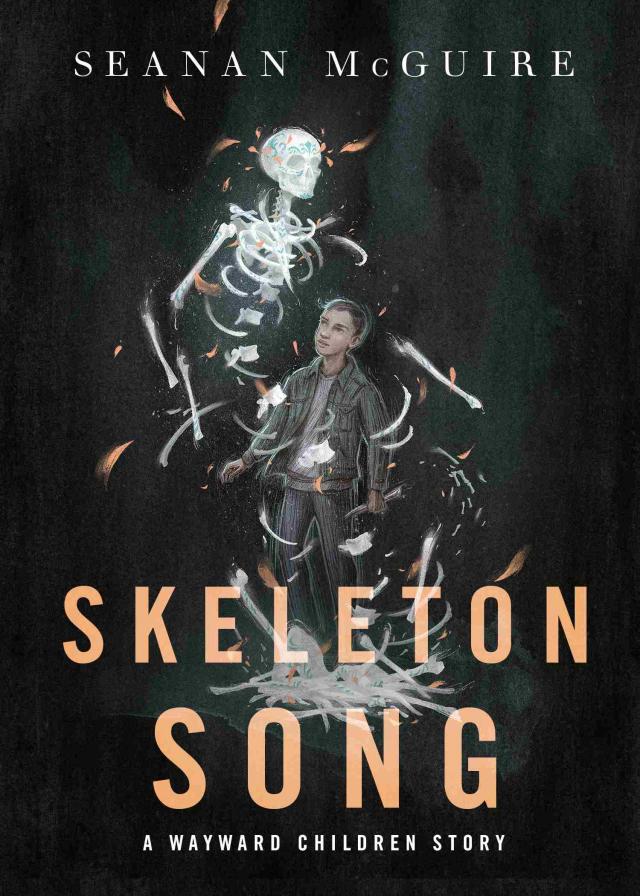
It was strange and fleshy, shaped as a skeleton was shaped, but with a covering of fat and skin stretched across it, concealing it from proper view. It hid most of its body under rags it called “clothing,” which had grown tattered and worn, developing holes where none had been before. Some among the palace staff had hoped, for a time, that the same might happen to the terrible creature’s “skin,” leaving proper, honest bone to shine through. It had not. When the creature broke its skin, as happened from time to time, it bled and wept and hurt, and took to the pile of rags it had claimed as a “bed.”
They would never have allowed it to remain in the palace were it not for one strange truth: hideous as the creature was, impossible as it seemed, the Princess loved it. Had loved it from the moment she first laid eyes on it, when it came stumbling through an arbor draped in fire vine. She had been the one to see the illness in it, the shadow below its skin, sickening and poisoning it, and draw the illness forth, first pulling it all into one of the creature’s bones, and then, with the ease afforded only to royalty, reaching inside the monster and plucking the afflicted bone free.
The creature carried the bone with it always, played it like a flute, and added music to Mariposa that had not been there before it came. Some of the guards had begun to think it might have value, for the music alone.
It watched the Princess’s bones as they shifted in their bed of marigold petals, plucked fresh each night, as befitted their regent. It observed as she pulled herself together, piece by piece, each bone slotting into place as if drawn tight by invisible strings. She had neither tendons nor muscles, but when the last of her bones had clicked into its socket, she sat up, opening eyes of gleaming starlight, searching the room as she did every evening. She knew too well what her guard thought of the creature she had claimed as her own, and while she most often woke before they did, the fear that one night she would find him gone was strong.
Instead, she found him waiting for her, fingers playing across the surface of his ever-present bone flute, dark eyes anxious. She would not have seen that anxiety in the beginning, would have seen no nuance in the fleshy substance of his expression, but she had learned him, even as he had learned her, even as they were still learning each other, even as they always would be.
“Good evening, Christopher,” she said, voice delicate as a wind chime. “How did you sleep?”
“Well,” he said, and his own voice was a heavier thing, rendered more substantial by the mechanisms of his breath, which was used to keep him alive, not just to speak. “I went to the meadow and slept in the sun for a while. It was nice.”
“I’d like to sleep in the sun,” she said, somewhat wistfully.
“You could,” he said. “I could carry your bones to the hill and let you sleep with me for a while. It wouldn’t be any trouble at all. You’re light as anything.”
“But skeletons don’t sleep in the sun,” she said. “We sleep in beds of flowers, or in the cool of the catacombs, away from sunlight. That’s how it is in Mariposa.”
“Do you know why?”
The Princess paused, tilting her head to the side. That was the best thing about Christopher, and she enjoyed him in all ways; it was wonderful to have a companion who didn’t demand she be a perfect princess, but allowed her to be a person when she wanted to be.
“No,” she said. “It’s what the songs say. We sleep in shadow to evade the sun, and wake when the stars return. The days of Mariposa have to happen for the sake of the flowers, and the butterflies, but they stay short and sweet for us. That’s how it’s meant to be. That’s how it’s always been. Did you seek your doorway during the day, Christopher?”
He hesitated, and his fingers actually stuttered a stop on his flute, which was unusual enough that the Princess sat up straighter, waiting for him to speak. Finally, in a voice as small as an echo, he asked, “Are you in a hurry for me to go?”
“What? No!” She climbed from her bower of petals, rushing to kneel next to his chair, her hands clutching at his. His skin was so warm, even when he hadn’t been in the sun. Warmth came so easy to him, and she envied it, as she sometimes envied him the sun. “Why would you say such a thing?”
“Your advisors want me to go.”
The Princess clacked her teeth in displeasure, molars striking together in a staccato rattle. “My advisors do not set my tune for me.”
“I make them uncomfortable. They call me a monster when they think I can’t hear them.” Christopher sighed, looking at his motionless hands. “I don’t look for the door because if I find it, someone else can find it, and if they find it, they’ll send me back.”
Christopher came from a world of others like him, skeletons wrapped in flesh and skin, as they were in the teaching songs, the ones the abuelas sang of the origins of Mariposa. He had been very sick there, as she had seen when first he tumbled into her presence, falling through the fire vine and into the harvest celebration, and the healers of his land had been unable to treat him. She had heard songs of other travelers, of course—the abuelas sang of people whose bones could not be healed by the worlds of their birth, who found Mariposa to continue living after the heat left their flesh and left their bones behind. It was not unusual, according to the songs, for new rulers to meet such travelers, but Christopher had been her first, and she had reacted to his arrival with surprise, calling the sickness from his bones before she asked her teachers what to do.
If she had left it where it belonged, his flesh would have rotted away by now, leaving him as clean and unburdened as any citizen of Mariposa. But he had been so strange, and so lost, and there had been such fear in the way he held his shoulders, in the way he hung his head. She had been able to see his suffering, and had not thought to leave him in such a state, not when she knew the songs to make him well again. What ruler could have looked on such pain and left it as it was?
She laid her hands over his, holding him in place, and looked at him with all the solemnity she could gather. “They don’t like you, it’s true,” she said. “It’s rare for a creature of flesh to remain so in Mariposa for long. Flesh is hot and bones are cold, and bones belong to the night as flesh belongs to the day. For the two to walk together is strange to us, and we don’t know what to do with it.”
“Will they make me go back?”
“Would that be so terrible?” She stayed where she was, watching him. “You aren’t sick now. You’ve spoken of your family, of missing them, of ho
w they must have worried when you disappeared from the ‘hospital.’ Surely you must want to see them again.”
“I do,” he admitted. “But I want to stay with you even more than I want to see them.”
The Princess hesitated. “You do?”
“I do.” Christopher slid from his chair so that they knelt across from each other, hands still intertwined. Her bones were cool against his skin, and they left dents where they pressed down. It felt good. It had been strange at first, but now it felt good, and familiar, and like home. “I love you.”
The light flickered in the Princess’s sockets. She didn’t pull away. “You’ve told me the women of your world walk in flesh, as you do—”
“Where I come from, a skeleton without any flesh on it is a dead thing, all the time, night and day. They never wake up. They never go dancing.”
The Princess shivered.
“But I’m not there. I’m here. You were strange at first, but I’ve learned to see how beautiful you are. And you were always kind to me, from the start.” He freed one hand to reach up and caress her angular, gilded cheek. “You’re clever and you’re generous and I love you. I don’t think I’ll ever love anyone but you. And I don’t want to leave you, which means I’m not looking for any doors.”
The Princess pulled away from him. Christopher’s eyes widened when he realized what she was doing, and he grabbed for her hands, almost desperate. “I’m sorry! Was that wrong? Should I not have said it? We can just pretend I didn’t say it. We can—”
“Quiet, Christopher,” said the Princess. “The waking song is done. The echoes fade. I need to paint myself for the night and sing the evening song, and then we need to go to the catacombs.”
“The catacombs?” he asked, blankly.
“If you love me, you need to meet my parents,” she said. “It’s the way of things.”
Christopher thought about this for a moment before he pushed off from the floor, smiling at her. “I’ll get the paints,” he said.
* * *
Lacking faces, or hair, or flesh in need of clothing, the skeletons of Mariposa distinguished themselves through complex cosmetics, applying them every evening according to some predetermined calendar that Christopher had yet to fully unravel, but had come to understand was tied to the season and the weather. Only the Princess was allowed to use the royal palette, filled with pigments made from crushed pearl, dried marigolds, and the powdered wings of migratory butterflies. Other skeletons possessed other palettes, and there were colors that only appeared on anyone, even the Princess, on very special occasions.
He sat quietly as she painted her skull, watching in rapt attention, his fingers playing across the surface of his flute. It had been a part of him once, a sick part, corrupting and killing the whole by being out of tune with his body. He forgave it, though. He had forgiven it the moment the Princess had pressed it into his palm, his arm still aching from the extraction—which should have hurt so much more than it had, a bone working its way through his skin and out into the air, leaving a hole through which she had slipped a replacement, quick as a wink, before he could draw breath to protest—and told him his song was his own again.
He intended to play that song through to the end according to his own ideas of the shape it should take. Not illness, not adults who thought they knew what was best for him just because they were older and worried about him, not the strange prejudices of a world filled with living skeletons that looked at him and saw a monster. He played the song of his own life, and that life included the Princess of Mariposa, his very own Skeleton Girl, and she was the first girl he had ever loved, and the one he would love until the end of his days.
So he watched as she traced lines of gold and orange and silver across the planes of her skull, and thought she was just as beautiful without them as she was with them. He had tried his hand at Mariposan cosmetics a few times, when he’d still been a stranger in this land, before he’d learned to find the ripest berries in the forest and how to hook the silvery fish from the streams, but the paint which made her look so ethereal and impossible had only made him look more fleshy, more concrete, and farther away from her than he had ever been before.
When she was done, she turned to him, perfect as a picture, and asked, as she asked every evening, “Well?”
“You look beautiful,” he said with absolute sincerity, and she had no lips, but still he saw that she was smiling as she offered him her hands, and together they walked out of her bower, and he thought his heart might burst with happiness.
Would that be such a bad thing, in Mariposa? His heart was a part of his fleshy existence, and if it failed him, wouldn’t his skeleton get up to continue with its own life? But then, if that happened, would he still be Christopher? None of the people he’d met here—and they were people, even if they didn’t have skin to hide behind—remembered dying. They didn’t claim to have ever been cloaked in flesh and blood, and the few he’d asked had seemed horrified by the very idea.
Various guards and members of the court passed them in the hall, and the Princess greeted each with a cool nod of her head, saying nothing. Without her breaking the silence, they were not allowed to speak to her, and so she and Christopher made their way to the top of the palace, where a room carved from the long-dead bone of some great beast waited for them, its carved walls catching every whisper of the wind and turning it into an endless, meandering tune. The palace of Mariposa was one vast woodwind, played by the breath of the world itself.
Christopher had been staggered on the day he first realized that, and he was staggered now as his Skeleton Girl pulled her hand from his and walked to the great throne of bones, settling on its flower-covered seat with a small nod of satisfaction. The household staff who had been waiting to see if their work would be acceptable scattered immediately, off to tell their superiors the Princess had approved.
The pools of starlight in her sockets vanished as she closed her eyes, tilted her head back, and added her voice to the song of Mariposa.
It had no words. It needed no words: when the world sang, words would just have gotten in the way. Christopher knew it was important, essential, even, for the Princess to join the song each evening, even if most of the skeletons in the palace would only hum a few notes before they went about their business. She sang, and he ran his fingers across the surface of his flute, wishing he could find the nerve to join her. It wasn’t his place, though—not yet. Not until he could be sure he’d be staying.
Not until she told him he belonged.
The song filled the room and filled the world. Christopher closed his eyes, letting it wash over him, letting it wash the rest of his frivolous cares away. Maybe someday he’d find his door and be forced back into the world where his family waited, no doubt terrified by his absence; maybe this wasn’t forever. While his Skeleton Girl was singing, that didn’t matter. Nothing mattered but the song.
She stopped, and the song continued, wrapping its arms around them and carrying them on a curtain of wordless melody. Then, with a long, achingly elegant note, it faded, and silence fell across the room.
Christopher didn’t realize she’d gotten up until he heard her feet clacking across the floor toward him. He opened his eyes and watched as she approached, pale and glimmering in the dim light.
“The abuelas say we’re welcome in the catacombs, but we’ll have to go now if we want to make it to my parents and back before sunrise,” said the Princess, seizing his hand. “It’s a long journey. Have you eaten?”
The word was strange coming from her mouth, like it was a piece of a foreign language peppered in for his benefit, and in a way it was exactly that. Like all citizens of Mariposa, his Skeleton Girl got all the sustenance she needed from the songs the world sang to and with and through her; Christopher’s dependence on more substantial nourishment was strange to her, and always would be.
Laughing, he nodded and twined his fingers with her own. “I ate before sunset. I always do, remember?”
“I know, I just … maybe you’d forgotten.”
“I wouldn’t.” Eating was an activity they couldn’t share, and one she didn’t care to observe, not like her evening song, which wasn’t for him, but which he loved all the same. He always, always ate before she woke, lest he resent the time it took away from their hours together. She had her duties, as princess of an entire world, and his body demanded he sleep in the darkest hours of the morning, but on the whole, they could spend the night together. As long as he ate before the sun went down.