

Dandd dragonlance se.., p.1
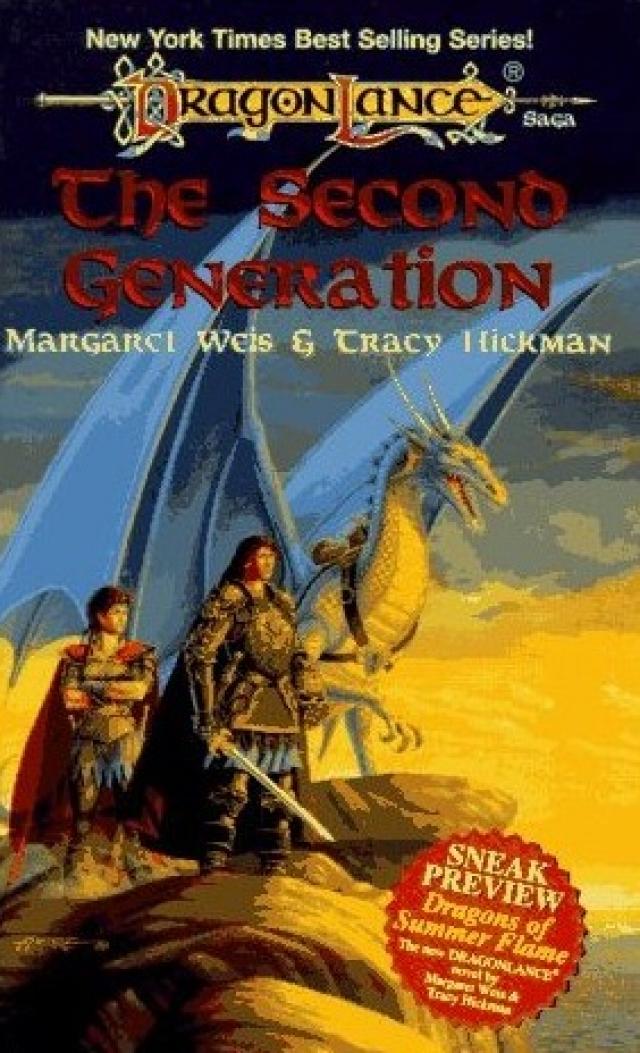
D&D - Dragonlance - Second Generation 01,
p.1


Prologue
It is always the map of believing,
the white landscape
and the shrouded farms.
It is always the land of remembrance,
of sunlight fractured
in old, immovable ice,
And always the heart,
cloistered and southerly,
misgives the ice, the drifting
for something perplexed and eternal.
It will end like this,
the heart will tell you,
it will end with mammoth and glacier,
with ten thousand years
of effacing night,
and someday the scientists
rifling lakes and moraines,
will find us in evidence,
our relics the outside of history,
but your story, whole and hollowed, will end
at the vanishing edge of your hand.
So says the heart
in its intricate cell,
charting with mirrors
the unchartable land
of remembrance and rivers and ice.
This time it was different:
the town had surrendered
to the hooded snow,
the houses and taverns
were awash in the fragmented light,
and the lake was marbled
with unstable ice,
as I walked through drifts
through lulling spirits,
content with the slate of the sky
and the prospect of calendared spring.
It will end like this,
the winter proclaimed,
sooner or later
in dark, inaccessible ice,
and you are the next one
to hear this story,
winter and winter
occluding the heart,
and there in Wisconsin,
mired by the snow
and by vanishing faith,
it did not seem bad
that the winter was taking
all light away,
that the darkness seemed welcome
and the last, effacing snow.
He stood in the midst
of frozen automobiles,
cars lined like cenotaphs.
In a bundle of coats
and wool hats and mufflers
he rummaged the trunk
for God knows what,
and I knew his name
by the misted spectacles,
the caved, ridiculous
hat he was wearing,
And whether the courage
was spring in its memory,
was sunlight in promise
or whiskeyed shade,
or something aligned
beyond snow and searching,
it was with me that moment
as I spoke to him there;
in my days I am thankful
it stood me that moment
IV
as I spoke to the bundled
weaver of accidents,
the everyday wizard
in search of impossible spring.
Tracy, I told him, poetry lies
in the seams of the story,
in old recollections and prospect
of what might always and never be
(And those were the words
I did not say, but poetry lies
in the prospect of what should have been:
you must believe that I said these words
past denial, past history),
and there in the winter
the first song began,
the moons twined and beckoned
on the borders of Krynn,
the country of snow
resolved to the grasslands
more brilliant and plausible.
And the first song continued
through prospects of summer,
where the promise returns
from the vanished seed,
where the staff returns
from forgetful deserts,
and even the northern lands
cry out to the spirit,
this is the map
of believing fulfilled;
this is the map of belief.
vi
Where’s my hat? You took it! I saw you. Don’t tell me if s on my head! I know better! I… Oh, there it is. Decided to bring it back, did you? No, I don’t believe you. Not for a minute. You’ve always had your eye on my hat, Hickman. I-What? You want me to write what? Now? This minute? Can’t do it. Don’t have the time. Trying to recall the words to a spell.
Fire sale. Fire engine. Great balls of fire
Thaf s close….
Oh, very well. I’ll write your blasted foreword.
But just this once, mind you. Here goes.
A long time ago, a couple of doorknobs named Margaret Weis and Tracy Hickman decided to leave their homes on Krynn and go out adventuring. I’m afraid there’s some ken-der blood in those two. They just couldn’t resist traipsing off to visit other new and exciting worlds.
But Weis and Hickman are like kender and bad pennies -they keep turning up. And so here they are again, all set to tell us about the wonderful things that are happening in Krynn.
Some of these stories we’ve heard before, but they have a couple of new ones, too, all about the children of that small band of adventurers who are now known as the Heroes of the Lance.
Many years have passed since the war. The Heroes’ children are growing up, going off on adventures of their own, heading out into a world that, I’m sorry to say, still has plenty of danger and trouble left to go around.
Now, as you read these stories, you will notice that sometimes Weis and Hickman contradict certain other stories you may have heard. Some of you might find yourselves more vu
than a little perplexed over their accounts of the Heroes’ past lives-accounts that differ from other accounts.
There is a perfectly simple explanation.
Following the War of the Lance, Tanis and Caramon and Raistlin and all the rest of the Companions stopped being ordinary people and became Legends. We liked hearing about the Heroes’ adventures so much, we didn’t want the stories to end. We wanted to hear more. To fill the demand, bards and legend-spinners came from all over Krynn to tell the wondrous tales. Some of these knew the Heroes well. Others simply repeated stories they’d heard told by a dwarf who had it from a kender who borrowed it from a knight who had an aunt who knew the Heroes …
You get the picture.
Some of these stories are absolutely, positively true. Others are probably almost absolutely, positively true, but not quite. Still others are what we refer to in polite society as “kender tales”-stories that aren’t true, but sure are a hoot to hear!
And so you ask: Fizban, Great and Powerful Wizard, which stories are which?
And I, Fizban, Great and Powerful Wizard, answer: As long as you enjoyed the stories, you doorknob, what does it matter?
Well, well. Glad we got that settled.
Now, go pack your pouches. Pocket your hankies. Grab your hoopak. We have a lot of adventuring to do. Come along! Forget your cares! Travel with Weis and Hickman through Krynn once again, if only for a little while. They won’t be here long, but they do plan to come back.
(Maybe next time, they’ll return my hat!)
What was my name again?
Oh, yes.
I remain, yours sincerely,
Fizban the Fabulous
At the edge of the world
the juggler wanders,
sightless and pathless,
trusting the venerable
breadth of his juggler’s hands.
He wanders the edge
of a long-ago story, juggling moons,
parading the fixed
anonymous stars in his passage.
Something like instinct
and something like agate
hard and transparent
in the depths of his reflexes
channels the objects
to life in the air:
stilettos and bottles,
wooden pins and ornaments
the seen and the unseen-all reassemble
translated to light and dexterity.
It is this version of light we steer by:
constellations of memory
and a chemistry born
in the blood’s alembic,
where motive and metaphor
and the impulse of night
are annealed by the morning
into our countenance,
into the whorls
of our surfacing fingers.
viii
Something in each of us yearns for this balance, for the vanished chemistries that temper the steel. The best of all jugglery lies in the truces that shape our intention out of knives, out of filament out of half-empty bottles and mirrors and chemistries, and from the forgotten ore of the night.
Kitiara’s Son
Chapter One the Strange Request Of A Blue Dragon Rider It was autumn on Ansalon, autumn in Solace. The leaves of the vallenwood trees were the most beautiful they’d ever been, so Caramon said-the reds blazing brighter than fire, the golds sparkling more brilliantly than the newly minted coins that were coming out of Palanthas. Tika, Caramon’s wife, agreed with him.
Never had such colors been seen befo
re in Solace.
And’ when he stepped out of the inn, went to haul in another barrel of brown ale, Tika shook her head and laughed.
“Caramon says the same thing every year. The leaves are more colorful, more beautiful than the year before. It never fails.”
The customers laughed with her, and a few teased the big man, when he came back into the inn, carrying the heavy barrel of brown ale on his back.
“The leaves seem a tad brown this year,” commented one sadly.
“Drying up,” said another.
“Aye, they’re falling too early, before they’ll have a chance to completely turn,” another remarked.
Caramon looked amazed. He swore stoutly that this wasn’t so and even dragged the disbelievers out onto the porch and shoved their faces in a leafy branch to prove his point.
The customers-longtime residents of Solace-admitted he was right. The leaves had never before looked so lovely. At which Caramon, as gratified as if he’d painted the leaves personally, escorted the customers back inside and treated them to free ale. This, too, happened every year.
The Inn of the Last Home was especially busy this autumn. Caramon would have liked to ascribe the increase in
CDargatet W«is xab Cracy (jicknun
trade to the leaves; there were many who made the pilgrimage to Solace, in these days of relative peace, to see the wondrous vallenwood trees, which grew here and nowhere else on Krynn (despite various claims to the contrary, made by certain jealous towns, whose names will not be mentioned).
But even Caramon was forced to agree with the practical-minded Tika. The upcoming Wizards’ Conclave was having more to do with the increased number of guests than the leaves-beautiful as they were.
A Wizards’ Conclave was held infrequently on Krynn, occurring only when the top-ranking magic-users in each of the three orders-White, Red, and Black-deemed it necessary that all those of all levels of magic, from the newest apprentice to the most skilled sorcerer, gather to discuss arcane affairs.
Mages from all over Ansalon traveled to the Tower of Wayreth to attend the conclave. Also invited were certain individuals of those known as the Graystone Gem races, whose people did not use magic, but who were involved in the crafting of various magical items and artifacts. Several members of the dwarven race were honored guests. A group of gnomes arrived, encumbered with blueprints, hoping to persuade the wizards to admit them. Numerous kender appeared, of course, but they were gently, albeit firmly, turned away at the borders.
The Inn of the Last Home was the last comfortable inn before a traveler reached the magical Forest of Wayreth, where stood one of the Towers of High Sorcery, ancient headquarters of magic on the continent. Many mages and their guests stopped at the inn on their way to the tower.
“They’ve come to admire the color of the leaves,” Caramon pointed out to his wife. “Most of these mages could have simply magicked themselves to the tower without bothering to stop anywhere in between.”
Tika could only laugh and shrug and agree with her husband that, yes, it must be the leaves, and so Caramon went about inordinately pleased with himself for the rest of the day.
Neither made mention of the fact that each mage who came to stay in the inn brought with him or her a small token of esteem and remembrance for Caramon’s twin brother, Raistlin. A mage of great power, and far greater ambition, Raistlin had turned to evil and very nearly destroyed the world.
But he had redeemed himself at the end by the sacrifice of his own life, over twenty years ago. One small room in the inn was deemed Raistlin’s Room and was now filled with various tokens (some of them magical) left to commemorate the wizard’s life. (No kender were ever permitted anywhere near this room!)
The Wizards’ Conclave was only three days away, and this night, for the first time in a week, the inn was empty. The mages had all traveled on, for the Wayreth Forest is a tricky place-you do not find the forest, it finds you. All mages, even the highest of their rank, knew that they might spend at least a day wandering about, waiting for the forest to appear.
And so the mages were gone, and none of the regulars had yet come back. The townsfolk, both of Solace and neighboring communities, who stopped by the inn nightly for either the ale or Tika’s spiced potatoes or both, stayed away when the mages came. Magic-users were tolerated on Ansalon, (unlike the old days, when they’d been persecuted), but they were not trusted, not even the white-robed mages, who were dedicated to good.
The first year the conclave had been held-several years after the War of the Lance-Caramon had opened his inn to mages (many inns refuse to serve them). There had been trouble. The regular customers had complained loudly and bitterly, and one had even been drunk enough to attempt to bully and torment a young red-robed wizard.
That was one of the few times anyone in Solace could remember seeing Caramon angry, and it was still talked of to this day, though not in Caramon’s presence. The drunk was carried out of the inn feetfirst, after his friends had removed his head from a fork in a tree branch grown into the inn.
After that, whenever a conclave occurred, the regulars took their business to other taverns, and Caramon served the mages. When the conclave ended, the regulars returned, and life went on as normal.
“But tonight,” said Caramon, pausing in his work to look admiringly at his wife, “we get to go to bed early.”
They had been married some twenty-two years, and Caramon was still firmly convinced that he had married
the most beautiful woman in Krynn. They had five children, three boys: Tanin, twenty years old, at the time of this story; Sturm, who was nineteen; sixteen-year-old Palin; and two small girls, Laura and Dezra, ages five and four. The two older boys longed to be knights and were always off in search of adventure, which is where they were this night. The youngest boy, Palin, was studying magic. (“If s a passing fancy,” Caramon said. “The boy’ll soon outgrow it.”) As for the little girls … well, theirs is another story.
“If 11 be nice,” Caramon repeated, “to get to bed early for a change.”
Sweeping the floor vigorously, Tika pursed her mouth, so that she wouldn’t give herself away by laughing, and replied, with a sigh, “Yes, the gods be praised. I’m so tired, I’ll probably fall asleep before my head hits the pillow.”
Caramon looked anxious. He dropped the cloth he was using to dry the freshly washed mugs and sidled around the bar. “You’re not that tired, are you, my dear? Palin’s at school, and the two older boys are away visiting Goldmoon and Riverwind, and the girls are in bed, and if s just the two of us, and I thought we might… well… have a little time to… uh … talk.”
Tika turned away so that he wouldn’t see her grin. “Yes, yes, I am tired,” she said, heaving another weary sigh. “I had all those beds to make up, plus the new cook to supervise, and the accounts to settle …”
Caramon’s shoulders slumped. “Well, that’s all right,” he mumbled. “Why don’t you just go on to bed, and I’ll finish-“
Tika threw down her broom. Laughing, she flung her arms around her husband-as far as they would go. Caramon’s girth had increased markedly over the years.
“You big doorknob,” she said fondly. “I was only teasing. Of course, we’ll go to bed and ‘talk,’ but you just remember that ‘talking’ was what got us the boys and the girls in the first place! Come on.” She tugged playfully at his apron. “Douse the lights and bolt the door. We’ll leave the rest of the work until morning.”
Caramon, grinning, slammed shut the door. He was just about to slide the heavy wooden bar across it when there came a faint knock from outside.
“Oh, blast!” Tika frowned. “Who could that be at this time of night?” Hastily, she blew out the candle in her hand. “Pretend we didn’t hear it. Maybe they’ll go away.”
“I don’t know,” the soft-hearted Caramon began. “It’s going to frost tonight-“
“Oh, Caramon!” Tika said, exasperated. “There are other inns-“
The knocking was repeated, louder this time, and a voice called, “Innkeep? I’m sorry if s late, but I am alone and in desperate need.”
“If s a woman,” said Caramon, and Tika knew she’d lost.
Her husband might-just might-be persuaded to allow a man to go in search of another inn on a cold night, but a woman, especially one traveling alone-never.
It didn’t hurt to argue a bit anyway. “And what’s a lone female doing wandering about at this time of night? Up to no good, I’ll wager.”
“Oh, now, Tika,” began Caramon, in the wheedling tone she knew so well, “you can’t say that.
Maybe she’s going to visit a sick relative and darkness caught her on the road or-“
Tika lit the candle. “Go ahead. Open up.”


