

Skins, p.1
Skins,
p.1
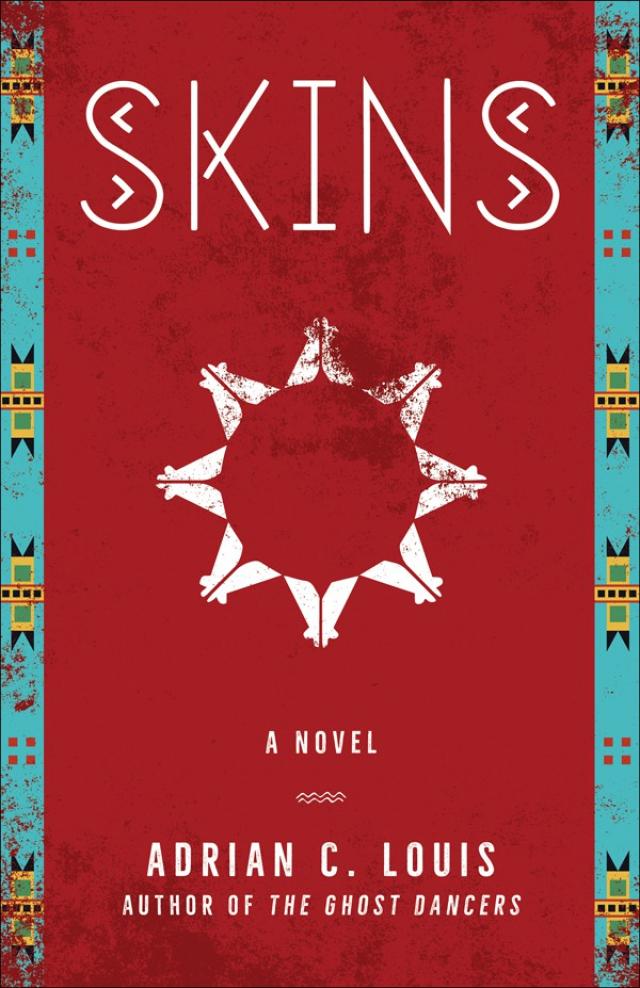


SKINS
A NOVEL
ADRIAN C. LOUIS
with a Foreword by
DAVID PICHASKE
UNIVERSITY OF NEVADA PRESS
Reno & Las Vegas
University of Nevada Press | Reno, Nevada 89557 USA
www.unpress.nevada.edu
Copyright © 2022 by University of Nevada Press
All rights reserved
Cover design by David Ter-Avanesyan/Ter33Design
LIBRARY OF CONGRESS CATALOGING-IN-PUBLICATION DATA
Names: Louis, Adrian C., author.
Title: Skins : a novel / by Adrian C. Louis.
Description: Reissue. | Reno : University of Nevada Press, [2022] |
Summary: “Skins is Adrian C. Louis’s realistic novel of life on Pine Ridge Reservation, the story of two brothers—one a rez cop, the other an alcoholic—and their relationship with each other, with their people, with their environment.”—Provided by publisher
Identifiers: LCCN 2022013816 | ISBN 9781647790226 (paperback) | ISBN 9781647790233 (ebook)
Subjects: LCSH: Vietnam War, 1961–1975—Veterans—Fiction. | Indians of North America— Fiction. | Brothers—Fiction. | Domestic fiction. | Pine Ridge Indian Reservation (S.D.)— Fiction. | South Dakota—Fiction. |
LCGFT: Novels.
Classification: LCC PS3562.O82 S58 2022 | DDC 813/.54—dc23/eng/20220420
LC record available at https://lccn.loc.gov/2022013816
For all my relations,
blood and spiritual relatives.
To Colleen and
to all those invisible ones
who struggle darkly through
this stolen country of our dreams.
At the Salvation Army a clerk
caught me wandering among old
spoons and knives, sweaters and shoes.
I couldn’t have stolen anything;
my life was stolen already.
—SIMON ORTIZ
Foreword
AUTHOR AND COLLEGE PROFESSOR Adrian C. Louis grew up as “Adrian Soukup,” a half-breed member of the Lovelock Tribe of Nevada Paiute Indians. In the poem “At a Grave in an Eastern City” he recalls deciding to leave his home on the reservation in his sixteenth year, writing on the outhouse wall, “Here I sit all broken hearted, / from Indian land I’ll soon be parted.”1 Adrian moved a hundred miles down the road to Yerington High School, where he played football. After graduating in 1964, he spent one year at UNLV, where he pledged ATO fraternity. Adrian then worked at a casino in Reno and at Anaconda Copper Mine before—apparently—serving time in Vietnam.2 Later, having “released himself from the crotch-rot / demands of jungled Vietnam,”3 he hitchhiked across the country, hanging out for a time in Haight-Ashbury with hippies and a girl named Maya Wu. He recalls meeting Richard Brautigan, Bob Kaufman, and Janis Joplin; listening to the Doors, Bob Dylan, and The Grateful Dead; smoking weed, drinking beer, and dropping acid. Nineteen seventy-five found him in Taos, in love with “Jeanne.”4 At this time, Adrian also replaced the surname of the stepfather he detested with his mother’s maiden name, to become legally Adrian C. Louis. In the title poem of Sweets for the Dancing Bear, he writes, “Through that decade of bad road I heard / trade winds scream for the import of variety. . . . For ten years I fought the dark magnet / in the Yellowstone of my bed.”5 Elsewhere he writes, “My life has been spent in cultural dyslexia.”6 In an often-quoted 1989 poem titled “Epitaphs for Some Idiots I Have Been,” Louis lists the stud, the lonesome traveler, the lackadaisical poet, the atheist, the redskin, and the academic.7
Louis the Academic emerged at Brown University in the later seventies, where he completed a BA and an MA in Creative Writing, and worked as a staff correspondent for the Boston Newspaper for the Arts. Nineteen eighty found Louis back in Nevada, a teaching fellow and PhD candidate in American Literature at University of Nevada-Reno. In Blood Thirsty Savages he writes, “Thick books of criticism / were stacked everywhere. / They blocked any vision of skin.”8 Louis returned to the East Coast in 1981–1982 as editor of Circle, a newspaper serving the American Indian Population of the New England States. The following year he was director of communications at the Los Angeles Indian Centers. (This job gave him a policeman’s driver’s license, which he kept tucked in an old billfold.)
Louis had discarded his Paiute self to explore a variety of new selves, none of which suited him. “I circled clouds for decades,” Louis writes in a poem titled “Wabuska,” “until I fell to the dry bones / of the Dakotas.”9 This was 1983, when Louis began working for The Lakota Times and teaching at Oglala Lakota College, everything from freshman composition to police report writing to Native American Literature. For a time he and his wife Colleen lived on the Pine Ridge Reservation; then they bought a house just below Pine Ridge in Rushville, Nebraska.
Even in his late high school years, Louis had been writing (and publishing) poetry, but the MA in creative writing at Brown University really launched his career as an author (mostly poetry, but in unpublished early manuscripts, fiction and even drama). Like most authors, Louis’s writing reflects his own experience and perspective on life, including his various lost selves. Muted War Drums, published in 1977, takes Louis all around America: Alabama, west Texas, Tulsa, Oklahoma, Georgia, and Rhode Island. The poems are full of wine and beer and Valium. Fire Water World (1989) mixes Nevada, New England, California, and South Dakota. Ancient Acid Flashes Back is memories of late sixties hippie California. In the 1990s the South Dakota landscape came to dominate Louis’s work so much that in his jacket blurb for Ceremonies of the Damned, Gary Snyder credits Louis’s “Pine Ridge Roots” with the book’s “amazing strength.”10 Albert Goldbarth writes in a blurb for the 2014 Tavern Books reprint of Among the Dog Eaters, “Adrian C. Louis. . .knows a people, the Lakota (and associated tribes), and much of his writing career has been a kind of mourning—sometimes angered, sometimes broken and sad, sometimes filled with pride for what’s been lost, sometimes bewildered: a complicated mourning—that brings a many-sided vision to his subject.”
Part of that vision is discomfort; part is anger about his discomfort. Looking back, Louis dismisses cities from Rhode Island to California as death: “Big cities have a way of chewing Indians up and spitting them out. We go to cities to get lost, or we go to die. Or most worst [sic] of all, some of us go to cities to become White.”11 Daniel Calvin Bloom, the very-Louis-like narrator of Louis’s unpublished novel The Dandelion Cowboys (which dates to his years at Brown), is “a man without a home, a man without a country.” In The Ghost Dancers, a novel which dates to his post-Brown University years, Louis deals with this problem via a persona named Bean, a half-breed Nevada Paiute Indian who attended Brown University, where “he had been able to enter the lives of old Yankee families through his art, his poetry.” Bean tells his son, “All the well-known Indian writers in America are housed in white forts called universities. . . They’ve become white. . .they ain’t shit. They’ve lost it.”12
Inevitably, recovery becomes Louis’s top priority, but he is unsure just what he’s recovering. One of the three dedications of Fire Water World (1989) is to “those Indians lost in cities who want to go home but can’t.” But home to what? The Paiute reservation is long gone. Pine Ridge is a mess—“the outhouse of Indian country. . .just booze, drugs, and violence. Pregnant teenagers and commodity cheese,” Louis writes in The Ghost Dancers.13 Small-town Rushville is “a ripened, diseased American heart” in “Earth Bone Connected to the Spirit Bone.”14 Louis renamed Rushville “Cowturdsville.” Louis’s next college would become the College of Evil Corn. His world—the Indian world in general—is not as beatific as many Native American writers would have us believe, and Louis is a realist, not a Fennimore Cooper / Dances with Wolves Romantic. And, although postmodernism may jibe with Native American structure, Louis is not a postmodern inventor in the manner of, say, Louise Erdrich. In “The Sacred Circle,” he writes of his own departure and return:
I wanted to run far, so far from Indian land.
And, God damn it, when I was old enough I did.
I loitered in some great halls of ivy
and allowed the inquisition of education:
electric cattle prods placed lovingly
into the lobes of my earth memories. . . .
Then, when I was old enough
I ran back to Indian land.
Now I’m thinking of running from here.
The 2014 reprint of Louis’s 1989 collection of poems titled Among the Dog Eaters quotes N. Scott Momaday on the back dust jacket: “Adrian C. Louis reaches to the core of contemporary Native American life. An equation of anger and survival, of acceptance and defiance brought into delicate balance.”
Part of Louis’s defiant recovery is language, the language of real people. Sometimes he uses Indian words, but in footnotes to poems in Among the Dog Eaters, he admits that his “Native American tongues” come from many Indian languages: Lakota, Paiute, Comanche, Navajo. Louis writes mostly in American English.15 While vestiges of academese remain even in Skins (Louis says this is “a forty-two-year-old schoolteacher” using “polysyllabic words to fog his brain”16), his is the “fire water language” spoken by students and colleagues on the rez and in Cowturdsville, Nebraska. “One of the angriest, raunchiest books of Native American poetry to be published in a long time,” wrote the reviewer in Bloomsbury Review.17 “The vocabulary can be seen as offensive to almost everybody,” writes Denise Low.18
Louis’s earthy language is just part of an earthy culture of sex and beer. This is w
hat Adrian C. Louis (among others) brought to Native American writing in the late twentieth century: a recognition of some kind of fallen, non-idealized, down-to-earth reality which, wherever it came from, is part of Indian culture today. The past is lost, and it’s the people’s own fault. “We stagger and stumble with contempt for the future / and with no words of pride for our past,” Louis writes in “Without Words.”19 In his poem “Among the Dog Eaters,”20 he writes,
At Big Bat’s Conoco, I wanted to scream:
Wake up, you damn people, wake up!
America does not owe you a living.
America does not owe you your souls.
You’ve got to grab your balls
and fill them with fire
and stop whining and drinking like bums. . .
LOUIS HIMSELF IS on-again off-again the wagon, but either way he is stuck in this adopted/reclaimed world. The titles of his books announce Louis’s realistic perspective: Blood Thirsty Savages (1994), Vortex of Indian Fevers (1995), Wild Indians and Other Creatures (1996), Ceremonies of the Damned (1997), Skull Dance (1998), Bone & Juice (2001), Evil Corn (2004). The Louis poem Joy Harjo selected for the Norton anthology of Native American poetry is titled “Skinology.”21
In the last analysis, it was Skins which won Louis a $105,000 Lila Wallace fellowship (1996–99) and gave him an international reputation. The novel was published by Crown Books on May 30, 1995, with a French edition (Colères Sioux: Les Guerriers d’Iktomi) released by Rocher in 1996. Louis had written a warm-up novel The Ghost Dancers,22 but Skins was his big book, with jacket blurbs from Joy Harjo, Sherman Alexie, and James Welch. Like so much of his writing, this novel reflects elements of Louis’s own life: the outhouse door, his parents’ alcoholism (and his own), his own football games, Vietnam, his hatred of his father, his background in journalism, his experience with police at the L.A. Indian Centers, memories of San Francisco (chapter three), Sonny’s job at Anaconda Copper Mine, Vivianne’s work as a schoolteacher (like Colleen’s), Rudy’s college degree. Like Louis, Rudy believes his people cannot get things straight; the Indian nation is “a car without headlights” (chapter 12). But Rudy and Mogie are fullbloods, not half-breeds, and the setting is firmly Pine Ridge (he has moved his main character out of the academic world of The Ghost Dancers and into a cop job at Pine Ridge), making Skins a critique of non-academic Lakota/Indian life. From Iktomi, the Trickster, to the spiders and spiritual rocks, to Sitting Bull and to the yuwipi ceremony, the novel is full of Indian mythology and history, rez problems and politics, which (with the book’s dedication to “all my relations, blood and spiritual relatives”) become (despite Chippewa-Sioux differences and various tribal slurs) the problems of Indians everywhere. Sherman Alexie found Skins “a complex portrait of racism and brotherhood, sexism and affection, murder and redemption, alcoholism and laughter. These are not the simple Sioux of Dances with Wolves.” “His first novel is notable for its distancing from the myth of the noble Indian,” wrote Sheila Riley in her Library Journal review.23 “The truth Louis forces us to face,” writes Robert L. Berner, “is something much darker—that the racial accident of being born Indian does not necessarily make anyone any saintlier than anyone else, that the wisdom of Wovoka or Black Elk or any other traditional Indian holy man is not inherited in the blood but embraced in the heart, and indeed that some Indians are so brutal toward the environment and toward each other that they hardly can be distinguished from other sociopaths.”24
Skins connected with Gen-X audiences both on and off the reservation. Even readers in Politically Correct academia were amused by and applauded Louis’s honesty.25 The psychology of Skins is on one level autobiographical, on another level South Dakota Lakota, on another level a generalized “Skinology”. . .but on an even higher level an American or even global experience. “His guess was that maybe most men all over the world were this way,” Rudy thinks at the start of chapter three; “Mankind had always been a most violent animal.” “The rez was just like any other part of America,” he thinks at the start of chapter ten. Most of Louis’s rude and crude English is spoken both on and off the rez, and “Over hill, over dale, we will hit the dusty trail” is a song I sang as a kid in Philadelphia, Pennsylvania. Louis’s markers of place and life come from shared culture and are experienced by members of multiple ethnic groups, including Louis himself: McDonald’s and Kmart, Pepsi and Coke, Cracker Jacks and Campbell’s chicken noodle soup and Mister Donut, Nike and Air Jordans, Marlboro and Camels, Budweiser and Jim Beam, Elvis Presley, the Beatles, the Stones, Bob Dylan, Babe Ruth, Big Bat’s Conoco, sex, beer, wine, and, for both Mogie and Rudy, the Vietnam War. Many a sixties American had—like Adrian C. Louis and Rudy Yellow Shirt—“lost his faith in this silly country” (chapter 12) and fantasized some revenge. And the archetypal narratives and figures of Indian mythologies have counterparts in other mythologies both Christian and Buddhist.26 As the diverse cultures of indigenous peoples merge into a single shared experience, the red worlds and white worlds merge, so that the brothers’ (and author’s) cultural “alienation and rootlessness” are shared by many. Thus Skins spoke to. . .well, not everyone, but to those of us who share a vaguely Sixties hostility toward a System which controls/exploits not only Lakota Sioux of the Pine Ridge Reservation, not only many indigenous people, but populations of any and all ethnicities. What Louis (among others, including Joy Harjo in Ceremony) brought to Native American literature in the late twentieth century was (a) realism, (b) the English language, and (c) an awareness of overlap between Native American problems and the problems confronting all American culture and perhaps all cultures in the late twentieth century. Many people on this planet empathize with the Simon Ortiz line Louis selected as an epigraph for Skins, “My life was stolen already.”
In 2002, after Crown Publishers had dropped the book out of print (Ellis Press published a second edition in 2002), Skins became a movie, scripted by Jennifer Lyne, directed by Chris Eyre, and filmed in South Dakota and Nebraska, with Eric Schweig playing Rudy Yellow Shirt and Graham Greene playing brother Mogie. It premiered at the Sundance Film Festival in January 2002, and was officially released on September 27, 2002. That was bad timing: the 9–11 attacks on the World Trade Center towers and the Pentagon certainly cost it plenty of audience, given Rudy the Avenging Warrior’s attacks on the liquor store, Trudeau’s RV, and Mount Rushmore. (Through various insertions of American flag patches and purple heart medals, the film broadens the scope of critique from Pine Ridge to America.) Still, reviewers praised the film’s actors, and Roger Ebert gave it three out of four stars. Louis was not happy with the movie because it omitted or softened much of the novel’s sexuality (and homosexuality), focusing more on alcoholism and domestic violence, on family relationships and responsibilities, on enhanced lectures about Wounded Knee, on the hope embodied in Herbie, the younger generation. The film grossed, finally, about $250,000.
And now the novel Skins is being rereleased. How will Louis’s hard-nosed 1995 analysis of his own psyche, of his peoples’ culture, of American life be received in 2022, an age of (possibly waning, possibly not) Political Correctness? (Surely Louis’s words violate the codes of “professional behavior” now enforced at “The College of Evil Corn.”) Will readers see in this book a hopeful realism, or an insult to be ignored and thus excised? Will fear of criticism and ostracism silence Louis’s supporters? The ultra-polite Language Writers, whom Louis dismisses for their artsy minimalism in his epic “Colossal American Copulation,”27 still control most creative writing programs across the country—will Skins join Invisible Man and The Adventures of Huckleberry Finn as novels NOT to be taught, ever, not even at college? Will an upsurge of global concern over the Russian attacks on Ukraine bury the book, the way 9–11 buried the film? Do promoters of Cultural Diversity now find America’s red and white cultures so homogenized that diversity can be found only in (socially acceptable) cultures overseas? Or has the pendulum swung back far enough that we are ready for Louis’s self- and cultural critiques and promises? The work of various younger authors in Silko’s 2020 Norton anthology suggest various answers to those concerns: Sherman Alexie sounds like an echo-generation Adrian Louis; Jamaica Osorio writes in her tribal language; other poets admit their absorption into a homogenized culture; still others sound like Language Poets. Time will tell what time will tell. Meanwhile, ave frater, atque vale.


