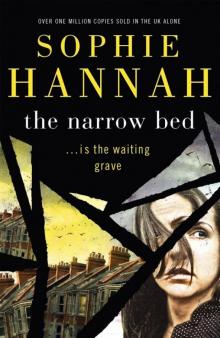
The narrow bed, p.16
The Narrow Bed,
p.16


Worst of all was the nightmare in which my grandmother climbed on stage halfway through my set at St George’s Hall in Bradford (this time I remembered the venue) and shouted to the audience, ‘Will one of you take her? We don’t want her!’
Going back wasn’t safe for someone like me. I could only cope if I looked determinedly ahead. And then I realised I had the answer to another of Gibbs’ questions: why don’t I fear the future, especially when it might contain my murder at the hands of Billy Dead Mates?
It’s because the future’s always been the best bit, the bit that’s not the past – it’s not losing your family, or finding them when you’re eighteen and being hurt by them over and over again; it’s not finding your husband’s hidden stash of drugs for the twenty-seventh time, and having to believe his lame promises that he’ll give up, he swears, he means it this time; it’s not realising that your lover, who’s supposed to have hidden depths, is nothing more than a blank hard surface; it’s not being handed a small white book by a man who looks at you in a way that stops your breath and makes you want to run …
The future is none of those things. It’s where the good things are finally going to start happening. That’s why it’s not scary.
I thought everyone knew this.
From: inessa.hughes@goochandhughes.com
Sent: 11 April 2016 09.21:34
To: Susan.Nordlein@nordleinvinter.co.uk
Subject: Origami by Kim Tribbeck
Dear Susan
Thanks for your email. I’m so glad you love the book as much as I do! And I’m delighted to hear that your jaw hit the floor at the Liv and Gibbs revelation. Mine did too. I agree it’s a legal minefield, but it’s such an intriguing part of the story and I suspect Kim might dig in her heels and refuse to publish without it. Surely Nordlein and Vinter are covered on the legal front by the simple fact of the Liv and Gibbs element being verifiably true?
I’m afraid I haven’t been able to talk Kim out of her favourite hobby of defending Billy Dead Mates on Twitter and Facebook. She jokily refers to it as ‘my pro bono work’. ‘Who would you rather I defend?’ she said when I first broached the subject. ‘Joanna Lumley? Prince George the royal toddler? All the people who’ve done nothing wrong and are being vilified by nobody?’ I didn’t give up quite straight away, but I’m afraid I lost the battle. Kim’s argument is 1) she’s not for a moment claiming murder is acceptable, and 2) blanket condemnation and writing people off as evil only adds to the sum total of pain in the world.
Do you think her portrayal is too sympathetic? I felt for poor old Billy when I read Kim’s book, in a way that I didn’t at all when I heard the news reports. I’m afraid that at that point my only thought was, ‘What a monster!’ We should be prepared for some negative feedback along those lines, I think: that Billy’s depicted as being almost a regular, flawed human like the rest of us, albeit one who took a senseless obsession too far. Though I’ve read and reread the manuscript and there’s absolutely nothing in there than condones or justifies the murders.
I’m sorry to report that I didn’t get very far when I tried to raise the thorny subject of how Kim portrays herself in the book. I told her we didn’t recognise Origami’s spiky, slightly hard-hearted protagonist as the kind, warm, compassionate Kim we all know and love. To no avail: she claims that since she did, thought and felt all the things she attributes to herself in the book, it is accurate and not in need of amendment. (She also told me quite firmly that she is funny, but not a nice or good person, and that I shouldn’t imagine she was just because she makes me laugh.)
This is certainly the most surprising and dramatic project I’ve ever worked on! I passionately believe it will be worth it and I do so hope you agree.
Warmest best wishes as ever,
Inessa
PS I LOVE The Narrow Bed as a title, but Kim is not keen. She has suggested Every Bed Is Narrow, which she thinks is more interesting – but also, I fear, less commercial a prospect! She also said that even if we end up calling it something else, its ‘real’ name will always be Origami.
8
from Origami by Kim Tribbeck
I blame my unsuccessful marriage on the phrase ‘opposites attract’. I met Gabe on a train, having tried not to. I did the polite quick-smile-eyes-down manoeuvre to signal that I wanted to read my book in peace, but he was determined to talk to me, and full of energy, confidence and ideas he wanted to share with a random stranger. He didn’t recognise me from The Village Parallel, a TV show I had a minor part in at the time, so I didn’t suspect him of talking to me only to be able to tell his friends later.
By the time we’d arrived at our destination (we were both going to London – me to see my agent and Gabe to pitch for new business), we’d disagreed about at least ten things, starting with people who claimed they could only sit facing the direction of travel on trains. Gabe thought they were bullshitters who’d been getting away with it for too long.
I disagreed. I was happy to sit facing either way myself, but I’d met a handful of people over the years who soon felt dizzy on a train if they weren’t looking forward. Why would they lie about it? ‘Status,’ Gabe replied without hesitation. ‘If you’re whiny and sensitive, you’re seen as special. If you muck in like a trouper, no one notices or cares.’
‘That’s too cynical,’ I told him. ‘If you’re right and it’s bullshit, they’re not doing it in a calculating way. It’s a psychological defence reflex. Probably means they weren’t fed often enough as hungry babies or something. Now they’re adults, they’ve worked out a few strategies for getting their needs met, but they have to make sure those needs keep coming, as the cue for endless reassurance. When the needs stop, the meeting of them stops too. Then they’re catapulted right back to their childhood misery.’
‘Oh, I’m sure that’s what they’ve all agreed to say if challenged.’ Gabe nodded emphatically, as if no conspiracy could get past him. ‘It’s up to you if you want to take the word of the backwards-facing cabal over mine.’
I couldn’t help laughing. In our early days, Gabe did this all the time: veered towards the surreal when he was losing an argument – not in order to win; purely for entertainment’s sake. It made me realise how dull and rule-bound most people’s conversation was. As I told Marion when she asked about the new boyfriend I hadn’t yet let her meet: ‘He’s as much fun to chat to as a gay man, but straight.’ Marion frowned and said she didn’t think she’d ever spoken to a homosexual.
Gabe was as infuriating as he was amusing. I soon learned that his moral code bore no resemblance to mine. He was happy to wander around with disused marjoram jars full of sprigs of skunkweed nestling in his every pocket, but he thought cheating on your partner was scummy. He was sweetly naïve about sexual exclusivity being an integral part of romantic love. On that first train journey, he proudly declared himself to be the if-you-kiss-anyone-else-it’s-over type, and I showered him with good-natured ridicule for it. (That’s right: he read the small print before he opted in, in case any of you are worried about him.)
As Gabe said in his speech at our wedding, the woman in seat D14 and the man in seat D16 had nothing in common but powerful sexual attraction. This was what convinced me, before our train had pulled into King’s Cross station, that I’d met my future husband. Opposites attract, don’t they? Every romantic book and film ever made tells us that thinking someone’s an utter twat is a crucial pre-love stage that can’t be bypassed or else your relationship is lacking something.
If I were a romantic novelist, I’d want to send out a different message: imagine the same words and behaviour minus the attractive physical shell – would you still be interested? Or would you want to tell the person to fuck off? If the latter, do not marry.
To be fair, it wasn’t only Gabe’s physical beauty that drew me to him. His verbal and intellectual dexterity were partly responsible. But still, in retrospect: do not marry. Divorcing a clever, witty man is no fun at all.
Monday, 12 January 2015
Gabe’s already there when I arrive at Dempster’s Café. He’s holding his iPhone in one hand and typing on his MacBook Air with the other. I don’t need to take a closer look to know that he’s got at least four tabs open on his laptop. Why doesn’t he—
I stop myself mid-thought. Gabe is not my responsibility any more. If he wants to try to do too much at once, that’s his problem. That and his drug addiction.
‘Oh, you’re here,’ he says, looking up. ‘Get a drink – I’ll be with you in five.’
Minutes. You have to add minutes.
‘Is your meeting with yourself running late?’ I say mock-sweetly.
‘Are you comparing a work conversation by email to masturbation?’
‘I was thinking more of self-absorption than anything sexual, but now you mention it …’
‘Ha! You’re doing it!’
‘What?’
‘I feel like a school teacher suspected of pushing illicit chocolate doughnuts onto already overweight schoolchildren.’
‘What?’
‘You’re assessing the size of my pupils.’ Gabe grins. ‘And drawing bad conclusions.’
‘That’s the worst joke I’ve ever heard,’ I tell him. On the substantive issue, he’s right. ‘It’s a hard habit to break. I’m afraid it’ll carry forward into any relationship I have from now on. I’ll stare into the eyes of future beloveds, searching for pupil dilation of the drug-induced variety.’
‘No one would put up with that apart from me.’
‘Is that because you’re an extra-special saint?’ I relent and finally respond to his smile with one of my own. ‘I need a coffee – do you want another?’
Gabe shakes his head. ‘Already had two.’
Dempster’s was his choice, not mine. I don’t like the way they use every inch of wall space to try and flog appalling ‘computer art’ and I don’t like their customers. It’s almost against the rules to come in here without at least one Apple device – Gabe and I have argued about this before, and I still maintain it’s not just a modern life thing. There’s a café three doors down where you can walk in at any time and not see a single MacBook or iPad mini. Dempster’s is the kind of place that might at any moment decide it’s not a café but a ‘connectivity hub’ or some such nonsense; if you order a slice of cake here, you get it on a plank of wood or a shard of black slate.
I buy a double espresso, carry it over to Gabe’s table and sit down. ‘So, are there really people out there who look at their romantic partners and don’t zoom straight in on the eyes in search of evidence of recent bonging?’
‘I’ll be able to give you a definitive answer once my Guardian Soulmates profile goes live,’ says Gabe. ‘That’s what I’ve said I’m looking for: an intelligent, sexy, funny, loyal woman with no narcotics-policing tendencies.’
Unfortunately, he’s joking. I wish he would look for someone else and stop lobbying to get me back.
‘I’m sure you and she will be idyllically happy together,’ I say. ‘Most people are on your side – they see nothing wrong with using marijuana to stupefy yourself day in, day out. Soon it’ll be fully legal everywhere. What a depressing thought.’
‘And yet, all these years later, I’m not stupefied, am I? All the things you said would happen to me – slower reactions, duller brain … See any evidence?’
‘No, but you’re relatively young. And I don’t want to live with a drug addict any more than I’d want to live with a man who was plotting to blow up St Paul’s Cathedral.’
‘What’s the connection?’
‘Vandalism – of yourself, of a beautiful building. It’s the same thing.’
‘Well, either that or it’s a totally different thing and you’re a fanatic.’ Gabe shrugs.
‘Yup. One or the other. The great thing is, we don’t have to have this argument any more. Now we’re apart, you can smoke as much weed as you want. I don’t care.’
Gabe runs his hands through his hair. ‘I hate us being apart. I want you back, Kim. I’m not going to give up.’
‘Oh – you left off the word “drugs” there. You’re not going to give up drugs. That’s why you’re not getting me back. Might as well face it, Gabe.’
‘What if I did give up the weed?’
I laugh. ‘What a brilliant idea! Why didn’t I think of that?’
‘You think I never will because I never did, but you’re wrong. I didn’t before because I didn’t believe you meant it when you threatened to leave me. Now I see you did. That changes everything.’
‘Gabe.’
‘Mm?’
‘I left you ages ago. Since then, have you smoked skunkweed every day?’
‘No.’
‘Oh, fuck off. Gone back to lying about it, have you?’
‘I’m not lying! I bought a vaporiser – treated myself, to cheer me up after getting dumped.’
‘Right. A machine that allows you to ingest the same amount of weed while also indulging your passion for new gadgets.’
Gabe grins and nods. ‘Also, it’s much easier on the lungs. Not at all carcinogenic – which was one of your issues, wasn’t it, body-vandalism-wise?’
‘Yet the destruction of your mental faculties proceeds apace. I’m not impressed. But I will rephrase my question: since I booted you out of the house, has a day passed without you smoking or vaporising skunkweed?’
‘Nope,’ Gabe says proudly.
I sip my tea to hide the sting of pain. I shouldn’t feel it any more, but I do.
‘So your question – what if you did give up weed? – is a pointless one, isn’t it? You never will, because you very much don’t want to.’
‘I’d give up like a shot if you’d have me back. Why not try me? Accept the challenge: if you’re right about me and I screw up on day one, leave me again. There’s no way I could fool you, not with your state-of-the-art pupil-measuring techniques. But if I’m as good as my word, we stay together.’
‘As good as your word?’ I raise an eyebrow. ‘Gabe, in a contest between you, Pinocchio, The Boy Who Cried Wolf and Bernie Madoff, your word would come stone cold last. You’ve lied to me about drugs hundreds of times. For all I know, you’ve found some cunning anti-pupil-dilation device that’ll help you outwit me. Sorry, but I’m not falling for it.’
‘No such device exists.’ Gabe looks annoyed about this. ‘You’re a coward.’
‘I’m a realist,’ I correct him. ‘If you were capable of giving up, you’d have done so the second I said we were finished. That’s what I’d have done if I were you and wanted me back. I’d have said, “Okay, I didn’t think you meant it, but you clearly do, so I’m clean as of now. I’ll take regular drug tests—”’
‘Well, I will.’ Gabe smiles. He looks so reasonable. Reasonable and sexy. I want to hit him. ‘Come on, who else are you ever going to meet who’ll let you test their urine whenever the mood takes you? We’re a match made in heaven. We could even turn it into an exciting sexual role play: you could be a Thai airport official, and I’ll be the hapless passenger who’s had his luggage tampered with, and—’
‘Gabe, stop it.’ I don’t want to chat to him like we used to. It’s dangerous. He knows it, the bastard.
‘Kim, listen. No, I didn’t respond to being dumped by immediately getting “clean”, as you call it – though, you know, I continue to shower and wash my hair every day, and brush my teeth. Why didn’t I ditch the weed on the spot? Because there was no incentive. You’d left me! I felt like shit. I still do. Whether you like it or not, I enjoy smoking weed. For all I knew, you were done with me for good and wouldn’t have me back even if I did make a colossal sacrifice for your sake—’
‘Yes. That is the situation, perfectly summarised.’
‘I can give up skunk, no problem.’
‘No, you can’t.’
‘Yes, I can. But only if you guarantee you’ll make it worth my while.’
‘Fuck off, Gabe.’
‘Promise me that if I’m drug-free for a year, you’ll take me back and stay with me until such time as I reoffend.’
‘No.’
‘I’ll take a drug test every day if you want me to.’
‘No! I don’t want to live with a man I have to test for illegal substances every day, or, actually, ever. Most people don’t do that – you do know that, don’t you? The way normal people live?’
‘Your anti-weed prejudice is a relic from a bygone era, Kim.’ Gabe looks sad for me. ‘Most people—’
‘I don’t care about most people. I hate most people. If I ever have another relationship – which is by no means guaranteed – I need it to be one in which drugs aren’t an issue, any more than arson or gambling is an issue. If no man exists who can give me that, I’ll stay celibate. Look, can we talk about what we came here to talk about?’