The thousand earths, p.2
The Thousand Earths,
p.2


He said, ‘Because it’s as far as we can go. Because we will be reporting back from places nobody has visited before. Because we will return, even if only on the longest of timescales, with some truly startling science. Our own Galaxy seen from the outside. A close-up look at Andromeda. You know that in five billion years or so the Milky Way and Andromeda are going to collide? What an event that will be – and it shapes every future you can conceive of. The earlier we can get a good handle on that, the better.’
She had to smile. ‘You are thinking big, aren’t you?’
‘Well, in the nineteen-sixties President Kennedy set his nation just as tough a challenge, in context: to reach the Moon in a decade. Now Secretary-General Bandanaik has set an equivalent goal: to reach out to Andromeda.’
She nodded. ‘The parallels are obvious. Project Apollo then, Project Perseus now … Why Perseus, by the way?’
‘Well, in myth he was the son of Zeus, king of the Greek gods. A real pre-Hercules hero. And among other stunts he rescued Andromeda from Cetus, the sea monster. Ask me about the relevance of that bit of myth when we get back.’
‘In five million years …’ She looked him in the eye. ‘We used to be married. I still don’t know you. Whatever the logic of the mission itself, why you? Why must you go? You were the first to Neptune. Isn’t that enough?’
‘When you’ve gone to the edge of the Solar System, driving a freighter to Callisto just doesn’t cut it.’
‘You know, and I know, there’s more to it than that.’
He looked away, as if searching for the right words. Or avoiding them. ‘You’re going to ask me about Sarah? On the record?’
‘I have to, John. Because if you don’t talk about it now, nobody will ever understand you, and why you are doing this.’
‘Even if it has nothing to do with my determination to see through the mission?
‘Even if that were true, and most people wouldn’t believe it anyhow.’
He looked down, at fingers nested around his own cup, on the table. ‘You want me to summarise the event? For the sake of your piece. In my own words?’
The event. ‘No, John,’ she said softly. ‘Just tell me how you feel.’
And, she was sure, they both knew what she meant.
3
Sarah had been their niece, daughter of Denise’s sister, her only sibling.
John had no siblings. And he had grown up sterile, thanks to a gene-warfare attack on London when he was a boy. So Sarah was precious to the whole extended family – and had always seemed particularly so to John, otherwise introverted, emotionally undeveloped. Or so even his wife, Denise, found him.
The accident that killed Sarah had been a freak.
They had been holidaying in the national forest that, in the twenty-second century, much of northern England had become. One evening, while the evening meal was being prepared, Sarah, six years old, wandered off, alone.
And the ground had given way under her, as simple as that. She fell deep, and then lay, stunned, in a puddle of groundwater, deep enough to drown her before she woke.
It was a sinkhole, the geologists decided at length. A freak, caused by groundwater slowly dissolving a layer of gypsum in the bedrock, creating a kind of hidden underground cavity – a cavity whose roof eventually gave way.
This was ten years before. It seemed to Denise that John had never recovered. She said so now.
He shrugged. ‘Recovery is an inappropriate concept—’
‘You speak about yourself in the third person when you talk of such things. No, not even that – you talk of incidents, feelings, as if they were external to you entirely. As if you were describing a faulty engine component.’
He looked surprised at that. ‘Well, I am an engineer, at bottom. Engineer and scientist. I … it was the sheer randomness of it.’
‘That made it hurt more?’
‘I looked it up. You know this … for the record. The sinkhole. It turns out to have been a phenomenon of deep time. That gypsum layer was a relic of a drying sea that existed back when the area was at the heart of a supercontinent, called Pangaea. This was maybe a quarter of a billion years ago, or more. All that time, you see, and that bit of ground could have given way at any time, any of those ten thousand trillion seconds – but it just had to happen in the one second Sarah was walking over it, over that primeval cavern.’ He said this calmly.
She reached out, held his hands, still wrapped around his cup. ‘And that’s why,’ she said. ‘That’s why you’re flying off into the far future. Because Sarah was killed by deep time. Are you sure that’s going to fix you?’
‘Fix me?’ He looked at her. ‘Look, you can write all this down as you like. I just want to remember her. For somebody to remember her. For as long as is technically possible.’
She thought that over. ‘People say this trip is a kind of sublimated suicide—’
‘No. I see it as an extension of human consciousness, of memory, far into the future. Of empathy, even. A new evolutionary step, if you will. As for Sarah – I’ll remember her as long as I live.’
She nodded. ‘We will remember. And then what?’
‘She’ll be remembered as long as the Sun shines.’
‘And then what?’
‘As long as the stars shine.’
‘… And then what?’
He just grinned.
‘And me, John? Will you remember me?’
He withdrew his hands. He sipped his drink.
‘Always,’ he said. ‘You are my Andromeda. Well. I should show you the control room …’
4
She returned to Earth, and never saw John Hackett again.
And, after years of routine reports, she heard only one piece of significant news about him.
The event occurred about ten years and five months after the departure of the Perseus, with the ship about ten light-years from Earth – and with only eighteen months having elapsed for Hackett, such was the ferocious piling-on of relativistic time dilation. The news, of course, had taken another ten years to limp back to Earth. More than twenty years after he had left.
Hackett had been revived, as he was, briefly, regularly, every six months as the ship settled into its long journey, to supplement automated checks with a human inspection.
He found his six crewmates, all of them, were dead.
A little checking proved to his own satisfaction that the cause was sabotage – presumably, he reported, by political opponents of the mission, either outside the UN or even within it.
Why not kill all seven, though? Some speculated that Hackett himself, a victim of his own complex motivations, might have been the murderer – or maybe, Denise had thought darkly, he had given in to those suicidal impulses she had suspected, after all.
But the ship’s internal records, downloaded to Earth, showed traces of deep malware in the operating system, malware demonstrably in place long before the ship’s departure, malware with no apparent connection to Hackett, requiring nothing to be precipitated by him in flight. Hackett denied any responsibility; most people believed him, Denise saw. And so did she.
Hackett himself speculated that he had been left alive, alone, on purpose: solely so he could make the confirmatory report of the deaths of the others. In the expectation that he would be unable to complete the mission solo.
But that wasn’t going to be the case, he reported.
When he had recovered from the discovery, he sent his crewmates’ bodies, carefully preserved in their sleep tanks, with suitable markers and origin information, out in six diverse directions. Each of them a pioneer of a new realm of deep space. He reported on this.
And then concluded, ‘Very well. Alone. Perseus out.’
Mela
Years 30 to 22
5
Year 30
On the evening before the funeral of their great-aunt Vaer, and thirty years before the end of the world, Mela took her twin sister Ish out to count the Earths.
They walked together from their house on the edge of town, and then to a low hill, set in parkland, a favourite playground for the two of them since they had been small. Well, Mela reflected, as they headed up the grassy slope, favourite at least since big brother Tabor had decided that it was more fun to run with the gangs of boys in the town than to pick on his little sisters when their parents were out of sight. They were safe here now.
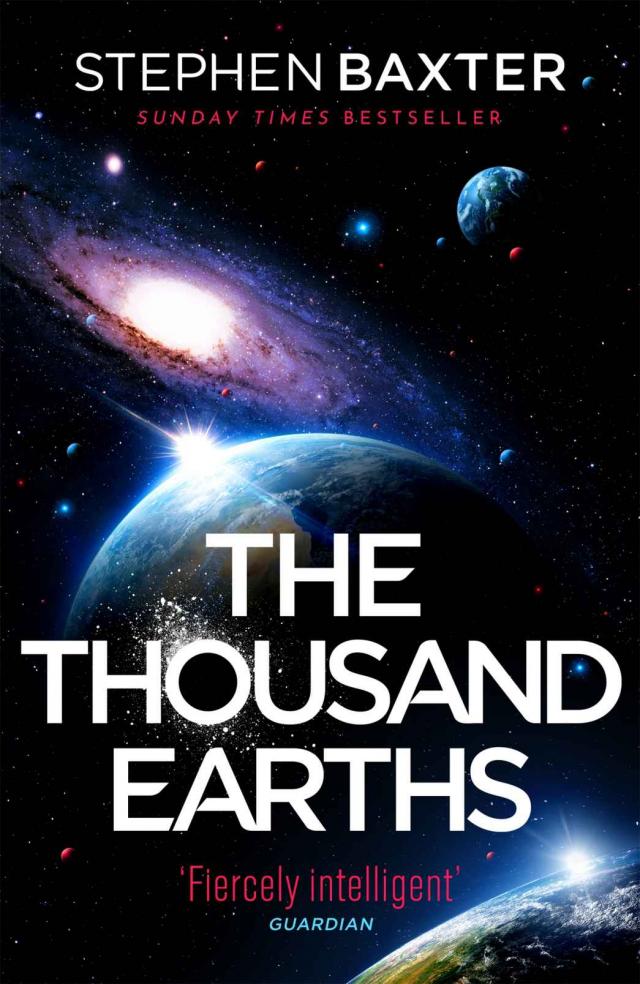
It was a steady climb, and the path was easy to pick out in the muddle of light from the cloudless sky. The ruddy background swathe of the stars was a setting for the bright blue-green diamonds of the thousand Earths in their regular array, as if the whole sky was a jewellery box, Mela sometimes thought, like the big box her parents shared, a fascination of studs and clips and pins and brooches that Mela and Ish, twelve years old, were not yet old enough to be allowed to handle.
And, under that sky, Mela was learning to appreciate the way the view around her unfolded as they climbed higher. You could see the roofs of the houses and inns and shops, and the broad, shining vein of the River as it passed through Procyon. Of course the River, the town, this home from which she had yet to venture far even with her parents, was a mere waystation, as she knew now. Just one more place for the River to pass in its twelve-hundred-kilometre journey from the Heartland Mountains at the centre of this Earth, all the way south to the Perimeter, where, it was said, the flow dissipated in the Tide, a waterfall full of the light of the end of the world.
And, looking downstream of the town, she saw that this evening the River was mirrored by a kind of ribbon of light, following the bank’s graceful curves, perhaps twenty metres from the water. That was a caravan, she knew, Immigrants, thousands of them from some other town further south. They were fleeing the Tide, fleeing the advancing Perimeter, steadily plodding upstream.
The Immies were camped for the night, she imagined, and she saw the glistening of their lamps and fires. But they were supposed to have passed through the town by tomorrow night.
Tomorrow being the day of Aunt Vaer’s funeral, of course, so Mela and Ish would be down at the cemetery, near the River, when the Immigrants might pass. Mother – and Father too, to some extent – had already issued stern warnings to the girls, Tabor too probably, about keeping a safe distance from the Immigrants, to let the Town Guards do their work if there was any trouble.
As she took in all this, Mela kept an eye on Ish, who, as usual, lagged behind as she climbed. The walk was deceptively steep. They were both panting by the time they reached the summit of the hill.
There were a couple of benches here, and play frames, litter left scattered on the grass by earlier walkers. Ish threw herself down at the base of a wooden play frame, and leaned back against a post. Rather than sit on the cold ground, Mela would have preferred to climb the frame. Even maybe hang upside down, so that it was as if she held up her whole world like a tremendous dish over her head, thrillingly threatened by the prospect of an endless fall into the sea of stars and Earths. But Ish was rarely up for that sort of thing, and certainly not tonight. So Mela sat down beside her, legs crossed, on a patch of bare dirt that wasn’t covered in damp, dewy grass.
And Ish was already counting the Earths. ‘Fifteen. Sixteen.’ She pointed to each one, each glowing dish in the sky.
Mela squinted. ‘I can never tell which ones you are pointing at.’
Though they were far outnumbered by the jumble of crimson stars beyond, and though they were regularly spaced across the sky in their cloud, the Earths were a bewildering horde, as if hanging from invisible threads, each a blue dot surrounded by a wider, elusive, silvery glimmer.
The teachers at school had tried to explain the sky, starting with baby-talk when the pupils were small, progressing to more detail as they grew older – even diagrams, numbers.
Mela knew that you had to imagine a greater sphere, with all the Earths, including this, her home world, like flat panels fixed to the inside of that sphere. She had long known that she would always be worse at geometry than at books and geography and stuff about people, but she got the general idea.
So here she was looking up at the interior of that greater, imaginary sphere, lying on one of those panels, looking up at the rest of all the panel-worlds around her own. Some were closer, others – nearer the apex of the sky – farther away, looking smaller.
The Earths were all the same size – the same size as her own – so the nearer they were, the brighter they looked, on average. But even on the nearest of those worlds you couldn’t make out features, not with the naked eye, as you would see on a map, if only because they were all but edge-on to her own. But Mela had learned at school that you could see more detail on distant worlds through telescopes.
To add to the spectacle, at any moment some worlds were dimmer than others, some brighter. They all went through their own daily cycles, as the daylight glow crept across their lands and seas, and washed away back to the night again – just as happened on Earth, their Earth, Mela’s and Ish’s. And, she supposed, her Earth would just be a blue smear to somebody living on one of these other Earths, lost in the cloud.
And still Ish counted them, every time they came out here like this, seeing how many of the legendary thousand she could pick out.
They were twins but not identical, as her parents always felt necessary to explain to people. Ish had always been smaller physically, quieter, shyer than her sister. Just as Mela had led the way up the hill now, so it was Mela who usually chose what game to play or book to read, Mela who read stories to her sister when she was sickly rather than the other way round, Mela who protected Ish from Tabor’s occasional meanness. The doctor said there was nothing wrong with Ish. Father called Ish precious, and Mela noble. Mother, when she looked up from her work – all her buying and selling, buying and selling – called Ish a coward.
Anyhow it was only now, now that they were twelve years old, that Ish seemed to be coming out of her shell and finding her own interests, her own path. Like counting the Earths.
‘Fifty-two,’ she whispered now, her head subtly moving from side to side. ‘Fifty-three. Fifty-four.’
Mela took her hand. ‘I just don’t see how you can even get that far.’
Ish said, ‘I always pick one easy one to start with. Such as that big bright one. See?’
Mela could see; that particular Earth seemed bright enough to cast reflections from the roofs of the town below.
‘And then I just work out from there. Like a – a twirly thing. You know.’
‘A spiral?’
‘Oh, you made me lose count. Never mind, I’ll start again. I got to a hundred and twenty-four, once.’ She smiled.
Mela smiled back. ‘Including our Earth. The Earth.’
‘I know. Counting our Earth. Nine hundred and ninety-nine up there! One down here! I’ll get to a thousand one day, you’ll see.’
‘No, you won’t, you stupid.’
That was Tabor’s voice.
Glancing around, Mela saw her brother stomping up the hill. He seemed to drag his feet deliberately so as to obscure the footprints the girls had made in the dewy grass. As if erasing their traces. His mood seemed twitchy.
He was looking for something to do.
Mela’s heart sank a little, and she was on her guard.
‘Mother says to come home. You’ve got to get your suits fitted for the funeral.’
Fifteen years old – three years older than the twins – he had much the same dark colouring as the girls, but he was much bigger than either, his voice already deep, like a man’s, Mela thought. But now he put on a whiny tone. ‘Oh, it’s all such a rush.’
Mela snorted. ‘Who’s that supposed to be, Mother or Father?’
He pulled a face. ‘Who’s that supposed to be? Who’s that supposed to be? You think you’re smart, don’t you? You’re as stupid as she is.’
Ish scowled, her expression clear in the muddled Earthlight. ‘I’m not stupid, you—’
‘Oh, leave her alone,’ Mela said.
‘Leave her alone,’ Tabor parroted. ‘To do what? Count to ten, forget what comes next, and start all over?’
Ish scowled and turned away.
Mela just felt … tired. Tabor was always like this, out of sight of their parents anyhow, and sometimes even when they were around – particularly Mother, who was a lot less likely to pay attention and to dish out punishment. Tabor didn’t usually harm you that badly. But he was relentless. Every day was the same.
She said, ‘I like hearing her count. And what difference does it make to you?’
He grinned. ‘I just like hearing you two be stupid, that’s all. Counting the Earths is stupid.’
Ish protested, ‘No, it’s not—’
‘It is. Because the Earths aren’t important. Mother says so. She says the stars are much more important, and they think at each other, and if you could only see their thoughts you’d have something worth counting.’
Mela frowned, uneasy.
Tabor, typically, was picking at a scab, another flaw in their family. And he was doing it just to be cruel.
Mother and Father followed different faiths, she the Starrist, he the Perseid. The two great creeds sometimes worked together, and sometimes fought. ‘They are complementary,’ her father had told her, spelling the word for her. ‘They talk about the same … universe. The same mankind, the same us, and our place in that universe. The same stars, the same Earths, the same history. They just think different bits are important.’
But, Mela had learned, those differences of doctrine had caused wars in the past, back in history, and had sometimes caused wars in their own household. Such as over the funeral arrangements for Aunt Vaer, as they called her, actually Mother’s own aunt. What kind of service should it be – Starrist austerity or Perseid humanity? And Tabor was old enough to see the barely concealed differences between their parents as a mine for spite, because those differences frightened his sisters.