

Year of the serpent malc.., p.1
Year of the Serpent (Malcolm Chaucer Thriller Book 3),
p.1
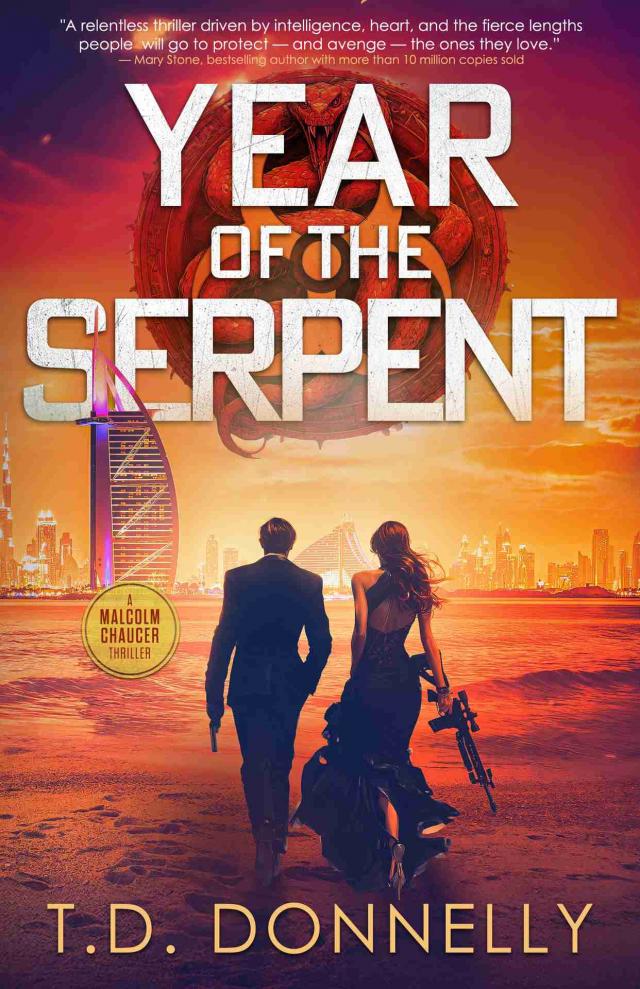


First published by Thunder Road Press in 2026
Copyright © T.D. Donnelly 2026
All rights reserved
ISBN: 978-1-965247-04-4 (eBook)
No part of this publication may be reproduced, stored, or transmitted in any form or by any means—electronic, mechanical, photocopying, recording, scanning, or otherwise—without written permission from the publisher. It is illegal to copy this book, post it to a website, or distribute it by any other means without permission. No part of this book may be used, stored, or reproduced for the purpose of developing or training artificial intelligence systems or technologies. Names, characters, businesses, places, events, and incidents are either the products of the author’s imagination or used in a purely fictitious manner. Any resemblance to actual persons, living or dead, or actual events is purely coincidental.
Cover art designed by Miblart
Edited by Nancy Finch
Interior formatting by Rebecca Millar
CONTENTS
Praise for T. D. Donnelly
Malcolm Chaucer returns…
Prologue
Chapter 1
Chapter 2
Chapter 3
Chapter 4
Chapter 5
Chapter 6
Chapter 7
Chapter 8
Chapter 9
Chapter 10
Chapter 11
Chapter 12
Chapter 13
Chapter 14
Chapter 15
Chapter 16
Chapter 17
Chapter 18
Chapter 19
Chapter 20
Chapter 21
Chapter 22
Chapter 23
Chapter 24
Chapter 25
Chapter 26
Chapter 27
Chapter 28
Chapter 29
Chapter 30
Chapter 31
Chapter 32
Chapter 33
Chapter 34
Chapter 35
Chapter 36
Chapter 37
Chapter 38
Chapter 39
Chapter 40
Chapter 41
Chapter 42
Chapter 43
Chapter 44
Chapter 45
Chapter 46
Chapter 47
Chapter 48
Chapter 49
Chapter 50
Chapter 51
Chapter 52
Chapter 53
Chapter 54
Chapter 55
Chapter 56
Chapter 57
Chapter 58
Chapter 59
Chapter 60
Chapter 61
Chapter 62
Chapter 63
Chapter 64
Chapter 65
Chapter 66
Chapter 67
Chapter 68
Chapter 69
Chapter 70
Malcolm Chaucer returns…
If you enjoyed this book
Also by T.D. Donnelly
Acknowledgments
About the Author
PRAISE FOR T. D. DONNELLY
“YEAR OF THE RABBIT is a compelling page-turner with expertly drawn characters and an intricate plot chock full of twists and turns. T.D. Donnelly can tell a story!”
—Marc Cameron, New York Times bestselling author of Arliss Cutter, Jericho Quinn, and Tom Clancy/Jack Ryan Thrillers
“With Malcolm Chaucer, T.D. Donnelly has created one of the most original heroes in recent spy fiction. YEAR OF THE RABBIT is a brilliantly paced thriller that will have you ripping the pages to get to the next twist.”
—Brian Freeman, New York Times bestselling author of Robert Ludlum’s Jason Bourne series
“Sensational! A page-turning thriller with a truly original character in Chaucer. I couldn’t put it down. The spy thriller of the year is here!”
—J.F. Penn, New York Times and USA Today bestselling author
“Fast, intense, gritty. This is the type of thriller I can SEE as I read. Perfect for fans of the genre, and I wouldn’t be surprised to see Malcolm Chaucer on the big screen real soon!”
—Nick Thacker, USA Today bestselling author
“A uniquely fascinating protagonist, non-stop action, and stakes that keep rising make YEAR OF THE RABBIT a wild ride — and great fun. Strap in, and cancel your plans."
—Joseph Finder, New York Times bestselling author of THE OLIGARCH’S DAUGHTER
“A stellar debut! This may be T.D. Donnelly's first novel, but it's clear from page 1 that he's been working on his craft. This story is a thrill ride from start to finish. YEAR OF THE RABBIT has everything: murder, spies, interrogations, chases, and political intrigue. Malcolm Chaucer is a compelling protagonist, and the propulsive storyline never slows down. We will be hearing much more from T.D. Donnelly. Highly recommended.”
—Sheldon Siegel, New York Times bestselling author of SPECIAL CIRCUMSTANCES
Malcolm Chaucer returns in the novella…
YEAR OF THE SHEEP
Absolutely FREE just for signing up to my reader group
at TDDONNELLY.COM
For Aidan
Whose heart is as big as the world, and whose mind is as sharp as Chaucer’s himself. You fill me with awe. I can’t wait to see the adventures you’ll have in your life!
PROLOGUE
Special Facility No. 8
Murmansk, USSR
September 4, 1972
An anemic half-bell woke Dr. Lukin Borzov from his slumber. He was a slim man—barely 150 pounds and five foot six—with oily black hair that currently flopped into his face. He fumbled around in the darkness of his small bedroom, barely twice the size of his single cot, until he found the room’s lone lamp and switched it on. The lime-green walls of the small space illuminated, revealing the cot, a small end table, and some portable wire shelving that Borzov had turned into a kind of dresser for his clothes.
The mechanical alarm clock on the table said 6:30 in the morning. He was confused. He had worked the late shift in the special facility and was still supposed to be sleeping for several hours.
That was when he realized the alarm had not gone off. The bell was not the alarm clock.
The bell was the phone.
The phone in his room was decoration more than anything. It never rang. In fact, it had been so long since it had rung, Borzov did not at first even know where it was. He located it under his bed, wedged between two untidy stacks of research papers. He pulled out the ancient, stamped metal device and lifted the receiver to his ear. “What—”
The voice on the other end was Gureyev, a fellow scientist. A bit of an alarmist, but a decent mind. His voice was unusually strained, and it was hard to hear him over some kind of background noise. “Lukin! Lukin! We have a containment breach!”
Borzov remained calm. Silo number eight contained some of the most dangerous substances created by man. Containment was an ongoing worry. Still, the noise in the call's background put him on edge. “What is that racket I’m hearing?”
“The containment alarm.”
Borzov bolted fully upright. This was wrong. This was very wrong. The facility was constructed like an onion. The “live” lab was the heart of the onion, with a strict containment protocol comprising a semi-vacuum chamber, steel vault doors, and Krasny Level bio-suits, what the Americans called Level 4 Biosafety Level, reserved for the truest monsters science could create. Outside of that vault door was another containment zone filled with sterilization zones and another vault door, leading to the main observation area, which itself was sealed by a third layer of detection and protection.
The worry that grew inside Borzov sprang from the fact that each layer of the onion had a unique set of sensors and a different alarm. And what he heard in the background of the call? He failed to identify it because he had never heard it before. The primary zone alarm had sounded a handful of times. The secondary zone alarm: never. Not once.
“I want you to be very clear with me, Gureyev. What alarm am I hearing?”
“We have a level two breach alarm, comrade!”
Borzov felt his stomach lurch. He wanted to vomit. This was unheard of. This was potentially a disaster. How something could’ve escaped detection and decontamination—it boggled the mind. Then, suddenly, Borzov pictured what could do this. He pictured the demon they had placed in a bottle. The thing that frequently kept him up at night. He had to find out.
“Which variant?” he asked. It was all Borzov said, but in his mind he already knew what the answer would be.
The voice on the other end replied, “Variant 1-1-1.”
Lukin Borzov said nothing further. He leapt into the clothes he had worn the previous night, racing like a man possessed to make it down to the lab. This bedroom, at his request, was located inside Special Facility No. 8. Given the hours he slaved over this project, the half-hour drives to the nearest town were simply too much wasted time, so he moved inside the special facility. And now, that decision seemed particularly wise.
Variant 1-1-1 was threatening to be on the loose. The Red Serpent was attempting to escape.
Doctor Gureyev, a bear of a man with curly red hair and beard, met Borzov as he ran into the lab. “We don’t know how we missed it!” Gureyev shouted.
Borzov barely heard him over the incessant alarm b
ell ringing on the far wall. He stared at the two desks nearest him, both with flashing red lights and vacillating needles deep in the red zone of their respective instruments.
“Which alarm sounded first?”
Gureyev gulped. “Both at the same time.”
It should not have been possible. And yet, every reading on every workstation verified it. The Red Serpent, variant 1-1-1, was just one door from the entire world.
Just then, Victor Fradkin burst into the room. Fradkin was a frail, older man; his face a mask of total paranoia.
“How did this happen?” Fradkin yelled.
“Variant 1-1-1,” Gureyev said.
Fradkin yelled back, “What were they thinking? We should never have allowed it to be studied!”
Dr. Lukin Borzov, star of the Soviet Union’s microbiology division, knew the answer all too well.
A chemical and biological weapons treaty was about to be signed, and their friends in the Politburo wanted to reassess every monster they hid under rocks like this one. They wanted to know what to destroy and what to hide.
Little did they know that sometimes, when you lift a rock, the monster springs loose.
Borzov finished his scan of the instruments and turned back to Gureyev and Fradkin.
“Containment seems to be holding at the second barrier. Nothing has ever broken through the third. We should be fine. Who is locked inside?”
“Just Dr. Mara Latsis, I believe,” Fradkin said. “She was finishing her shift, on her way out, when the first alarm sounded. Then, the second, just a moment later.”
The hairs on the back of Borzov’s neck rose.
“What do you mean she was on her way out? Where exactly was she when the alarm sounded?”
Fradkin looked to Gureyev. Gureyev looked to Fradkin. Neither of them knew.
Borzov crossed the room to a metal box mounted on the wall—an internal communications unit. He keyed it, turning the dial to the Level 2 containment room.
A moment later, Dr. Mara Latsis picked up.
“Mara, what is your situation?”
The voice on the other end was not the confident, cocky woman he had worked with for the past five years. This was a woman shaken to her core.
“I was testing 1-1-1 as instructed. All procedures were followed. It was returned. I was decontaminated, and I resealed the lab. I went through the second containment level and sealed that. I was heading out the third lock when the alarm sounded.”
Borzov felt a lump in his throat.
“Heading out the third lock? Have you breached the airlock door yet?”
“Yes—but only the inner door. I hadn’t yet reached the outer door. When the alarm sounded, I got scared. I retreated out of the airlock and back into the Level 2 containment zone.”
Borzov controlled his breathing.
That act may have just doomed her—and may have just saved the facility.
If sample 1-1-1 had reached two containment levels and made it into that airlock, there was no telling whether that single door would hold it back.
“You will get the Order of Lenin for this,” Borzov said. “I promise you.”
He thought he heard a sob on the other end. He realized instantly his mistake.
He was speaking to her as though she were already dead.
Of course she was. The Red Serpent could not get out.
Discovered in the 1950s, it was the Soviet Union’s emergency measure if it lost the energy race. Experimented on for a decade after that, it gradually transformed from a weapon into an absolute monster. And no variant was as monstrous as Variant 1-1-1.
Dr. Mara Latsis’s action may well have saved her lab, her team, the Soviet Union, and likely the entire world. But it would not save her.
Once containment was assured, they would pump pure oxygen into the inner chambers, then burn every living thing inside until they were absolutely certain nothing could survive.
But that was nothing compared to Special Facility No. 8’s ultimate contingency.
Borzov shuddered at the thought.
If the third alarm sounded, they were all doomed.
If Variant 1-1-1 escaped, Borzov knew he would need to preserve the last remaining sample—if only to give his fellow scientists a fighting chance.
“The backup samples,” he said. “The hardened cases. Have you checked them?”
Gureyev snapped out of his reverie. “No, sir. We were more concerned with what was happening.”
“Give me the vault code,” Borzov cut him off. “Now!”
Gureyev scurried to his desk, flipping through a binder. Instead of writing it down, he ripped the page out and handed it to Borzov.
Just then, the klaxon sounded.
The alarms for Level 1 and Level 2 were bells.
Level 3 was an air-raid siren.
It was deafening. A dozen more would sound throughout the facility. Why the designers thought such an alarm necessary was beyond Borzov.
The sound spelled doom for nearly everyone.
Nearly.
Borzov raced down the concrete hallway and into the vault room. A heavy steel bank vault stood before him. He turned the massive tumbler—chunk-chunk—and pulled on the door.
It barely budged.
He pulled harder, straining his barely used muscles to their limit.
Then it moved.
Inside were shiny metal cases in cages.
He unlocked the cage marked 111, pulled the case free, and ran for his life.
Special Facility No. 8 lay one hundred feet beneath the earth. The silo elevator took a full minute to reach the surface—the longest minute of Borzov’s life.
He stared overhead, at the light emanating from the door atop the shaft. Freedom. Even here, Borzov could smell actual air, not the canned, recycled stuff they breathed below.
Then, suddenly, the elevator stopped. It was four feet short of the top of the shaft.
Had it seized? Had the power been cut?
Borzov didn’t stop to think. He reached up and grabbed the bottom of the door with both hands. He forced the door open, snaked his body out, dragging Case 111 behind him.
He breathed in the crisp September air—and heard helicopter rotors.
Special Facility No. 8 looked like less than nothing from the earth’s surface. Barely a mound on the vast, undulating tundra. The only indication it was anything more than a small hill was a parking lot at the bottom of the hill and a helipad on the other side of the mound. In that direction, Borzov heard the unmistakable sound of a Sikorsky spinning up for lift-off.
He ran.
Two soldiers trained their Kalashnikovs on him, lowering them only when they recognized their director.
“We have strict orders,” one said. “No one is to leave!”
Borzov held up the case as if it were a religious relic.
“This is the greatest weapon the Soviet Union has ever designed. It cannot be lost. Step aside!”
They hesitated—then did as he commanded.
Thirty seconds later, he was aboard. A minute after that, the helicopter lifted off.
The pilots did not ask questions. They were only too happy to leave.
Borzov’s foot tapped nervously. Any second now.
Would they be far enough away? Or was their fate already sealed?
With each second, Borzov felt better. He felt that he had escaped fate itself.
Then the rotors stuttered. A moment later, the engine sputtered.
Borzov knew instantly.
The elevator had not failed by chance. It had been contaminated by the Red Serpent. Borzov himself had become a carrier. And now, his one hope, this helicopter, had been contaminated.
The pilot shouted, “Brace for impact!” and pulled the autorotation lever.
The helicopter slammed into the earth, upright but wrecked.
Borzov grabbed the case and ran.
He made it three steps. Then the ground erupted.
Beneath Special Facility No. 8, the ultimate contingency detonated. A hydrogen bomb. To Borzov, everything in his field of vision went white.
In his ultimate act, Borzov hurled Case 111 away from the blast.
He saw the fireball reflected in its polished steel as it sailed through the air.
CHAPTER 1
Two feet of fresh snow was a perfect silencer. A Russian jeep, a UAZ Hunter, sped across a barren field of pure white, making barely a sound. Four men occupied the cramped, spartan interior and soaked in the quiet. Three were trained killers, and one was their prisoner.


