The morningside, p.1
The Morningside,
p.1
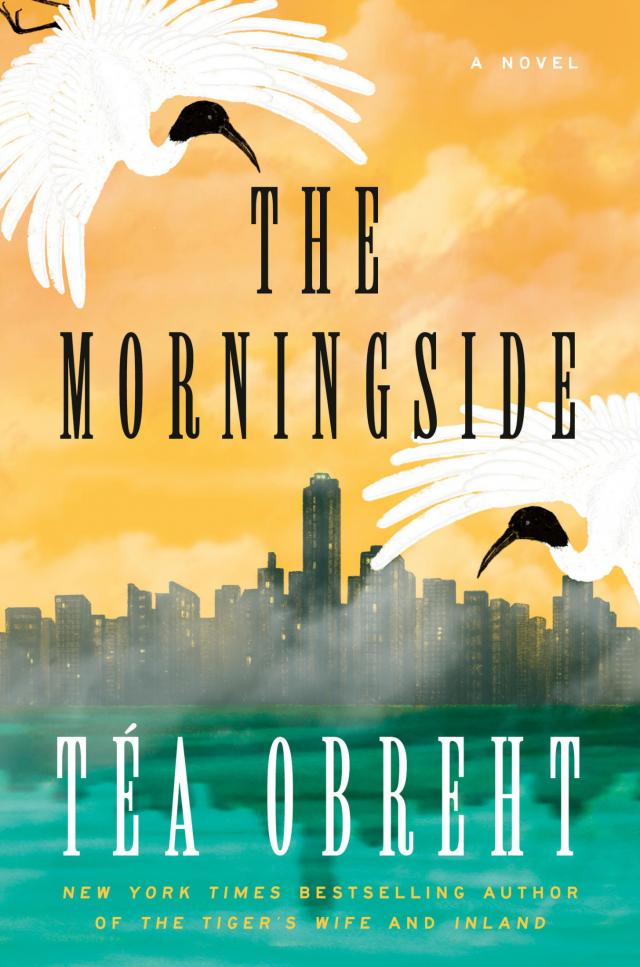


The Morningside is a work of fiction. Names, characters, places, and incidents are the products of the author’s imagination or are used fictitiously. Any resemblance to actual events, locales, or persons, living or dead, is entirely coincidental.
Copyright © 2024 by Téa Obreht
All rights reserved.
Published in the United States by Random House, an imprint and division of Penguin Random House LLC, New York.
Random House and the House colophon are registered trademarks of Penguin Random House LLC.
Library of Congress Cataloging-in-Publication Data
Names: Obreht, Téa, author.
Title: The morningside: a novel / Téa Obreht.
Description: First Edition. | New York: Random House [2024]
Identifiers: LCCN 2023011845 (print) | LCCN 2023011846 (ebook) | ISBN 9781984855503 (Hardback) | ISBN 9781984855510 (Ebook)
Subjects: LCGFT: Novels.
Classification: LCC PS3615.B73 M67 2024 (print) | LCC PS3615.B73 (ebook) | DDC 813/.6--dc23/eng/20230313
LC record available at https://lccn.loc.gov/2023011845
LC ebook record available at https://lccn.loc.gov/2023011846
International edition ISBN 978-0-593-73269-4
Ebook ISBN 9781984855510
randomhousebooks.com
Book design by Virginia Norey, adapted for ebook
Map © Jeffrey L. Ward
Cover design: Lucas Heinrich
Cover illustration: Nana An
ep_prh_6.3_146464160_c0_r0
Contents
Cover
Title Page
Copyright
Map
Prologue
Book I: Ena
Book II: Bezi Duras
Book III: Mila
Book IV: My Mother
Dedication
Acknowledgments
By Téa Obreht
About the Author
_146464160_
An old familiar dread was waiting for me this morning. I couldn’t tell where it came from. It hadn’t followed me out of a dream—at least not one I could remember—but when I got up, there it was in everything. The airless heat of the motel room. The halo of sunlight around the window shades. The vacant smile of the girl at the front desk when she took the key from my hand.
I thought it might stay behind when I left the motel, but it hitched a ride through the desert with me. Just sitting there. Tightening the world. It knew me so well.
When I got to the train station, I finally gave in and did what I knew the feeling was after me to do: I looked up my mother. I hadn’t done it in a long time because the suspense made me sick, even though what I imagined I would read was always worse than what was actually posted. It didn’t feel like the kind of morning for bad news: quiet, unusually free of wildfire smoke, blue, and windless. The train was late, the platform mostly empty. A few passengers had drifted out of the station and were standing in the sun as they looked down the track. The handful of others, like me, were clearly there to meet someone. It was the calmest I’d felt all week, so I thumbed my mother’s name into the search bar. There was the brief nervousness that always stopped my breath before the forums loaded. The dread of something having changed, some new, poisonous derangement. Usually, there was nothing. Hadn’t been for years.
Today was different. A new picture had been added to the Belen case file. It was not, as I always feared it would be, a police snapshot of Mila’s corpse. It was a Polaroid taken almost sixteen years before, the day we arrived in Island City. In the picture, my mother and I are backlit by the vanishing sun, standing side by side on Morningside Street. Our suitcases aren’t quite out of view. We’re smiling halfheartedly, hovering just far enough away from each other to make a comfortable embrace impossible. My mother looks worn and flustered, standing there in an old dress of mine that is clearly too long for her. I’m the tallest eleven-year-old you’ve ever seen: gangly, shapeless. I’ve got my arm some of the way around my mother’s shoulders, and am obviously smiling just to oblige the person behind the camera: my aunt Ena, whom I haven’t yet hugged hello.
I remembered the moment the picture was taken, and vaguely remembered seeing the finished result pinned up on our fridge, until it disappeared under months of Repopulation Program leaflets. I hadn’t seen it since we escaped, and hadn’t thought about it in years. But here it was, after all this time. Who had put it up? And how the hell had they gotten hold of it? And when? Here I’d been going about my life, thinking this memory and this picture were back in the past somewhere, invulnerable to even the kinds of things I was afraid of—and yet, for some unknown while, strangers had been peering at it on their cursory journey through the handful of forums still devoted to the question of my mother’s criminality.
It didn’t take me long to feel dizzy enough to faint. When the vendor walked by, I got a bottle of water from him and drank the whole thing in one tilt.
Then it got worse. In the background of the photo, way up the sloping street behind us, I recognized the unmistakable form of Bezi Duras. She was just starting up the hill, and her three dogs—rangy silhouettes, black as the gaps between stars—were out ahead of her. Whatever I remembered of this photo, Bezi Duras certainly wasn’t part of it. Neither were the dogs. How funny, I thought. Here I’d had a very different, very specific memory of the first time I saw her, and all the while, this picture had been out there, confirming an entirely incompatible truth. Some stranger, whose name I did not know and face I would never see, had held all of us together in the palm of their hand: Bezi, my mother, me. Even Ena, offscreen. The only person absent from the scene, fittingly enough, was Mila.
Of course, also fittingly enough, she was the only person the people commenting on the picture really cared about. They couldn’t put any of it together. The furthest they could get with it was “Isn’t this the woman from the Belen case?,” which earned them a smattering of replies from strangers.
For the first time in years, I thought about adding my two cents. What harm would it do to chime in? To write something like “You don’t have the first clue.” There were plenty of anonymous comments. Nothing would set mine apart. Nothing would point back to me.
But then the loudspeaker crackled to life, announcing the coming train, and I x-ed out of the forum, stood, and went forward with my little sign.
BOOK I
Ena
Long ago, before the desert, when my mother and I first arrived in Island City, we moved to a tower called the Morningside, where my aunt had already been serving as superintendent for about ten years.
The Morningside had been the jewel of an upper-city neighborhood called Battle Hill for more than a century. Save for the descendants of a handful of its original residents, however, the tower was, and looked, deserted. It reared above the park and the surrounding townhomes with just a few lighted windows skittering up its black edifice like notes of an unfinished song, here-and-there brightness all the way to the thirty-third floor, where Bezi Duras’s penthouse windows blazed, day and night, in all directions.
By the time we arrived, most people, especially those for whom such towers were intended, had fled the privation and the rot and the rising tide and gone upriver to scattered little freshwater townships. Those holding fast in the city belonged to one of two groups: people like my aunt and my mother and me, refuge seekers recruited from abroad by the federal Repopulation Program to move in and sway the balance against total urban abandonment, or the stalwart handful of locals hanging on in their shrinking neighborhoods, convinced that once the right person was voted into the mayor’s office and the tide pumps got working again, things would at least go back to the way they had always been.
The Morningside had changed hands a number of times and was then in the care of a man named Popovich. He was from Back Home, in the old country, which was how my aunt had come to work for him.
Ena was our only living relative—or so I assumed, because she was the only one my mother ever talked about, the one in whose direction we were always moving as we ticked around the world. As a result, she had come to occupy valuable real estate in my imagination. This was helped by the fact that my mother, who never volunteered intelligence of any kind, had given me very little from which to assemble my mental prototype of her. There were no pictures of Ena, no stories. I wasn’t even sure if she was my mother’s aunt, or mine, or just a sort of general aunt, related by blood to nobody. The only time I’d spoken to her, when we called from Paraiso to share the good news that our Repopulation papers had finally come through, my mother had waited until the line began to ring before whispering, “Remember, her wife just died, so don’t forget to mention Beanie,” before thrusting the receiver into my hand. I’d never even heard of the wife, this “Beanie” person, until that very moment.
For eight long years I’d been conjuring Ena out of nothing—and I’d come up with a version of her that really suited me: a tall, flowing, vulpine sort of person, generous and chuckling and mantled in benevolence. Imagine my disappointment when she turned out to be short, loud, and incredibly ill-practiced at speaking to eleven-year-old nieces.
“My God, Silvia” was the first thing she said to me face-to-face, standing out there by the Morningside gate with her camera while my mother and I dragged our suitcases up the hill. “Are we going to have enough rations for
you?”
It was impossible to tell whether she felt I should have more or less than I was already getting. Something about her tone implied that she might be able to secure a grander breakfast than I was used to, the kind I’d only ever read about—pastries and jam, maybe even eggs. But, of course, Island City was adhering to its own version of Posterity measures, and breakfast here was a roll of the dice, just as it was in every other place we’d ever lived. Sometimes it was government tea and canned mush. Sometimes a loaf of bread and a suspect egg to share between two or three or four people. Whatever your ration card happened to say when it refreshed in the morning—assuming your local convenience store could even fulfill the request.
Ena lived in the battered little two-bedroom superintendent’s suite on the tenth floor of the Morningside. The place was furnished with scrounged items: a haphazardly reupholstered sofa, a small dining table surrounded by chairs in different states of refurbishment, a jungle of ferns and ivies Ena had found abandoned on the sidewalk and nursed back to abundance. The bay, gray and brackish, filled the view from our window. On low-tide days you could see the old freeway, which had once run just west of the building. Every now and again, a barge would get stuck between the submerged guardrails, and the whole neighborhood would descend to the waterline to watch its rescue, reminding you that the city was not as empty as it seemed.
My mother and I shared a cot in the room that had served as Beanie’s study. Our first night under that greening roof, I lay awake, watching unfamiliar lights rove the ceiling. You could have fit our whole Paraiso flat in just this room, but that smallness had felt safe. Upstairs, downstairs, all around us, neighbors had been laughing and quarreling, playing music, tromping up and down the ancient, echoing stairs. But here, the only noise seemed to come from the occasional lighthouse horn, and a strange clatter and screech that periodically sounded through the window. My mother didn’t seem to hear it, which made things worse.
I hadn’t felt the urge to make a protection for us in a long time. I was proud of that—not just because I had followed through on my decision to leave all that behind in Paraiso, but because doing so meant that I had managed to conceal the habit from my mother. For years, I had lived in fear that she would find the talismans I’d hidden around our flat, mistake them for trash, and throw them away without my knowledge, thus nullifying their effect. Or, worse, confront me about them.
“What the hell is this?” she would say.
I, having imagined this precise moment, would be ready. “Looks like your old perfume bottle.”
“What’s it doing behind the stove?”
“I have no idea.”
“I could have sworn I threw it out years ago.”
“Huh.”
That was meant to be my innocent, ignorant closer—because what else was there to say? “You actually did throw it out, Mama, but I dug it out of the trash because you really loved that perfume, and Signora Tesseretti said that I need at least three meaningful objects to make a good protection”?
Anyway, that was all behind me now. The Morningside could be as looming and empty and laden with unfamiliar noises as it liked. I didn’t have three items to make a protection with anymore. I had deliberately thrown away the fragment of a photograph of a person I suspected might be my father, breaking the necessary triad. All I had left were a pair of scissors and the perfume bottle my mother had continued to spray in the vicinity of her neck long after it was empty. And I was determined that nothing would compel me to use them.
Besides, Ena was a kind of protection in and of herself. There was nothing she couldn’t explain or abate. When I asked her about the clattering and shrieking the next morning, she pointed out a huge nest that crowned the roof of a neighboring townhouse.
Rook cranes had begun migrating through the city only about ten years before, so they were still a novelty—though to even more recent newcomers like us, they seemed as much a fixture of its rooftops as the water towers where they made their nests. We had a few breeding pairs up-island, but their big rookery was sixty blocks south, in what had come to be known as the Marsh, that impassible waistline of the island that separated its upper and lower reaches, newly narrowed by the river on one side and the bay on the other. Callers to the Drowned City Dispatch radio station were equally divided between the opinion that Island City must honor its place on the birds’ migratory route and the belief that the whole flock should be exterminated. Ena leaned toward the latter view—though, in truth, she would probably have felt differently had the birds just bypassed the surfaces she was responsible for maintaining.
Anything that hindered Ena’s work was a liability. She was getting too old to serve as superintendent, and was keenly aware of it. She was prideful about her endurance, her mind stretched by the constant tally of what she had done, was doing, and had yet to do. On matters not pertaining to the Morningside, she cultivated a cool neutrality. Had she spent the past few years fervently praying that my mother and I would number among the lucky few accepted by the Repopulation Program? Not really—but she was glad we had made it. Did she have a lot of optimism about the Posterity Initiative—did she believe that ration cards and tidal mitigation and everyone pulling together would actually work, and that we would, as promised, be rewarded with a new townhouse on South Falls Island for doing our part to revive the city? Perhaps. She would believe it when she saw it. For now, she ate breakfast by the pale light of five a.m., leaning over the sink, locked in a one-sided argument with those callers to the Drowned City Dispatch whose opinions enraged her the most. To supplement our rations, she foraged in the park at the bottom of our street, returning with bags full of nameless greens, which she boiled, pinned between flat disks of dough, and stacked in the back of the freezer. She smelled of metal and soap. Her right thumb stuck out from the rest of her hand at an odd angle, and when she felt like fucking with me, she pretended she’d just broken it anew.
There were plenty of opportunities to break thumbs and other appendages all over the Morningside. In its time, the building had been an architectural wonder. Thirty-three stories of pale Malta limestone. Six opulent units per floor. A library. A basement pool designed by the great mosaic artist Flynn Vethers. A stunning penthouse, served by a private elevator. Beyond the courtyard, the lobby doors opened into a huge, glass-enclosed entrance hall with a black spiral staircase leading up to the lounge, which in the old days had boasted a glittering bar, the site of glamorous parties immortalized in the photographs around the door.
But the building was more than a hundred years old. Mighty forces were at work on it. The Board of Occupants had an annual appointment with the engineering firm of Mishkin & Mishkin, whose findings were always the same: things were stable for now, but the Morningside had not been built to withstand hurricanes, nor a soil base that was disintegrating, however gradually, into the bay. We weren’t looking at an Exchequer Street situation just yet; a total collapse wasn’t imminent. But cracks were beginning to form. These days, the elevator got stuck at least once a week. You did not want to be aboard when it did, Ena told us during our introductory tour. Minds had been lost this way. Fingers, too—not so much in the elevator as in the ill-advised attempts to climb out of it via the emergency hatch. A teenaged boy had been crushed, twenty years before, in just such an effort. He now lived on the eighth floor, occasionally appearing in the hallway outfitted in the same clothes he’d been wearing the day of his demise.
“Don’t talk nonsense,” my mother said, jerking her head in my direction.
“Why? He’s harmless!” Ena grabbed my shoulder and stared reassuringly into my face. “Harmless!”
The same could not be said of the building’s other quirks. The windows were difficult to open, and if offended could come crashing down onto your hands like guillotines. The mezzanine carpet, red as a tongue, had a tendency to pull itself into folds underfoot. Sometimes you went into the breaker room and felt a charge, and you wouldn’t know what to make of it—you couldn’t tell if a wire had come loose or if the building just needed a minute to pull itself together. In such instances it was advisable to wait before touching anything, to listen for the exhalation of those dense, rust-streaked basement walls.