

The time travelling cave.., p.1
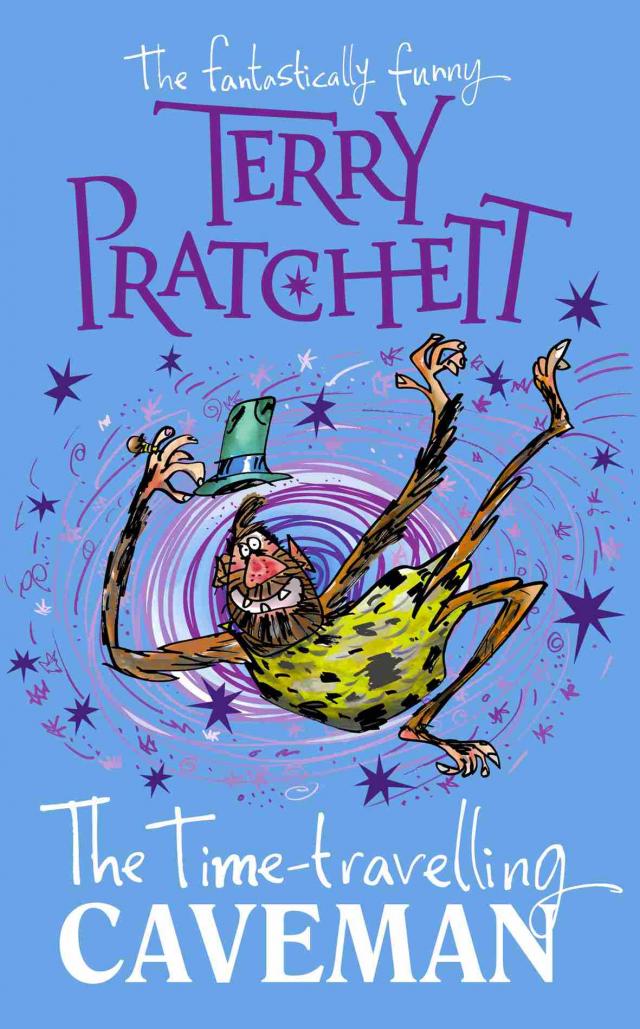
The Time-travelling Caveman,
p.1


CONTENTS
Introduction
Professor Whelk’s Trip to Mars
The Tropnecian Invasion of Great Britain
The Pied Piper of Blackbury
Ub and the Toad
The Mark One Computer
The Great Big Weather Fight
The Time-travelling Caveman
Lemonade on the Moon
The Hole in Time
The Wizard of Blackbury United
Bedwyr and Arthur’s Hill
Mr Trapcheese and his Ark
Doggins Has an Awfully Big Adventure
Johnno, the Talking Horse
The Wild Knight
The Wergs’ Invasion of Earth
Bason and the Hugonauts
About the Author
Terry Pratchett was the acclaimed creator of the global bestselling Discworld series, the first of which, The Colour of Magic, was published in 1983. In all, he was the author of over fifty bestselling books. His novels have been widely adapted for stage and screen, and he was the winner of multiple prizes, including the Carnegie Medal, as well as being awarded a knighthood for services to literature. He died in March 2015.
Also by , for children:
The Carpet People
The Bromeliad Trilogy:
Truckers
Diggers
Wings
The Johnny Maxwell Trilogy:
Only You Can Save Mankind
Johnny and the Dead
Johnny and the Bomb
Dragons at Crumbling Castle and Other Stories
The Witch’s Vacuum Cleaner and Other Stories
Father Christmas’s Fake Beard and Other Stories
For young adults and above:
The Amazing Maurice and His Educated Rodents
(A Discworld® novel)
The Tiffany Aching Sequence (Discworld® novels):
The Wee Free Men
A Hat Full of Sky
Wintersmith
I Shall Wear Midnight
The Shepherd’s Crown
Nation
Dodger
Dodger’s Guide to London
A full list of Terry Pratchett’s books
can be found on www.terrypratchett.co.uk
To Terry – aged seventeen
INTRODUCTION
Do you have an imagination? Do you read lots of books, sometimes all in one go, enjoying them from end to end and then starting again from the beginning because they were all so good? Does reading make you want to write your own stories?
Well, if so, that’s exactly how Terry Pratchett became a world-famous author. When he was a young lad, he would pedal down to his local library and take out as many books as he could carry and then go home and read the lot.
He wasn’t much older than you are now either when he wrote the stories in this book – a junior reporter for his local newspapers, the Bucks Free Press and the Western Daily Press, way back in the 1960s and 1970s.
Picture Terry in your head. A young lad on a motorbike, notebook and pen in his pocket (no smartphones or tablets in those olden days!), heading off to interview a man who was building a rocketship in his shed, or a lady who had grown a potato that looked like the Queen.
Later, Terry wrote books that became huge bestsellers – read and enjoyed all over the world by millions of readers. He is often described as a writer of fantasy – but Terry thought most stories were fantasies of some kind. In his words: ‘Fantasy plays games with the universe … all human life is there: a moral code, a sense of order and, sometimes, great big green things with teeth.’
The stories here – chosen from the best that Terry wrote for the Bucks Free Press and the Western Daily Press, and which were later dug out of a cupboard and polished up a little – don’t have any great big green things with teeth, but there is a man building a rocketship in his shed, as well as kings and mayors, a hairy Neanderthal, an intrepid grasshopper, a Pied Piper, a pinch of time travel and plenty of exciting journeys – under the sea and up into space.
And a good story is timeless. Just as much fun now as when it was first written.
Written by someone with a fabulous imagination, for anyone else with an imagination too.
PROFESSOR WHELK’S TRIP TO MARS
Professor Whelk’s home-made rocketship was rather too big to fit in his workshop. So half of it always had to stick out the door (where, if it was raining, it got wet) while he worked on the other half. He still wasn’t sure the engines were working properly, so he spent most of his time tinkering about with them – lying on his back, with his feet poking out either side of the rocket, and oil dripping down his sleeves.fn1
‘What’s all this then?’ said Mr Brown, the man next door, leaning over the fence and scratching his head.
‘Mumble, mumble, mumble.’ (Mr Whelk still had a hammer in his mouth.) ‘Oh, it’s you,’ he said. (He had now removed the hammer.) He crawled out of the oily puddle and picked up a saw. ‘It’s a spaceship.’
‘Really?’ said Mr Brown. ‘Going anywhere in particular? I haven’t had my holidays this year either.’
‘I had thought -
‘of going to’ -
– ‘Mars. I’ve never been to Mars.’ There was silence for a moment, interrupted only by a piece of broken rocketship falling into a bucket. As the professor went into his workshop, Mr Brown heard noises like someone treading on a rake and getting tangled in a hosepipe (which was quite likely, since Professor Whelk also kept his gardening tools there).
Mr Brown now began to get rather curious.
The rocket was about six metres long, with two large wheels in the middle and a very tall chimney on top, decorated with gold bands. There were curtains in the windows and the main entrance was a grand front door with a brass knocker. Once Mr Whelk had pulled the rocket free of the shed, and winched it upright (so it was ready for take-off), he opened a hatch at the back and put a few logs in. Soon there was a merry blaze going, and the big wheels at the side of the rocket began to spin, getting faster and faster. Whelk closed the hatch and screwed down the safety valve.
‘A steam-powered rocket, eh?’ said Mr Brown.
‘Want to come with me?’ asked Professor Whelk.
Mr Brown now looked very curious. And very tempted. But eventually he said, ‘I’d better not, need to be getting back in to make dinner, and I get terribly travel-sick, especially in space . . .’
‘Oh well, I’ll send you a postcard,’ said Professor Whelk, and he opened the heavy front door of the rocketship with much puffing and wheezing. As he began to clamber into the rocket, it rose very slowly from the ground, its wheels whizzing and whirring.
‘WHAT ABOUT YOUR AIR?’ shouted Mr Brown. ‘YOU WON’T BE ABLE TO BREATHE IN SPACE WITHOUT ANY AIR!’ he bellowed, as the rocket began to rise above the apple tree.
‘MY HAIR? IT’S ALL RIGHT. I’VE BROUGHT A BRUSH AND COMB WITH ME,’ came Professor Whelk’s answer, floating back over the breeze.
‘NO, I MEANT AIR—’ shouted Mr Brown. But the rocket was going faster and faster, and it was soon well out of sight and sound.
By the time Professor Whelk had got around to brewing himself a cup of tea, settling into an armchair and turning on his TV, the world was beginning to look quite circular.
High above him, the stars were coming out, and the tiny ship was chugging towards them at about six and a half miles an hour. Hiss, went the radio next to Professor Whelk’s armchair.
‘Jodrell Bank Observatory here,’ the voice said. ‘Is that Whelk?’
‘It is,’ said Professor Whelk, who was busy sewing some magnets onto his socks as he struggled to stay sitting in his chair: there’s no gravity in space, you see, and so people – and objects – tend to float about a lot more than they do on Earth.fn2
‘What is your exact position?’
went the radio.
‘I am at present floating on my back near the ceiling,’ Professor Whelk said. Indeed, he had by now begun to float to the top of the spaceship, passing the kitchen, the living room and his bedroom on the way up.
‘Ah, that’ll be because there’s no gravity out there. I meant your position in space, how close are you to Mars?’ – hiss.
But by now Professor Whelk had pushed himself away from the ceiling and was floating down again. The magnets on his socks stuck to the floor and the professor was finally able to stay on the ground.
He sat down at the control panel which, because the rocket was steam-driven, was a mass of taps, pipes, valves and cisterns, and peered through the telescope at Mars. It was still a long way off, so he pumped up a nice head of steam and increased speed to five thousand miles per hour, just to make sure he got there in good time.
Above the control panel was a list of ‘Things to do Today’. As he looked at it, the sugar bowl sailed lazily by and disappeared under the sink, leaving a little trail of sugar floating next to his head.
Professor Whelk carefully turned the rocket round and the line of sugar glided through the air and back into the bowl.
‘Amazing,’ said Professor Whelk.
Soon Mars was looming, and the rocket’s wheels were whizzing round as they tried to slow the machine down.
‘I really should have put in some sort of brake system,’ muttered the professor, holding onto the control panel and closing his eyes.
A loud hissing noise from outside the rocket told Professor Whelk that he was now entering Mars’s atmosphere. Things started sliding off the shelves and the
floor was rapidly becoming the ceiling. The professor’s half-drunk tea was floating through the air and all the safety valves on the control panel blew off at once. Then, suddenly, the rocket was grinding and bouncing over the Martian sands at tremendous speed on its specially designed wheels. That was until it hit a rock and came to a very abrupt stop.
‘Yes, if there’s one thing I should have put in,’ said a small and weary voice from underneath a pile of blankets, tea, sugar and the very finest china mugs and plates, ‘it’s brakes.’
Professor Whelk carefully manoeuvred himself out of the rocket, which had left a big long groove across the Martian desert. The sand was rust-coloured and stretched away in all directions, as far as the eye could see, with a few unusual rocks here and there. The sky was still dark and covered with stars; there was a blue one and a small silver one very close together. Professor Whelk realized with some amazement that he was looking at the Earth and the Moon.
‘Well, well,’ said the professor. He put on a huge, old-fashioned diving suit (this was so he could breathe on Mars, of course), and momentarily adjusted its breathing tube before setting off. There was a large green patch on the horizon which he wanted to investigate.
Professor Whelk’s mode of transport was a bicycle, and as he cycled off towards the green patch, the tyres left a little track in the sand. Now, nearly everyone who gets to Mars in a story manages to discover a city,fn3 and pretty soon Whelk was cycling down the main street of one. Large and interesting buildings loomed up on either side.
‘Is there anybody here?’ he shouted.
‘ Is there anybody here?’ came the echo.
‘Well, well,’ said Whelk.
‘Well, what?’ said the echo.
A little unnerved by this, Whelk pedalled out of the city as fast as he could.
His rocket was where he had left it – and there weren’t even any footprints around it.fn4 What an amazingly boring place this is, he thought.
A few weeks later, Mr Brown was planting potatoes when he heard a familiar puttering noise high above him. Very slowly, Professor Whelk’s steam-rocket floated down and landed in the soft earth outside its home – the shed. It was a bit battered, and covered in red sand.
‘Back so soon?’ said Mr Brown, intrigued. ‘The Americans have just sent a rocket of their own up there.’
‘Three cheers for them,’ grunted Whelk, pushing the rocket (well, half of it) back into his shed. ‘Though they might be in for a bit of a surprise!’
This was because, since there didn’t seem to be anyone living on Mars, Professor Whelk had planted a big sign before he left. It said:
I CLAIM THIS PLANET
IN THE NAME OF PROFESSOR WHELK
Then he added:
Then he added again:
And to make triple sure he wrote a final:
And then he’d written:
BEST WISHES, PROFESSOR WHELK
Because whichever planet you’re trying to claim is yours and yours alone, it always pays to be polite.
THE TROPNECIAN INVASION OF GREAT BRITAIN
Tropnecia is a very small country somewhere in the Tosheroon Islands, but once upon a time it very nearly conquered Great Britain.
In AD 411, when the last of the Romans had just left, a small Tropnecian sailing ship that happened to be passing spotted the coast of England, and thought it would be a good place to conquer. That was how things were done in history. As soon as you saw a place, you had to conquer it, and usually the English Channel was full of ships queuing up to come and have a good conquer.
‘If you’ve got nothing to do,’ chieftains would tell their sons, ‘go and conquer England.’
Anyway, the Tropnecians arrived on a Sunday, when there was no one about, so the first thing they did was build a road. That’s another thing you have to do. Either you burn down houses or you build roads and walls, otherwise you don’t stand much chance of being put in the history books.
Tropnecian roads can always be recognized because they never go in straight lines. The roads were all designed by the famous Tropnecian architect, General Bulbus Hangdoge, and he wasn’t very good at drawing straight lines. Very good on the corners, but very bad on the straight lines. So all the roads were a little
At that time England was full of Picts, Scots, Druids, Angles, Saxons, Vikings, Stonehenges, wet weather and various kinds of kings, the most famous of which was King Rupert the Never Ready, of Wessex. He was never ready for anything, which was why England kept getting conquered.
People would say, ‘Are you ready to fight the Vikings if they try to conquer us?’ and he would say, ‘I don’t think so.’ The next thing you knew, Vikings were all over the place, burning down houses. It was all pretty miserable in those days.
By the time the Tropnecian army had marched into King Rupert’s castle he was feeling more never ready than usual. ‘Are you Romans?’ he said, poking his head out of his bedroom window.
‘No, we’re Tropnecians,’ said General Hangdoge. ‘We came, we saw, we conquered.’
‘It’s people like you who ruin history,’ grumbled King Rupert. ‘The Anglo-Saxons come after the Romans, and they’re not here yet. No one ever said anything about any Tropnecians. Wait your turn.’
And with that he banged the window shut and went back to bed.
The Tropnecians felt rather stupid, standing around with everybody looking at them. They thought perhaps King Rupert had a point – maybe they weren’t supposed to be there, and this was all wrong.
‘I’m going home,’ said General Hangdoge. ‘My feet are wet.’ (It had been raining very hard for a very long time by this point. That’s England for you. If you’re going to invade a place, please do check the weather forecast.)
And so they all marched back to the coast of England,fn1 leaving the way clear for the Anglo-Saxons, who turned up the next day and immediately started to burn houses.
And so history was allowed to get going again.
THE PIED PIPER OF BLACKBURY
Rubbish!
The streets of Blackbury were full of it. This was because the Corporation dustmen had gone on strike (they wanted their wages raised to five hundred pounds a week). All the bins were overflowing, and soon the main square of Blackbury was piled high with old baked beans tins, herring tails and banana peel. All of it was smelly, steaming, brightly coloured … and everywhere!
A big crowd had gathered outside the Town Hall and was banging on the door.
‘Pay the dustmen!’ they shouted. ‘Pay the dustmen!’
Blackbury Council didn’t like this one bit – they were hiding in their meeting room with all the chairs piled up against the door.
‘I don’t see why we should pay the dustmen a whole five hundred pounds a week,’ muttered the mayor, who was sitting under the table because people had started throwing things (mostly rubbish) through the window. ‘Two hundred pounds a week is enough for anybody, and they’d only spend the rest on fizzy drinks and sweets. Where is Mr Patel, the town clerk?’
‘I think they threw him into the river,’ said a councillor who was lying on top of the bookcase.
‘Oh dear. Whatever shall we do?’ said the mayor, blowing his nose on his fancy robes.
Just then, as if by magic (as indeed it was), a small van painted in orange and yellow stripes drew up outside the Town Hall and some little tinkling bells on top started playing a tune, accompanying a song that came from nowhere in particular. It went:
You’ll never have more than two hundred pounds to pay If you clean up your rubbish the Pied Piper way.
‘Hello, hello, hello, I’m the Pied Piper man!’ said a strange figure, landing on the table (no one was quite sure how he had got inside the Town Hall). He was a tall thin man, wearing an orange-and-yellow striped suit and a bowler hat, with a large box under his arm which had ‘Pied Piper Rubbish Remover’ written on it in large red letters. ‘Just answer one simple question: how much will you pay me to remove your rubbish?’


