

Discworld 06 wyrd sist.., p.24
Discworld 06 - Wyrd Sisters,
p.24
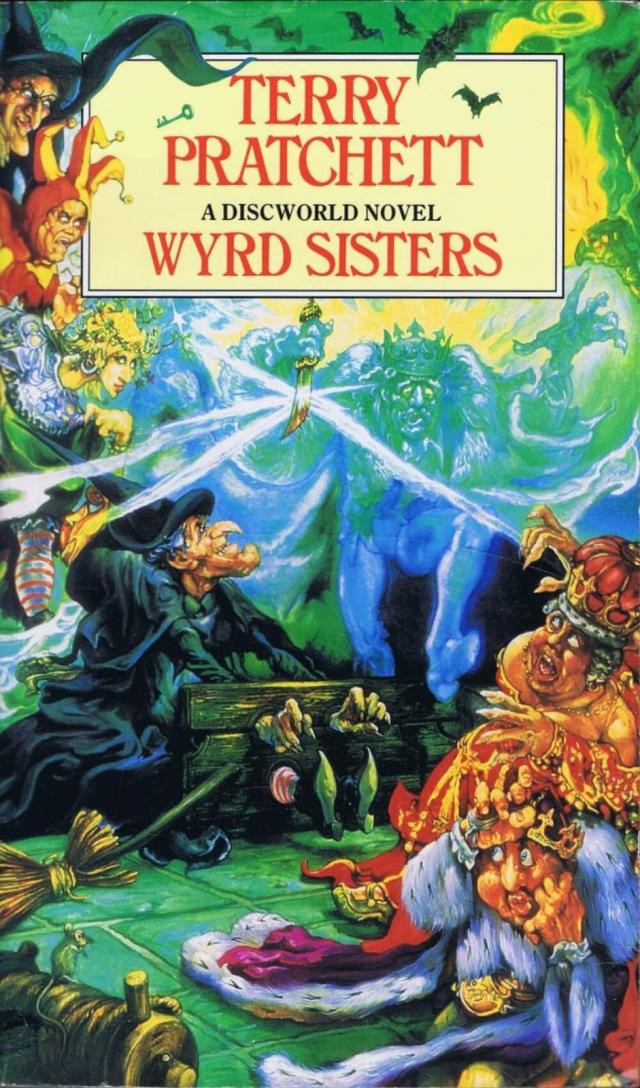


Tomorrow night came, and the witches went by a roundabout route to the castle, with considerable reluctance.
“If he wants us to be here, I don’t want to go,” said Granny. “He’s got some plan. He’s using headology on us.”
“There’s something up,” said Magrat. “He had his men set fire to three cottages in our village last night. He always does that when he’s in a good mood. That new sergeant is a quick man with the matches, too.”
“Our Daff said she saw them actors practicin’ this morning,” said Nanny Ogg, who was carrying a bag of walnuts and a leather bottle from which rose a rich, sharp smell. “She said it was all shouting and stabbing and then wondering who done it and long bits with people muttering to themselves in loud voices.”
“Actors,” said Granny, witheringly. “As if the world weren’t full of enough history without inventing more.”
“They shout so loud, too,” said Nanny. “You can hardly hear yourself talk.” She was also carrying, deep in her apron pocket, a lump of haunted castle rock. The king was getting in free.
Granny nodded. But, she thought, it was going to be worth it. She hadn’t got the faintest idea what Tomjon had in mind, but her inbuilt sense of drama assured her that the boy would be bound to do something important. She wondered if he would leap off the stage and stab the duke to death, and realized that she was hoping like hell that he would.
“All hail wossname,” she said under her breath, “who shall be king here, after.”
“Let’s get a move on,” said Nanny. “All the sherry’ll be gone.”
The Fool was waiting despondently inside the little wicket gate. His face brightened when he saw Magrat, and then froze in an expression of polite surprise when he saw the other two.
“There’s not going to be any trouble, is there?” he said. “I don’t want there to be any trouble. Please.”
“I’m sure I don’t know what you mean,” said Granny regally, sweeping past.
“Wotcha, jinglebells,” said Nanny, elbowing the man in the ribs. “I hope you haven’t been keeping our girl here up late o’nights!”
“Nanny!” said Magrat, shocked. The Fool gave the terrified, ingratiating rictus of young men everywhere when confronted by importunate elderly women commenting on their intimately personal lives.
The older witches brushed past. The Fool grabbed Magrat’s hand.
“I know where we can get a good view,” he said.
She hesitated.
“It’s all right,” said the Fool urgently. “You’ll be perfectly safe with me.”
“Yes, I will, won’t I,” said Magrat, trying to look around him to see where the others had gone.
“They’re staging the play outside, in the big courtyard. We’ll get a lovely view from one of the gate towers, and no one else will be there. I put some wine up there for us, and everything.”
When she still looked half-reluctant he added, “And there’s a cistern of water and a fireplace that the guards use sometimes. In case you want to wash your hair.”
* * *
The castle was full of people standing around in that polite, sheepish way affected by people who see each other all day and are now seeing each other again in unusual social circumstances, like an office party. The witches passed quite unremarked among them and found seats in the rows of benches in the main courtyard, set up before a hastily assembled stage.
Nanny Ogg waved her bag of walnuts at Granny.
“Want one?” she said.
An alderman of Lancre shuffled past her and pointed politely to the seat on her left.
“Is anyone sitting here?” he said.
“Yes,” said Nanny.
The alderman looked distractedly at the rest of the benches, which were filling up fast, and then down at the clearly empty space in front of him. He hitched up his robes with a determined expression.
“I think that since the play is commencing to start, your friends must find a seat elsewhere, when they arrive,” he said, and sat down.
Within seconds his face went white. His teeth began to chatter. He clutched at his stomach and groaned.[*]
“I told you,” said Nanny, as he lurched away. “What’s the good of asking if you’re not going to listen?” She leaned toward the empty seat. “Walnut?”
“No, thank you,” said King Verence, waving a spectral hand. “They go right through me, you know.”
“Pray, gentles all, list to our tale…”
“What’s this?” hissed Granny. “Who’s the fellow in the tights?”
“He’s the Prologue,” said Nanny. “You have to have him at the beginning so everyone knows what the play’s about.”
“Can’t understand a word of it,” muttered Granny. “What’s a gentle, anyway?”
“Type of maggot,” said Nanny.
“That’s nice, isn’t it? ‘Hallo maggots, welcome to the show.’ Puts people in a nice frame of mind, doesn’t it?”
There was a chorus of “sshs.”
“These walnuts are damn tough,” said Nanny, spitting one out into her hand. “I’m going to have to take my shoe off to this one.”
Granny subsided into unaccustomed, troubled silence, and tried to listen to the prologue. The theater worried her. It had a magic of its own, one that didn’t belong to her, one that wasn’t in her control. It changed the world, and said things were otherwise than they were. And it was worse than that. It was magic that didn’t belong to magical people. It was commanded by ordinary people, who didn’t know the rules. They altered the world because it sounded better.
The duke and duchess were sitting on their thrones right in front of the stage. As Granny glared at them the duke half turned, and she saw his smile.
I want the world the way it is, she thought. I want the past the way it was. The past used to be a lot better than it is now.
And the band struck up.
Hwel peered around a pillar and signaled to Wimsloe and Brattsley, who hobbled out into the glare of the torches.
OLD MAN (an Elder): “What hath befell the land?”
OLD WOMAN (a Crone): “’Tis a terror—”
The dwarf watched them for a few seconds from the wings, his lips moving soundlessly. Then he scuttled back to the guardroom where the rest of the cast were still in the last hasty stages of dressing. He uttered the stage manager’s traditional scream of rage.
“C’mon,” he ordered. “Soldiers of the king, at the double! And the witches—where are the blasted witches?”
Three junior apprentices presented themselves.
“I’ve lost my wart!”
“The cauldon’s all full of yuk!”
“There’s something living in this wig!”
“Calm down, calm down,” screamed Hwel. “It’ll all be all right on the night!”
“This is the night, Hwel!”
Hwel snatched a handful of putty from the makeup table and slammed on a wart like an orange. The offending straw wig was rammed on its owner’s head, livestock and all, and the cauldron was very briefly inspected and pronounced full of just the right sort of yuk, nothing wrong with yuk like that.
On stage a guard dropped his shield, bent down to pick it up, and dropped his spear. Hwel rolled his eyes and offered up a silent prayer to any gods that might be watching.
It was already going wrong. The earlier rehearsals had their little teething troubles, it was true, but Hwel had known one or two monumental horrors in his time and this one was shaping up to be the worst. The company was more jittery than a potful of lobsters. Out of the corner of his ear he heard the on-stage dialogue falter, and scurried to the wings.
“—avenge the terror of thy father’s death—” he hissed, and hurried back to the trembling witches. He groaned. Divers alarums. This lot were supposed to be terrorizing a kingdom. He had about a minute before the cue.
“Right!” he said, pulling himself together. “Now, what are you? You’re evil hags, right?”
“Yes, Hwel,” they said meekly.
“Tell me what you are,” he commanded.
“We’re evil hags, Hwel.”
“Louder!”
“We’ve Evil Hags!”
Hwel stalked the length of the quaking line, then turned abruptly on his heel, “And what are you going to do?”
The 2nd Witche scratched his crawling wig.
“We’re going to curse people?” he ventured. “It says in the script—”
“I-can’t-HEAR-you!”
“We’re going to curse people!” they chorused, springing to attention and staring straight ahead to avoid his gaze.
Hwel stumped back along the line.
“What are you?”
“We’re hags, Hwel!”
“What kind of hags?”
“We’re black and midnight hags!” they yelled, getting into the spirit.
“What kind of black and midnight hags?”
“Evil black and midnight hags!”
“Are you scheming?”
“Yeah!”
“Are you secret?”
“Yeah!”
Hwel drew himself to his full height, such as it was.
“What-are-you?” he screamed.
“We’re scheming evil secret black and midnight hags!”
“Right!” He pointed a vibrating finger toward the stage and lowered his voice and, at that moment, a dramatic inspiration dived through the atmosphere and slammed into his creative node, causing him to say, “Now I want you to get out there and give ’em hell. Not for me. Not for the goddam captain.” He shifted the butt of an imaginary cigar from one side of his mouth to the other, and pushed back a nonexistent tin helmet, and rasped, “But for Corporal Walkowski and his little dawg.”
They stared at him in disbelief.
On cue, someone shook a sheet of tin and broke the spell.
Hwel rolled his eyes. He’d grown up in the mountains, where thunderstorms stalked from peak to peak on legs of lightning. He remembered thunderstorms that left mountains a different shape and flattened whole forests. Somehow, a sheet of tin wasn’t the same, no matter how enthusiastically it was shaken.
Just once, he thought, just once. Let me get it right just once.
He opened his eyes and glared at the witches.
“What are you hanging around here for?” he yelled. “Get out there and curse them!”
He watched them scamper onto the stage, and then Tomjon tapped him on the head.
“Hwel, there’s no crown.”
“Hmm?” said the dwarf, his mind wrestling with ways of building thunder-and-lightning machines.
“There’s no crown, Hwel. I’ve got to wear a crown.”
“Of course there’s a crown. The big one with the red glass, very impressive, we used it in that place with the big square—”
“I think we left it there.”
There was another tinny roll of thunder but, even so, the part of Hwel that was living the play heard a faltering voice on stage. He darted to the wings.
“—I have smother’d many a babe—” he hissed, and sprinted back.
“Well, just find another one, then,” he said vaguely. “In the props box. You’re the Evil King, you’ve got to have a crown. Get on with it, lad, you’re on in a few minutes. Improvise.”
Tomjon wandered back to the box. He’d grown up among crowns, big golden crowns made of wood and plaster, studded with finest glass. He’d cut his teeth on the hat-brims of Authority. But most of them had been left in the Dysk now. He pulled out collapsible daggers and skulls and vases, the strata of the years and, right at the bottom, his fingers closed on something thin and crown shaped, which no one had ever wanted to wear because it looked so uncrownly.
It would be nice to say it tingled under his hand. Perhaps it did.
* * *
Granny was sitting as still as a statue, and almost as cold. The horror of realization was stealing over her.
“That’s us,” she said. “Round that silly cauldron. That’s meant to be us, Gytha.”
Nanny Ogg paused with a walnut halfway to her gums. She listened to the words.
“I never shipwrecked anybody!” she said. “They just said they shipwreck people! I never did!”
Up in the tower Magrat elbowed the Fool in the ribs.
“Green blusher,” she said, staring at the 3rd Witche. “I don’t look like that. I don’t, do I?”
“Absolutely not,” said the Fool.
“And that hair!”
The Fool peered through the crenellations like an over-eager gargoyle.
“It looks like straw,” he said. “Not very clean, either.”
He hesitated, picking at the lichened stonework with his fingers. Before he’d left the city he’d asked Hwel for a few suitable words to say to a young lady, and he had been memorizing them on the way home. It was now or never.
“I’d like to know if I could compare you to a summer’s day. Because—well, June 12th was quite nice, and…Oh. You’ve gone…”
* * *
King Verence gripped the edge of his seat; his fingers went through it. Tomjon had strutted onto the stage.
“That’s him, isn’t it? That’s my son?”
The uncracked walnut fell from Nanny Ogg’s fingers and rolled onto the floor. She nodded.
Verence turned a haggard, transparent face toward her.
“But what is he doing? What is he saying?”
Nanny shook her head. The king listened with his mouth open as Tomjon, lurching crabwise across the stage, launched into his major speech.
“I think he’s meant to be you,” said Nanny, distantly.
“But I never walked like that! Why’s he got a hump on his back? What’s happened to his leg?” He listened some more, and added, in horrified tones, “And I certainly never did that! Or that. Why is he saying I did that?”
The look he gave Nanny was full of pleading. She shrugged.
The king reached up, lifted off his spectral crown, and examined it.
“And it’s my crown he’s wearing! Look, this is it! And he’s saying I did all those—” He paused for a minute, to listen to the latest couplet, and added, “All right. Maybe I did that. So I set fire to a few cottages. But everyone does that. It’s good for the building industry, anyway.”
He put the ghostly crown back on his head.
“Why’s he saying all this about me?” he pleaded.
“It’s art,” said Nanny. “It wossname, holds a mirror up to life.”
Granny turned slowly in her seat to look at the audience. They were staring at the performance, their faces rapt. The words washed over them in the breathless air. This was real. This was more real even than reality. This was history. It might not be true, but that had nothing to do with it.
Granny had never had much time for words. They were so insubstantial. Now she wished that she had found the time. Words were indeed insubstantial. They were as soft as water, but they were also as powerful as water and now they were rushing over the audience, eroding the levees of veracity, and carrying away the past.
That’s us down there, she thought. Everyone knows who we really are, but the things down there are what they’ll remember—three gibbering old baggages in pointy hats. All we’ve ever done, all we’ve ever been, won’t exist anymore.
She looked at the ghost of the king. Well, he’d been no worse than any other king. Oh, he might burn down the odd cottage every now and again, in a sort of absent-minded way, but only when he was really angry about something, and he could give it up any time he liked. Where he wounded the world, he left the kind of wounds that healed.
Whoever wrote this Theater knew about the uses of magic. Even I believe what’s happening, and I know there’s no truth in it.
This is Art holding a Mirror up to Life. That’s why everything is exactly the wrong way around.
We’ve lost. There is nothing we can do against this without becoming exactly what we aren’t.
Nanny Ogg gave her a violent nudge in the ribs.
“Did you hear that?” she said. “One of ’em said we put babbies in the cauldron! They’ve done a slander on me! I’m not sitting here and have’em say we put babbies in a cauldron!”
Granny grabbed her shawl as she tried to stand up.
“Don’t do anything!” she hissed. “It’ll make things worse.”
“‘Ditch-delivered by a drabe,’ they said. That’ll be young Millie Hipwood, who didn’t dare tell her mum and then went out gathering firewood. I was up all night with that one,” Nanny muttered. “Fine girl she produced. It’s a slander! What’s a drabe?” she added.
“Words,” said Granny, half to herself. “That’s all that’s left. Words.”
“And now there’s a man with a trumpet come on. What’s he going to do? Oh. End of Act One,” said Nanny.
The words won’t be forgotten, thought Granny. They’ve got a power to them. They’re damn good words, as words go.
There was yet another rattle of thunder, which ended with the kind of crash made, for example, by a sheet of tin escaping from someone’s hands and hitting the wall.
In the world outside the stage the heat pressed down like a pillow, squeezing the very life out of the air. Granny saw a footman bend down to the duke’s ear. No, he won’t stop the play. Of course he won’t. He wants it to run its course.
The duke must have felt the heat of her gaze on the back of his neck. He turned, focused on her, and gave her a strange little smile. Then he nudged his wife. They both laughed.
Granny Weatherwax was often angry. She considered it one of her strong points. Genuine anger was one of the world’s great creative forces. But you had to learn how to control it. That didn’t mean you let it trickle away. It meant you dammed it, carefully, let it develop a working head, let it drown whole valleys of the mind and then, just when the whole structure was about to collapse, opened a tiny pipeline at the base and let the iron-hard stream of wrath power the turbines of revenge.
She felt the land below her, even through several feet of foundations, flagstones, one thickness of leather and two thicknesses of sock. She felt it waiting.
She heard the king say, “My own flesh and blood? Why has he done this to me? I’m going to confront him!”


