

G mcdonald wallis, p.1
G. McDonald Wallis,
p.1
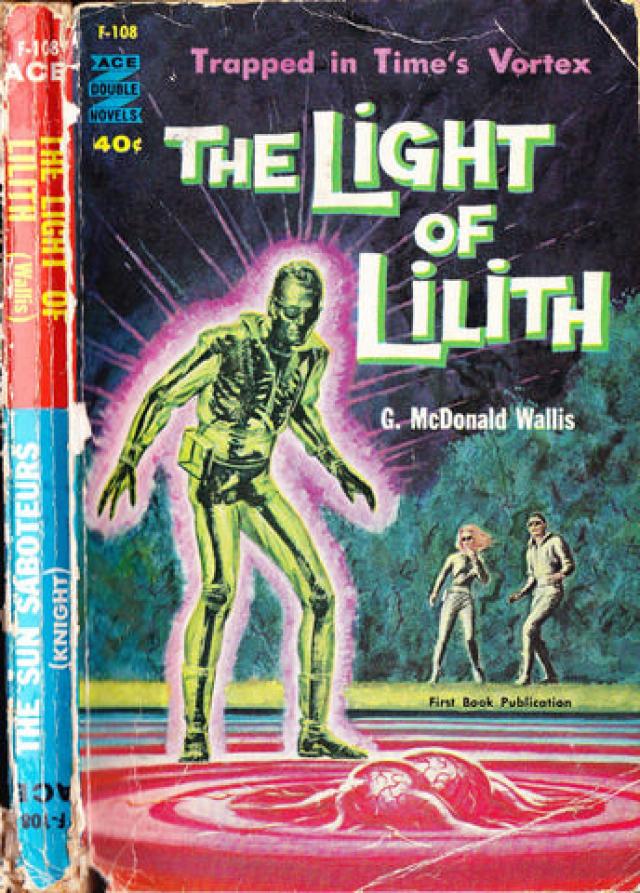


WORLD’S END-OR WORLDS BEGINNING?
In the strange light of the planet Lilith, Mason saw the future:
“Man was being scorched off the face of the Earth, and burned like a pestilence off the other neighboring planets. For now was the time of the end of his sun.
“And knowing that, for an instant Mason knew also how far he had, traveled. Not some thousands of light-years through space, through swirling galaxies and suns; that, yes, but not only that. He had also traveled into time, some ten thousand million years into the future to witness the end of the world.
“Not all the resources of the heavens, racing faster than the speed of light, could save the enormous population from its fate…”
But somehow Mason realized that he had been granted this vision for a purpose. In his foreknowledge lay the hope that this thing might not come to pass. Somehow, someway, on the eerie world of Lilith, there was a by-pass to that far-off doom. Would he know it when he saw it?
G. McDONALD WALLIS was raised in Hawaii and the Orient where, she states, her interest in science fiction began. There was something about living in a natural paradise and simultaneously being exposed to many different cultures that evoked a consuming curiosity about man and the universe in which he lives.
An actress for many years in radio, TV and summer stock, she made an extensive USO tour through North Africa and Europe where her concern was further deepened by impressions of the war and witnessing the Nuremberg Trials,
She has been writing as long as she can remember and recalls that her first .published effort appeared in the Shanghai American School newspaper where it created quite a stir, and she was regarded, for a child, as being terribly avant-garde… . The printers had neglected to include the end of the story.
She has written for the stage and radio, short stories, articles and a juvenile novel about the theater. She regards science fiction not so much as fantasy but as tales of probability that offer both warning and promise to man, and that, on a deeper level, reflect man’s own fears and wishes for his future.
THE LIGHT OF LILITH
By
G. McDONALD WALLIS
TO JOHN GERSTAD gratefully
Chapter One
Mason had thought the atmosphere unusually dense. His “baby bullet” had wobbled and danced crazily as they descended from the mother ship to the speckled riot of color that was the surface of the planet Lilith. Now that he stood here on what should be the familiar ground of the spaceport, one hand resting lightly on the warm side of his entry capsule, he felt rather than saw a difference about the place—a faint luminescence in the sunlight that he didn’t remember; a curious thickness in the air.
Well, Mason thought, he’d only reported from here twice before and wasn’t expected to know all of the local phenomena. Satisfied at this inner explanation, he leaned over and adjusted the controls of the capsule, closed the hatch and patted the Miranda twice for luck. He stepped back and watched his baby soar unerringly into the sky. In ten minutes she would be safely back in the big belly of her mother ship.
The moment Mason turned to walk toward the port offices he had an immediate, disquieting suspicion that he shouldn’t have sent her back. His neck prickled uncomfortably and his heart leapt in an unreasonable stab of fear. He wheeled around in a panic and looked for the Miranda. Too late. She was gone, well on her way now beyond the atmosphere.
Idiocy, Mason fairly shouted at himself, fighting to put down the strange terror. Sheer idiocy! He hadn’t been reporting anywhere near long enough to acquire that condition known in the Federation as “space hysteria.” If any of his present sensations persisted, Mason promised himself he’d go straight to Ulinski who was right here on Lilith.’
Lilith. Older than Eve, the first wife of Adam; the ancient female spirit of evil splendor—Lilith! What a name for an experimental planet, Mason thought, and unexpectedly found himself laughing. With relief at finding his emotions normal once more, he strode purposefully toward the low buildings flanking the field.
Simpkins, Trope and Plummer, Mason repeated to himself, trying to remember the names and faces of the staff: They’d be here, and possibly Yee Mon, if he were lucky. He hoped that Yee’s presence at the port might save him a trip into the interior. But the Vining sisters were sure to be out at the second lab and the Federation would insist he see them.
Mason sighed, resigning any hope of an easy stay at the port and faintly dreading the prospect of the difficult trip over the mountains and into the interior jungles. Would they ever get around to authorizing flyers instead of land rovers for a place like this!
Now, in which lab would Herb Gregson be, he wondered vaguely. And Louisa Wenger. She was one member of the staff he wouldn’t mind trekking many miles without a land rover to see. Thinking of Louisa, Mason smiled warmly and began to walk a little faster.
Suddenly, without any warning, he was picked up off his feet and blown at least six feet into the air. He whirled around dizzily choking on mouthfuls of a fine, black substance that spiraled around him and bit fiercely through his clothing, stabbing him with the sharp precision of shot. He fell to the ground gasping and spitting, nearly blinded by the black stuff that still clung to his eyes, sending vicious stabs of pain into the retinas.
Then, as suddenly as it had come, it was gone. The stuff practically danced away from him, leaving with a swiftness that looked almost like flight. Mason cautiously rubbed his smarting eyes but there wasn’t a speck left. He followed the black cloud, watching as it spiraled like a top over the buildings and then seemed to dissipate before his eyes. Gone! There was nothing left of it but the pain in his eyes and a severe wrench in his back where he had fallen.
Curiously, he realized that he hadn’t been afraid. He wondered momentarily at the inaccuracies of his reactions: fear at the wrong time, and complete steadiness in the middle of the storm. No, not storm—that ridiculous small tornado. But was it a tornado? Was it any sort of storm? Mason frowned, trying to recall an impression that had seemed terribly vivid six feet up in the spiral. But all he could remember now was a faint childlike dream of dust and houses spinning—Oz! Of course, the age-old dream of a journey to Oz. But had that been the real impression?
For the first time since he’d landed, Mason became uncomfortably aware of the absolute stillness of the port. A dead quiet that permeated slowly, making him intensely aware of the beating of his heart. His movements, as he pulled himself up from the ground, were unnaturally loud. He could hear his own exhalation and took a deep breath, unconsciously trying to hold it as long as possible.
He looked around, noticing the emptiness of the field, finally understanding that all the ordinary sounds of a spaceport were unreasonably and unmistakably absent.
For the second time a thrill of fear coursed through Mason and he began to run, loudly, as only a solitary human in a vastly empty space can run. As he reached the door of the main building and tore it open he realized he was yelling. Yelling with an hysterical violence so strange that hearing it brought him up sharply. It couldn’t be he making those maniacal sounds.
He forced himself to stand quite still and take deep breaths. Where was Ulinski? At the moment it was all he cared to know. Somehow it had registered on his senses that the buildings were deserted, that the offices were an amorphous mass of tumbled papers and overturned chairs. Even running over the field he had understood that the usual quota of parked land rovers were gone.
But at this moment Mason was quite certain that something serious had affected his psyche and he wanted desperately to see Dr. Ulinski before it was too late. Rigid, breathing deeply, he stood there clenching and unclenching his fists until a sound, the first sound other than his own, made him spin around in terrified swiftness and search the dim comers of the room.
It was a moan, the faint whimper of something in pain, and it was unmistakably a human sound. This certainty brought Mason around so abruptly that he almost cried with relief. And immediately (later he thought it quite miraculous) all of Mason’s control returned. It was less than a minute before his fear had entirely vanished and he was bending carefully over the broken, mutilated body of Herb Gregson.
“Mason, I stayed to warn you,” Gregson whispered. “Knew you were coming. Others have gone… .” His breathing became more and more difficult until the words that followed were only disjointed gasps, blurted out with a final effort of will. “Other lab … there. Our fault, shouldn’t tamper …. Be careful… .”
“What happened?” Mason urged as gently as he could. “Who did this?”
But Gregson’s eyes were closed and he could only say, “No …. No, our fault,” before he was gone.
Mason rose slowly and stood looking down at the pitiful body for a moment, a strange new compassion stirring within him. A compassion that had something to do with meeting so violent a death here on Lilith. He didn’t believe that he would feel so deeply had it occurred on Earth or even on one of the other settled planets.
He walked over to the window and looked out at the panorama across the field. In the distance the rainbow range of Lilith’s strange colors made the surrounding vegetation look like an artist’s dream of a world gone crazy. The faintly purple hue of the tall fern trees cast long shadows across the terrain.
Gregson should have to be buried out there, Mason thought with an instinctive repugnance. He would have to lie out there, under the multicolored earth that would shift and change, eventually claiming Gregson as its own. Mason had a swift and nostalgic visio
n of the quiet brown loam of Earth, a more fitting rest for a man. He was, at that moment, bitterly sorry that the Federation had ever discovered Lilith.
Mason had been six when he was chosen. Barely the minimum age for preparation. A tall boy for his age, with a shock of thick sandy hair and serious dark eyes, he had grown during the years of his schooling into a taller, more mature replica of the child he had been. The rigors of space training had given him a hard, lean look. But his job as a reporter, with the many quiet hours of writing it required, had allowed him to retain that contemplative seriousness which had been so characteristic of him as a child.
He had been home only once since that time twenty years ago when he boarded the school ship to prepare for his life in space. Not until this last trip, when he had been assigned again to report on the station at Lilith, had he ever questioned that decision made on a windy hill on Earth during a summer evening, when he lay on his back sucking a long blade of grass and staring up at the stars. Even at six he had recognized the precariousness of his childhood and understood that in taking the stars he would be relinquishing the most precious years of his life.
That moment often returned to him, with the odors of the damp ground, the slick feeling of wet grass against his tongue and the physical connection with the ground of Earth that he had felt so deeply. But none of this could prevail against that blazing sight in the heavens. What child could look long at the universe without an unbearable longing?
Mason was accepted quickly when his wish was made known. He had already been tested in his first Earth school, and was one of only three boys in his town chosen for life in space. His parents made the separation against their will, painfully but proudly. They had little choice between the Federation tests and the wish of their only child.
And on that first trip back when he was just sixteen, Mason had found Earth a strange home. He was so accustomed to other planets, to the company of fellow reporters, to his work, that the adjustment was almost impossible. His parents were changed. His memory of them had become dimmed through the long years of separation, and meeting again was a strained and emotionally charged encounter. But somehow the impressions gathered during that time had stayed with him, and now, in a comer of his being, was a wish to know Earth again and know her well, not as a visitor but as a child who had come home.
Lilith only intensified this feeling. When Mason had been given his orders, he had felt a reluctance to set foot again on this planet which was so utterly unlike any other. Most of the inhabited or experimental planets were at least similar to Earth in many respects. Mason had never been to an “alien” planet. Reporters were sent only to Man’s experimental stations or to report on human settlers elsewhere. Mason was a specialist in experimental stations, and of them all he least liked Lilith with her eerie spectrum that confounded his senses and made him feel isolated in the universe.
His eyes, as he stared out the window, were haunted with a longing for home. They burned deeply in his tanned, craggy face. Someone seeing Mason at that moment would have been struck by the contrast between those serious eyes and his air of youthfulness. There was something naive and childlike, something unfinished about Russell Mason.
It wasn’t until he had buried Gregson that Mason remembered the Miranda. Cursing himself for the sentiment that had displaced his own instinct for survival, he drew out a tiny transmitter from his pocket and began a call. Again he was too late. The mother ship had left and would now be on her way to the next experimental station to drop off another reporter, not returning for him until—Mason began to wonder about that until.
Then he remembered that of course he could contact the ship anywhere from the radio room here on the stronger frequency. He raced back to the offices, running through the labyrinth of corridors until he found it. One look at the complicated apparatus and Mason realized that he didn’t know the first thing about it. He pulled levers and switches, pressed buttons, turned dials, damning the mentality that had sent him here equipped to use one little transmitter to his ship, and that only when she was directly above.
Why hadn’t they prepared him for an emergency like this, he thought numbly as he sat down on the Tech’s chair, knowing that his efforts were futile. Space exploration had become too mundane, he guessed, these experimental stations too ordinary. Well, they wanted a reporter and they had one. He supposed it had never crossed their minds that anything could happen to the staff. And, actually, it hadn’t crossed his either. In a way he had no right to accuse; he should have forseen an emergency himself.
Soberly he took pen and paper and drew up a list. Then he walked carefully through the building seeking out storerooms and deliberately fashioning a pack for himself. Survival kit, he thought ironically, remembering his history, when every Federation member was obliged to carry one. Eventually he was equipped with what he considered necessary and wondered whether any of it would be of the least value.
The storeroom for the interior was stacked with a seemingly full inventory. He admitted this grudgingly, realizing that if the entire staff had gone to the second lab—which was his ardent hope—they would surely have depleted the supplies. Still, Gregson had managed to say, “Second lab,” and Mason knew he had been hanging on by a thread. He would not have said anything that wasn’t meaningful.
If the others had fled in some sort of panic, which was how it looked, what were they running from? Mason had been thinking incessantly of Gregson’s last words: “Our fault.” He thought he knew what Gregson had been trying to say. It wasn’t a staff member who had killed him; it was something else. That tornado? Mason doubted it. Even though he’d been tossed around a bit, it hardly had the necessary force. And too, there’d been something about Gregson that spoke of something more evil than a local storm.
He arranged the kit on his back, took a last look around and walked out. He searched the entire field for a land rover, hating to give up the idea that in some nook or cranny he’d find one. This was something he really couldn’t understand. Even if they had left in a hurry, they would surely have had
the foresight to leave one for him. They knew he was coming.
Their complement of the sturdy little cars had been a substantial one. How many? Mason tried to recall his figures from the last report. They’d been alloted at least ten. Ten rovers to take a small group to the interior? It didn’t make sense. Grimly, Mason started walking.
He hadn’t gone more than a mile up the rough road when he became aware that his teeth were aching strangely. There was a queer, metallic taste in his mouth and the air had a faintly leaden cast and odor that irritated his nostrils and stung his eyes. Was he due for another spin in one of those black clouds? Mason frowned and looked around, seeing nothing unusual except a gray tint to the landscape that seemed to be growing stronger as he walked on.
It was certainly different from the usual patchwork riot of color, but that didn’t worry him greatly. The unusual spectrum and rapid changes of reflection brought constant surprise to the eye. It was Lilith’s color, in fact, that had determined her fate as an experimental planet.
The taste grew stronger and the metal, if metal it was, caused every nerve in his mouth to jump painfully. Mason rounded a curve, coming out from the dense vegetation that lined the road to a clear stretch that looked at least a half a mile long and wide.
It was a circular area, looking quite like a flat gray metal disc. The center was almost black with concentric rings of gray circling out from it and fading gradually as they grew toward the outer rim. At first glance Mason thought he had come upon a man-made rink of some sort—for what purpose he couldn’t imagine.
Then he realized that it was the earth itself, flattened and pounded with amazing precision. What had they done this for, he wondered incredulously, and then realized that the lab here didn’t even have the equipment necessary to do a job like this.
Without thinking further, he hurried on toward the black center. He hadn’t taken more than two steps into the gray when he realized that whereas he had started walking, he was now being pulled. Magneticl The understanding came in a flash and Mason tried to turn around and go back the way he had come. At first he made no headway—he was trying to run and as he lifted his feet they were forced back and he would fall, finding himself being drawn closer to the center.


