War at the snow white mo.., p.14
War at the Snow White Motel and Other Stories,
p.14


“Why didn’t I think of that?” said Matt.
Then Annie excused herself. “Which reminds me,” she said as she motored off in her walker. “I’d better get started on my knitting.”
She returned with her knitting bag. Matt hadn’t seen her knit in ages. Her arthritis was usually too bad. Now she seemed raring to go. “What do you think?” she said, taking her favorite seat by the window. “Blue or pink?” She held up two thick balls of pastel-colored yarn.
Matt was at a loss. “What do they think?” he said gesturing toward the china cabinet.
Annie laughed. “Oh, them,” she said, dismissing the strangers with a wave of her hand. “They could care less about knitting.” Then she dug out a ball of creamy white wool. “I’ll go with white,” she said. “Better safe than sorry.”
“Annie?” said Matt. “What would you say if I told you I don’t see anyone in the corner. No one at all.”
Annie looked at him with kindly eyes. “I’d say you should see someone about your vision.”
“How about I walk home after school from now on?” said Matt to his mother in the car that night. This was a joke. They lived in the country, twenty kilometers from Annie’s condo. “I just can’t keep up!” he cried.
“Christmas is coming,” said his mother trying to cheer him up. “Auntie Bridget and her family will be here and you’ll get a well-deserved break.”
“Annie’s already got more visitors than she can handle,” said Matt. He stamped his foot. “Why can’t I convince her they’re not real?”
They drove in silence for a moment, the snow swirling into phantom forms in the darkness before them. And then Matt’s mother said, “Well, they are real to her, Matt. It’s hard to argue with someone about something they can see with their own eyes.” Matt didn’t respond. Then his mother said, “She’s in such a good mood. And knitting, too. Play along if you can, okay?”
Matt turned to the back seat piled high with groceries. “You hear that, guys?” he said. “We’ve got to play along.”
His mother laughed. “That’s the spirit,” she said.
And he did play along.
Auntie Annie Ping-Pong was deep in conversation with the three strangers when Matt arrived the next day. “They’re magicians,” she said.
Matt waved at the china cabinet. “Hi, guys?” he said. “Can you do disappearing tricks?”
“I’m sure they can,” said Annie, knitting away, her gnarled fingers going a mile a minute. “They were doing card tricks earlier. And one of them, Gaspar, he made a gold coin come out of my ear.”
“Casper,” said Matt. “The friendly ghost?”
Annie laughed. “Don’t be silly, dear. I said Gaspar. And the tall one is Balthazar and the other’s got such a thick accent I can’t get his name, so I just call him Norman. Now, why don’t you go see how the others are doing?”
The others.
The TV was blaring in Annie’s bedroom. Wrestling was on. Matt watched for a moment as Goldilocks Gabor pinned Herod the Horrible to the floor. Then Matt noticed that there were cups of tea strewn all over the bedroom. And plates of cookies. There was even a plate on the floor. He picked up one of the cookies. It was still warm. It was one of Annie’s shortbreads, a little too brown on top but good.
In the kitchen, he checked the oven; it wasn’t hot. But the toaster oven was.
“Good cookies,” said Matt rejoining Annie in the living room.
She smiled appreciatively, the skin around her eyes crinkling. “You’re kind to say so,” she said. “They’re a little dry. But you see, I had to do something, with all these new folks arriving. And their dogs, too.”
“Ah, dogs. That explains the cookies on the floor.”
She nodded. Then she stopped knitting for a minute and looked puzzled. “What are those things that go Baaaaa?” she asked.
“Sheep,” said Matt.
“They might be sheep,” said Annie.
“Sheep,” said Matt again. Hmmm, he thought. This was getting interesting. He sat at Annie’s feet, watching her knit, and said, “That looks like a blanket, is somebody having a baby?”
“That’s what they say,” said Annie gesturing with her busy needles toward the three strangers.
“The magicians,” he asked.
“That’s right,” said Annie.
“Sort of like wise men,” said Matt.
“Oh, they certainly seem so,” said Annie. Then she leaned forward and whispered to Matt, “Actually, they can be a bit snooty at times.” Matt snickered and Annie admonished him to keep quiet. “They’ve probably got a lot on their mind,” she added.
“I bet,” said Matt.
Annie’s eyes twinkled. She had once been a first-class twinkler. Matt had almost forgotten. Her eyes usually looked foggy lately on account of all her medication. But they looked twinkly now, and it was as welcome to Matt as the smell of baking. Suddenly, he felt good. He had a pretty good idea what was going on and he was full of things he could say. “The ones in the bedroom watching wrestling: Do you think maybe they’re shepherds?”
Annie paused. “Yes,” she said. “Except I think one of them said he was an electrician. Oh, and I just remembered,” she added excitedly. “Some of them are angels, Matt. You just ask.”
Matt nodded. “Figures,” he said. “I mean with the wings and all.” And then he had a great idea. “So how about we make them something special?”
Matt put the fuses back into the oven and set it at the right temperature for angel food cake. It was one of Annie’s specialties. She didn’t need a recipe. She hummed a little song while she worked and she got around fine on her pins, Matt noticed. He separated eggs. It wasn’t easy.
When Matt’s mother came, they had to wait for the cake to finish baking. Matt introduced his mother to the wise men and the gang in the bedroom who were watching The Simpsons now. The Christmas special.
* * *
Finally, inevitably — although it always seemed to take forever — Christmas Eve day rolled into town. Matt’s father’s sister Bridget arrived from Winnipeg. A limp and wretched little tree was found in town and made presentable with decorations. Presents appeared from nowhere to go under it. Annie looked flushed and a little perplexed. “It’s going to be very crowded,” she whispered to Matt. He knew what she meant.
Then Bridget said, wouldn’t it be nice if they all went to Midnight Mass together. Annie had to sit down. She looked bewildered. “Oh, but I can’t,” she said.
“Please come,” said Bridget. “You always love that service.”
Annie started wringing her hands. She appealed to Matt.
“It’s okay,” he said, taking her hand. Then he explained to Bridget and her husband, Bob, and his cousins Ray and Sylvia why Annie had to stay behind.
His cousins looked around them with alarm as if hanging out with a bunch of shepherds and sheep — even imaginary ones — wasn’t their idea of a good time. “You sort of get used to it,” said Matt understandingly.
At Annie’s suggestion, he introduced everyone to the wise men, the shepherds, the sheep, the angels and the electrician. Then everybody went to church. Everybody except Auntie Annie Ping-Pong and Matt. They stayed behind and waited, Annie at the window, Matt pacing.
Then, a little after eleven, with a gasp of delight, Annie flung open the sliding door.
“You two must be bushed!” she said as she welcomed the invisible travelers into her house. Matt watched with fascination as Annie led her guests to the bedroom, making small talk the whole way, about the weather and the trip and taxes and how Mary was holding up. Matt found himself suddenly wishing he could see what she could see.
He sat there alone by the Christmas tree. After a bit he got up and went to the door. It was a cold night. He thought maybe he’d better let the donkey in or give it some hay or something. He laughed to himself. Here he was playing the game. It was easier when you knew the story, knew the players. Christmas gave him a script. What would happen after Christmas? There was a lot of life left in Annie. Oh well, he thought. Whatever. But he knew he would keep finding the ball and putting it back in play: ping-pong, ping-pong, ping-pong.
There was no donkey on the deck. Of course not. But there was a winter moon and a fresh supply of air gift-wrapped with stars. Revived and shivering, Matt stepped back into the delicious warmth of Annie’s apartment.
He went to check up on her. She was sitting in a corner of her bedroom lit by a dimmed lamp, her hands folded together under her chin, staring lovingly at the blanket she had made, which lay in the middle of her bed. Matt looked at the bed. There was no one there that he could see, no haloed child. But when he looked at Auntie Annie, there was a miracle all right. In her eyes.
Afterword
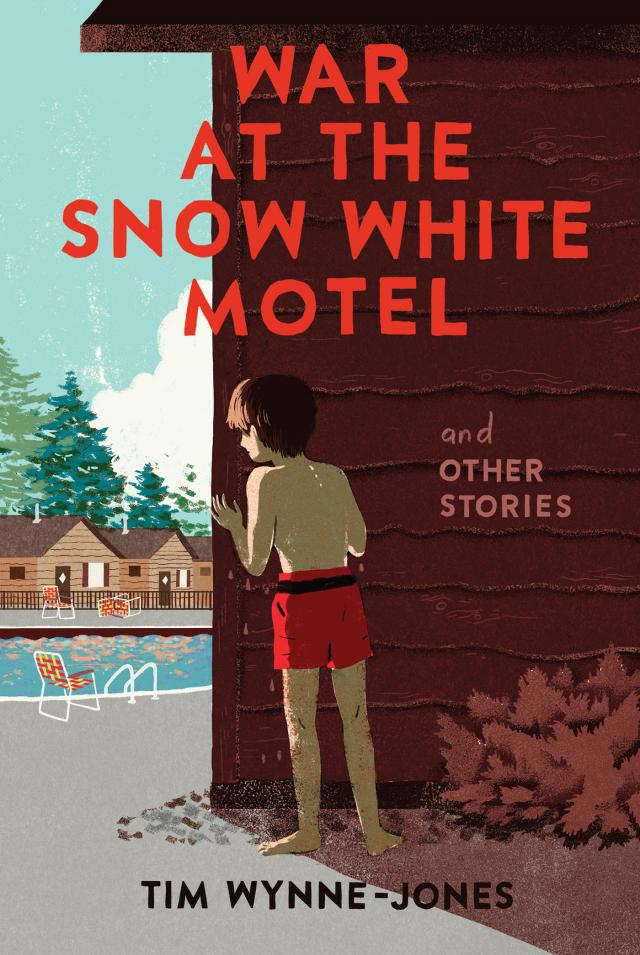
War at the Snow White Motel
One of the best times of my life as an author was writing the semi-autobiographical Rex Zero Trilogy, set in the Cold War of the early sixties. (Rex Zero and the End of the World; Rex Zero, King of Nothing; and Rex Zero, the Great Pretender.) I went on to write a fourth book in the series, but it just didn’t work out. Happens. I’ve written several novels over the years that, no matter how much work I put into them or how many drafts I sweated over, just never were good enough to publish. Luckily, manuscripts like that still have some good bits in them, a passage here, a nice little chunk of dialogue there. Those manuscripts end up in my own personal literary wrecking yard, ready to be repurposed one day. That’s what happened to the opening chapter of the book I was going to call Rex Zero in Deep. I reworked it to make this story and I think it turned out just fine.
You can read about what happened on August 4, 1964, on Wikipedia. The “incident” that did or didn’t happen brought about the “The Gulf of Tonkin Resolution,” which gave the president of the United States, Lyndon B. Johnson, the legal justification to start open warfare against North Vietnam. Skip tells Rex that hopefully the war could be over “real soon,” but the truth was it didn’t end until 1975.
Like Rex, I spent quite a number of summers in Ocean Park, Maine, and we sometimes stayed in motels en route, though never one quite like the Snow White! I think 1964 might have been the last summer we went to Maine, but I have no idea what dates we were there. I can’t help thinking how eerie it would be to arrive somewhere for a holiday just as that country went to war.
Ant and the Praying Mantis
One of the most troubling, hurtful, even frightening things that can happen to you is being accused of something you didn’t do — or didn’t realize you were doing. Yes, you did something, but not what you’re being accused of and it’s all so complicated. When Ant tells the principal that he didn’t do what she alleges, she says, “Oh, you did,” as if it’s black and white in her mind, as if she hasn’t heard a word he’s said in his defense. He gets up to leave and she says, “Excuse me, young man, you have not been dismissed,” and he replies, “Yes, I have.” He’s not being rude, just telling the truth; she has dismissed him in that other sense — she has scorned him. I’m so glad Ant finds a way to really talk to Samantha and, through her, find something to stand up for. To stand tall.
Which brings me to the inspiring Greta Thunberg and her appeal to action on climate change. When I was trying to think of what could possibly raise Ant up from the personal despair in which he finds himself, I could think of nothing better than #FridaysForFuture. Samantha Grimsby-Paine is as blunt in her own passionate way as her Swedish heroine, and she’s just the spur that Ant needs to get back on his feet again.
The Pledge
Sooner or later, every good friend I’ve ever had admits to some dumb thing they did when they were kids (or maybe just last week — let’s face it, we never stop making dumb mistakes now and then). Typically, the story gets a good laugh, because it’s usually not all that big a deal, nothing really awful. And yet, it was a big deal when it happened. Excruciating. It’s amazing how you never quite get over the niggling feeling of embarrassment — sometimes shame — even decades after the incident. Part of the problem, I guess, is that you seldom get the chance to really apologize or pay back the person you did the dumb thing to. So the best you can do is pay it forward. Learn from the dumbness.
I guess that’s why I wanted to give Joe and Danny a chance to live up to this pledge they made to each other. I’m kind of guessing Joe only came up with the whole idea to calm Danny down, not really thinking the opportunity would ever truly arrive to do the right thing, make amends. What’s particularly worthy in my estimation is that they still could have easily gotten away with doing nothing and yet they fulfill their pledge anyway. Nice.
The Journey to Ompah
I live in Eastern Ontario, on seventy-six acres of bush and high meadow, with only a rind of topsoil. It’s not very arable, but I love the roughness of the landscape, with the rock punching through everywhere like an angry, old, giant prisoner, buried alive. There’s a line I heard once when we moved to these parts: if you see a rock you can take it for granite.
Place figures prominently in my writing. I love to ground a story in a real landscape; it often seems almost like a character to me. In this story, I created Michel’s grandfather out of a chunk of granite. He’s all sharp edges and heft. Unforgiving.
Three of my novels are set in the fictional town of Ladybank. You’ll also see it mentioned by name in “The Pledge.” The truth is that Ladybank is Perth, Ontario, and the landscape featured in most of these stories is Perth and its vicinity, where I’ve lived for the last thirty years. Fictionalizing a place allows you to add a store here or a street there or move the river over a little, if you feel like it. But the landscape — the blood and bones of it — isn’t fictional. To me, landscape is never simply setting. The word “setting” always makes me think of the backdrops in school plays, painted on paper and kind of just hanging there, pretending to be a field or the ocean, fluttering a bit when you walk past. For me, setting isn’t enough; I want the land to evoke a sense of place. I have this funny feeling we all become a little of where we live.
In a House Built Out of Dragonfly Wings
This story was written twenty-five years ago, which is an interesting coincidence, since it was commissioned for a book celebrating twenty-five years of Greenpeace. That anthology, Beyond the Rainbow Warrior, is a collection of stories that look at environmentally relevant issues from a lot of different angles. It’s good to see my own contribution reprinted again, although it’s a bit sad to realize that a quarter of a century on, we humans are still not doing enough to clean up our act. I like to think that imaginative souls like Jess can make a difference. In her flights of fancy, she turns her world into a place of magic and mystery — a place where toxic gunk has no place. Her passionate imagination gets turned into action. That’s the best part.
I wasn’t thinking about this story when I wrote “Ant and the Praying Mantis,” but it’s interesting to see a certain similarity in the duo of Jess and Walker compared to Ant and Samantha. What do they share? What makes them good partners?
Jack
I did find a frozen ermine in our garbage can. It was pretty amazing. We live in the country, and we keep the garbage in an out-of-service outhouse, just like in the story. Old Man Sunday is loosely modeled on a wood carver friend of mine, Michael, who does make remarkable animal figures. And yes, he does have a freezer full of dead creatures to use as models. He didn’t kill them; people bring him what they find.
Several years ago, when I was heading to England, I asked Michael to make a stoat as a present for Philip Pullman. The Golden Compass and the other novels in the His Dark Materials trilogy are among my very favorite books of all time. I was going to be visiting Pullman when I was overseas and thought it would be nice to bring him a “daemon,” like Lyra’s dearest companion, Pantalaimon. In Lyra’s world, a daemon is the external manifestation of a person’s inner self and takes the form of an animal. Michael did an amazing job, and Pullman immediately put the stoat in his breast pocket — the kind of place a daemon would likely hang out if it was small enough.
As someone who suffered bullying as a kid, it’s a subject that interests me. It’s also a subject that gets written about a lot, and bullies in fiction can be too easily stereotyped. I wanted Dougal Ashur to be someone who was struggling himself. I wanted there to be a whole other motivation for his attention to the lead character. When Sunday says to the unnamed protagonist, “It’s good to have a second set of eyes,” I wanted to make a point about how sometimes we have to look at things differently — not jump to conclusions.
The Stuffed Toy
Years ago, I wrote a piece called “What Happened to Baby Roo?” for an adult collection of mystery stories called Criminal Shorts: Mysteries by Canadian Crime Writers. I used the same basic premise here, an otherwise ordinary old stuffed toy with a remarkable story behind it. The story is true, or at least the part about Christopher Robin leaving Roo in the crotch of a tree. What really happened after that … well, somebody knows, I guess, but not me. Which is what made it so delicious to make up a story. Twice. Hey, Mozart and Bach used certain themes and motifs over and over again in their music, so I figured it was okay. And the stories are really quite different.
You might like to read The Enchanted Places, Christopher Milne’s book about being that very famous little boy. It’s really interesting, especially if, like me, you love the Winnie-the-Pooh books. I’d say The House at Pooh Corner is still one of my top-ten favorite books of all time. If you only know the Disney movies, you might want to check out the real Pooh.