Breath of bones, p.1
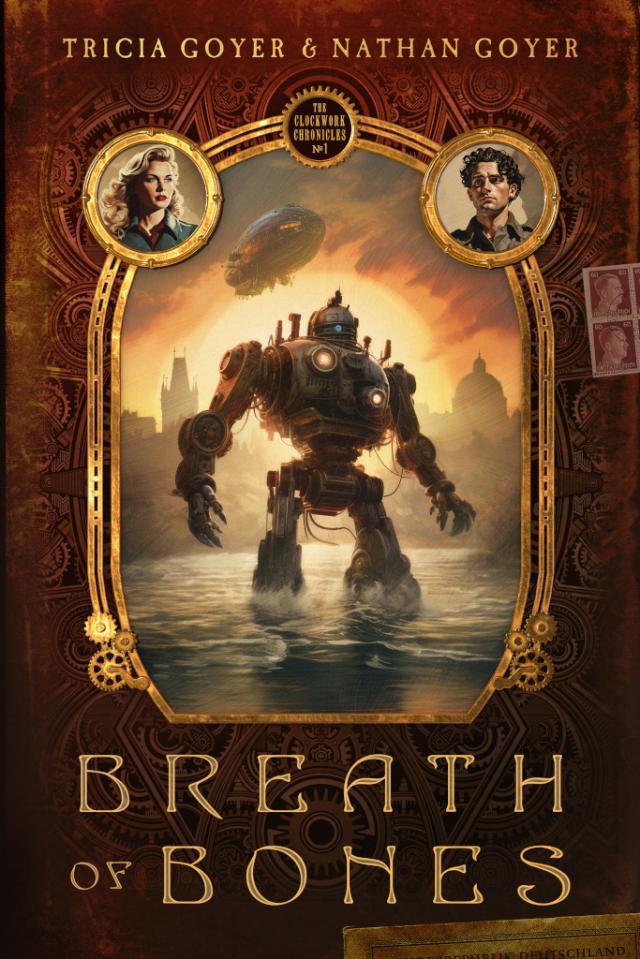
Breath of Bones,
p.1


Acclaim for
BREATH OF BONES
“Breath of Bones grabs early, very early, and does not let go. A captivating weave of legend and reality, this story will draw you in and make you say, ‘I need the next book in the series now.’”
—James L. Rubart, Christy Hall of Fame author
“A riveting piece of history welded with science fiction. Readers intrigued by steampunk, dieselpunk, or World War II will devour this well-researched, wonderfully crafted tale and come back for more.”
—Jamie Foley, award-winning author of Sentinel and Emberhawk
“Breath of Bones is a tale of forgotten legend, tragic hope, and faithful courage. Goyer and Goyer leave no stone unturned in their masterful research and transport the reader across time with a fantastic blend of fiction and history.”
—Nadine Brandes, award-winning author of Romanov and Fawkes
“Tricia and Nathan Goyer deliver the best of their respective worlds in Breath of Bones. Fans of historical fantasy, steampunk, dieselpunk—and WWII fiction-lovers looking for something delightfully different—this is a can’t-miss first installment of what’s sure to be a stellar series.”
—Lindsay A. Franklin, Carol Award–winning author of The Story Peddler
“History, legend, and imaginative tech come alive in Breath of Bones. Josef and Kateřina’s story will send you exploring architectural secrets, fighting for impossible choices, and cheering every victory.”
—Katherine Briggs, author of The Eternity Gate
“Breath of Bones is a fascinating WWII story that takes place in an alternate reality with a guardian for the Jews arriving in the form of a golem. Yet it also portrays the same courage and sacrifice that existed in our own history, of people who chose to save others in the face of evil. I was moved, I cried, and I was encouraged. This is a story for all readers. Highly recommend!”
—Morgan L. Busse, award-winning author of the Ravenwood Saga, Skyworld, and Winter’s Maiden
“With intense and imaginative storytelling and brilliant detail, Breath of Bones uses alternate history to bring us a vital reminder of a very real evil we must never forget.”
—James R. Hannibal, award-winning author of Lion Warrior
Books by Tricia Goyer
The Liberator Series
From Dust and Ashes
Night Song
Dawn of a Thousand Nights
Arms of Deliverance
The London Chronicles
A Secret Courage
A Daring Escape
Chronicles of the Spanish Civil War
A Valley of Betrayal
A Shadow of Treason
A Whisper of Freedom
The Gabi Mueller Series
The Swiss Courier
Chasing Mona Lisa
Songbird under a German Moon
Twice-Rescued Child
By the Light of the Silvery Moon
View more of Tricia’s books at triciagoyer.com.
Breath of Bones
Copyright © 2024 Tricia Goyer & Nathan Goyer
Published by Enclave Publishing, an imprint of Oasis Family Media, LLC
Carol Stream, Illinois, USA.
www.enclavepublishing.com
All rights reserved. No part of this publication may be reproduced, digitally stored, or transmitted in any form without written permission from Oasis Family Media, LLC.
This is a work of fiction. Names, characters, places, and incidents are products of the author’s imagination or are used fictitiously. Any similarity to actual people, organizations, and/or events is purely coincidental.
ISBN: 979-8-88605-126-1 (printed hardcover)
ISBN: 979-8-88605-127-8 (printed softcover)
ISBN: 979-8-88605-129-2 (ebook)
Cover design by Kirk DouPonce, www.FictionArtist.com
Typesetting by Jamie Foley, www.JamieFoley.com
Printed in the United States of America.
To my husband, John,
who always chooses movies with strange creatures
and otherworldliness, expanding my imagination.
To Nathan,
who jumped on board when I paused my sweeping to ask, “What do you think about a novel like this?”
To Steve Laube,
who was the first to read my work and say,
“This is going to get published,” and who turned to me at my first Realm Makers Conference and said,
“Come to the dark side,” inviting me to write in new,
creative ways to share God’s true light.
—Tricia
To my brother Cory,
who always listens to my crazy ideas
and tells me if they’re good or not.
To Tricia, my mother,
who has fostered my writing skills ever since I was a child.
To my dad, John,
who helped come up with some of the
fantastical elements you’re about to read.
—Nathan
Table of Contents
Cover
Acclaim for Breath of Bones
Half-Title
Books by Tricia Goyer
Title Page
Copyright Page
Dedication
Epigraph
Prologue
Chapter 1
Chapter 2
Chapter 3
Chapter 4
Chapter 5
Chapter 6
Chapter 7
Chapter 8
Chapter 9
Chapter 10
Chapter 11
Chapter 12
Chapter 13
Chapter 14
Chapter 15
Chapter 16
Chapter 17
Chapter 18
Chapter 19
Chapter 20
Chapter 21
Chapter 22
Chapter 23
Chapter 24
Chapter 25
Chapter 26
Chapter 27
Chapter 28
Chapter 29
Chapter 30
Chapter 31
Chapter 32
Chapter 33
Chapter 34
Chapter 35
Chapter 36
Chapter 37
Chapter 38
Chapter 39
Chapter 40
Epilogue
Acknowledgments
About the Author: Tricia Goyer
About the Author: Nathan Goyer
For the glory of God we all had to die,
For the mercy of God we only could cry.
On the eve of the feast, they began their foul deed,
When they grabbed every Jew they found in the street,
And forcibly tried to make him give up,
The creed of his fathers, his trust in our God . . .
May the offering please God be it lamb or sheep
Or the innocent children over whose suffering we weep . . .
O God, put an end to such murderous deed:
It follows us everywhere. The thought makes us bleed.
It made us a target of cruel contempt
In the Land of Bohemia and wherever we went . . .
—Rabbi Avigdor Kara, 1389
Quoted in Hana Volavkova
Judah Loew dodged sword strikes, unsteadily wielding his longsword while pressing a fistful of his tunic into his side, attempting to stop the flow of blood. Behind him, cries of enemy soldiers rose, as did the crunch of bones and blows against armor. On each side, bodies flew this way and that.
Then, as if moving in slow motion, the soldier standing before Judah lifted his gaze. His eyes widened in horror as an ominous shadow fell upon them.
Judah saw his chance and lunged, slicing open the man’s neck. Bright red droplets splattered across the ground. Crumpling, the Roman soldier’s sword fell, glistening with the fading sunlight and Judah’s blood.
He whispered a quiet prayer for the man, hoping for God’s mercy. Then Judah gasped and sank to a knee, gripping his side as heat spread through his abdomen.
Warm, sticky liquid spread over his fingers. Judah’s stomach clenched at its sweet, metallic scent. His blood mixed with that of his enemies as it dripped onto the clay and grass of the riverbank. Would the madness ever stop?
Judah had never wanted this slaughter, yet he would do whatever it took to protect his people. Will we ever be safe? Will the wolves always seek Jewish blood?
Using his sword as a brace, Judah attempted to rise. His knees wobbled. He pulled in one breath, then another, as if trying to suck air through clay at the river’s edge. His second attempt brought him to shaky feet, and his gaze danced over the surface of the Vltava River. Maybe my fight will end tonight. For the first time, this thought brought no sadness.
The looming shadow grew closer, darkening the water. Judah turned slowly, and his breath caught. And maybe yours, too, my friend.
The massive figure stood before him, bearing a man’s shape. Its opposing presence appeared as tall as the trees at the river’s edge and as wide as the castle wall beyond. It was not flesh that composed its body but deep-red clay, which still bore the marks where Judah had pressed and shaped its surface. A roughly formed face turned to Judah, and two glowing red spheres peered down.
Golem approached with halting steps, and the riverbank trembled under Judah’s feet. Dozens of arrows, spears, and even a sword pierced its body.
He’s only clay. He feels no pain, Judah reminded himself.
Judah stepped fo
rward and gasped as the figure raised a closed fist, ready to crush Judah into dust. Will this be my end? The creator destroyed by the creation?
Holding a halting gesture toward Golem, a whisper escaped his lips. “Calm, now. Hněv je špatný rádce.” Yes, anger is a bad advisor.
Golem took a jerky step forward, hesitated, and slowly lowered its fist.
“Good.” A raspy breath escaped, and then Judah coughed. “You did well.”
Movement caught his eye. Beyond Golem, another soldier writhed on the ground, his final breaths labored. More lifeless bodies dotted the river’s edge. Golem had fought them all. Golem had meant only to stop the threat. Stop them, he did. Death was only a living thing’s concept. Golem was not alive. Not touched with the breath of their Creator. But still. Golem did too well.
Judah motioned Golem forward. “Come, follow me now.”
Six steps, then Judah’s feet sunk into the red clay. He stumbled and fell to his knees. Judah gritted his teeth as pain surged through his battered body. He again pulled himself up with great effort. Step by labored step, he led Golem away from the battlefield.
Soon, cobblestone replaced the clay and grass from the river’s edge. Single-story homes and buildings lined the roads. The quiet streets mocked him. Despite his efforts, no one exited the doorways to cheer on this victory. Occasionally, a nervous face peered through a cracked window, but each face pulled back once Golem appeared. It’s not only the enemies who fear.
Lagging steps took them to the synagogue. The oldest Jewish temple in Prague, the Gothic Old-New Synagogue, stood silently on Maiselova Street. Its black, jagged-shaped roof jutted into the sky like the tip of a spear. Golem hunched down as he approached and shuffled through the entrance.
As Golem entered, the wooden beams that framed the doors knocked arrows from its shoulders, sending them clattering to the ground. Together, they shuffled to the back nave and peered up the stairs to the attic.
Red streaked the walls, evidence of the pogroms of 1389, where three thousand Jews sought refuge within the synagogue but met their deaths instead.
In the two hundred years since, there had been seasons of peace. Then, thirteen years ago, the priest Thaddeus claimed that the Jews of Prague used the blood of Christian children in their rituals. Ordinary men and soldiers made it unsafe for Jews to leave their homes. That’s when the words came to Judah in a dream: “Ata Bra Golem Dewuk Hachomer W’tigzar Zedim Chewel Torfe Jisrael.” You shall create a golem from clay, that the malicious anti-Semitic mob be destroyed.
Judah created Golem with the help of his son-in-law, Isaac, and his disciple, Jacob. Now, with their enemies destroyed, Golem had fulfilled its purpose. Judah’s chest heaved with labored breaths as he lifted one foot and then the other, dragging his body up the first step and the next. Golem filled the stairwell and moved with the same slow gait. With great effort, master and creature made their way to the attic.
Approaching an open tarp, Golem lowered himself to a sitting position. His eyes now level with Judah’s.
“It is the Sabbath, dear one.” Vision blurring, Judah neared Golem and reached out toward its face. Golem’s mouth opened, revealing a parchment covered in words. Judah removed the parchment, and Golem slumped. Its eyes faded, and its body stilled. Again, a lump of clay, lifeless.
“Yes, rest now. Rest.” Judah coughed again and then limped to the wall by the stairs. His body weighed heavily, and the world grew darker with each labored breath. Judah leaned against the wall, slid down its cold surface, and closed his eyes. “I will rest now, too.”
Josef Loew pressed himself against the shadow of the ancient gate that once marked the entrance to Josefov in the Jewish district. Nestling in the stone archway, he felt the cold, mossy surface against his back. A column of Wehrmacht Sturmtruppen, in their meticulously tailored uniforms, marched down the narrow street. The gas lamps’ flickering lights caught the polished edges of their attire, causing them to shimmer menacingly.
The rhythmic clomping of their heavy leather boots, reinforced with metal toe caps, echoed through the alleyways, harmonizing with the frantic beat of Josef’s heart. Their uniforms, a mix of deep charcoal and forest green, were immaculate, with golden epaulets and badges that shone under the ambient light. These were no ordinary troops. Their status was evident in their dress’s finery and march’s discipline.
Gleaming in steel and brass, their weapons were not mere tools of war but works of art. Rifles with ornately engraved barrels, pistols with wooden handles adorned in intricate patterns, and backpacks fitted with curious devices that emitted gentle puffs of smoke and the soft hum of machinery. Small gadgets with rotating gears and flickering lights attached to their belts showcased the blend of military might and the pinnacle of craftsmanship. The sight was both awe-inspiring and deeply foreboding.
Josef’s fists balled at his sides. This madness has to stop. For months, he’d dedicated his life to moving Jewish men, women, and children around the city to keep them one step ahead of the transports that rounded them up and shipped whole families off to the camps. But they couldn’t keep running forever. There was a time to hide and a time to fight. If only his inventions could puncture the Germans’ confidence and remind his people they didn’t have to be led away like lambs to the slaughter. Like David, Gideon, and Joshua in their ancient Scripture, perhaps it was time for the warriors to rise among them for the salvation of their people.
Josef pressed himself closer to the ground. Trailing the platoon of soldiers, a spider tank advanced with deliberate grace on its curved, elongated legs. Its brass-and-steel body reflected the muted light, revealing intricate gears and steam vents that hissed intermittently. Having been field-tested in Spain during their Civil War, the rumors of these eight-legged monstrosities capable of scaling walls and descending into trenches were chillingly accurate.
Each leg, expertly engineered, had joints decorated with ornate patterns, giving it a fusion of intimidation and elegance. The central body of the tank bore multiple viewing slits, with a rotating upper turret equipped with steam-powered cannons. The spider tank was manned by a team: a commander who dictated the strategy, a gunner who aimed the weapons, a loader responsible for ammunition, a driver who navigated the mechanical arachnid, and a radio operator ensuring seamless communication.
For all its engineering marvels and tactical advantages, the tank had one unmistakable flaw. The loud click, click, click of its legs echoed ominously as it traversed the medieval cobblestone streets, announcing its presence to anyone within earshot. Those in the resistance knew to listen for this sound as a harbinger of the approaching menace.
“Pavouci,” Josef mumbled under his breath. Spiders were out today. It meant only one thing: more families would be swept into their web. For eight months, men, women, and children had been hauled away “to the east.” While many hoped the families were simply relocated, the evil glints in the soldiers’ eyes told Josef a different story.
Above the medieval streets of the Jewish district, an airship navigated, floating over the gabled roofs and tightly packed buildings inhabited for over a thousand years. Under the dirigible, dressed in dark-blue uniforms with quilted layers for warmth, rode the Zeppelintruppen. Perched in the rigid basket, with rifles poised, they appeared like hunters aiming at skittering rabbits. Additional air scouts peered into the streets and alleyways with steel binoculars pressed to their faces.
The Wehrmacht column marched out of view, and Josef hurried to his place of refuge—soon to be the center of deliverance for his people. He was a Loew, after all. Like his father and grandfather, it was his turn to make his mark.
With quickened steps, Josef hurried toward his grandfather’s clock shop and the warehouse once used as a storehouse by Jewish merchants of the Prague markets. His advance turned into a jog as he moved past the Old Jewish cemetery with its rows of rock headstones, tilted and blackened with age. How many of his people had already died in this war, shuttled away to walled camps by the Einsatzgruppen, the killing units, with no tombstones to record their names or mark their final resting places?
The weight of his call rested on Josef’s shoulders. For centuries, his family had accepted the vocation established by his great-grandfather to protect the Jewish people. And today, Josef could be one step closer to doing that—if he could only get his newest weapon to work. An ache pinched in the pit of his stomach as he thought of the last words his father had spoken to him before joining the others being marched to the train station. You are a Loew. Remember that . . . There wasn’t a day he didn’t remember. Not a day he didn’t strive to prove himself worthy.