

Radio silent, p.1
Radio Silent,
p.1
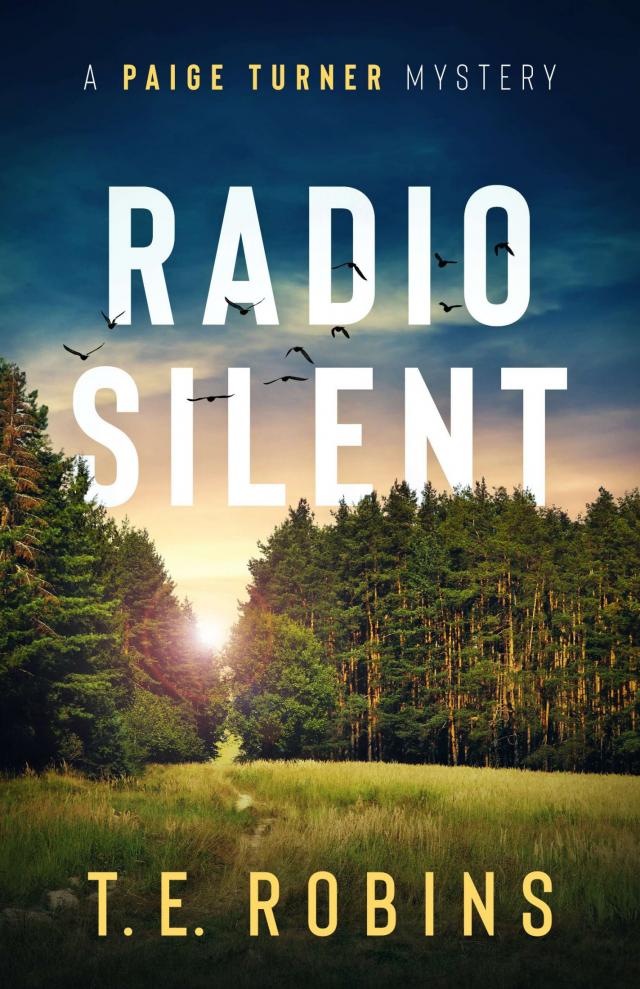


Copyright © 2023 by T.E. Robins
All rights reserved.
No part of this publication may be reproduced, distributed, or transmitted in any form or by any means, including photocopying, recording, or other electronic or mechanical methods, without the prior written permission of the publisher, except as permitted by copyright law. For permission requests, contact tudor@tudorrobins.com.
The story, all names, characters, and incidents portrayed in this production are fictitious. No identification with actual persons (living or deceased), places, buildings, and products is intended or should be inferred.
Book Cover by Dissect Designs
1st edition, 2023 – ISBN 978-1-990802-32-4 (ebook) | ISBN 978-1-990802-33-1 (paperback) | ISBN 978-1-990802-34-8 (hardcover) | ISBN 978-1-990802-35-5 (dust-jacketed hardcover) | ISBN 978-1-990802-36-2 (audiobook)
Contents
1. Prologue
2. One
3. Two
4. Three
5. Four
6. Five
7. Six
8. Seven
9. Eight
10. Nine
11. Ten
12. Eleven
13. Twelve
14. Thirteen
15. Fourteen
16. Fifteen
17. Sixteen
18. Seventeen
19. Eighteen
20. Nineteen
21. Twenty
22. Twenty-One
23. Twenty-Two
24. Twenty-Three
25. Twenty-Four
26. Twenty-Five
27. Twenty-Six
28. Twenty-Seven
29. Twenty-Eight
30. Twenty-Nine
31. Thirty
32. Thirty-One
33. Thirty-Two
34. Thirty-Three
35. Thirty-Four
36. Thirty-Five
37. Thirty-Six
Reviews mean everything ...
Preview
About the Author
Prologue
A clearing in the woods. Sun beams on a camp chair with a hoodie splayed over the back of it. A water bottle lists drunkenly out of the too-shallow cup holder.
In the dip of the canvas seat lies a walkie-talkie which crackles to life, “Rider seventy-seven, clear over jump three.”
Several seconds later, “Rider seventy-seven, clear over jump four.”
The birds keep twittering. They’re used to the all-day-long white-noise chatter of the radio.
“One refusal at jump five. Over on the second attempt.”
A distant thrumming builds to a drumming tattoo. Hard hooves striking a hollow sound from the earth.
The horse’s breath ragged and throaty. His rider calling, “Steady! Steady!”
They pound through the clearing with the sun glinting off the horse’s bright bay coat and the rider’s satin helmet cover.
The horse’s hooves cut the sod. He rocks back on his haunches and launches over the huge log — white flag on the left, red on the right — flying, landing, flicking his tail and carrying his rider forward.
The interruption ends on an enthusiastic, “Good boy!” and retreating hoofbeats. The birdsong resumes, along with the walkie-talkie’s reports, “… clear over jump seven …” all the way through to the finish.
Then, “Jump six? Radio check jump six. We didn’t get your last report.”
The feathered beating of a chickadee’s wings, a breeze riffling the newly-leafed-out trees, the rustle of a squirrel in the underbrush.
The radio again, “Hold on the course, please, while Nate goes to check on jump six. All other jump judges hold position.”
The next sound in the clearing is the rumble of a golf cart and the bump of its small tires over the grassy trail. It stops in the space between the big log and the camp chair. A man walks over, picks up the walkie-talkie, and says, “Control? I’m at jump six. There’s nobody here.”
One
At least I’m not that guy.
I’m standing at the edge of a rugby pitch watching the demo of a robotic line-painting machine … which has just lost a wheel and keeled over.
The guy in question, wearing a polo shirt emblazoned with Grass Graffiti is sprinting across the pitch.
The info sheet I’m clutching explains that the Grass Graffiti 2.0 will save the rugby club fifty percent on its paint costs. I lift my camera and zoom in on the glugging paint forming a white puddle around the capsized robot.
At least I didn’t have to pay for the paint.
Next to me a man swears and turns to the woman standing beside him. “Kick-off for under-sixteen regionals is at 8:30 tomorrow morning.”
At least I’m not organizing the under-sixteen regionals.
I’m trying to look on the bright side.
That was my editor’s advice when she handed me the press release titled Robo-Rugby Rumble: Line Painter Tackles Turf Trouble and said, “Three-hundred words should do it. You’ll get a photo credit, too,” and I replied, “Fantastic. I’ll wait for the Pulitzer committee to contact me.”
“Pulitzers are about attitude.” Maddy’s voice was unusually sharp. It made me double-take. “What does that mean?”
She sighed. “Studies show people who look on the bright side live longer, Paige.”
“Do they also win more Pulitzer Prizes?”
“I don’t know. Why don’t you research it and write me a story on it?”
I was tempted to point out no matter how good my attitude, nobody could expect to win a Pulitzer with the type of stories she’d been assigning me — Party like it’s $19.99 on how to host a barbecue on the cheap, and Baking Bad about a cannabis dispensary that helps people incorporate pot into their favourite family recipes — but there was something in her tone that made me cut my losses and head out to the rugby club.
Now I suspect the Grass Graffiti rep wishes he could cut his losses.
I send Maddy the photo of the incapacitated robot, with the press release headline rewritten “Rogue Rugby Robo: Line Painter Triggers Turf Trouble.”
And that’s when I receive the text that changes everything.
***
My sister doesn’t text me in the middle of the day. She doesn’t text me “just because.” In fact, my sister rarely texts me at all.
So, when I read her message saying, Any chance you could meet up soon? my spidey senses tingle. Even more so when I reply, I’m actually only fifteen minutes away. I could come now? and she immediately types, Yes, great. At the office.
It’s an even shorter drive to her office than to her house. I’ve never been there, but I know it’s on the main street of the village close to our tiny hometown. Fortunately, that village is still small enough for me to easily find Faye’s law firm.
As I start the car, my latest podcast starts auto-playing. After enjoying the first two episodes, it’s grating on my nerves, so I fumble to switch to radio. On the local news, they’re interviewing the owner of the cannabis dispensary I wrote about for my Baking Bad story. You’ve got to be kidding …
Power off. Silence.
Which, of course, just provides a vacuum for my thoughts to slide over to why Faye wants to see me now.
Don’t get me wrong. I love my sister, and she loves me. It’s just that our love is polite, and somewhat restrained, the way it is with all my siblings who are just enough older than me that they sometimes feel more like aunts and uncles than brothers and sisters.
I see them regularly — for holidays, and milestone anniversaries, and the births of nieces and nephews — almost always organized by invitations from Faye.
Just never by text, and never at 2:00 p.m. on a Thursday.
***
When I step into the reception area of Faye’s office, which was once the spacious front hall of one of the classic three-storey brick houses sprinkled along the main streets of most small Ontario towns, I don’t expect the receptionist to recognize me.
Which is why it’s disconcerting when a smile spreads across her face and she says, “You must be Faye’s sister.”
“Did she tell you I was coming?”
“No, but you look so much like her. And, of course, I’ve seen your photo in her office.”
The woman rises from her chair. “She’s just wrapping up with a client in the meeting room. I’ll take you through to her office to wait.”
I follow her, wondering, Do I look like Faye? I would have said no. From top to bottom, we’re so different. Every hair in Faye’s long bob turns under at all times. With her tasteful earrings, clean-framed glasses, and capsule wardrobe of Oxford shirts in a variety of tasteful colours, paired with chinos that look custom tailored to her slim frame, she’s got the look of someone you’d trust to write your will or run your parent council.
I, on the other hand, call my hair tousled, and pretend it’s a style. I can usually only ever find one earring at a time, and my wardrobe is a capsule of denim and jersey.
My sister and I are the same height, though. Our hair’s the same shade — although she enhances hers with subtle highlights. I definitely have more freckles than her, but I suppose the bone structure underneath those freckles is quite similar.
It’s a funny feeling to think I look so like my sister that this person I’ve never met pegged us as siblings. It’s even funnier to walk into her office — cream walls, original trim around the windows and doors, Persian rug on the wood floor, and well-cared-for plants on a shelf by the window — and see a picture of me on her tidy desk.
&
nbsp; Not just me — all five of us — Faye, Xander, Macy, and Rowan as well. I guess all the Turner siblings look alike. Especially when we’re smiling for the camera.
“Can I bring you anything? Something to drink?” The receptionist snaps my attention away from the photo.
“No thanks.” I say it less because I’m not thirsty and more because I have no idea if this strange midday, midweek summons is more of a cup-of-tea or whiskey-neat situation.
Besides, I have my water bottle with me. After the woman leaves, I pull it out of my canvas satchel. Its original fake-wood effect is mostly rubbed off and what’s left is largely covered by stickers from my university radio station and newspaper, along with one that says, That sounds like a you problem and, taking pride of place, one wrapped around the entire bottle that reads, Page Turners Pub — Books and Beers / Beers and Books.
I hear Faye’s hard-soles clicking behind me and shove the tatty water bottle back into my bag.
“Paige. I hope you weren’t waiting long.”
My sister’s voice is just as calm and polite as it always is. Her clothes are wrinkle-free. Her nails are clean and neatly rounded. No visual hints as to why I’m sitting here.
She settles onto her tufted velvet chair upholstered in a rich yellow shade. I was one of many people who chipped in to buy it for her fortieth birthday. It’s designer-gorgeous and ergonomic — form and function together. Perfect for my capable sister.
It’s the slump of her shoulders that provides the first clue. Faye isn’t a sloucher. Next, the sigh. Growing up in her house, I heard her chastise her kids, “A sigh says more than you think it does.” The unspoken ending to that sentence was, and what it says isn’t good.
Then she rises again, steps over to the floor-to-ceiling built-in unit which takes up one entire wall of her office and opens a door that turns out to hide a small refrigerator. She pulls out two cans, sets them on the desk, and sits down again.
Diet Coke. Jeepers creepers. This is worse than a whiskey-neat situation.
This is an aspartame-level emergency.
I lift my eyebrows and pick up one of the cans. “Is it that bad?” Back when I lived with her, the only fizz Faye allowed in the house was sparkling water. If I wanted a Diet Coke I had to hide it in my bedroom.
“What?” She rubs her temple. “Oh, I drink it when I’m stressed.”
She pauses, then a grin steals across her face. “I drink it every day.”
Although the grin is gone in an instant, its effect lingers. I’ve always been secure in my sister’s love, but that love has been as her ward — a charge for her to protect. I sit a weird half-generation between herself and her own kids, making me neither child, nor equal.
For the first time, in our shared guilty pleasure, I feel like an adult in her presence.
The equal footing gives me the guts to ask, “What’s ruffling your feathers, sis?”
For a second, I wonder if I’ve gone too far. If she’s going to shut down, clam up, collect herself, and say, “Nothing at all.”
Instead, she takes a big swig of her drink and says, “Oh, Paige. There’s no good way to tell you this — a girl’s gone missing.”
***
I’m not sure if I’m more shaken by the news of the missing woman, or by Faye raising it with me.
We don’t talk about this.
It’s my first reaction, and I know it’s wrong. This isn’t about you, I tell myself. Focus. Ask a semi-intelligent question.
“Who?” I manage.
It’s not great, but it’s enough to get Faye talking.
“Her name’s Wren. Wren Sheedy. She works at Oak Copse — you know, the stables where Charlotte rides. Charlotte’s rattled. Wren teaches her sometimes and she really looks up to her.”
“Oh!” I clap my hand to my breastbone. I know what it’s like to be fourteen and to have someone you care about go missing. “I’m so sorry for Charlotte. And, of course, for Wren. And for you, Faye.”
The only time I’ve ever seen my self-possessed sister cry was when she tripped on a pile of my nephew’s Lego, landed on the coffee table, and broke her arm. Now, though, her eyes are suspiciously shiny.
She exhales so forcefully her hair lifts from around her face. “It’s hit me hard, Paige. I’m finding it really upsetting.” My gut twists. The pain in her voice hurts me more than I could have guessed.
“What happened?” Wow. There’s my journalism degree showing. I’m up to two-word questions now.
Still, it’s enough to prompt Faye to hand her phone to me. “It’s probably easiest if you read this.” She leans back in her chair. “Take your time. I’ll just sit here and numb my stress with artificial sweetener.”
Loaded on her screen is a Facebook post from a group called Eastern Ontario Eventing.
To anyone who was at the Oak Copse Horse Trials today, or in the vicinity, please read this post. Wren Sheedy, a member of the Oak Copse staff, did not return from the cross-country jump where she was judging. Wren’s last walkie-talkie report was at approximately 2:15 p.m., after which she stopped answering her radio.
At the time of this post, we don’t know where Wren is.
Wren lives at Oak Copse, and stables her beloved palomino, Shine, there. Her car is still in its parking spot at Oak Copse.
We hope Wren will soon be home, safe and sound, but in the meantime, if you attended the horse trials, please review any photos or video footage from today. If you live in the area, please check any trail or security cameras, or dash cam footage from this afternoon.
Wren is twenty-seven years old, approximately five-foot-five, slightly built, with pink-streaked brown hair. She has a butterfly tattoo on her right shoulder. Today Wren was wearing an Oak Copse baseball cap, large silver hoop earrings with multiple small studs, a red Oak Copse volunteer t-shirt, rust breeches, and dark brown paddock boots.
Please contact provincial police with any information.
The Facebook group has thousands of members. There are two or three pictures of Wren posted over and over again. In this world where so many people walk around with high-quality cameras built into their phones, it always amazes me how many of the photos I see of missing people are blurry or grainy, and Wren’s are no exception.
In one she wears a baseball cap. A dog’s snout is just visible pushing over her shoulder and she has a hand up to the dog’s nose and is laughing. She looks casual, carefree, happy.
In another she’s mounted on a gold-coloured horse, wearing dark green riding pants, a peach-coloured shirt and, of course, a riding helmet. Although it’s a tight shot, the horse’s mane suggests they’re in motion, as do Wren’s eyes, fixed clearly on something she’s riding toward.
The third one makes me catch my breath. It’s not only that the pink streaks in her hair are visible — just like the ones my sister Leila had — the lift of her chin and the glint in her eye also remind me of my sister on certain days, at certain times. Like she had something to prove and was just about pulling it off.
My eyes fly to Faye and she nods. “I know. The one with the pink hair, right?”
Along with the photos are many comments using lots of praying hands and broken heart emojis. I pray you come home soon, You are loved and missed, I don’t know you, but you are in my prayers.
Reading the post has given me more questions than answers. “If it was a competition, weren’t there a lot of people around? How could she just disappear?”
“Jump judging is strange,” Faye says. “While there are nearly thirty people distributed along the course, most judges are alone at their stations, and they usually can’t see one-another, which is why they use radios to communicate. There’s about three or four minutes between each horse-rider combination. Wren radioed one rider in, and was gone by the time the next one came through.”
She continues, “At the end of the competition, when she didn’t check in and return her radio, the stable owner — Rose — asked all the volunteers to search the property. Nobody found anything.”
“What do the police say?”
“Rose called them out after the search. One car showed. They didn’t search that night and they haven’t made any public statements since.”
“But … the press … I haven’t seen anything.”
“Mmm-hmm.” I’m relieved to see a revival of my sister’s usual very strong (and rather opinionated) personality. “Ever since the OJJ closed …”


