Out there where the big.., p.1
Out There Where The Big Ships Go v1.0,
p.1


TWILIGHT CONVERSATION
Roger said, “What was it really like out there, sir?”
There was a pause so long that Roger was beginning to wonder whether the old man had heard his question, then: “There comes a moment, boy, when for the life of you, you can’t pick out the sun from all the rest of them. That’s when the thread snaps, and you slip right through the fingers of God. There’s nothing left for you to relate to. But if you’ve been well trained, or you’re thick as two planks, or maybe just plain lucky, you come through that and out on the other side. But something’s happened to you. You don’t know what’s real anymore. You get to wondering about the nature of Time and how old you really are. You question everything. And in the end, if you’re like me, the dime finally drops, and you realize you’ve been conned. And that’s the second moment of truth…
Books by Richard Cowper
Clone
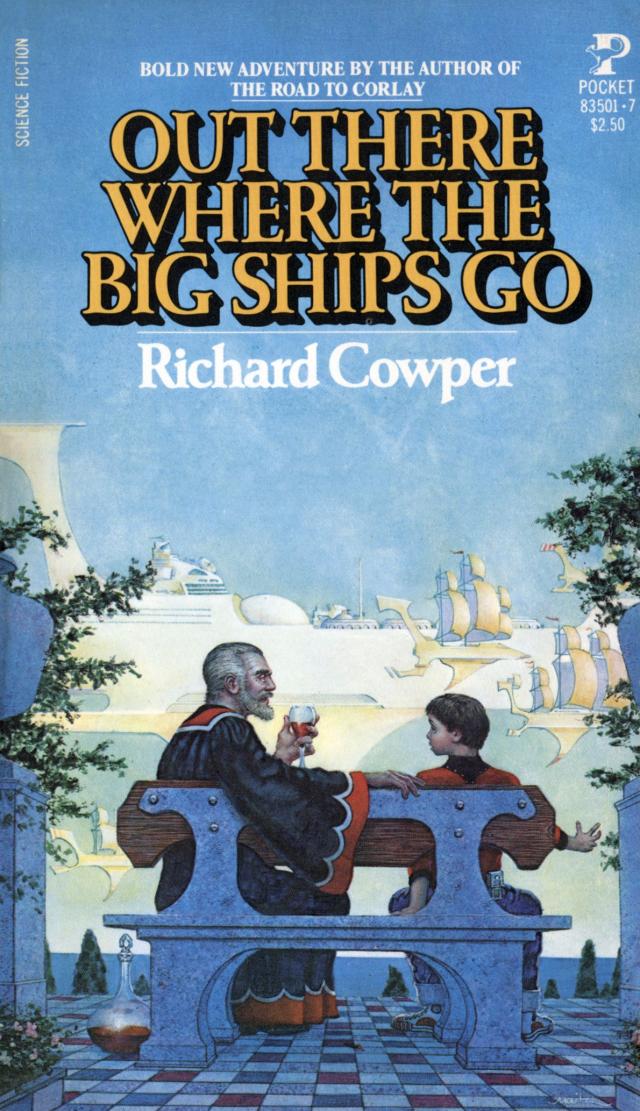
Out There Where the Big Ships
Go The Road to Corlay
Published by POCKET BOOKS
OUT THERE
WHERE THE
BIG SHIPS GO
Richard Cowper
PUBLISHED BY POCKET BOOKS NEW YORK
“The Custodians” copyright © 1975 by Colin Murry, “Paradise Beach” copyright © 1976 by Colin Murry and “The Hertford Manuscript” copyright © 1976 by Colin Murry were all previously published in The Custodians and Other Stories by Victor Gollancz in England.
“Out There Where the Big Ships Go” copyright © 1979 by Colin Murry and “The Web. of the Magi” copyright © 1980 by Colin Murry have previously appeared in The Magazine of Fantasy and Science Fiction, in the August 1979 and June 1980 issues, respectively.
Another Original publication of POCKET BOOKS
POCKET BOOKS, a Simon & Schuster division of
GULF & WESTERN CORPORATION
1230 Avenue of the Americas, New York, N.Y. 10020
Copyright © 1980 by Colin Murry
All rights reserved, including the right to reproduce this book or portions thereof in any form whatsoever. For information address Pocket Books, 1230 Avenue of the Americas, New York, N.Y. 10020
ISBN: 0-671-83501-7
First Pocket Books printing October, 1980
10 9 8 7 6 5 4 3 2 1
POCKET and colophon are trademarks of Simon & Schuster.
Printed in the U.S.A.
Out There Where the Big Ships Go
The
Paradise
The
Manuscript
The Web of the Magi
I did my level best to extract from them more deta
OUT THERE
WHERE THE
BIG SHIPS GO
Out There Where the Big Ships Go
It was at breakfast on the second day that Roger first noticed the gray-haired man with the beard. He was sitting at the far corner table, partly shadowed by the filmy swag of the gathered gauze curtain. It was the ideal vantage point from which to observe whatever might be going on outside the long vista-window or to survey the guests as they came into the hotel dining room. But the bearded man was doing neither. He was just sitting, staring straight ahead of him, as though he could see right through the partition wall which divided the dining room from the hotel bar, and on out across the town and the azure bay to where the giant clippers unfurled their glittering metal sails and reached up to grasp the Northeast Trades.
“Don’t stare, Roger. It’s rude.”
The boy flushed and made a play of unfolding his napkin and arranging it on his lap. “I wasn’t staring,” he muttered. “Just looking.”
A young waiter with a sickle-shaped scar above his left eyebrow moved across from the buffet and stood deferentially at the shoulder of Roger’s mother. He winked down at Roger, who smiled back at him shyly.
“You go on cruise today maybe, Señor? See Los dedos de Dios, hey?”
Roger shook his head.
Mrs. Herzheim looked up from the menu. “Is the fish real fresh?”
“Sí, they bring him in this morning.”
“We’ll have that then. And grapefruits for starters. And coffee.”
“Sí, Señora.” The young waiter flapped his napkin at Roger, winked again and hurried away.
Mrs. Herzheim tilted her head to one side and made a minuscule adjustment to one of her pearl eardrops. “What’re your plans, honey?” she inquired lazily.
“I don’t know, Mom. I thought maybe I’d—”
“Yoo-hoo, Susie! Over here!”
“Hi, Babs; hi, Roger. Have you ordered, hon?”
“Yeah. We’re having the fish. Where’s Harry?”
“Collecting his paper.”
The dining room was beginning to fill up, the waiters scurrying back and forth with laden trays, the air redolent with the aroma of fresh coffee and hot bread rolls. A slim girl with a lemon-yellow cardigan draped across her shoulders came in from the bar entrance. She was wearing tinted glasses, and her glossy, shoulder-length hair was the color of a freshly husked chestnut. She passed behind Roger’s chair, threading her way among the tables until she had reached the corner where the bearded man was sitting. She pulled out a chair and sat down beside him so that her profile was toward the other guests and she was directly facing the window.
Roger watched the pair covertly. He saw the man lean forward and murmur something to the girl. She nodded. He then raised a finger, beckoned, and as though he had been hovering in readiness just for this, a waiter hurried over to their table. While they were giving their breakfast order, Roger’s waiter reappeared with the grapefruits, a pot of coffee and a basket of rolls. As he was distributing them about the table, Susie Fogel signed to him.
He bent toward her attentively.
She twitched her snub nose in the direction of the comer table. “Is that who I think it is?” she murmured.
The waiter glanced swiftly round. “At the corner table? Sí, Señora, that is him.”
“Ah,” Susie let out her breath in a quiet sigh.
“When did he arrive?”
“Late last night, Señora.”
The waiter took her order and retreated in the direction of the kitchens. Mrs. Herzheim poured out a cup of coffee and handed it to Roger. As he was reaching for it, Harry Fogel appeared. He wished Roger and his mother a genial good morning and took the seat opposite his wife.
Susie lost no time in passing on her news.
Harry turned his head and scanned the couple in the corner. “Well, well,” he said. “That must mean Guilio’s around too. How’s that for a turn-up?”
Roger said, “Who is he, Mr. Fogel?”
Harry Fogel’s round face transformed itself into a parody of wide-eyed incredulity. “Oi vai,” he sighed. “Don’t they teach you kids any history these days?”
Roger flushed and buried his nose in his grapefruit.
“Aw, come on, son,” protested Harry. “Help an old man to preserve his illusions. Sure even a twelve-year-old’s heard of The Icarus?”
Roger nodded, acutely conscious that his ears were burning.
“Well, there you are then. That’s Mr. Icarus in person. The one and only. Come to add luster to our little tourney. Very big deal, eh, Babs?”
Roger’s mother nodded, reached out for the sugar bowl and sprinkled more calories than she could reasonably afford over her grapefruit.
Roger risked another glance at the corner table. To his acute consternation the bearded man now appeared to be gazing directly across at him. For a moment their eyes met, and then, in the very act of glancing away, Roger thought he saw the old man lower his left eyelid ever so slightly.
At ten o’clock, Roger accompanied his mother to the youth salon. It was a trip he had been making in innumerable resorts for almost as long as he could remember. Hitherto, it had not occurred to him to resent it any more than it would have occurred to the poodles and chihuahuas to resent their diamante studded leashes. Had anyone thought to ask him, he would probably have admitted that he genuinely enjoyed the warm, familiar femininity of the salons with their quiet carpets, their scents of aromatic waxes and lacquers, their whispered confessions which came creeping into his ears like exotic tendrils from beneath the anonymous helmets of the driers while, mouselike and unobserved, he turned the pages of the picture magazines. But today, when they reached the portico of the salon he suddenly announced, “I think I’ll go on down to the harbor and take a look at the clippers, Mom.”
Mrs. Herzheim frowned doubtfully. “All on your own, honey? Are you sure? I mean it’s—well..
Roger smiled. “I’ll be fine. You don’t have to worry about me.”
“But we can go together this afternoon,” she countered. “I’m looking forward to seeing those clippers too, honey.”
Roger’s smile remained inflexible, and suddenly it dawned upon his mother that the only way she would get him inside that salon would be to drag him in by main force. The realization shocked her profoundly. She gnawed at her bottom lip as she eyed askance her twelve-year-old son, who had chosen this moment to challenge, gently, her absolute authority over him. She consulted her Cartier wrist-watch and sighed audibly. “Well, all right then,” she conceded. “But you’re to be right back here on this very spot at noon sharp. You hear that? Promise me, now.”
Roger nodded. “Sure, Mom.”
Mrs. Herzheim unclipped her handbag, took out a currency bill and passed it over. Roger folded it carefully, unzipped the money pouch on
his belt and stuffed the note inside. ‘Thanks,” he said.
They stood for a moment, eying each other thoughtfully; then Mrs. Herzheim leaned forward and kissed him lightly on the forehead. “You’re going to tell me all about it over lunch,” she said. “I’m counting on it.”
Roger grinned and nodded as he watched her turn and vanish through the swing doors of the salon; then he too turned lightly on his heel and began skipping down the cobbled street toward the harbor. After a few seconds he broke into a trot which gradually accelerated into a sort of wild, leaping dance which lasted until he hurtled out, breathless, through the shadow of an ancient arched gateway and found himself on the quayside.
He clutched at a stone stanchion while he got his breath back. Then he blinked his eyes and looked about him. The sunshine striking off the ripples was flinging a shifting web of light across the hulls of the fishing boats. The very air seemed to swirl like the seabirds as they circled and swooped and dived for floating fragments of fishgut. Dark-eyed women in gaudy shawls, brass combs winking in their black hair, shouted to one another across the water from the ornate iron balconies of the waterside tenements. Donkey carts rattled up and down the slabbed causeway. Huge swarthy men, sheathed in leather aprons, their bare arms ashimmer with fish scales, trotted past crowned with swaying pagodas of baskets and flashed white teeth at him in gleaming grins. A posse of mongrels queued up to cock their legs against a shellfish stall only to scatter, yelping, as the outraged owner swore and hurled an empty box at them. Roger laughed. relinquished his stanchion and began dodging among the fishermen and the sightseers, heading past the dim and echoing warehouses toward the light tower on the inner harbor mole.
When he reached his goal he sat down and drew a deep breath of pure delight. On a rock ledge some ten meters beneath him, two boys of about his own age were fishing. He watched them for a moment, then raised his eyes and looked up at the dark volcanic hills. He noted the scattering of solar “sunflower” generators; the distant globe of the observatory, the tumbling, trade-driven clouds; the lime-washed houses clambering on each other’s shoulders up the steep hillside; the great hotels squatting smugly high above. By screwing up his eyes he just managed to make out in one of them the shuttered windows of the rooms which, for the next fortnight, were to be his and his mother’s.
Suddenly, for no particular reason, he found himself remembering the old man and the girl with auburn hair. He tried to recall what he had read about The Icarus, but apart from the fact that she had been the last of the star-ships, he could not recall very much. As Mr. Fogel had said, that was history, and history had never been his favorite subject. But there was something about that grayhaired, bearded man which would not let his mind alone. And suddenly he knew what it was! “He just wasn’t seeing us,” he said aloud. “He didn’t care!”
Hearing his voice, the two boys below glanced up. “Cigarillo, Señor?” one called hopefully.
Roger smiled and shook his head apologetically.
The boys looked at one another, laughed, shouted something he could not understand and returned to their fishing.
Far out to sea, sunlight twinkled from the dipping topsails of an eight-masted clipper. Roger thrust out his little finger at the full stretch of his arm and tried to estimate her speed, counting silently to mark off the seconds it took her to flicker out of his sight and back again. Twenty-four. And an eight-master meant at least two hundred meters overall. Two hundred in twenty-four seconds would be one hundred in twelve would be … five hundred in a minute. Multiply five hundred by sixty and you got … thirty kilometers an hour. Just about average for the Northeast Trade route. But, even so, six days from now she would be rounding Barbados and sniffing for the Gulf. Very quietly he began to hum the theme of Trade Winds, the universal hit of a year or two back, following the great ship with his dreaming eyes as she dipped and soared over the distant swells and vowing that one day he too would be in command of such a vessel, plunging silver-winged along the immemorial trade routes of the world.
He sat gazing out to sea long after the great ship had slipped down out of sight below the horizon. Then with a sigh he climbed to his feet and began making his way back along the harbor, dimly conscious that some part of him was still out there on the ocean but not yet sufficiently self-aware to know which part it was.
A clock in a church tower halfway up the hillside sent its noonday chimes fluttering out over the roofs of the town like a flock of silver birds. Roger suddenly remembered his promise to his mother and broke into a run.
Mrs. Herzheim discovered that the youth salon had given her a headache. So after lunch she retired to her bedroom leaving Roger to spend the afternoon by the hotel pool. He had it to himself, most of the other guests having opted for one or other of the organized excursions to the local beauty spots, or, like Roger’s mother, chosen to rest up prior to the ardors of the night’s session.
Roger swam the eight lengths he had set himself, then climbed out and padded across to the loafer-where he had left his towel and his micomicon. Who was it to be? He sat down, gave a cursory scrub to his wet hair, then flipped open the back of the cabinet and ran his eye down the familiar index. Nelson, Camelot, Kennedy, Pasteur, Alan Quartermain, Huck Finn, Tarzan, Frodo, Titus Groan— his finger hovered and a voice seemed to whisper deep inside his head “each flint a cold blue stanza of delight, each feather, terrible. … He shivered and was on the point of uncoiling the agate earplugs when he heard a splash behind him. He glanced round in time to see the head of the girl who had shared the old man’s breakfast table emerging from the water. A slim brown hand came up, palmed the wet hair from her eyes; then she turned over on her back and began threshing the water to a glittering froth, forging down the length of the pool toward him.
Five meters out, she stopped kicking and came gliding in to the edge under her own impetus. She reached up, caught hold of the tiled trough, and turned over. Her head and the tops of her shoulders appeared above the rim of the pool. She regarded Roger thoughtfully for a moment then smiled. “Hello there.”
“Hi,” said Roger.
“Not exactly crowded, is it?”
“They’re all out on excursions,” he said, noting that she had violet eyes. “Or taking a siesta.”
“All except us.”
“Yes,” he said. “Except us.”
“What’s your name?”
“Roger Herzheim.”
“Mine’s Anne. Anne Henderson.”
“I saw you at breakfast this morning,” he said. “You were with .. .”
She wrinkled her nose like a rabbit. “My husband. We saw you too.”
Roger glanced swiftly round. “Is—is he coming for a swim too?”
“Pete? No, he’s up at the observatory.”
Roger nodded. “Are you here on holiday?”
She flicked him a quick, appraising glance. “Well, sort of. And you?”
“Mom’s playing in the tourney. She’s partnering Mr. Fogel.”
“And what do you do, Roger?”
“Oh, I come along for the trips. In the vacations, that is.”
“Don’t you get bored?”
“Bored?” he repeated. “No.”
The girl paddled herself along to the steps and climbed out. She was wearing a minute token costume of gold beeswing, and the sunlight seemed to drip from her. She skipped across and squatted down beside him. “May I see?” she asked, pointing to the micomicon.
“Sure,” said Roger amicably. “I guess they’ll seem a pretty old-fashioned bunch to you.”
She peered at the spool index and suddenly said, “Hey! You’ve got one of mine there!”
“Yours?”
“Sure. I played Lady Fuchsia in Titus for Universal.” Roger stared at her with the sort of absorbed attention a connoisseur might have given to a rare piece of Dresden. “You,” he repeated tonelessly. “You’re Lady Fuchsia?”