Heads to the storm v1 0, p.1
Heads to The Storm (v1.0),
p.1


Hey kid…wanna be a writer …?
“Kipling is complicated, complicated in the way Vergil is complicated—out of fashion, perhaps, and tending not to win favor with freshman English teachers—because the reasons Kipling is complicated have less to do with his grammar than with his skill at building sensory impression. That is what I sensed when I first read the poems, that, unlike my experience with certain poets highly in vogue, when you read Kipling, you’re there. Kipling leads the hearer step by step through a series of impressions that evoke the senses in the correct viewpointed sequence, to build a total sensory impression that surpasses the language. This is why a thirteen-year-old read the books and the poetry without being asked to by an English teacher, this is why the adult writer considers Kipling a better poet than the ones they are teaching regularly in schools, and this is why Kipling is too complicated to teach to the average English class. Learn how Kipling plays sequence games with yoursenses and your opinions and you’ll be a writer, my friend.”
—C.J. Cherryh, from
“On Kipling and Weekday Afternoons”
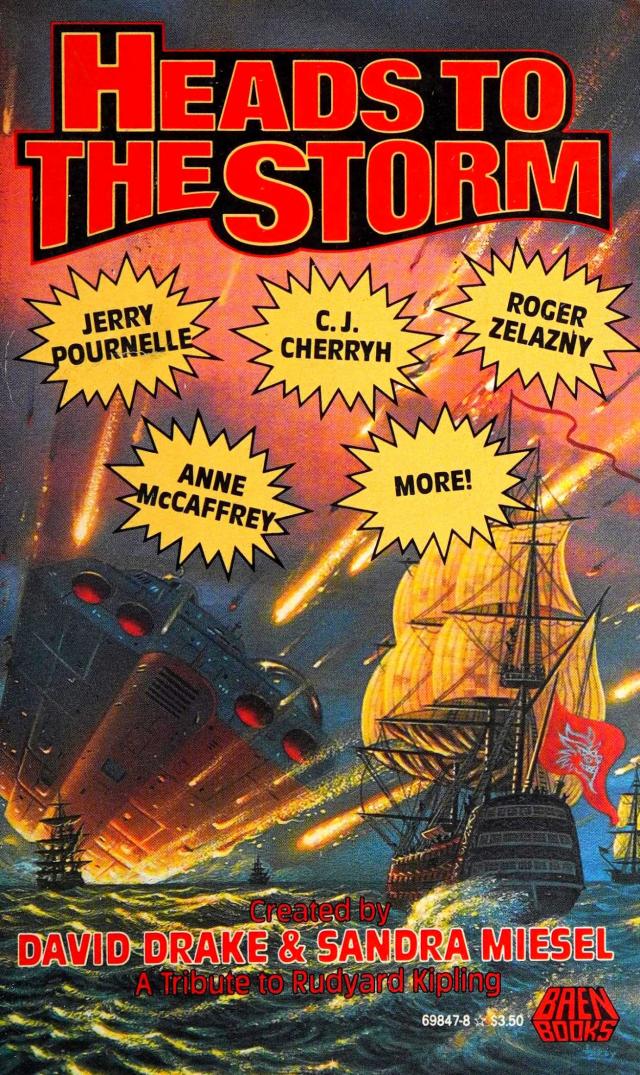
DAVID DRAKE &
SANDRA MIESEL
HEADS TO THE STORM
This is a work of fiction. All the characters and events portrayed in this book are fictional, and any resemblance to real people or incidents is purely coincidental.
Copyright © 1989 by David Drake and Sandra Miesel
All rights reserved, including the right to reproduce this book or portions thereof in any form.
A Baen Books Original
Baen Publishing Enterprises
260 Fifth Avenue
New York, N.Y. 10001
ISBN: 0-671-69847-8
Cover art by David Hardy
First printing, November 1989
Distributed by
SIMON & SCHUSTER
1230 Avenue of the Americas
New York, N.Y. 10020
Printed in the United States of America
ACKNOWLEDGMENTS
“Why I Admire Rudyard Kipling” by Gordon R. Dickson copyright, ©, 1989, Gordon R. Dickson.
“Because Our Hearts Are Small” by Gordon R. Dickson and Sandra Miesel copyright, ©, 1989, Gordon R. Dickson and Sandra Miesel.
“Our First Death” by Gordon R. Dickson copyright, ©, 1955 Fantasy House, Inc.; copyright renewed 1983 by Gordon R. Dickson, reprinted by permission of the author.
“Introduction” by Poul Anderson copyright, ©, 1989, Poul Anderson.
“The Visitor” by Poul Anderson copyright, ©, 1974, Mercury Press, Inc.
“On Kipling and Weekday Afternoons” by D.J. Cherryh copyright, ©, 1989, C.J. Cherryh.
“The Haunted Tower” by C.J. Cherryh copyright, ©, 1981, C.J. Cherryh appeared in Sunfall by C.J. Cherryh, reprinted by permission of the author.
“Late Have I Loved Thee, Kipling” by Sandra Miesel copyright, ©, 1989, Sandra Miesel.
“The Shadow Hart” by Sandra Miesel copyright, ©, 1985, Sandra Miesel appeared in Moonsingers Friends edited by Susan M. Shwartz, reprinted by permission of the author.
“Introduction” by David Drake copyright, ©, 1989, David Drake.
“The Barrow Troll” by David Drake copyright, ©, 1975, Stuart David Schiff.
“Introduction” by Poul Anderson copyright, ©, 1989, Poul Anderson.
“” by Poul Anderson copyright, ©, 1980, Poul Anderson appeared in The Westerfilk Songbook, reprinted by permission of the author.
“Introduction” by Gene Wolfe copyright, ©, 1989, Gene Wolfe.
“Love, Among the Corridors” by Gene Wolfe copyright, ©, 1984, Gene Wolfe appeared in Interzone, reprinted by permission of the author and the author’s agent, Virginia Kidd.
“Introduction” by Jerry Pournelle copyright, ©, 1989, Jerry Pournelle.
“The Friggin Falcon” by Theodore R. Cogswell copyright, ©, 1981, Theodore R. Cogswell appeared in Placebos for the Orthodox by Theodore R.
Cogswell, reprinted by permission of the author’s agents,
Owlswick Literary Agency.
“The Writer as Showman and Bard: A Personal View of Rudyard Kipling” by John Brunner copyright, ©, 1989, Brunner Fact and Fiction, Ltd. Used by permission.
“Mowgli” by John Brunner appeared in Authentic Science Fiction Number 69 copyright, 1956, first serial rights only, Hamilton and Co. (Stafford), Ltd. copyright assigned, 1966, to Brunner Fact and Fiction, Ltd. by the author. United States copyright, ©, renewed, 1988. Used by permission of Brunner Fact and Fiction, Ltd. and its agents for the United States, Messrs. John Hawkins and Associates.
“Introduction” by George R.R. Martin copyright, ©, 1989, Hie Fevre River Packet Co. Used by permission.
“And Seven Times Never Kill Man” by George R.R. Martin copyright, ©, 1975, Cond6 Nast Publications, Inc. Used by permission of the author and The Fevre River Packet Co.
“East Is East” by Sandra Miesel copyright, ©, 1989, Sandra Miesel.
“The Burning of the Brain” by Cordwainer Smith copyright, ©, 1958, Quinn Publishing Co. Reprinted by permission of the author and the author’s agents, Scott Meredith Literary Agency, Inc., 845 Third Avenue, New York, New York 10022.
“Big Friend of the World—Rudyard” by Anne McCaffrey copyright, ©, 1989, Anne McCaffrey.
“The Ship Who Sang” by Anne McCaffrey copyright, ©, 1961, Mercury Press, Inc. Reprinted by permission of the author and the author’s agent, Virginia Kidd.
“Introduction” by Roger Zelazny copyright, ©, 1989, The Amber Corporation.
“Lucifer” by Roger Zelazny copyright, ©, 1964, Galaxy Publishing Corp. Used by permission of the author.
“Kipling” by John Brunner appeared in Twentieth-Century Science-Fiction Writers, ed. Curtis C. Smith, copyright, ©, 1981, Macmillan Press, Ltd. Used by permission of the author and the publishers, St. James Press, Chicago and London.
Contents: -
Why I Admire Rudyard Kipling - Gordon R. Dickson
Because Our Hearts Are Small - Gordon R. Dickson and Sandra Miesel
Our First Death - Gordon R. Dickson
Introduction - Poul Anderson
The Visitor - Poul Anderson
On Kipling and Weekday Afternoons - C. J. Cherryh
The Haunted Tower - C. J. Cherryh
Late Have I Loved Thee, Kipling - Sandra Miesel
The Shadow Hart - Sandra Miesel
Introduction - David Drake
The Barrow Troll - avid Drake
Introduction - Poul Anderson
The Ballad of the Three Kings - Poul Anderson
Introduction - Gene Wolfe
Love, Among The Corridors A Fable - Gene Wolfe
Introduction - Jerry Pournelle
The Friggin Falcon - Theodore R. Cogswell
The Writer as Showman and Bard: A Personal View of Rudyard Kipling - John Brunner
Mowgli - John Brunner
Introduction - George R.R. Martin
And Seven Times Never Kill Man - George R.R. Martin
East Is East - Sandra Miesel
The Burning of The Brain - Cordwainer Smith I. Dolores Oh
II. The Lost Locksheet
III. The Secret Of The Old Dark Brain
Big Friend of the World—Rudyard - Anne McCaffrey
The Ship Who Sang - Anne McCaffrey
Introduction - Roger Zelazny
Lucifer - Roger Zelazny
Kipling - John Brunner
The Eye of Allah - Rudyard Kipling
’They’ - Rudyard Kipling
To
Buck and Juanita Coulson:
Friends Indeed
Why I Admire Rudyard Kipling
Gordon R. Dickson
T. S. Eliot once said in the introduction to a collection of Kipling’s poetry that most poets have to be supported against accusations of obscurity. In Kipling’s case the need is to defend him against the baseless charge of writing jingles.
He did not write jingles. Anyone who believes that should be locked in a room and not let out until he or she has written at least a twenty-page paper on the various levels of meaning to be found in his poem “Sack of the Gods.” But he makes his prose and his poetry seem to have been written with no effort.
They were not. They were carefully and deliberately constructed over as long a period as was necessary, and with the sort of conscious craftsmanship that places Kipling among the great literary artists of the language. It is ironic to remember that it was precisely Shakespeare’s conscious craftsmanship that the critics of his own time held against him. True art, it was felt, came from the Muse—like Athene, folly formed from the head of Zeus— not from craftsmanship, which was workaday and inferior. Shakespeare was a master craftsman, not only of words and scenes, but of the way the stage can be put to use.
It is not possible, nor ever was, to ignore the involvement of craft in any greatly successful creative effort. Craft can make a pedestrian form of poetry or prose without art. But no art is possible in story or prose without craft being involved—conscious or unconscious—on the part of its creator. The measure of that truth is the influence (and Kipling, like Shakespeare, was a highly conscious craftsman) that a writer’s craft has had upon generations of succeeding authors.
The end result is that, in his poetry as well as his prose, Kipling is a master of storytelling. And storytelling must be there, from the Iliad to the most recent verse that attempts to claim an audience, and in any piece of fiction that makes the same attempt.
Cla
ssics—real classics—are books you can find on library shelves that have been found in such places for a hundred or more years. Books, in other words, written in the environment of a time now past and gone, but in which the characters and the actions ring true to us even now because what they present of humanity is visceral, universal, basic to the human race, three thousand years ago as now.
It must always be remembered that it is not the words, the phrase, the scene by itself that makes for literary art. It is the overall conception of the writer. Christopher Marlowe, who was praised above Shakespeare when the two were contemporary, is hardly recognized by the majority of people who recognize the name of Shakespeare nowadays.
Marlowe has two pages of quotes in the fourteenth edition of Bartlett’s Familiar Quotations. Shakespeare has eighty-four.
Kipling has five.
.…So far.
Because Our Hearts Are Small
Gordon R. Dickson and Sandra Miesel
“Our First Death” contrasts a party of colonists and the new planet they are attempting to colonize. The heartbreaking bleakness of the alien landscape around them is more implied than described yet it is as much a “character” in the story as the moor in Wuthering Heights. In fact, it is the active enemy of the colonists, withering their lives because it reminds them how far they are from Earth and the flowery fields of home.
The Kipling connection here is the parallel to the British Raj. The English were acutely sensitive to the alienness of India. They proudly believed that they understood the “natives” even though events like the Sepoy Rebellion occasionally shook their confidence. But subconsciously, they knew they were not wanted and rather than admit this, they took out their hostility on the land itself, exaggerating its real perils to blame it for every ill that befell them.
British civil servants, who might wield the power of petty princes in India, would have been nothing more romantic than minor government clerks if they had stayed at home. Their ambivalent position created keen anxieties about social status and race. The English-bom claimed precedence over the Indian-bom and both looked down on the local people—especially those who imitated their conquerors too closely or carried mixed blood.
The women of the Raj rejected Indian ways even more forcefully than the men did. In defiance of good sense, they stubbornly tried to eat, drink, dress, and socialize in proper British fashion. Men and women alike blinded themselves to the exotic beauty around them. Many of them only came to appreciate India when they retired to England and drab obscurity.
Kipling, who was bom in India but educated in England, was painfully aware of alienation throughout his life. He sought security in family, friends, and Inner Rings of Power. His fiction often explores miniature societies—a military unit, a work crew, the ladies of the Raj in summer retreat at Simla. He likes to place them under stress in hostile surroundings where they must close ranks or perish, for he knew such challenges well.
Exiled from India by his literary success, miserably out of place in his wife’s native America, Kipling finally found the land of home he had always longed for in “Sussex by the Sea.” He came to love the English countryside with a convert’s fervor: only an English oak was a proper oak. Precisely because he was an outsider, he looked on the Motherland’s woods and fields and waters and found enchantment there.
Kipling celebrated his rediscovered heritage in Puck of Pook’s Hill (1906) and Rewards and Fairies (1910). He even modeled the children in these books on his own John and Elsie, taking yet another opportunity to write about the youth with “quivering tenderness,” as Lord Birkenhead put it.
Yet Kipling’s happy and productive years in Sussex were bracketed between two deaths. His older daughter Josie died of pneumonia in New York in 1899; his son was blown to bits at Loos in 1915. He commemorated these tragedies in “They” (1904) and in much bitter poetry about World War I, but the scars struck so deep, he could not bear to mention them in his autobiographical Something of Myself (1937).
Nevertheless, Kipling and his family did have a chance to set down roots long enough to honor his pledge:
So to the land our hearts we give
Till the sure magic strike,
And Memory, Use, and Love make live
Us and our fields alike—
The characters in the following story have no such luck.
Our First Death
Gordon R. Dickson
Juny Vewlan died about 400 hours of the morning and we tuned her (hat same day before noon at 1100 hours, because we had no means of keeping the body. She had not wanted to be cremated; and because she was our first and because some of her young horror at the thought of being done away with entirely had seeped into the rest of us during her illness (if you could call it illness—at any rate, as she lay dying), an exception was made in her case and we decided in foil assembly to bury her.
As for the subsidiary reasons for this decision of ours, they were not actually clear to us at the time, nor yet indeed for a long time afterward. Certainly the fatherless, motherless girl had touched our hearts toward the end. Certainly the old man—her grandfather Gothrud Vewlan, who with his wife, Van Meyer and Kurt Meklin made up our four Leaders—caught us all up in foe heartache of his own sorrow, as he stood feebly forth on the platform to ask of us this last favor for his dead grandchild. And certainly Kurt Meklin murmured against it, which was enough to dispose some of foe more stiff-necked of us in its favor.
However—we buried her. It was a cold hard day, for winter had already set in on Our Planet. We carried her out over foe unyielding ground, under foe white and different sky, and lowered her down into foe grave some of our men had dug for her. Beneath foe transparent lid of her coffin, she looked younger than sixteen years—younger, in feet, than she had looked in a long time, with her dark hair combed back from around the small pointed face and her eyes closed. Her hands were folded in front of her. She had, Gothrud told us, also wished some flowers to hold in them; and none of us could imagine where she had got such an idea until one of the younger children came forward with an illustration from our library’s Snow White and the Seven Dwarfs, showing Show White in her coffin with a bunch of flowers that never faded clasped in her hands. It was clear then, to some of us at least, that Juny had not been free from the dream of herself as a sort of captive—now sleeping—princess, merely putting in her time until the Prince her lover should arrive and carry her off.
But we had, of course, no flowers.
After she had been lowered into the grave and all of us had come up to look at her, Lydia Vewlan, Gothrud’s wife and colony doctor as well as one of the Leaders, read some sort of service over her. Then, when all was finished, a cloth was laid over the transparent face of the plastic coffin and the earth was shoveled back. It had been dug out in chunks—a chunk to a spadeful; and the chunks had frozen in the bitter air, so that it was like piling angular rocks back upon the coffin, heavy purple rocks with the marblings of white shapes that were the embryos of strange plants frozen in hibernation. Because of their hard awkward shapes, they made quite a pile above the grave when they were all put back; and in fact it was not until the following summer was completely gone that the top of the grave was level again with the surrounding earth. By that time we had a small fence of white plastic pickets all around it; and it was part of the duty of the children in the colony to keep them scrubbed clean and free of the gray mold.