Thev startling stories o.., p.1
Thev Startling Stories of Henry Kuttner,
p.1
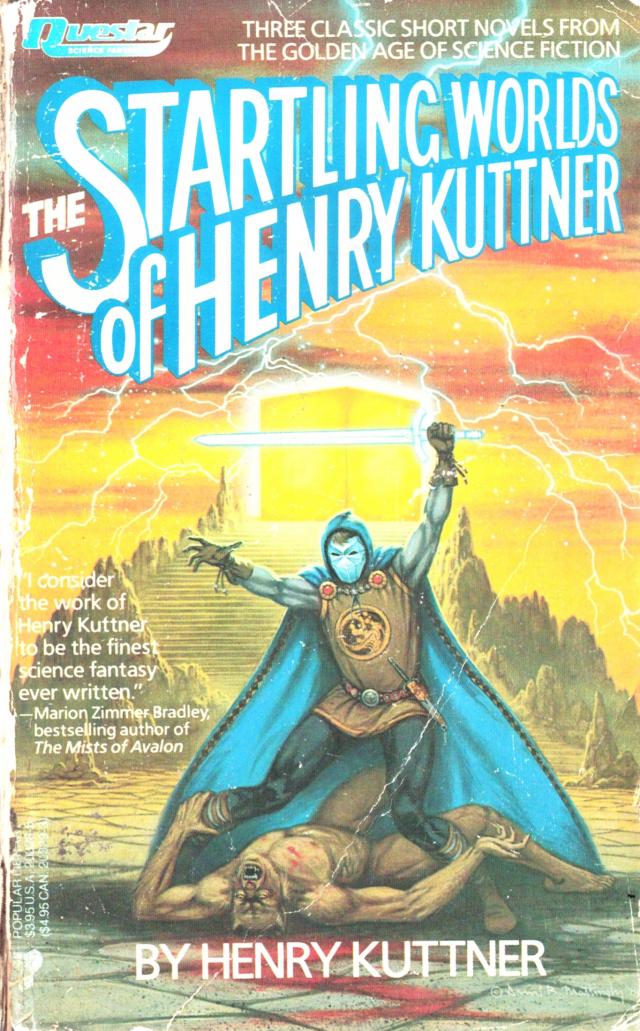


Three Different Pathways to
A Future Not Our Own
The Portal in the Picture—Passing through a portal in time and space, Eddie Burton discovered a bizarre twin city to his own New York, a city where priests ruled in the name of a religion called Alchemy—and a man from our Earth could start a revolution with one little flame…
★ ★ ★
Valley of the Flame—In search of a legendary radioactive fire, Brian Raft stumbles upon a nightmare land where monsters rule, guarding the cosmic power that may someday create new life—or destroy all that lives…
★ ★ ★
The Dark World—A feteful visit from a giant wolf and a mysterious hooded figure catapults Edward Bond into a dangerous alternate world—and a deadly battle between the forces of science and sorcery…
HENRY KUTTNER was one of the finest writers of the “pulp” era of science fiction, a man whom author and critic Anthony Boucher called: ‘among the most imaginative, technically skilled and literarily adroit science fantasy writers.’ Henry Kuttner more than lived up to that praise. Writing both alone and in collaboration with his wife, C.L Moore, and using countless noms de plume, Henry Kuttner produced a vast body of truly remarkable tales including his classic novel Fury, his delightful stories about ‘Galloway Gallegher,’ a drunken inventor with a robot companion, and stories dealing with everything from undersea cities to mutant telepaths to life after nuclear war. A writer whose influence on the field spans more than two decades, Henry Kuttner died in 1958, leaving behind a legacy of some of the finest fiction written in science fiction’s golden age.
ATTENTION: SCHOOLS ANO CORPORATIONS
POPULAR LIBRARY books are available at quantity discounts with butik purchase for educational, business, or sales promotional use. For information, please write to SPECIAL SALES DEPARTMENT. POPULAR LIBRARY. 666 FIFTH AVENUE. NEW YORK. N Y10103
ARE THERE POPULAR LISRARV BOOKS YOU WANT SUT CANNOT RNO IN YOUR LOCAL STORES?
You can get any POPULAR LIBRARY title in print. Simply send title and retail price, plus 50¢ per order and 50¢ per copy to cover mailing and handling costs for each book desired. New York State and California residents add applicable sales tax Enclose check or money order only no cash please, to POPULAR LIBRARY P O. BOX 690. NEW YORK. N Y 10019
BY HENRY KUTTNER
POPULAR LIBRARY EDITION
Introduction copyright © 1987 by Warner Books, Inc.
THE PORTAL IN THE PICTURE
(Formerly Published in book form as BEYOND EARTH’S GATE)
Copyright © 1954 by Ace Books, Inc.
Copyright © renewed 1982 by Catherine Kuttner Reggie
VALLEY OF THE FLAME
Copyright © 1964 by Ace Books, Inc.
THE DARK WORLD
Copyright © 1946 by Ace Books
Copyright © renewed 1974 by Catherine Kuttner Reggie
All rights reserved.
Popular Library® and Questar® are registered trademarks of Warner Books, Inc.
This Popular Library Edition is published by arrangement with the author.
Cover art by Dave Mattingly
Popular Library books are published by Warner Books, Inc.
666 Fifth Avenue
New York, N.Y. 10103
A Warner Communications Company
Printed in the United States of America
First Popular Library Printing: January, 1987
10 9 8 7 6 5 4 3 2 1
Contents:-
THE PORTAL IN THE PICTURE
Prologue
Chapter I
Chapter II
Chapter III
Chapter IV
Chapter V
Chapter VI
Chapter VII
Chapter VIII
Chapter IX
Chapter X
Chapter XI
Chapter XII
Chapter XIII
Chapter XIV
Chapter XV
Chapter XVI
Chapter XVII
Chapter XVIII
Epilogue
VALLEY OF THE FLAME
I - FACE OF A GIRL
II - DRUMBEAT OF DEATH
III - GATE TO PAITITI
IV - JANISSA
V - VALLEY OF WONDERS
VI - MAD KING
VII - DREAD FLAME
VIII - KHARN, THE TERRIBLE
IX - ASSASSIN’S PLOT
X - NIGHTMARE GARDEN
XI - CREEPING MENACE
XII - POWER OF SCIENCE
XIII - FLYING DEMONS
XIV - RAFT CHOOSES
THE DARK WORLD
I - FIRE IN THE NIGHT
II - CALL OF THE RED WITCH
III - LOCKED WORLDS
IV - MATHOLCH—AND MEDEA
V - SCARLET WITCH
VI - THE RIDE TO CAER SÉCAIRE
VII - MEN OF THE FOREST
VIII - FREYDIS
IX - REALM OF THE SUPERCONSCIOUS
X - SWORDS FOR THE COVEN
XI - IN GHAST RHYMI’S TOWER
XII - HARP OF SATAN
XIII - WAR—RED WAR!
XIV - FIRE OF LIFE
XV - LAIR OF POWER
XVI - SELF AGAINST SELF
XVII - FREEDOM AT LAST!
Henry Kuttner and
Startling Stories
(and C.L. Moore)
Forty years ago if you wanted to read science fiction and/or fantasy, you didn’t go to a bookstore or a library. You popped round to your neighborhood newsstand and if you were lucky, you’d find one or more of about a dozen magazines devoted to “that Buck Rogers stuff” or related genres. They had alluring names such as Famous Fantastic Mysteries, Thrilling Wonder Stories, Weird Tales, and Startling Stories.
Of those magazines, the one that has gone down in history is Astounding Stories, which still exists under the name of Analog. And that was because under its editor, John W. Campbell, Jr., it brought a new sensibility to science fiction. Its authors and many of its stories have become classics of the field and rightfully so. But another of the magazines was also much more quietly establishing important links to the future without being quite so revolutionary about it. This was Startling Stories, under the editorship of Samuel Merwin. It was much more traditional than Campbell’s magazine. The covers almost always had a Bug-Eyed Monster (which were affectionately known as BEMs) and a seminaked lady, whose seminakedness was usually covered in such interesting examples of haute couture as a brass brassiere. (A seminaked lady on Astounding was as rare as a hobbit in Trantor.)
Startling Stories continued the older tradition of science fantasy and space opera, but with more and more variation from the old formulas. The result was what might be called soft SF (as opposed to the high-tech “hard” SF of Astounding), on the literary spectrum leaning more toward fantasy. For example, one of Merwin’s discoveries was a brilliant young author who wrote under the name of Jack Vance, whose work was undoubtedly much too fanciful for Campbell. And Arthur Clarke’s beautiful Against the Fall of Night (which was to be rewritten as The City and the Stars) first appeared in Startling.
In short, Merwin and Startling carried on the tradition of nontechnical SF, which, combined with fantasy, is much closer to today’s taste.
By all odds, the most popular writer in Startling Stories was Henry Kuttner, whose “novels” (a pulp magazine novel was much closer in length to a novelette in today’s terms) were begged for in the letters column and greeted with joy when they appeared.
Kuttner was the pulp writer par excellence. He could write anything, any style, and did so: tales of the supernatural (his first published story had the engaging title of “The Graveyard Rats”), sword and sorcery, soft JSF, and hard SF. (Some of his best work indeed appeared in Astounding, but he was not one of Campbell’s “stable.”) But he also wrote well, with wondrously imaginative concepts. He wrote so well, in fact, that any SF reader of the ’40s, if asked his favorite writer, would have been as likely to say Kuttner as Asimov or Hein-lein or Van Vogt.
His prodigious and varied output was complicated by appearing under any number of pen names (there was a persistent rumor that Jack Vance was one of these), and further complicated when he married the equally talented writer C. L. Moore (in 1940). The two, more often than not, collaborated on their stories thereafter, which might then appear under either name or yet another nom de plume.
But of all this bewildering oeuvre, the most exciting and the most popular were the science fantasies he (they) wrote for Startling Stories. Vaguely akin to the earlier works of A. Merritt, they usually placed the hero elsewhere, in other worlds—planes?—dimensions?—that infringed somehow on ours, and that (given the vaguest of scientific rationales) were full of wonderfiilly exotic beings, beasts, and things. Speed was of the essence in SF-magazine writing, and Kuttner’s novels were very speedy indeed; a thrill a minute was the rule. Reading them today is a marvelous antidote to the verbose trilogies with which we’re currently afflicted. But there is somehow always room for Kuttner (and Moore) to inject liberal amounts of colorful atmosphere. Curiously enough, there are few, if any, contemporary writers whose work seems so cinematic, so close to the dazzling special effects that the movies have developed. What visions Kuttner (and Moore) evoked in the mind’s camera lens!
So welcome to three of Henry Kuttner’s (and C. L. Moore’s) most startling worlds: Paititi, lost in the South American jungle, where time does strange thin
gs; Malesco, an alternate Earth based loosely (and a little giddily) on the science of alchemy; and the most famous and popular of all, the Dark World, where the legends live.
—Baird Searles
THE
PORTAL
IN
THE
PICTURE
Prologue
She called herself Malesca. Her agent called her the “Loveliest Girl in the World” and I suppose he wasn’t far wrong, at that. If I’d known she was playing the Windsor Roof that night I’d have gone somewhere else.
But by the time I was at the table, having a sandwich and a highball, it was too late. The lights dimmed, the spot went on and there stood Malesca, bowing to the storm of applause. I wasn’t going to let her spoil my drink. I could always look somewhere else while she was on. I ate white meat of chicken, drank my highball and thought about other things — until the famous velvet voice began to sing.
I listened to her sing. A chair creaked. In the dimness someone sat down beside me. I peered through the gloom, recognizing the man, a top figure in show business.
“Hello, Burton,” he said.
“Hello.”
“Mind if I join you?”
I waved my hand and he gave his order to the waiter who slid up noiselessly. Malesca was still singing.
The man beside me watched her, as rapt and intent as everybody else in the club except me.
Two encores later, when the lights went up, I realized that he was staring at me curiously. My disinterest in the singer must have been pretty obvious.
“No like?” he asked in a puzzled voice.
Even before Korzybski that particular question would have been meaningless. I couldn’t answer him and I knew it. So I didn’t bother. I just didn’t say anything. I could see Malesca from the corner of my eye, hear the rustle of her stiff skirts as she came through the tables toward me. I sighed.
She was wearing some light flowery scent I knew she hadn’t picked out for herself. She put her hand on the table edge and leaned toward me.
“Eddie,” she said.
“Well?”
“Eddie, I haven’t seen you for ages.”
“That’s right.”
“Listen, why don’t you wait around? Take me somewhere after my last show. We could have a drink or something. How about it, Eddie?”
Her voice was pure magic. It had been magic on radio and records and video. It would soon be magic in the movies. I didn’t say a word.
“Eddie — please.”
I picked up my glass, emptied it, brushed crumbs off my coat, laid the napkin beside the plate.
“Thanks,” I said. “Wish I could.”
She stared at me, the familiar, searching stare full of incomprehension. I could hear the applause still echoing.
“Eddie — ”
“You heard me,” I said. “Take a walk. Take an encore. Go on, beat it.”
Without a word she turned away and went back to the floor, her skirts frothing and hissing as she squeezed between the tables. The man beside me said: “Eddie, are you crazy?”
“Probably,” I said. I wasn’t going to explain to him.
“All right, Eddie. You know the answers, I suppose. But something must be wrong. The most beautiful woman in the world throwing herself at your feet — and you won’t even look at her. That just isn’t sensible.”
“I’m not a very sensible guy,” I told him. It was a lie, of course. I’m the most sensible guy in the world — in any world.
“Don’t give me clichés,” he said. “That’s no answer.”
“Clichés!” I said and choked in my glass. “Okay, okay, never mind. Nothing wrong with clichés, you know. They’re just truths that happen so often they’re trite. It doesn’t make them any less true, does it?” I looked at Malesca squaring off at the mike, getting ready to sing again.
“I knew a man once who tried to discredit clichés,” I went on thoughtfully, knowing I was probably saying too much. “He failed. He had quite a time, that guy.”
“What happened?”
“Oh, he found a fabulous land and rescued a beautiful goddess and overthrew a wicked high priest and — forget it. Maybe it was a book I read.”
“What fabulous land was that?” my friend inquired idly.
“Malesco.”
He lifted an eyebrow at me and glanced across the room at the Most Beautiful Girl in the World.
“Malesco? Where’s that?”
“Right behind you,” I said.
Then I picked up my fresh highball and buried my nose in it. I had nothing more to say — to him. But a chord in the music just then woke a thin shivering wire of sound at the back of my brain, and for an instant the barrier between this world and the worlds outside was as thin as air.
Malesco, I thought. I shut my eyes and tried to make the domes and towers of that rose-red city take shape in the darkness while the chord still sounded in my ears. But I couldn’t do it. Malesco had gone back into the fable again and the gates were shut forever.
And yet, when I think about it now even the sense of wonder and disbelief is suspended and I have no feeling at all that it was in some dream I walked those streets. They were real. I’ve got the most convincing kind of proof that they were real.
It all happened quite a while ago …
Chapter I
Remember the story of the blind men and the elephant? Not one of them ever found out it was an elephant. That’s the way it was with me. A new world was opening right in front of me and I put it down to eyestrain.
I sat there in my apartment with a bottle and watched the air flicker.
I told myself to get up and switch off the lights because Lorna had got in the habit of dropping by if I didn’t show up at the ginmill where she worked, and I didn’t want to talk to her. Lorna Maxwell was a leech. She had attached herself to me with all the simple relentlessness of her one-track mind and short of killing her I knew no way to pry her loose.
It all seemed so easy to Lorna. Here I was, rising young actor Eddie Burton with a record of three straight Broadway hits and a good part in something new that all the critics liked. Fine.
Here she was, that third-rate young ginmill singer Lorna Maxwell with no record at all that she admitted to. Don’t ask me how we met or how she got her hooks into me. I’m a born easy mark. Children, animals and people like Lorna can spot people like me a mile away.
She’d got it into her addled little head somehow that all I had to do was say the word and she’d be right up there beside me, a success, the darling of the columnists. Only selfishness kept me from saying the magic word to somebody in authority and turning her into Cinderella. Arguments wouldn’t move her. It seemed simpler to turn off the lights when I was at home alone and not answer the door.
The air flickered again. I squinted and shook my head. This was getting a little alarming. It couldn’t be the Scotch. It never happened outside the apartment. It never happened unless I was looking at that particular wall.
There was a Rousseau picture on it, Sleeping Gypsy, something Uncle Jim had left me along with the apartment. I made a great effort to focus on the blue-green sky, the lion’s blowing mane, the striped robe of the black man on the sand.