Invasion earth harry h.., p.1
Invasion Earth - Harry Harrison (v1.0),
p.1


It was dark inside. The beam revealed shapes. Machinery. Containers of some kind. Rob moved the beam. More of the same. Then in the other direction. Something white against the far wall.
“It moved!” Groot called out. “Aim the light. I’m going in!”
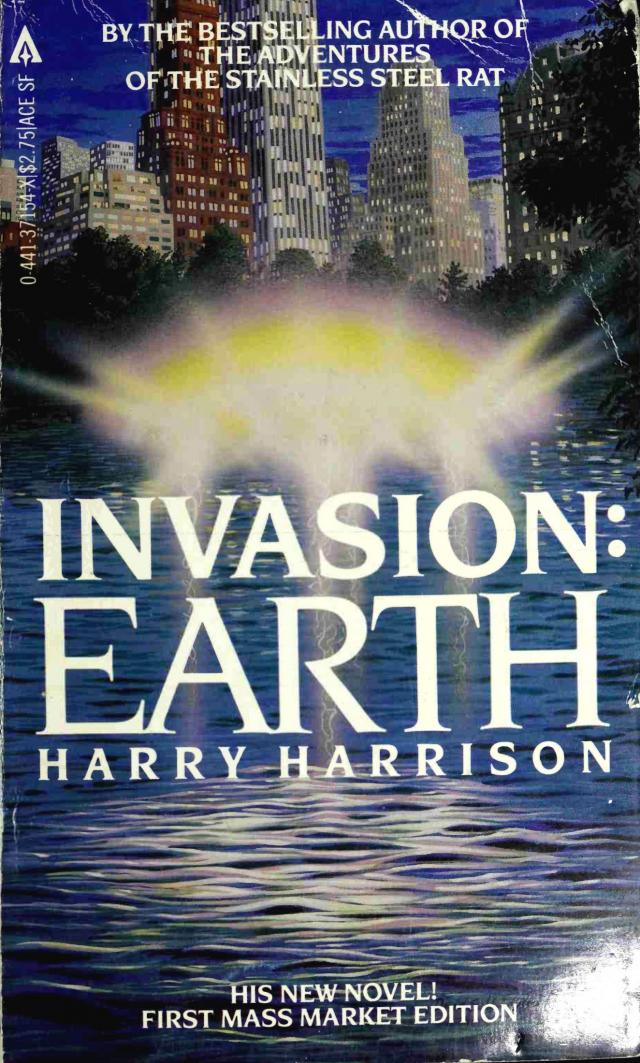
INVASION: EARTH
The New Novel by the bestselling author of
THE ADVENTURES OF
THE STAINLESS STEEL RAT
Harry Harrison
INVASION:
EARTH
HARRY HARRISON
ACE SCIENCE FICTION
NEW YORK
All characters in this book are fictitious.
Any resemblance to actual persons, living or dead, is purely coincidental.
INVASION: EARTH
An Ace Science Fiction Book/published by arrangement with the author
PRINTING HISTORY
Ace Trade edition I April 1982
Ace Mass Market edition I May 1983
All rights reserved.
Copyright © 1982 by Harry Harrison
Illustrations copyright © by Evan Ten Broeck Steadman
Cover art by David Schleinkofer
This book may not be reproduced in whole or in part, by mimeograph or any other means, without permission. For information address: Ace Science Fiction Books,
200 Madison Avenue, New York, N.Y. 10016
ISBN: 0-441-37154-X
Ace Science Fiction Books are published by Charter Communications, Inc.
200 Madison Avenue, New York, New York 10016.
PRINTED IN THE UNITED STATES OF AMERICA
Contents:-
The Arrival
1. Intruder from the Sky
3. An Alien Encounter
4. Intelligence Report
5. The Quest
6. Message of Doom
7. The Battle of Earth
8. To the Moon
9. First Contact
10. The Blettr
11. Return to Earth
12. Command Decision
13. Battle Plan
14. Zero Hour
15. All Systems Go
16. On the Ice
17. The Attack
18. Killing Ground
19. No Way Out
20. Prisoners
21. The Ultimatum
22. No Reprieve
23. Final Glory
Also by Harry Harrison:
SKYFALL
MAKE ROOM! MAKE ROOM!
Available from Ace Science Fiction
The Arrival
It came out of the Pacific Ocean just before dawn, bursting up over the horizon and screaming across the California coastline with meteoric speed. It was so fast that it was over Arizona before the first crash of its supersonic flight struck the ground. The explosion of sound blew out windows, activated countless burglar alarms, set every dog in its track to howling. At the same instant the military Early Warning radar exploded into life. Enemy attack!
The jet fighters were scrambled, ground to air missiles zeroed in, ICBMs readied in their silos. The whistle almost blew to start the big one—but not quite. There was just nothing orthodox about the trace that resembled an attacking missile. It came from the wrong place, at the wrong speed and the wrong altitude. It hurtled along at close to Mach-5 and it should have burnt up. It did not. When it changed speed, over Kansas, it did so abruptly, dropping to Mach-3. In less than thirty minutes it had crossed half of the United States, with aimed missiles tracking it all the way. They were not fired.
“Nothing is right about that thing,” a military radar controller said, speaking for all of them. “We don’t have a bird that can fly like that—and neither do the Russkies.”
“We hope,” his commanding officer said grimly, looking at the red telephone before him, waiting for an answer to his emergency call. The President would be on the Hot Line to Moscow right now, getting an answer to that very important question. He had the phone pressed to his ear the instant it began to ring. Listening closely, nodding. “Yes, sir,” he said, hanging the instrument up slowly. “You’re right. It’s not the Russkies. They are as surprised as we are. Intelligence reports confirm that it couldn’t possibly be theirs. But if not theirs…?”
It is significant that he did not speak aloud his thoughts about the possible origin of a craft like this one—nor did anyone else. They watched, dumbstruck, and waited.
Not for long. With an altitude change just as disconcerting and sudden as its earlier alteration in speed, it dropped to a thousand feet as it crossed the New Jersey Highlands and hurtled out over the Outer Bay. Then turned north towards Manhattan Island.
It did not do this in an arc. It simply turned a comer, changing its course by ninety degrees in a fractional instant of time. On the radar screens the course plot was an unbelievable L shape.
It was aiming towards the World Trade Center. The highest building in the world.
Sharon Forkner was standing and looking south out of a window on the ninetieth floor at that very moment, staring unseeingly at the magnificent view, thinking about what she had to get at the deli on the way home. A glint of light on the horizon drew her attention. She glanced at it, at the black speck growing beneath it, growing and swelling in a frantic heartbeat of time. Something immense and dark hurtling directly at her—then past with an explosion of sound. A foot high gouge was ripped through the fabric of the building not ten feet from her as some portion of the thing brushed against the Trade Tower. Particles of plaster and a cloud of dust boiled out, then cleared to reveal the long gap in the wall with sunlight pouring in. She fainted, falling limply against the desk then sliding slowly to the floor.
As though the Trade Towers had been its target, the vehicle began dropping as soon as it had passed between them. Its speed slowed from supersonic to subsonic before it had crossed Forty-second Street. It was scant feet above the midtown skyscrapers and falling like a rock as it came over Fifty-ninth Street. Its dark form blotted out the sun; people looked up, horrified, as it dropped towards them. Just clearing the Central Park Zoo to crash headlong into the grassy slope beyond. Plowing a rut in the ground before coming to a stop. A park attendant was obliterated by its landing, as was a nurse pushing an expensive baby carriage. They were the only casualties.
In the silence that followed its arrival screams and shouts could now be heard, and the shrill blast of a police whistle. The first sirens sounded in the distance.
1. Intruder from the Sky
New York is a city that knows how to move fast. Within five minutes a police cordon had pushed the bystanders back a hundred yards from the grounded object. Two photographers were snapping pictures over the cops’ shoulders while a cine buff was dragged out of a tree, still grinding away happily. Almost as the thing touched the ground the switchboard at the Daily News lit up—cash awards are given to people who phone in news tips—while the fire trucks arrived at the same time as the squad cars. When the military helicopter landed a good thirty-five minutes later, the situation was well in hand.
“I’ll take command of the situation now,” the general said, swinging down from his helicopter.
“You’re under arrest,” the grizzled police captain said, his face registering all the emotion of a chunk of granite. He pointed a finger like a loaded gun at the helicopter pilot. “You have ten seconds to lift that thing off and out of this area. Move.”
“You can’t…!” the general shouted just as two policemen did, pulling his arms behind his back and clamping cuffs about his wrists. The copter pilot took one look at this and kicked the engine into life. The roar of the blades drowned out the general’s voice which was all for the best.
Rob Hayward had reached the police cordon just in time to witness the incident. He permitted himself one grin of intense satisfaction before wiping all emotion from his face. Taking out his wallet with his identification he moved forward through the line.
“I am Colonel Robert Hayward, Air Force Intelligence. This is my identification.”
The police captain looked at the man who had appeared at his side. Tall, solid, blue eyes in a tanned face, a nose broken more than once. The captain glanced at the ID.
“What do you want, colonel?” he asked.
“To supply you with some information. That object out there crossed the West Coast about an hour ago. We tracked it here. We have no idea what it is. An official investigation team and Army personnel are on their way now to relieve you. With Presidential authorization. Until they arrive I respectfully suggest that you move your cordon back at least another hundred yards and begin to clear the streets and buildings in the immediate area.”
The captain nodded. “I appreciate those suggestions, colonel, and will put them into effect.” He had to raise his voice to be heard over the hoarse bellowing of the handcuffed officer. Rob Hayward leaned close as he spoke again.
“Your prisoner is General Hawker, commander of the Governor’s Island garrison. Do you think you could release him in my custody? Outside your police lines of course.”
“I know who the son of a bitch is. You can have him if you want him.” A thin smile vanished as soon as it appeared on that leathery face. “I just wanted to make a jurisdictional point.”
It was dark by the time the military units had replaced the police, but the banks of searchlights turned the park as bright as day. There had been no changes. The scarred, ninety-foot-long wedge of blue metal lay dormant and mute. Guns of every
calibre were trained on the thing, as well as the massed banks of recording instruments. Rob Hayward stood with the small group of officers and scientists who were deciding on the next step.
“We can get a volunteer to go hammer on the thing,” an armored cavalry general said.
“We had been thinking of some form of communication a little more sophisticated,” one of the scientific team sniffed. “Radio broadcasts, changing frequencies, infrared and ultraviolet…”
“A thirty inch round from a naval gun would let them know we’re here,” an admiral said.
Rob Hayward kept his peace. Chance had put him on the spot; as East Coast director of Air Force Intelligence he didn’t visit New York that often, and he intended to make the most of it. His recording teams were already in position. The brass could make the opening moves; he would follow up when events entered his jurisdiction. For the moment he was just going to observe…
The loudspeaker on the communications trailer rustled into life and the voice of one of the operators boomed out.
“We’re receiving short wave radiation from the thing. And sounds of some kind…”
His voice was drowned out by metallic creaking from the object before them—followed by an explo- sive bang as a great slab of metal dropped from the craft’s side. The gunners crouched over their sights, fingers poised on the triggers.
“Hold your fire!” an imperious voice cracked out. “Unless there is an order there will be no firing.”
The man who had spoken, General Beltine, stepped forward and turned to face the ranked troops. An old-fashioned swagger stick slapped against his thigh as he glowered at the soldiers; their fingers relaxed. Only when he was sure that his command had been understood did he turn about and face the silent opening with the others.
Nothing more happened. After one minute the general signalled one of his aides and gave a command. The man hurried to the waiting officers, scanning their faces as they looked eagerly at him. He came up to Rob Hayward and saluted.
“General wishes to see you, colonel.” Rob returned the salute and followed him forward.
“Orders from the Pentagon,” Beltine said. “If that thing shows no signs of aggression that have to be immediately countered then I am to put Plan L67 into action. That’s you and your team, right?”
“Yes, general. L67 is one of the contingency plans drawn up for use in case of an emergency of this kind.”
“Don’t tell me you were expecting this to happen?
“We weren’t expecting anything to happen, sir. We just have plans for a number of situations of emergency. May I proceed?”
“Is your team here?”
“Yes, sir.”
“Then—go ahead. And good luck.”
Rob spoke quietly into his two-way, then turned back towards the lines of troops and vehicles. L67. One of the blue-sky plans that everyone had laughed at. What if a flying saucer lands? What then? Ha-ha. Not only weren’t they laughing now—they probably weren’t even smiling.
He pulled open the flap of the tent and stepped in. Sergeant Groot held out the web belt with Rob’s equipment already attached. The sergeant was six foot six, big and black and just as mean as he looked. He had left South Africa when he was still a teenager—the police there were still looking for him—and had immediately enlisted in the US Army upon arrival here. His combat record was an astonishing one, as was his reputation as an unarmed defense expert. He had been working with Rob for over six years and their relation was one of mutual respect.
“What do we know about that thing?” Groot asked.
“Absolutely nothing. There is an open door. We go in blind. Are you ready, Shetly?”
Corporal Shetly nodded in response, adjusting the clips on the heavy communication pack on his back. He was gangly and thin, with a protruding Adam’s apple; he looked and sounded like a dim ridge-runner from the Tennessee mountains. He was also an electronics specialist who could work and repair any device manufactured by man. He settled the reel into position on his hip and payed out a length of wire. “Recordin’ now,” he said, activating the TV camera with attendant pickups.
“Let’s go then.” Rob tightened his helmet strap and switched on the light fixed into place on it. They went out smoothly, one, two, three, just as they had practiced a hundred times.
His backup squad was waiting. They fell into position to the rear without being given any commands. As they proceeded, soldier after soldier dropped behind to guard the thin communication wire that stretched back to the recorders in the tent. The signal was being radio broadcast as well, but the signal would undoubtedly cut out as soon as the pickups were inside the metal shell. The wire was their backup. The cordon of troops opened ranks as they approached, then closed in behind them. Rob led the way forward, stopping only when he was within arm’s length of the vessel.
“The opening is in front of me,” he said, the microphones picking up and recording his words. “Rectangular. About eight feet high. Metal wall a foot thick at least. Metal wall inside as well, floor, light blue, no patterns, no markings. The corridor turns. Nothing else visible. We’re going in.”
He moved. Jumping over the low sill and landing with a clang on the floor inside, not slowing until he reached the turn in the corridor. He stopped there and waited for the others to catch up. “Communications?” he asked.
“In the green on everythin’, colonel. Making a damn fine home movie.”
“Stay close. If I need support I want it fast.” Groot’s noncommital grunt was the only answer, but he knew what it meant. He would get all the backup he needed when he needed it.
“Proceeding down the corridor.”
He led the way, one slow step at a time, stopping suddenly when Shetly spoke.
“Radio reception and broadcast gone. Everythin’s goin’ out on the wire now.”
“Doors ahead. I’m stopping at the first one. No handle. An orange-colored disc in the center. I’m going to touch the disc…”
Rob reached forward slowly, aware of Sergeant Groot’s large form moving up close behind him. He never touched the door. When his fingers were still six inches away the mechanism was actuated. There was a sharp clicking sound and the door dropped out of sight into the sill.
As they looked in, Rob could not control a sudden gasped intake of breath. Behind him Shetly muttered an oath under his breath. Only Groot was silent, but the muzzle of his .45 automatic quested forward slowly until Rob pushed it aside.
“We won’t need weapons,” he said hoarsely, then cleared his throat. “For the record. The door is now open and we are looking into what appears to be the control room of this craft. There are banks of instruments of many kinds, plus viewing screens that show remarkably clear pictures of the surroundings. The pilots, if that is what they are, both appear to be dead. One is on the deck beside his chair. The other still seated, but slumped to one side. Both have what appear to be multiple wounds. The one on the floor is lying in what might be a pool of blood. I say ‘might’ because the congealed liquid is…green. These creatures do not appear to be human in any way. I am going closer.”
Rob slowly entered the room, his team keeping pace behind him. Groot’s gun nosing in all directions for any possible attackers. There were none. Just the two at the controls. Rob moved closer, then waved to Shetly who was hanging back.
“Get that camera closer, corporal.”
“Got a telescopic lens on now, colonel. I don’t rightly favor gettin’ too close…”
“I want that camera right beside me. Just turn your head aside if you’re going to flip your cookies.”
“I just might!”
“Right there. Hold it. The subject appears to be about seven feet tall. It is wearing a harness of some kind with various instruments attached to it, but no other clothing. It is covered with matted dark fur however, so anatomical details are not clear. It has suffered numerous cuts and contusions. The skin on its…hands is dark, with six, no seven fingers. Spatulate. No nails, but there appear to be small claws on the tip of each finger. It has two eyes, no visible ears, slits for a nose covered with a leathery sort of flap. The mouth is hanging open. It has teeth like…a shark. Pointed and serrated, two rows of them. The thing is, well, ugly. That’s the only word for it. Not something I would like to meet on a dark night!” Rob turned away, not realizing that he shuddered as he did. The creature was repulsive, would have been so even without the terrible oozing wounds.