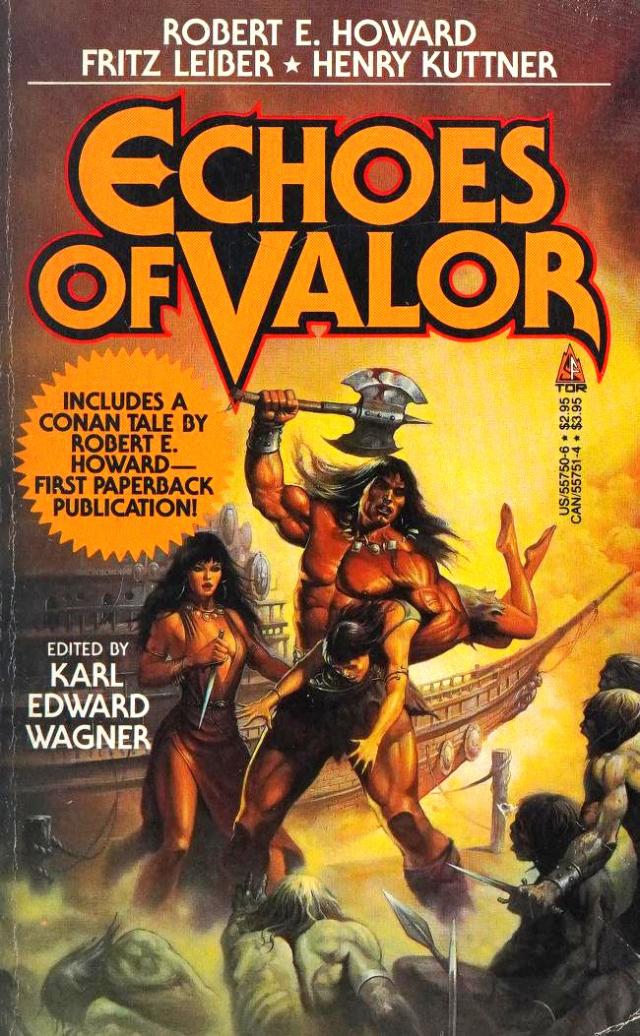
Echoes of valor v1 0, p.1
Echoes of Valor (v1.0),
p.1


03-03-2023
The Pict, staggering under the impact of the corpse against him, made no attempt to parry the dripping axe; the instinct to slay submerging even the instinct to live, he drove his spear ferociously at his enemy’s broad breast. The Cimmerian had the advantage of a greater intelligence, and a weapon in each hand. The hatchet, checking its downward sweep, struck the spear aside, and the knife in the Cimmerian’s left hand ripped upward into the painted belly.
An awful howl burst from the Pict’s lips as he crumpled, disembowelled—a cry not of fear or of pain, but of baffled, bestial fury, the death-screech of a panther. It was answered by a wild chorus of yells some distance east of the glade. The Cimmerian started convulsively, wheeled, crouching like a wild thing at bay, lips asnarl, shaking the sweat from his face. Blood trickled down his forearm from under the bandage.
ROBERT E. HOWARD1
FRITZ LEIBER * HENRY KUTTNER
Edited by
EDWARD
WAGNER
A TOM DOHERTY ASSOCIATES BOOK
This is a work of fiction. Athe characters and events portrayed1 in this book are fictional, and any resemblance to real people or1 incidents is purely coincidental.
ECHOES OF VALOR
Copyright © 1987 by Karl Edward Wagner
Arights reserved, including the right to reproduce this book or1 portions thereof in any form.
First printing: February 1987
A TOR Book Published by Tom Doherty Associates, Inc.
49 West 24 Street1
New York, N.Y. 10010
Cover art by Ken Kelly
ISBN: 0-812-55750-61
CAN. ED.: 0-812-55751-4
Printed in the United States of America 0987654321
ACKNOWLEDGMENTS
The Black Stranger by Robert E. Howard. Copyright © 1953 by Future Publications, Inc., for Fantasy1 Magazine, March 1953. This version copyright ©1 1987 by Conan Properties, Inc. Published by permission of Conan Properties, Inc.
Adept’s Gambit by Fritz Leiber. Copyright © 1947 by Fritz Leiber, Jr., for Night’s Black Agents. Reprinted by permission of the author and the author’s1 agent, Richard Curtis Assoc.
Wet Magic by Henry Kuttner. Copyright © 1942 by Street & Smith Publications, Inc., for Unknown1 Worlds, February 1943. Reprinted by permission of1 Don Congdon Assoc., agent for the author’s estate.
To Richard Minter—
The man who loves pulps
Contents:-
The Black Stranger - Robert E. Howard
Adept’s Gambit - Fritz Leiber
Wet Magic - Ray Bradbury
The Black Stranger
Robert E. Howard
Editor’s Introduction to
“The Black Stranger”
While the origins of epic fantasy are as old as mankind itself ‘, it was Robert E. Howard who crystallized the various elements that formed this genre’s pulp traditions. Born January 22, 1906, in Peasier, Texas, Howard grew up in various smatowns acroTexas until his father and mother settled in CroPlains. In poor health as a child (there are good indications that he had rheumatic fever and later suffered from rheumatic heart disease), the young Howard found escape through his intense imagination—creating magical realms of fantastic adventure from such books of ancient history and myths as he was able to find. At the same time, he was fascinated by the tales of gunfights and Indian wars stivividly recalled by survivors of those lawledays. It was this fusion of Old World myth and Old West legend that directed the emergence of a new approach to epic fantasy in Howard’s writing.
By age 15 Howard had determined to become a writer. Undaunted by rejection slips, he managed to make his first sale to Weird Tales—a story of primitive man entitled “Spear and Fang” (July 1925). Sales were pitifully slow in coming, but by the close of the 1920s Howard’s stories were beginning to attract notice in Weird Tales. Most popular were his stories involving series characters: Solomon Kane, a Puritan adventurer in the age of Elizabeth; Bran Mak Morn, a Pictish king in the early years of third-century Roman Britain; King Kull, a savage who became king in the age of lost Atlantis.
With the December 1932 issue of Weird Tales appeared Howard’s most famous creation, Conan. This first story,
“The Phoenix on the Sword,’
’ was actually a rewrite of a King Kustory that editor Farnsworth Wright had earlier rejected, and it takes place quite late in Conan’s career. Howard would quickly fiin the gaps of Conan’s saga, with tales of Conan as a thief, a pirate, a mercenary, an adventurer, a king—and always a barbarian, no matter what his role. While a great popular succewith the readers of Weird Tales, Conan was not a commercial success. Weird Tales was a poor-paying market when it did manage to pay, and at the time of Howard’s death the magazine owed him $1350 for stories already published. Financial necessities forced Howard to abandon Conan in 1935 and to write for better-paying markets. On June 12, 1936, during a speof profound depression, Howard shot himself.
Robert E. Howard completed twenty-one Conan stories during those four years. Of these, seventeen were published in Weird Tales, while four were rejected by Wright and remained unpublished until many years after Howard’s death. “The Black Stranger” is one of this latter group, first published in an abridged form in the March 1953 issue of Fantasy Magazine. It is one of the last Conan stories that Howard wrote, and in terms of Conan’s career it takes place immediately following “Beyond the Black River” (Weird Tales, May and June 1935).
These two stories mark a departure from Howard’s usual milieu for the Conan stories. Commenting on this, Howard wrote: “My latest sales to Weird Tales have been a two-part Conan serial, ‘Beyond the Black River’—a frontier story, and a novelet dealing with Mississippi negroes, etc…In the Conan story I’ve attempted a new style and setting entirely—abandoned the exotic settings of lost cities, decaying civilizations, golden domes, marble palaces, silk-clad dancing girls, etc., and thrown my story against a background of forests and rivers, log cabins, frontier outposts, buckskin-clad settlers, and painted tribesmen. Some day I’m going to try my hand at a longer yarn of the same style, and a serial of four or five parts.” Howard did try his hand at this, and “The Black Stranger” was the result. Unfortunately, Wright rejected the piece. Howard made an unsuccessful attempt to salvage the story by rewriting it as a pirate story, “Swords of the Red Brotherhood” substituting his swashbuckling hero, Black Vulmea, for Conan. This version was eventually published as part of a hardcover collection, Black Vulmea’s Vengeance (Grant, 1976). There has been some confusion as to which is the original version. I have the photocopy of Howard’s original manuscript of “The Black Stranger” which clearly shows Howard’s efforts to change the story from the Conan to the Black Vulmea version. This version here follows Howard’s original manuscript. This is the first time the complete form of * The Black Stranger” has appeared in print.
The Black Stranger
Robert E. Howard
Chapter 1 - The Painted Men
One moment the glade lay empty; the next, a man stood poised warily at the edge of the bushes. There had been no sound to warn the grey squirrels of his coming. But the gay-hued birds that flitted about in the sunshine of the open space took fright at his sudden appearance and rose in a clamoring cloud. The man scowled and glanced quickly back the way he had come, as if fearing their flight had betrayed his position to some one unseen. Then he stalked acrothe glade, placing his feet with care. For ahis massive, muscular build he moved with the supple certitude of a panther. He was naked except for a rag twisted about his loins, and his limbs were criss-crossed with scratches from briars, and caked with dried mud. A brown-crusted bandage was knotted about his thickly-muscled left arm. Under his matted black mane his face was drawn and gaunt, and his eyes burned like the eyes of a wounded panther. He limped slightly as he followed the dim path that led acrothe open space.
Halfway acrothe glade he stopped short and whirled, catlike, facing back the way he had come, as a long-drawn caquavered out acrothe forest. To another man it would have seemed merely the howl of a wolf. But this man knew it was no wolf. He was a Cimmerian and understood the voices of the wilderneas a city-bred man understands the voices of his friends.
Rage burned redly in his bloodshot eyes as he turned once more and hurried along the path, which, as it left the glade, ran along the edge of a dense thicket that rose in a solid clump of greenery among the trees and bushes. A massive log, deeply embedded in the grassy earth, paralleled the fringe of the thicket, lying between it and the path. When the Cimmerian saw this log he halted and looked back acrothe glade. To the average eye there were no signs to show that he had passed; but there was evidence visible to his wilderness-sharpened eyes, and therefore to the equally keen eyes of those who pursued him. He snarled silently, the red rage growing in his eyes—the berserk fury of a hunted beast which is ready to turn at bay.
He walked down the trail with comparative carelessness, here and there crushing a grass-blade beneath his foot. Then, when he had reached the further end of the great log, he sprang upon it, turned and ran lightly back along it. The bark had long been worn away by the elements. He left no sign to show the keenest forest-eyes that he had doubled on his trail. When he reached the densest point of the thicket he faded into it like a shadow, with hardly the quiver of a leaf to mark his passing.
The minutes dragged. The grey squirrels chattered again on the branches—then flattened their bodies and were suddenly mute. Again the glade was
invaded. As silently as the first man had appeared, throther men materialized out of the eastern edge of the clearing. They were dark-skinned men of short stature, with thickly-muscled chests and arms. They wore beaded buckskin loincloths, and an eagle’s feather was thrust into each black mane. They were painted in hideous designs, and heavily armed.
They had scanned the glade carefully before showing themselves in the open, for they moved out of the bushes without hesitation, in close single-file, treading as softly as leopards, and bending down to stare at the path. They were following the trail of the Cimmerian, but it was no easy task even for these human bloodhounds. They moved slowly acrothe glade, and then one stiffened, grunted and pointed with his broad-bladed stabbing spear at a crushed grass-blade where the path entered the forest again. Ahalted instantly and their beady black eyes quested the forest walls. But their quarry was wehidden; they saw nothing to awake their suspicion, and presently they moved on, more rapidly, following the faint marks that seemed to indicate their prey was growing carelethrough weakneor desperation.
They had just passed the spot where the thicket crowded closest to the ancient trail when the Cimmerian bounded into the path behind them and plunged his knife between the shoulders of the last man. The attack was so quick and unexpected the Pict had no chance to save himself. The blade was in his heart before he knew, he was in peril. The other two whirled with the instant, steel-trap quickneof savages, but even as his knife sank home, the Cimmerian struck a tremendous blow with the war-axe in his right hand. The second Pict was in the act of turning as the axe fell. It split his skuto the teeth.
The remaining Piet, a chief by the scarlet tip of his eagle-feather, came savagely to the attack. He was stabbing at the Cimmerian’s breast even as the killer wrenched his axe from the dead man’s head. The Cimmerian hurled the body against the chief and followed with an attack as furious and desperate as the charge of a wounded tiger. The Piet, staggering under the impact of the corpse against him, made no attempt to parry the dripping axe; the instinct to slay submerging even the instinct to live, he drove his spear ferociously at his enemy’s broad breast. The Cimmerian had the advantage of a greater intelligence, and a weapon in each hand. The hatchet, checking its downward sweep, struck the spear aside, and the knife in the Cimmerian’s left hand ripped upward into the painted belly.
An awful howl burst from the Piet’s lips as he crumpled, disembowelled—a cry not of fear or of pain, but of baffled, bestial fury, the death-screech of a panther. It was answered by a wild chorus of yells some distance east of the glade. The Cimmerian started convulsively, wheeled, crouching like a wild thing at bay, lips asnarl, shaking the sweat from his face. Blood trickled down his forearm from under the bandage.
With a gasping, incoherent imprecation he turned and fled westward. He did not pick his way now, but ran with athe speed of his long legs, calling on the deep and abut inexhaustible reservoirs of endurance which are Nature’s compensation for a barbaric existence. Behind him for a space the woods were silent, then a demoniacal howling burst out at the spot he had recently left, and he knew his pursuers had found the bodies of his victims. He had no breath for cursing the blood-drops that kept spilling to the ground from his freshly opened wound, leaving a trail a child could follow. He had thought that perhaps these thrPiets were athat stipursued him of the war-party which had followed him for over a hundred miles. But he might have known these human wolves never quit a blood-trail.
The woods were silent again, and that meant they were racing after him, marking his path by the betraying blood-drops he could not check. A wind out of the west blew against his face, laden with a salty dampnehe recognized. Dully he was amazed. If he was that close to the sea the long chase had been even longer than he had realized. But it was nearly over. Even his wolfish vitality was ebbing under the terrible strain. He gasped for breath and there was a sharp pain in his side. His legs trembled with wearineand the lame one ached like the cut of a knife in the tendons each time he set the foot to earth. He had followed the instincts of the wildernewhich bred him, straining every nerve and sinew, exhausting every subtlety and artifice to survive. Now in his extremity he was obeying another instinct, looking for a place to turn at bay and sehis life at a bloody price.
He did not leave the trail for the tangled depths on either hand. He knew that it was futile to hope to evade his pursuers now. He ran on down the trail while the blood pounded louder and louder in his ears and each breath he drew was a racking, dry-lipped gulp. Behind him a mad baying broke out, token that they were close on his heels and expected to overhaul their prey swiftly. They would come as fleet as starving wolves now, howling at every leap.
Abruptly he burst from the denseneof the trees and saw, ahead of him, the ground pitching upward, and the ancient trail winding up rocky ledges between jagged boulders. Aswam before him in a dizzy red mist, but it was a hihe had come to, a rugged crag rising abruptly from the forest about its foot. And the dim trail wound up to a broad ledge near the summit.
That ledge would be as good a place to die as any. He limped up the trail, going on hands and knees in the steeper places, his knife between his teeth. He had not yet reached the jutting ledge when some forty painted savages broke from among the trees, howling like wolves. At the sight of their prey their screams rose to a devil’s crescendo, and they raced toward the foot of the crag, loosing arrows as they came. The shafts showered about the man who doggedly climbed upward, and one stuck in the calf of his leg. Without pausing in his climb he tore it out and threw it aside, heedleof the leaccurate missiles which splintered on the rocks about him. Grimly he hauled himself over the rim of the ledge and turned about, drawing his hatchet and shifting knife to hand. He lay glaring down at his pursuers over the rim, only his shock of hair and blazing eyes visible. His chest heaved as he drank in the air in great shuddering gasps, and he clenched his teeth against a tendency toward nausea.
Only a few arrows whistled up at him. The horde knew its prey was cornered. The warriors came on howling, leaping agilely over the rocks at the foot of the hill, war-axes in their hand. The first to reach the crag was a brawny brave whose eagle feather was stained scarlet as a token of chieftainship. He halted briefly, one foot on the sloping trail, arrow notched and drawn halfway back, head thrown back and lips parted for an exultant yell. But the shaft was never loosed. He froze into motionlessness, and the blood-lust in his black eyes gave way to a look of startled recognition. With a whoop he gave back, throwing his arms wide to check the rush of his howling braves. The man crouching on the ledge above them understood the Pictish tongue, but he was tfar away to catch the significance of the staccato phrases snapped at the warriors by the crimson-feathered chief.
But aceased their yelping, and stood mutely staring up—not at the man on the ledge, it seemed to him, but at the hiitself. Then without further hesitation, they unstrung their bows and thrust them into buckskin cases at their girdles; turned their backs and trotted acrothe open space, to melt into the forest without a backward look.
The Cimmerian glared in amazement. He knew the Pictish nature twenot to recognize the finality ex- pressed in the departure. He knew they would not come back. They were heading for their villages, a hundred miles to the east.
But he could not understand it. What was there about his refuge that would cause a Pictish war-party to abandon a chase it had followed so long with ail the passion of hungry wolves? He knew there were sacred places, spots set aside as sanctuaries by the various clans, and that a fugitive, taking refuge in one of these sanctuaries, was safe from the clan which raised it. But the different tribes seldom respected sanctuaries of other tribes; and the men who had pursued him certainly had no sacred spots of their own in this region. They were the men of the Eagle, whose villages lay far to the east, adjoining the country of the Wolf-Picts.