Beyond the curtain of da.., p.1
Beyond the Curtain of Dark (v1.0),
p.1


28-02-2023
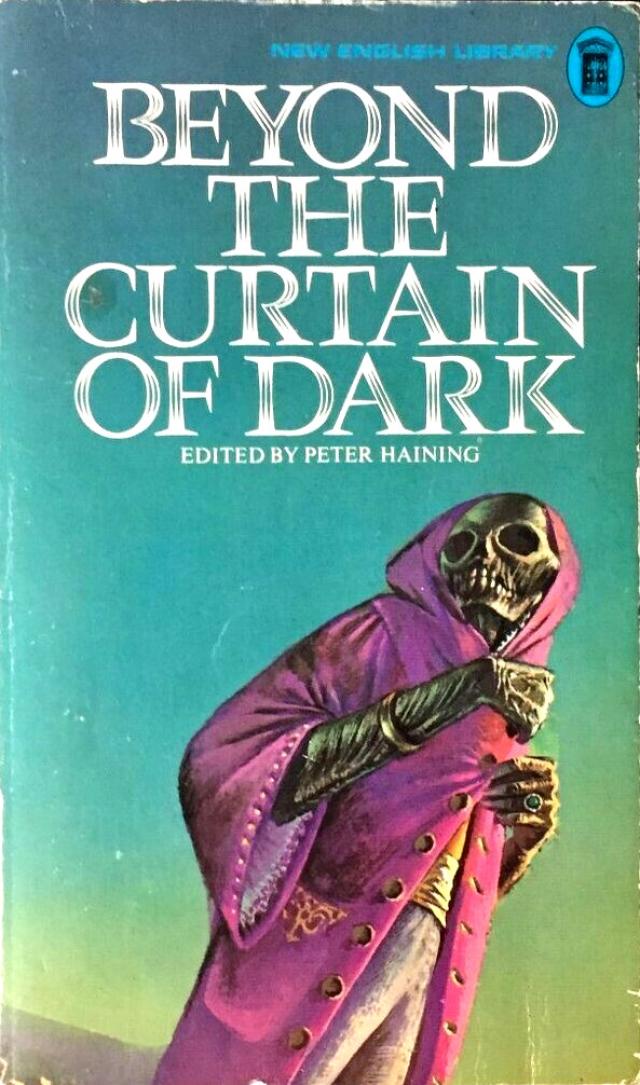
BEYOND THE CURTAIN OF DARK
BEYOND THE
CURTAIN OF DARK
Edited by
PETER HAINING
NEW ENGLISH LIBRARY
TIMES MIRROR
For my wife, Philippa,
who has shared me with the
monsters for a long time.
This collection © copyright by Peter Haining, 1966
First published by The New English Library Limited in October 1966
New edition November 1972
Conditions of Sale: This book shall not, without the written consent of the publishers first given, be lent, resold, hired out, or otherwise disposed of by way of trade in any form of binding or cover other than that in which it is published.
Four Square Books are published by The New English Library Limited from Barnard's
Inn, Holborn, London, E.C.J. Made and printed in Great Britain by
Hazell Watson & Viney Ltd, Aylesbury, Bucks
450012972
Contents
BEYOND THE CURTAIN OF DARK
FOREWORD By Judith Merril
INTRODUCTION
LIZZIE BORDEN TOOK AN AXE…By Robert Bloch
THE SNAIL WATCHER By Patricia Highsmith
CHICKAMAUGA By Ambrose Bierce
AT LAST, THE TRUE STORY OF FRANKENSTEIN By Harry Harrison
FEVER DREAM By Ray Bradbury
THE OTHER CELIA By Theodore Sturgeon
THE OVAL PORTRAIT By Edgar Allan Poe
THE MONSTER-MAKER By William C. Morrow
COME AND GO MAD By Fredric Brown
THE SURVIVOR By H. P. Lovecraft and August Derleth
THE ANCESTOR By H. P. Lovecraft and August Derleth
THE MORTAL IMMORTAL By Mary Shelley
DR. HEIDEGGER’S EXPERIMENT By Nathaniel Hawthorne
BY THESE PRESENTS By Henry Kuttner
WHOSITS DISEASE By Henry Slesar
KING PEST By Edgar Allan Poe
MAYAYA'S LITTLE GREEN MEN By Harold Lawlor
FOR THE BLOOD IS THE LIFE By Francis Marion Crawford
THE HUMAN CHAIR By Edogawa Rampo
THE FORTUNES OF SIR ROBERT ARDAGH By Joseph Sheridan Le Fanu
RETURN TO THE SABBATH By Robert Bloch
THE WILL OF LUKE CARLOWE By Clive Pemberton
EYES DO MORE THAN SEE By Isaac Asimov
FOREWORD
By Judith Merril
I am not ordinarily partial to the weird or horror story—at least not those which depend, as many do, on nothing but the statement that something Strange and Terrible Did Happen, for their effect. But I think the Editor’s selection in this volume is extraordinary, both in the selection of individual stories, and in the complementary character of the combination.
In hindsight I am not sure whether I was more pleasantly surprised at seeing such overlooked items as The Snail Watcher by Patricia Highsmith and The Other Celia by Theodore Sturgeon included, or at my own first reading of the Harold Lawlor, Francis Marion Crawford and Edogawa Rampo stories—as well as Mary Shelly’s The Mortal Immortal, which I had heard of but never seen.
But, to be sure, all the stories are pleasing and I have no hesitation in recommending Beyond The Curtain Of Dark as a fine collection.
The Editor is indebted to the following authors and their agents for permission to reproduce copyright material in this anthology: Robert Block for “Lizzie Borden Took An Axe” and “Return to the Sabbath”; Patricia High-smith and A. M. Heath Ltd. for “The Snail Watcher”; Harry Harrison and E. J. Camell for “At Last, The True Story Of Frankenstein”; Theodore Sturgeon and E. J. Camell for “The Other Celia”; Ray Bradbury for “Fever Dream”; Fredric Brown for “Come And Go Mad”; August Derleth and Scott Meredith for “The Survivor” and “The Ancestor” by H. P. Lovecraft and August Derleth; Henry Kuttner for “By These Presents”; Henry Slesar and Theron Raines for “Whosits Disease”; Harold Lawlor for “Mayaya’s Little Green Men”; Edogawa Rampo and Kurt Singer Features for “The Human Chair”; Isaac Asimov for “Eyes Do More Than See.” I should also like particularly to thank Kurt Singer who has proved an invaluable source of information throughout the compiling of this book.
P.H.
INTRODUCTION
The horror story has a wider spectrum of people, places and objects from which to draw its inspiration than probably any other short story form. There is literally no limit to which the master of the genre cannot go in search of the macabre and the weird. If he chooses, he can employ the most commonplace items—everyday things like a chair, a picture or even a glass jar—and imbue them with the most terrifying possibilities so that they will never again seem quite so innocent. Or he can explore the nether world inhabited by nameless things which almost defy description. Both the common and the uncommon have their own special chilling qualities and in this collection are combined together in a feast of fear.
In “Beyond The Curtain Of Dark” I believe we have assembled what amounts to as representative a selection of horror and fantasy stories as has ever appeared in one volume. Apart from the wide spectrum which they cover, the stories have also been drawn from the writings of the last 200 years. Needless to say, every major writer in the field is included—and some of their stories are appearing in paperback for the very first time. The result, I believe, shows that there is horror all around us—day or night—and in every situation we are likely to encounter.
But before taking up this invitation to be frightened to death, a few notes on the men who have concocted these masterpieces of the macabre may be of interest to the horrorphile. For instance…
Robert Bloch, who opens the collection with a gruesome piece on the hatchet-wielding activities of Lizzie Borden, is a mild-mannered, quietly-spoken American who is far more ready to talk about his hobby, baseball, than his explorations into the haunting regions of the unknown. Mr. Bloch, whose reputation was assured immediately the critics saw the brilliant suspense film, “Psycho,” based on his book, also contributes a topical second story featuring horror movies and those who make them, “Return to the Sabbath.”
Patricia Highsmith, who follows Robert Bloch, is another writer who came to public attention through a film of her novel, “Strangers On A Train.” This was made in 1951 by Alfred Hitchcock and is regularly revived for the benefit of crime aficionados. In “The Snail Watcher,” Miss Highsmith has, however, turned to a subject far removed from that crime. But—strangely—a subject which is close to her heart. For she is an avid collector of snails and even takes her “pets” with her whenever she travels abroad. Her knowledge of these creatures—so repulsive to most—is quite extraordinary as the reader who explores the world of the snail watcher will discover.
Miss Highsmith was born on the same day (January 19) as another of our most notable contributors: Edgar Allan Poe. This extraordinary, tormented American genius, who was without doubt the first great modem horror story writer, has left an indelible mark on the genre. His work has been reprinted endlessly and I count myself lucky to have found two of his lesser known stories for this collection—“The Oval Portrait” and “King Pest,” the latter surely one of the finest pieces of Black Humour ever penned. In Poe’s homeland his high standard of writing is commemorated each year by the Mystery Writers of America who award the Edgar Allan Poe Prize to the best mystery work of the year. Not surprisingly, this honour is much coveted in the writing world. Appropriately, Poe’s modem “pupil” and fellow Capricomian, Patricia Highsmith, has one!)
If the prize had been instituted during the lifetime of Ambrose Bierce, one cannot help feeling that this fellow American would have been certain to qualify for one. Bierce, who came to be known as “Bitter Bierce” because of his morbid and acid writings, was a mysterious, restless man who travelled endlessly in search of an illusion and suddenly disappeared at the height of his fame while visiting Mexico in 1913. His stories are often preoccupied with war and death and the particular example included here, “Chickamauga,” is a brutal exposé of the effect battle can have on both soldiers and civilians.
Harry Harrison, the next contributor, is first and foremost a Science Fiction writer, but in “At Last, The True Story of Frankenstein” he has taken a new look at the old legend of the mad scientist and produced one of the most original horror stories for many years. Harrison, who occupies his time in between writing novels with working on film scripts, often chooses the most unlikely themes for his short stories and recently published a chilling little piece about a “Pop” group who literally devour their fans!
In Ray Bradbury we have a modem writer who also lets his imagination free in the dark comers of human terror—and comes up with small masterpieces like “Fever Dream.” Bradbury is unquestionably the most famous horror story writer alive and his work is always eagerly sought after for every new anthology. The story I have selected appeared originally in “Weird Tales,” the ill-fated pioneer horror story magazine which was produced in the United States in the 1920’s and first published such now-famous names as Robert Bloch, August Derleth, H. P. Lovecraft and Bradbury himself. Copies are now collectors items and change hands for quite large sums of money.
Theodore Sturgeon, the next in line, is another American writer who had early work published in “Weird Tales.” His contribution to this anthology, “The Other Celia,” is very typical of his outlandish fantasy and illustrates why he is often referred to as “one of the most gifted explorers of the strange byway
s of other worlds.”
W. C. Morrow and Fredric Brown who follow Sturgeon are separated by nearly half a century, yet both have strangely similar comments to make about obsessions in their respective stories, “The Monster Maker” and “Come And Go Mad.” The settings are in no way alike, yet the indefinable force which drives the crazy old surgeon to destruction is encountered again in a somewhat similar manner by Brown’s alert and cynical newspaper reporter on the lookout for a story.
Following these two tales I have thought it most suitable to introduce the “scoops” in the collection—“The Survivor” and “The Ancestor” from the joint pens of H. P. Lovecraft and August Derleth. Behind them lies a remarkable story which involves two of the most famous names in the genre.
Howard Phillips Lovecraft is still considered today—some forty years after his death—as one of the all-time greats of the honor story. Living quietly in Rhode Island and subsisting almost entirely on sweet, black coffee (which eventually contributed to his early death), Lovecraft produced a brand of lurking evil quite unique in its macabre fascination. His output was at no time phenomenal and after his death his admirers naturally believed they had read the last of Lovecraft.
This was not so, however, and it is thanks mainly to the efforts of August Derleth, horror story writer, publisher and anthologist, that a cache of forgotten tales came to light. Derleth, who was himself a fan of H.P., learned that before his death the master storyteller had deposited a number of notes and outlines with a friend, Mr. R. H. Barlow, who in the meantime had also died. After extensive enquiries these papers were again brought to light—a find of no small magnitude for Lovecraft enthusiasts. Derleth then set himself to work on the notes—some of which were almost complete plots—and the result was a collection of new stories faithful in every way to Lovecraft’s style.
The two I have chosen for “Beyond The Curtain Of Dark” have never been anthologized before and I am greatly indebted to August Derleth for his permission to reproduce them here. They are the gems of the collection.
Henry Slesar is one of the most prolific of today’s short story writers and is as frequently found in Science Fiction magazines as in crime and mystery publications. “Whosits Disease” which has been taken from this profusion, is one of his shorter works but lacks none of the nuances of black humour and carefully constructed shudders usually associated with the name of Slesar.
The next three stories are all on a favourite theme of mine: immortality. They were all written at entirely different periods and each author has his own very special ideas on the subject. Mary Shelley—wife of the poet and creator of the most famous of all monster makers, Frankenstein—discourses on the dangers of living for ever in “The Mortal Immortal”; Nathaniel Hawthorne, author of the world-famous “The House of the Seven Gables,” is in a skittish frame of mind in “Dr. Heidegger’s Experiment” while Henry Kuttner describes the unexpected results of signing a pact with the Devil in return for eternal life in “By These Presents.” I think you will find them all fascinating.
Harold Lawlor concerns himself with the strange powers of the West Indies in “Mayaya’s Little Green Men”—and a maid who can almost charm the kitchen utensils into doing the housework themselves! A quick trip back in time then takes the reader straight into the terror-laden atmosphere inhabited by vampires in Francis Marion Crawford’s “For The Blood Is The Life.” This unearthly tale of a bloodsucking creature of the night is perhaps the best short story Crawford ever wrote, though, strangely, probably the least reprinted. He is most noted for Ms Italian romances and the national ode he wrote in 1887 to celebrate the centennial of the American Constitution.
After Crawford, I have picked a new story by the leading Japanese author, Edogawa Rampo. He appears here to ensure that no reader will ever again sit quite so comfortably after learning the truth of “The Human Chair.”
Joseph Sheridan Le Fanu is another of the great masters of the ghost/horror story in the same mould as Poe and Ambrose Bierce. Bom in the middle of the nineteenth century in Ireland, he saw a decaying culture all around him and reflected this in his work. “The Fortunes of Sir Robert Ardagh” is a masterly study of a man’s disintegration through fear of the supernatural.
So, finally, we come to the last two contributors in the collection—Clive Pemberton, a virtually unknown—but nonetheless outstanding—newspaperman who wrote horror stories for Ms own amusement (some of which appeared in “The Morning Leader” at the beginning of the century) and Isaac Asimov, the internationally famous Science Fiction and Science Fact authority. Mr. Asimov’s very short piece, “Eyes Do More Than See,” may seem at first reading to be strangely out of place in a collection such as this. But a second look will show that in a few precise words the author has brilliantly described the ultimate horror that could overtake humanity. It is a salutary lesson in our world which may no longer seriously fear the shapes of night but has hanging over it the much more dreadful fear of global annihilation.
Peter Haining
LIZZIE BORDEN TOOK AN AXE…
By Robert Bloch
"Lizzie Borden took an axe
And gave her mother forty -whacks.
When she saw what she had done
She gave her father forty-one
1
Men say that horror comes at midnight, born of whispers out of dreams. But horror came to me at high noon, heralded only by the prosaic jangling of a telephone.
I had been sitting in the office all morning, staring down the dusty road that led to the hills. It coiled and twisted before my aching eyes as a shimmering sun played tricks upon my vision. Nor were my eyes the only organs that betrayed me; something about the heat and the stillness seemed to invade my brain. I was restless, irritable, disturbed by a vague presentiment.
The sharp clangor of the phone bell crystallized my apprehension in a single, strident note.
My palms dripped perspiration-patterns across the receiver. The phone was warm, leaden weight against my ear. But the voice I heard was cold; icy cold, frozen with fear. The words congealed.
“Jim—come and help me!”
That was all. The receiver clicked before I could reply. The phone slid to the desk as I rose and ran to the door.
It was Anita’s voice, of course.
It was Anita’s voice that sent me speeding towards my car; sent me racing down that desolate, heat-riddled road towards the old house deep in the hills.
Something had happened out there. Something was bound to happen, sooner or later. I’d known it, and now I cursed myself for not insisting on the sensible thing Anita and I should have eloped weeks ago.
I should have had the courage to snatch her bodily away from this atmosphere of Faulkneresque melodrama, and I might have, if only I had been able to believe in it.
At the time it all seemed so improbable. Worse than that, it seemed unreal.
There are no legend-haunted houses looming on lonely hillsides. Yet Anita lived in one.
There are no gaunt, fanatical old men who brood over black books; no “hex doctors” whose neighbors shun them in superstitious dread. Yet Anita’s uncle, Gideon Godfrey, was such a man.
Young girls cannot be kept virtual prisoners in this day and age; they cannot be forbidden to leave the house, to love, and marry the man of their choice. Yet Anita’s uncle had her under lock and key, and our wedding was prohibited.
Yes, it was all sheer melodrama. The whole affair struck me as ridiculous when I thought about it; but when I was with Anita, I did not laugh.
When I heard Anita talk about her uncle, I almost believed; not that he had supernatural powers, but that he was cunningly, persistently attempting to drive her mad.
That’s something you can understand, something evil, yet tangible.
There was a trust fund, and Gideon Godfrey was Anita’s legal guardian. He had her out there in his rotting hulk of a house—completely at his mercy. It might easily occur to him to work on her imagination with wild stories and subtle confirmations.