The mindblocked man v1 0, p.1
The Mindblocked Man (v1.0),
p.1


22-03-2023
Patient 17L was missing from the space satellite clinic that orbited the Earth constantly. It was impossible for anyone to simply vanish from such a place, for it was a worldlet of its own, the absolute preserve of its head physician, and no shuttle or lander could hope to approach it in secret and abduct a patient. Yet the man had vanished.
Not just anyone could be treated at such an orbital hospital. Only someone of the maximum importance could gain entry. Only someone with the okay of the top authorities could authorize a bed or a release. This patient was clearly of such a caliber that even the attendants did not know his name or the nature of his medical problem.
But his disappearance had to be reported —to the Earth, to Mars, to the satellites of Jupiter. And when it was—the Solar System might never be the same again.
Jeff Sutton is an editorial consultant in the aerospace field and a writer. He is an ex-newspaperman and an ex-marine who was a successful writer of non-fiction until 1959 when he turned to fiction and sold his first novel—a science fiction paperback. Since then he has written and published over a dozen science fiction books in hard covers and paperbound, including Apollo at Go, Alton’s Unguessable, First on the Moon, and a mainstream novel of the areo-space industry, The Missile Lords, published by Putnam’s.
Mr. Sutton and his family live in La Mesa, California.
THE MINDBLOCKED
MAN
JEFF SUTTON
DAW BOOKS, INC.
donald a. wollhiem, publisher
1301 Avenue of the Americas
New York, N. Y. 10019
Contents
ONE
TWO
THREE
FOUR
FIVE
SIX
SEVEN
EIGHT
NINE
TEN
ELEVEN
TWELVE
THIRTEEN
FOURTEEN
Copyright ©. 1972. by Jeff Sutton
ALL RIGHTS RESERVED.
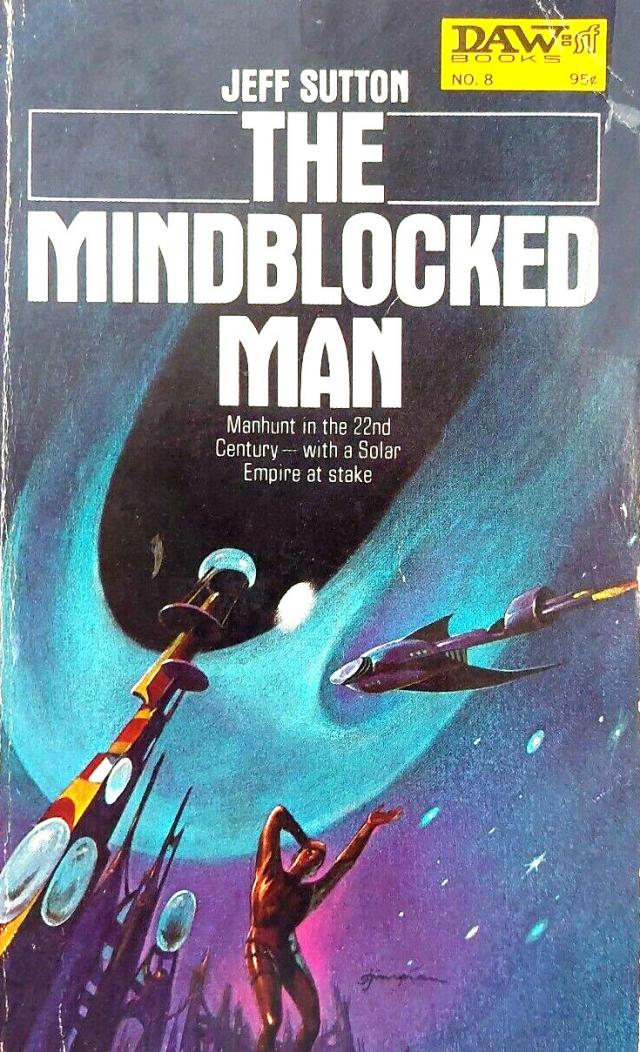
COVER ART BY JACK GAUGHAN.
PRINTED IN U.S.A.
ONE
“Aaaugh!”
He awoke, trembling, the strangled cry on his lips.
The fish eye! The distorted sky! The blob that ate the stars! He convulsed violently as the nightmarish visions fled from the forefront of his mind back into its hidden comers, leaving only the horror of their passage. Shaken, he felt suddenly cold and empty.
As his thoughts cleared, he became aware that he was sprawled face-down on a frayed rug. Alarmed, he pushed himself to a sitting position and looked around. A sagging couch, a table that held a vase of artificial flowers, odds and ends of worn furniture—a strange, nondescript room, yet it held a haunting familiarity that prickled at his memory.
Where am I? Suppressing his uneasiness, he scrutinized his surroundings more critically. A shaft of yellow light filtered through a window adorned with frilly blue drapes that appeared in curious contrast to the room’s general drabness. Several doors led to … where? He stumbled giddily to his feet
Where am I? The question came again, then, more urgently: Who am I? Frantically groping at his memory, he found none beyond the fleeting nightmares which had awakened him. The distorted sky—he shivered at the recollection.
Lord, his aching head! He rubbed his temples with tremulous fingertips, his gaze fixed on his thin, pajama-clad body—the bare, bony feet. Extending a hand, he was repelled by the blue veins that ridged its back, the hawkish curve of the all but fleshless fingers.
My God, who am l? The question screamed in his mind. He edged toward the nearest door. Partially open, it disclosed a bathroom. Bracing himself for he knew not what, he entered it and looked into a mirror above the washbasin.
“No!” he exclaimed. He recoiled a step, then regained his courage and looked again into the glass. Thin, pinched, with deep lines etched into the corners of the faded blue eyes, the face confronting him was that of a stranger.
He forced himself to look at the narrow-bridged nose, the tight mouth pulled down at the comers, the thinning brown hair that held the unnatural gloss of dye. The skin was pigmented, weathered with age. A narrow white scar crossed the temple near the hairline, running back around the perimeter of his head. But it was the face itself that appalled him; he looked to be well over seventy years old.
“My God,” he whispered. He touched the scar gingerly, felt a tingling sensation. Hastily pulling off his pajama top, he gaped in horror at his wasted body. Jutted outward with dark hollows between, the ribs appeared like sun-bleached bones. Shuddering, he slowly donned the garment and returned to the other room.
Who am I? The question brought a nameless fear. At the same time the room’s haunting familiarity perplexed him—it held the echo of something long forgotten.
He went to the window and parted the drapes to peer out onto a narrow street lined with sleazy shops. Weather-scarred balconies above them, a few displaying artificial flowers and plants, identified the section as a residential area for the poorer working classes. How did he know that? He frowned perplexedly.
Several aircars buzzed around a slender gray tower in the distance. Beyond it, a large space freighter rose silently on anti-gravs. The tower marked a space terminal. Space terminal! He groped wildly at the single clue. For a single instant he had the eerie impression that his mind was about to open, that the knowledge he sought would tumble forth; but then the prickling of memory faded, as if a hand had reached into his mind to erase it clean.
He heard a noise at the door and whirled as a young woman came in. She saw him at the same instant and halted, a look of fright on her face. “What are you doing here?” she demanded.
“I … don’t know.” He looked numbly at her. Young, in the middle twenties, he guessed, she had dark hair, a rather plain face. Her cheap skirt and blouse marked her as a worker.
“Don’t know?” She moistened her lips nervously.
“I just woke up, found myself here.”
“In my front room?”
He nodded, unable to speak.
“Are you sick?” she demanded.
“I… don’t know.”
“Did someone dump you here?”
“I don’t know,” he repeated numbly. “I just woke up.” “Who are you?” Gathering her courage, she moved a step closer.
“I don’t know.”
“Don’t know?”
“I can’t remember.” His eyes beseeched her. “Where am I?”
“In my apartment,” she answered firmly.
“But … where?”
“If you mean the address, it’s Three-two-five point four Glade Avenue. Apartment Two-twelve,” she added.
“The city?” he mumbled.
“You don’t even remember that?” she asked incredulously. “You’re in Los Angeles.”
“The Capital?”
“You remember that much.”
“Not really,” he admitted. “It just came to me.”
“You are sick,” she asserted. “Where are your clothes?” He smiled ruefully. “I guess I haven’t any.”
“They dumped you like that?” Her face grew sympathetic. “If you’re broke, why didn’t they take you to a public ward?”
“I don’t know.” He fought the desire to weep. “I won’t bother you. I’ll go away.”
“Like that?” she asked incredulously.
He looked down at his pajamas. “They’re all I have.” “Wait, I’ll get you something.” She hurried from the room. Probably going to call the police, he reflected. He went back into the bathroom to peer into the mirror.
Who am I? He stroked his whiskered face wonderingly. Odd, but he knew the names of the objects around him; he could speak, think, recognize his predicament, remember everything clearly from the moment he had awakened. But beyond that, nothing. Except the fish eye. He’d had that wild dream of distorted universes before—of harsh stars blotted out by a huge whirling blob. When? He couldn’t remember; the past was a void that defied analysis.
Amnesia? Of course, it had to be. But how had he gotten into the girl’s apartment? Someone had dumped him; that was her belief. But who? And why here?
He heard her returning and went into the other room to meet her. She was carrying a sleeveless tan shirt and a pair of dark knee-length trousers of the kind commonly worn by manual laborers.
“I got them from a fellow down the hall,” she explained. “They’re old but it’s the best I could do.”
‘They’ll do fine,” he answered eagerly.
“Oh, I forgot shoes. What size do you wear?”
“I don’t know.” He gazed at his bony feet with their ridging blue veins.
“About medium,” she guessed. “I’ll see what I can find.”
“You’re very kind.”
“I just want to get you out of here.”
“I’m sorry to trouble you,” he apologized.
“You’re not labor, are you?” She stepped closer. “You have a bit of an accent”
“Accent?”
“I can’t place it. Were you an outworlder?”
“I don’t know.” He smiled wistfully. “I wish I did, but I don’t.”
“Loss of memory happens quite often to old people, even with the shots,” she said. She caught the pain in his eyes and exclaimed, “Oh, I didn’t mean that.”
“I seem quite old,” he replied gently.
“Not that old.” She forced a smile, peering closer. “Your face is familiar
.”
“It is?” he asked hopefully.
“Perhaps you live around here.”
“I don’t know.”
“I know I’ve seen you before.”
“That makes me feel better,” he asserted.
“Why?”
“I don’t feel quite so alone.”
“Your memory will come back.” She smiled reassuringly. “I’ll see about shoes.”
When she left, he stripped off the pajamas and donned the shirt and pants. Far too large, they made him appear even more emaciated than he was. Going to the window, he felt the prickling in his brain as he gazed at the slender tower rising up from the space terminal. When had he seen it before? The attempt to answer was almost a pain. But he had seen it before! He smiled nostalgically at the fleeting impression of dejà vu—the knowledge of having lived through this scene before. Somehow the space tower had evoked a feedback from his memory cells, coupling the present with the past.
Who am I? My God, who am l? Would he ever know? The thought that he might not was terrifying. Outworlder, she had guessed. Mars? Or had she meant one of the satellite planets beyond? If that were true, how had he come here? His head began to ache, bringing a nausea that pervaded his entire body. His legs felt weak and tremulous. Footsteps at the door brought him around. She came in bearing a pair of old sandals.
“They’re large,” she apologized.
“They’ll do fine.” He slipped them on his feet and tightened the straps. Straightening, he looked at her. “I don’t quite know how to thank you.”
“That’s all right,” she answered tonelessly.
“What’s your name?”
“Mura.,. Mura Breen.”
‘That’s a pretty name. Quite unusual.”
“It’s Martian.” Her eyes blazed defiantly.
“You’re from Mars?”
“Noachis, near the dead sea Serpentis.”
“Noachis, I remember.”
“You’ve been there?” she asked sharply.
“I don’t believe so.” He shook his head. “It’s just the memory of a name. Why did you come to Earth?”
“Please,” she begged.
“I’m sorry, I’d better be going.” He moved toward the door.
“Where to?”
“I don’t know.”
“Have you a charge plate? No, of course you haven’t. Then how will you live?”
“I’ll manage,” he replied uncertainly.
“Without a charge plate?” She shook her head. “Why 9
don’t you let me call the police? They’ll take you to a public clinic.”
“No,” he exclaimed. He felt a surge of fear.
“Why not? Have you done something wrong?”
“I don’t believe so.”
“You can’t wander the streets like that,” she remonstrated.
“I have to find out who I am,” he explained,
“The police will do that for you.”
“No, I have to find out for myself.” He walked out into a dingy hall, spotted the stairwell, and started toward it.
“Wait,” she called. Even the few steps had drained him. She eyed him worriedly. “If you can’t find a place, come back. You can sleep on the couch.”
“I’ll be all right.” He turned and slowly descended the stairs. When he stepped outside and gazed around, he again felt a haunting sense of familiarity. Who am 1?
Straightening his thin shoulders, he started along the street.
17L was missing!
The white-gowned attendant stared stupidly at the empty hospital bed. How could a drugged patient be missing? His eyes, darting wildly around the small cubicle, told him that the impossible was possible. He hurriedly examined the remaining half a dozen cubicles; all were empty. So was surgery. He dashed into the galley. The cook looked up, startled.
“Have you seen the patient?”
“The patient? My God, is he … ”
“Have you seen him?” the attendant shouted.
“No.”
“Has anyone gone down into maintenance?”
“N-no one,” the cook stuttered. The attendant ran back into the corridor and pounded on the nurse’s door.
“What is it?” she called.
“Seventeen-L is missing,” he hissed softly.
“Missing?” She pulled the door open, her face ashen. “Impossible!”
“But he is,” he blurted.
“Have you tried the galley?”
“The galley, maintenance—he’s nowhere!” he exclaimed.
“The landers?”
“The landers, of course!” He snapped his fingers and started toward the outboard wells. Both landers were there, both empty. He swung back, licking his lips nervously.
“He might be with Dr. Sundberg,” she suggested nervously.
“How could he be? He’s drugged to the ears.”
“Go see,” she urged.
“It’s no use.” Nevertheless he went to a door at the end of the corridor and pressed a button. A chime sounded softly on the other side.
“What is it?” a voice called testily.
“Kelsey. I have to see you.”
“Come in.” Dr. Gerald Sundberg, fortyish, slender, with a high, gleaming forehead, regarded him with annoyance. “Wen … ?”
Kelsey gulped and said, “Seventeen-L is missing.”
“Missing?” Sundberg exclaimed incredulously. He leaped up from his chair. “That is impossible!”
“He’s gone!”
“Have you looked in the other recovery rooms, the galley?”
‘‘I’ve searched the ship, every inch.”
“The landers?”
“They’re both in their wells, empty.”
“It’s impossible, I tell you!” Sundberg banged a fist on the desk. “Search again.”
“Yes, sir.” As the attendant withdrew, Sundberg went to a port and looked out; the Sky Haven Clinic was racing down over the top of the world. Ice fields wheeled past beneath him. Far ahead, to the left, he saw the purple blur of mountains rising from the polar forests.
He looked at his hand—it was shaking—then returned to his desk and slumped down. Escape from the clinic was impossible! No lander could have approached without setting off the detector alarms; kidnapping was out. Neither could he have been spirited from the clinic without inside connivance. Sundberg gazed wanly at his hands; he couldn’t remember when last they’d trembled.
“Craxton Wehl”—he croaked the missing man’s name softly. Both the nurse and Kelsey knew the patient’s true identity, of course. So did the cook and maintenance help; but none ever had acknowledged it. He was simply 17L, a record designation, as were others who sought Sundberg’s services from time to time.
But Craxton Wehl’s case was different. Vastly different!
The mere contemplation of it brought the sweat to his brow. Craxton Wehl, premier, the most powerful figure in the Solar Empire, had ruled as a not-too-gentle despot for more than thirty years. His word had been absolute law.
At age seventy-six, paranoiac and in rapidly failing health, Wehl had come to him for help—had placed his life in Sundberg’s hands. Almost as abruptly, he had announced that he would pass the power. Bernard Rayburn, his hand-picked successor, had been a political unknown from the tiny satellite world of Europa, third out of the Jovian moons.
The succession ceremony, held in the satellite clinic, saw Wehl step down, Rayburn step up; in that instant the latter’s word had become absolute law. All that was a matter of public record; but what had happened to the old man afterward was not. Ostensibly a patient, he had been held absolute prisoner. Now he had vanished.
And the new premier was dying!
The gods were against him, Sundberg reflected. He cursed the day he’d first taken Wehl as a patient. Since then, machinations within machinations had pinned him to the wall. Now the new premier, shadowed by death, had to return the power. But how could he return it to a man who wasn’t there?