Eye of the cat, p.1
Eye of The cat,
p.1
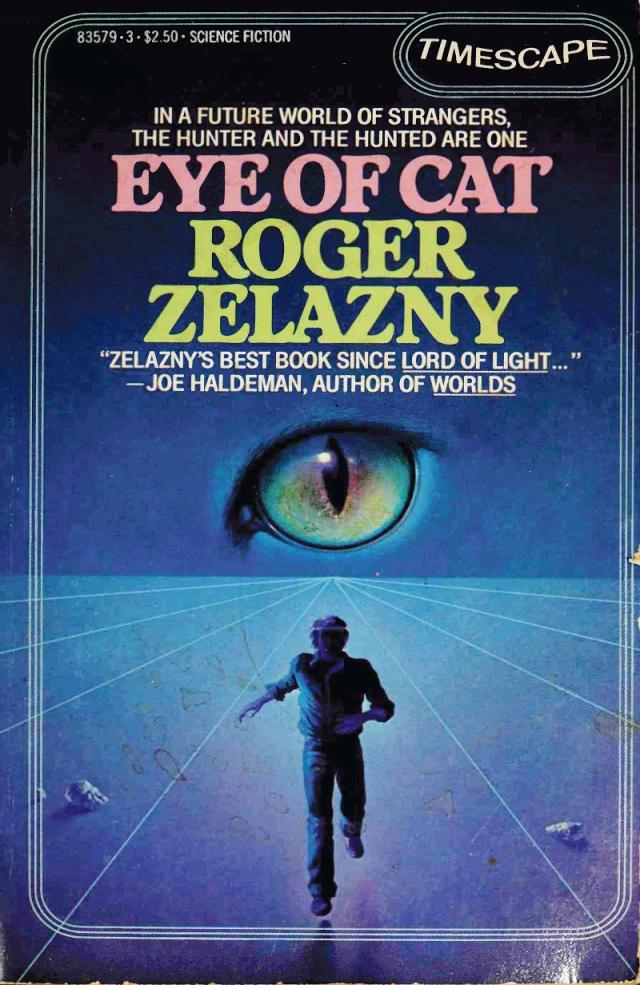


EYE OF CAT
is
“PROFOUND…
It offers what is expected of Zelazny at his best: stylistic brilliance, subtleties of characterization, originality, and strong mythic themes of power.”
—Washington Post Book World
“MARVELOUS . . . a novel of renewed promise that Zelazny’s many fans will want to read”
—Publishers Weekly
“A WEIRDLY BEAUTIFUL TALE…
Eye of Cat is easily the best Zelazny in nearly a decade.”
—Fantasy Newsletter
“Zelazny combines mysticism, telepathy, aliens, and
Navajo mythology into an adventure…
EYE OF CAT BELONGS IN ALL MAJOR SF
COLLECTIONS.”
—Library Journal
Books by Roger Zelazny
Eye of Cat
The Last Defender of Camelot
Published by TIMESCAPE BOOKS
Most Timescape Books are available at special quantity discounts for
bulk purchases for sales promotions, premiums or fund raising. Special
books or book excerpts can also be created to fit specific needs.
For details write the office of the Vice President of Special Markets,
Pocket Books, 1230 Avenue of the Americas, New York, New York 10020.
EYE OF CAT
ROGER ZELAZNY
A TIMESCAPE BOOK
PUBLISHED BY POCKET BOOKS NEW YORK
This is a work of fiction. Names, characters, places, and incidents either are the product of the author’s imagination or are used fictitiously. Any resemblance to actual events or locales or persons, living or dead, is entirely coincidental.
Another Original publication of TIMESCAPE BOOKS
A Timescape Book published by
POCKET BOOKS, a division of Simon & Schuster, Inc.
1230 Avenue of the Americas, New York, N.Y. 10020
Copyright © 1982 by The Amber Corporation
All rights reserved, including the right to reproduce this book or portions thereof in any form whatsoever.
For information address Timescape Books, 1230
Avenue of the Americas, New York, N.Y. 10020
ISBN: 0-671-83579-3
First Timescape Books paperback printing July, 1983
10 9 8 7 6 5 4 3 2 1
POCKET and colophon are registered trademarks of Simon & Schuster, Inc.
Use of the trademark TIMESCAPE is by exclusive license from Gregory Benford, the trademark owner.
Also available in a Timescape hardcover edition
Printed in the U.S.A.
For Joe Leaphorn, Jimmy Chee and Tony Hillerman
PART I
At the door to the House of Darkness
lies a pair of red coyotes with heads reversed.
Nayenezgani parts them with his dark staff
and comes in search of me.
With lightning behind him,
with lightning before him,
he comes in search of me,
with a rock crystal and a talking ketahn.
Beyond, at the corners by the door
of the House of Darkness,
lie two red bluejays with heads reversed.
With lightning behind him,
with lightning before him,
he parts them with his dark staff
and comes in search of me.
Farther, at the fire-pit of the Dark House,
lie two red hoot-owls with heads reversed.
He parts these with his staff
and comes in search of me,
with rock crystal and talking ketahn.
At the center of the Darkness House
where two red screech-owls lie with heads reversed,
Nayenezgani casts them aside
coming in search of me,
lightning behind him,
lightning before him.
Bearing a rock crystal and a talking ketahn,
he comes for me.
From the center of the earth he comes.
Farther …
Evil-Chasing Prayer
Night, near the eastern edge of the walled, sloping grounds of the estate, within these walls, perhaps a quarter-mile from the house itself, at the small stand of trees, under a moonless sky, listening, he stands, absolutely silent.
Beneath his boots, the ground is moist. A cold wind tells him that winter yields but grudgingly to spring in upstate New York. He reaches out and touches the dark line of a slender branch to his right, gently. He feels the buds of the fresh year’s green, dreaming of summer beneath his wide, dark hand.
He wears a blue velveteen shirt hanging out over his jeans, a wide concha belt securing it at his waist. A heavy squash blossom necklace—a very old one—hangs down upon his breast. High about his neck is a slender strand of turquoise heiche. He has a silver bracelet on his left wrist, studded with random chunks of turquoise and coral. The buttons of his shirt are hammered dimes from the early twentieth century. His long hair is bound with a strip of red cloth.
Tall, out of place, out of time, he listens for that which may or may not become audible: indication of the strange struggle at the dark house. No matter how the encounter goes, he, William Blackhorse Singer, will be the loser. But this is his own thing to bear, from a force he set into motion long ago, a chindi which has dogged his heels across the years.
He hears a brief noise from the direction of the house, followed immediately by a loud crashing. This does not end it, however. The sounds continue. From somewhere out over the walls, a coyote howls.
He almost laughs. A dog, certainly. Though it sounds more like the other, to which he has again become accustomed. None of them around here, of course.
William Blackhorse Singer. He has other names, but the remembering machines know him by this one. It was by this one that they summoned him.
The sounds cease abruptly, and after a short while begin again. He estimates that it must be near midnight in this part of the world. He looks to the skies, but Christ’s blood does not stream in the firmament. Only Ini, the bird of thunder among the southwestern stars, ready with his lightning, clouds and rain, extending his headplume to tickle the nose of Sas, the bear, telling him it is time to bring new life to the earth, there by the Milky Way.
Silence. Sudden, and stretching pulsebeat by pulsebeat to fill his world. Is it over? Is it really over?
Again, short barks followed by the howling. Once he had known many things to do, still knew some of them. All are closed to him now, but for the waiting.
No. There is yet a thing with which to fill it.
Softly, but with growing force, he begins the song.
First man was not exactly jumping with joy over the dark underworld in which he was created. He shared it with eight other humans, and the ants and the beetles and later the locusts whom they encountered as they explored, and Coyote—the First Angry One, He-who-was-formed-in-the-water, Scrawny Wanderer. Everyone multiplied; and the dragonflies, the wasps and the bat people later joined them; and Spider Man and Spider Woman. The place grew crowded and was full of bugs. Strife ensued.
“Let’s get out of here,” a number of them suggested.
First Man, who was wise and powerful, fetched his treasures of White Shell, Tlirquoise, Abalone, Jet and the Red-White Stone.
He placed the White Shell in the east and breathed upon it. Up from it rose a white tower of cloud. He placed the Tbrquoise to the south and breathed upon it. From it there rose a blue cloud tower. To the west he set the Abalone, and when he had breathed upon it a yellow cloud tower rose up in that place. To the north he set the Jet, and touched by his breath it sent up a black tower of cloud. The white and the yellow grew, met overhead and crossed, as did the blue and the black. These became the Night and the Day.
Then he placed the Red-White Stone at the center and breathed upon it. From it there rose a many-colored tower.
The tower to the east was called Folding Dawn; that to the south was called Folding Blue Sky; to the west, Folding Twilight; that to the north, Folding Darkness. One by one, Coyote visited each of them, changing his color to match their own. For this reason, he is known as Child of the Dawn, as Child of the Blue Sky, Child of the Twilight and Child of Darkness, along with all his other names. At each of these places, his power was increased.
While the towers of the four cardinal points were holy, giving birth to the prayer rites, the central one bore all pains, evils and diseases. And it was this tower up which First Man and Coyote led the People, bringing them into the second world; and, of course, along with them, the evils.
There they explored and they met with others, and First Man fought with many, defeating them all and taking their songs of power.
But this also was a place of suffering, of misery, a thing Coyote discovered as he went to and fro in the world and up and down it. And so to First Man he took the pleas that they depart.
First Man made a white smoke and blew it to the east, then swallowed it again—and the same in every direction. This removed all the evils from the world and brought them back to the People from whence they had come. Then he laid Lightning, both jagged and straight, to the east, and Rainbow and Sunlight, but nothing occurred. He moved them to the south, the west and the north. The world trembled but brought forth no power to bear them upward. He made then a wand of Jet, Tbrquoise, Abalone and White Shell. Atop this, he set the Red-White Stone. It rose and bore them upward into the next world.
Here they met the many snakes, a
nd Salt Man and Woman and Fire God. Nor should Spider Ant be forgotten. And light and darkness came up from the towers of the four colors, as in the other worlds.
But then First Man set a streak of yellow and another of red and yellow in the east, and these halted the movement of the white light.
And the People were afraid. Salt Man counseled them to explore in the east, but the streaks retreated as they advanced. Then they heard a voice summoning them to the south. There they found the old man Dontso, called Messenger Fly, who told them what First Man had done. The yellow streak, he said, represented the emergence of the People; the other, vegetation and pollen, with the red part indicating all diseases.
Then Owl and Kit Fox and Wolf and Wildcat came, and with them Horned Rattlesnake, who offered First Man the shell he carried on his head—and promises of offerings of White Shell, Tbrquoise, Abalone and Jet in the future. First Man accepted the shell and its magic and removed the streaks from the sky.
The People then realized that First Man was evil. Coyote spied upon their counsels and reported to First Man that they knew he had stopped the light in the east to gain a treasure.
When later they confronted him with it, First Man replied, “Yes. It is true, grandchildren. Very true. I am evil. Yet I have employed my evil on your behalf. For these offerings shall benefit all of us. And I do know when to withhold my evil from those about me.”
And he proceeded to prove this thing by building the first medicine hogan, where he shared with them his knowledge of things good and evil.
He remembered the party the night before he had found the coyote.
Garbed in the rented splendor of a shimmering synthetic-fibered foursquare and blackrib Pleat & Ruffle evegarb, he had tripped through to the mansion in Arlington. Notables past and present filled the sparkling, high-ceilinged rooms. He was decidedly Past, but he had gone anyway, to see a few old friends, to touch that other life again.
A middle-aged woman of professional charm greeted him, approached him, embraced him and spoke with him for half a minute in the enthusiastic voice of a newscaster, until a fresh arrival at his back produced a reflex pressure from her hand upon his arm, directing him to the side.
Grateful, he moved off, accepting a drink from a tray, glancing at faces, nodding to some, pausing to exchange a few words, working his way to a small room he recalled from previous visits.
He sighed when he entered. He liked the wood and iron, stone and rough plaster, books and quiet pictures, the single window with its uninterrupted view of the river, the fireplace burning softly.
“I knew you’d find me here,” she said, from her chair near the hearth.
He smiled.
“So did I—in the only room built during a lapse in tastelessness.”
He drew up a chair, seating himself near her but facing slightly past her toward the fire. Her heavy, lined face, the bright blue eyes beneath white hair, her short stocky figure, had not changed recently. In some ways she was the older, in others she was not. Time had played its favorite game— irony—with them both. He thought of the century-old Fon-tenelle and Mme. Grimaud, almost as old as he. Yet there was a gulf here of a different sort.
“Will you go collecting again soon?” she asked him.
“They’ve all the beasties they need for a while. I’m retired.”
“Do you like it?”
“As well as anything.”
Her brows tightened in a small wince.
“I can never tell whether it’s native fatalism, worldweariness or a pose with you.”
“I can’t either, anymore,” he said.
“Perhaps you’re suffering from leisure.”
“That’s about as exclusive as rain these days. I exist in a private culture.”
“Really. It can’t be as bad as all that,” she said.
“Bad? Good and evil are always mixed up. It provides order.”
“Nothing else?”
“It is easy to love what is present and desire what is absent.”
She reached out and squeezed his hand.
“You crazy Indian. Do you exist when I’m not here?”
“I’m not sure,” he said. “I was a privileged traveler. Maybe I died and no one had the heart to tell me. How’ve you been, Margaret?”
After a time, she said, “Still living in an age of timidity, I suppose. And ideas.”
He raised his drink and took a big swallow.
“…Stale, flat and unprofitable,” she said.
He raised the glass higher, holding it to the light, staring through it.
“Not that bad,” he stated. “They got the vermouth right this time.”
She chuckled.
“Philosophy doesn’t change people, does it?” she asked. “I don’t think so.”
“What are you going to do now?”
“Go and talk with some of the others, I guess, have a few more drinks. Maybe dance a little.”
“I don’t mean tonight.”
“I know. Nothing special, I guess. I don’t need to.”
“A man like you should be doing something.”
“What?”
“That’s for you to say. When the gods are silent someone must choose.”
“The gods are silent,” he said, finally looking into her bright ancient eyes, “and my choices are all used up.” “That’s not true.”
He looked away again.
“Let it be,” he said, “as you did before.”
“Don’t.”
“I’m sorry.”
She removed her hand from his. He finished his drink. “Your character is your fate,” she said at last, “and you are a creature of change.”
“I live strategically.”
“Maybe too much so.”
“Let it be, lady. It’s not on my worry-list. I’ve changed enough and I’m tired.”
“Will even that last?”
“Sounds like a trick question to me. You had your chance. If I’ve an appointment with folly I’ll keep it. Don’t try to heal my wounds until you’re sure they’re there.”
“I’m sure. You have to find something.”
“I don’t do requests.”
“…And I hope it’s soon.”
“I’ve got to take a little walk,” he said. “I’ll be back.” She nodded and he left quickly. She would too, shortly. Later that evening his eyes suddenly traced a red strand in the rug and he followed it, to find himself near the trip-box. “What the hell,” he said.
He sought his hostess, thanked her and moved back to the transport unit. He pushed the coordinates, and as he entered he stumbled.
Freeze frame on man falling.
There was a time when the day light was night light.
Black-god rode upon my right shoulder.
Time spun moebius about me, as I sailed up Darkness Mountain in the sky.
And the beasts, the beasts I hunted.
When l called them they would come to me, out of Darkness Mountain.
It had snowed the previous night, dry and powdery, but the day had been unseasonably warm and much of it had melted. The sky was still clear as the sun retreated behind a dark rocky crest, and already the cold was coming back into the world, riding the wind that sighed among the pine trees. Silvery strings of sunlight marked the higher sinews of a mesa far to the right, its foot already aswirl with gray in the first tides of evening. At least there would be no snow tonight, he knew, and he could watch the stars before he closed his eyes.