Fane v1 0, p.1
Fane (v1.0),
p.1


06-03-2023
“We’re Surrounded”
Throughout the night Gran tin had become accustomed to the clatter of the leaves. It was the absence of that sound which caused him to awaken. Sitting up sleepily, he needed a moment to remember where he was. Strange…he could not recall bedding down so close to the woods. Twisting his head, Grantin was surprised to see that he and Chom were surrounded.
“Chom!” he called. Chom awakened instantly. As soon as his eyes cleared the Fanist stood, turned a brief circle, and addressed the crown of the largest and oldest tree.
“What do you plan to do to us?’*
“Who are you talking to? What’s going on? Where…**
“These are not ordinary trees. I sensed something last night but could not interpret what I was feeling. Obviously they have some plans for us. What is it that you want, friend trees?”
A smooth, deep bluish vine terminating in thick palps which wiggled like a nest of worms slipped from the gnarled tree and snaked toward the Fanist.
“Pull back your arm before we are forced to employ our magic against you,” Grantin warned in a nervous voice…
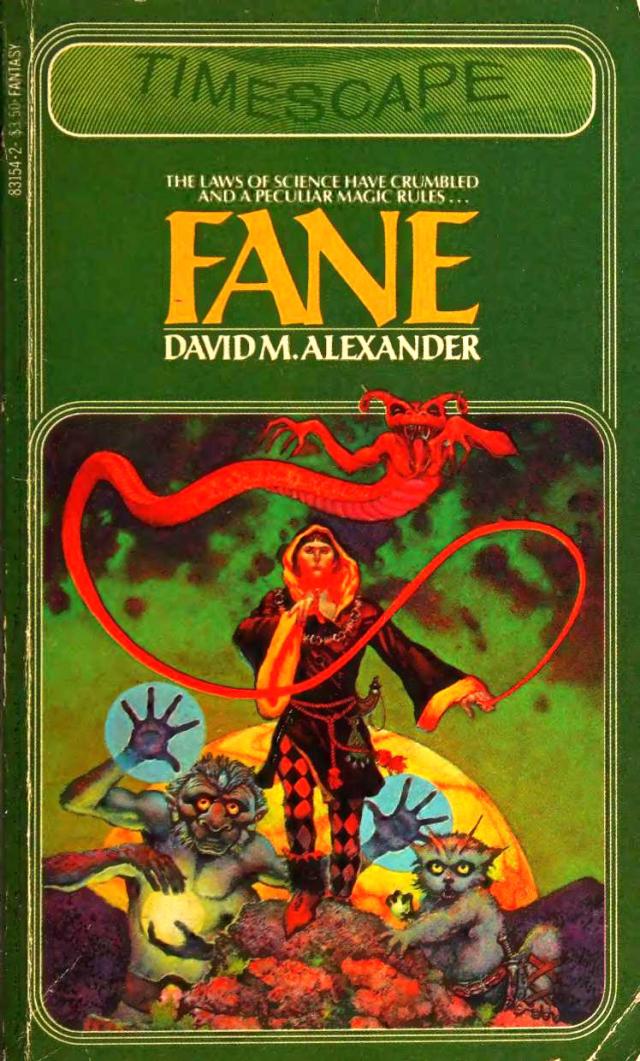
FANE
DAVID M. ALEXANDER
A TIMESCAPE BOOK
PUBLISHED BY POCKET BOOKS NEW YORK
This novel Is a work of fiction. Names, characters, places and incidents are either the product of the author’s imagination or are used fictitiously, and any resemblance to actual persons, living or dead, events or locales is entirely coincidental.
Another Original publication of TIMESCAPE BOOKS
A Timescape Book published by
POCKET BOOKS, a Simon & Schuster division of
GULF & WESTERN CORPORATION
1230 Avenue of the Americas, New York, N.Y. 10020
Copyright © 1981 by David M. Alexander
All rights reserved, including the right to reproduce this book or portions thereof in any form whatsoever.
For information address Timescape Books, 1230
Avenue of the Americas, New York, N.Y. 10020
ISBN: 0-671-83154-2
First Timescape Books printing August, 1981
10 9 8 7 6 5 4 3 2 1
POCKET and colophon are trademarks of Simon & Schuster.
Use of the TIMESCAPE trademark under exclusive license from trademark owner.
Printed in the U.S.A.
To Jack Vance, the writer whose prose and imagination I most admire
Racial /Political Groupings on the Planet Fane
Hartfords
(descendants of the human colony group led by Amis Hartford)
Greyhorn
Grantin
Gogols
(descendants of the escaped human criminals led by Gogol, a master necromancer of the Black Church on Abraham V)
Hazar and the other lords Mara (half-Hartford/half-Gogol)
Ajaj
(descendants of former crewmen of the colony ship Lillith, natives of the planet Ajagel; short, furred, pacific humanoids; servants of the Hartfords and the Gogols)
Castor
Fanists
(natives of the planet Fane; large, bipedal, four-armed hairless humanoids)
Chom
Contents
Chapter One
Chapter Two
Chapter Three
Chapter Four
Chapter Five
Chapter Six
Chapter Seven
Chapter Eight
Chapter Nine
Chapter Ten
Chapter Eleven
Chapter Twelve
Chapter Thirteen
Chapter Fourteen
Chapter Fifteen
Chapter Sixteen
Chapter Seventeen
Chapter Eighteen
Chapter Nineteen
Chapter Twenty
Chapter Twenty-one
Chapter Twenty-two
Chapter Twenty-three
Chapter Twenty-four
Chapter Twenty-five
Chapter Twenty-six
Chapter Twenty -seven
Chapter Twenty-eight
Chapter Twenty-nine
Chapter Thirty
Chapter Thirty-one
Chapter Thirty-two
Chapter Thirty-three
Chapter Thirty-four
Chapter Thirty-five
Chapter Thirty-six
Chapter Thirty-seven
Chapter Thirty-eight
Chapter Thirty-nine
Chapter Forty
Chapter Forty-one
Chapter Forty-two
Chapter Forty-three
Chapter Forty-four
Chapter Forty-five
Chapter Forty-six
Chapter Forty-Seven
Chapter Forty-eight
Chapter Forty-nine
Chapter Fifty
Chapter Fifty-one
Chapter One
Man had crossed the void, spread out, split up, and dispersed like water through a grate. Perhaps somewhere commerce still flourished and spaceships went forth serving an organized community of man, but not here. -On the far spiral arm at the eastern edge of the galaxy only suns swung through the void. No ships sailed the star lanes, and what men there were had almost forgotten life beyond their narrow realms.
Out in the mist of the Great Dog Nebula the nearest stars were occluded by dust and debris. Almost alone in the center of the interstellar storm rode the great orange sun Pyra. Around it floated a single planet, Fane.
Fane’s night sky was a gray, faintly glowing blanket pierced here and there by the pinpricks which were all that could be seen of the far glories in the heavens.
For unknown reasons, perhaps the interaction of the storm with Fane’s peculiar modulating magnetic field, the relationship here of man and matter was changed. Mechanized society rapidly broke down—machines disintegrated and power packs ran dry. Magic, sorcery, and spells built a new technology to fill the void. A skilled wizard could become a wealthy and powerful man. Greyhorn was such a wizard.
Greyhorn paused a moment and cocked his head. What was that? A noise in the hall? He sensitized his mind but felt no unauthorized presence. Then, at the edge of his awareness, he sensed his nephew Grantin, down the hall near the library. At least that wastrel was performing his lessons for a change. Greyhorn shrugged and turned back to the bulging plate of glass balanced on the desk in front of him.
The object was neither clear nor frosty, but at the same time both watercolored and confused. It seemed filled with a thick, clear, swirling oil which, while having no color of its own, distorted and puddled the image of anything that might lie behind its surface. The plate was a foot in diameter and five inches thick at the center, tapering to a half inch at the edge. The front was flattened, while the surface away from Greyhorn bulged asymmetrically.
Under the sorcerer’s gaze flecks of color sparkled and congealed in the center of the plate. To Greyhorn’s eyes, a three-dimensional simulacrum of a man’s head and shoulders occupied the center of the disk. In an instant the picture became sharp, though if Grantin had stood at his uncle’s elbow he would have seen only a formless swirl. In reality the scene was not in the plate but in Greyhorn’s mind, the device functioning only as a focusing mechanism for the thoughts of the men who used it. Hundreds of leagues away in a similar room the man whose image filled Greyhorn’s lens stared into a companion device in which he thought he saw Greyhorn’s image.
The forces of the lens—or, better, the forces of the planet Fane which were controlled and focused through the lens—concentrated and intensified the principal qualities of each man’s visage. A face long and narrow with sunken cheeks and a bulging, puffy structure under the* eyes stared out at Greyhorn. The skin was of a sallow, glistening copper hue and was adorned above the mouth with a coal-black, downturned mustache. Bushy black oily brows lay above the eyes. The hair was also black and gleaming and full. It rose in fluffy crests from the center of the forehead and at each temple. The pupils, as well, were black, while the whites seemed to glow with a sickly yellow tone. From the man’s neck hung a crude copper necklace centered with a smooth red stone. On his left hand glowed a golden ring likewise bearing at its center another bloody, polished jewel.
In his associate’s face Greyhorn detected lust, greed, power, envy, cunning, malice, and, above all else, unbridled ambition: a lovely man, a perfect man, the ideal man for Greyhorn’s needs.
“Your deacons and underdeacons are dedicated to our purpose and ready to act?” mouthed the face in Greyhorn’s lens.
“No worry as to that, Hazar. I have picked carefully and well. They will follow my every order.”
“When will they be fully trained in the spells I have revealed to you?”
“Soon, very soon. Another few days at most. No more than that. They are strong and determined. The weak have already died. Now remains only the job of directing the power with subtlety and fine control. Those who were soft have long since been consumed by their inability to direct Fane’s mighty energies. Have no fear; all will be ready. We can move as soon as I receive my ring.”
“Ah, yes, the ring. That may prove a bit of a problem. Full control of the stones has not yet been placed at my disposal. My associates are jealous of their powers and they know me to be a man of action. In order to avoid delaying the plan, we may have to move before your ring is available.”
“Not at all!” Greyhorn answered with cold finality. “My cooperation and that of my deacons, underdeacons, associates, informers, coconspirators, powers, energie
s, and spells are all contingent upon the tendering to me of the bloodstone, without which our association is at an end.”
“My dear Greyhorn,” Hazar responded with an oily smile, “if I did not know you better I would think that you failed to trust me. Surely you realize I cannot rule Fane alone. From the instant that we take power you shall have dominion until your dying day over every person within a hundred leagues of your manor house.”
“That I will, Hazar, with or without our association, and I shall also have the ring. And, by the way, before you think upon our arrangement with the mind of a shyster, I will remind you that my dying day is a long time hence. Now, with these minor details out of the way, when and how will I receive the ring?”
An insincere smile split Hazar’s lips. He nodded his head in an expression of acquiescence.
“I will send a courier to Alicon, someone special, someone who will not look as though she comes from me.”
“She? What will she look like? How will I recognize her?”
“You should not meet her yourself. These things go better with a bit more mystery. There is no need for her to know for whom the bloodstone is intended. And”—Hazar paused meaningfully—“there is no need for you to learn the identity of my operatives. Send a trusted associate to Alicon. Have him wear your amulet. She will recognize him by it and make the exchange. She will comment on the stone, and your courier will say that his father once had a ring with a gem of that type. She will offer to sell him the bloodstone for five coppers, which he will pay her upon delivery of the ring.”
“When should I expect the messenger?”
“Perhaps tomorrow afternoon. If not then, the next day certainly.”
“Agreed,” Greyhorn answered.
Hazar’s visage nodded solemnly, then faded; the lens cleared. …
Greyhorn’s left hand involuntarily twitched in the direction of the plate. It was only through the exercise of conscious effort that the sorcerer restrained himself from hurling a spell at Hazar’s vanished form. You will have power until the day you die. If Hazar had anything to do with it that day would be soon indeed. Greyhorn was not fooled. If he did not conceive a plan to eliminate the Gogol sorcerer his life would be in constant danger. No, it would soon come down to one or the other of them—but first to get the bloodstone! Whom to send to Alicon to pick it up? Werner? No; Werner’s eyes were too close together, his face too feral, his soul too thin. Maurita? No; Maurita had her advantages, but the bloodstone might tempt her to break her solemn oaths. Greyhorn considered each of his deacons and subdeacons. He concluded that none of them was sufficiently trustworthy. Well, one does not expect to find selfless loyalty in the hearts of those who are willing to sell their fellows into slavery.
Was Grantin up to the chore? Perhaps his worthless nephew would at last be good for something. Up to now the wastrel had only shown an aptitude for womanizing, sleeping, and creating debts. Grantin, son of a sorcerer, nephew of a master sorcerer, grandson of an expert sorcerer—and still he possessed the talents of a field hand. Everyone said the power was in the blood, yet Grantin seemed determined to prove the theory wrong. Well, no matter; perhaps he would at last make himself useful. Certainly he could successfully reach a village only two leagues distant, pick up a bauble, and return it to the manor in reasonably good condition. He knew little enough about magic to understand the power of the ring.
Greyhorn again cocked his head and let his senses roam the hallways of the second floor. Yes, remarkable though it seemed, Grantin was still in the library apparently hard at work. Greyhorn decided to look in on him. Perhaps later in the day he would charge Grantin with the errand. He slipped from his workroom, sealed the door behind him, and padded to the library where Grantin studied the forbidden history.
Chapter Two
Grantin pulled back the cover and began to read the first page of the Ajaj’s journal. The ink was of a brownish umber tone. The edges of each letter puddled and ran, as though the fluid were unusually thin. When Gran tin concentrated on some of the broader lines he was able to detect in the strokes a shading of pale chocolate at the center of the lines darkening to a deep brown-black hue at their edges.
The paper was an aged, mottled tan which popped and crackled as he turned the pages. Nevertheless, the script was precise and demonstrated a fine expressive flair. The Ajaj who had penned the book was a master scribbler indeed.
Grantin tinned another rattling page, then halted to listen for sounds from the corridor beyond. He remembered the last time his uncle had caught him trying to read the book.
“Here you are,” Greyhorn had screamed, “the nephew of a master wizard, and you can’t even pluck a flower out of the ground without bending over to pick it up. Now, instead of studying your spells, I catch you wasting your * time with this nonsense. You’re deficient, and every day you become a worse embarrassment for me. Remember, this is not some sparkling dream planet. This is Fane, and I, as master wizard of this locality, have a reputation to uphold.”
Now, Grantin held his breath. The house was quiet enough to let him hear the beating of his own heart. He exhaled. With another crackle he turned the next page and continued his study of the history of Fane.
The Lillith was of acceptable construction and of the type often seen on our sad world Ajagel. Great blocks of metal and glass were fused as needed. From the outside the starship appeared as a tumble of interlaced blocks, cubes, and rectangles joined haphazardly at sides, top, or bottom. In some ways she resembled the old, broken city of Alnarth built by our ancestors in the days of water before our sun grew red. Now we, the faithful Ajaj, are drawn from Ajagel like blood leaking from a wound.
Time period by time period the gray, twisted space slipped behind us. One after another the planets we investigated were rejected by the colonists who had chartered the Lillith.
One planet, 4-Clarion 4312, was passed because its gravity was twice what the humans were used to bearing. They did not wish to carry too heavy a load. Another, 2-Marissa 1847, had a trace too much chlorine in the atmosphere. Our passengers claimed that this would irritate their noses. It, too, was rejected.
Captain Marvin had made an unfortunate charter arrangement. In an expansive moment he had agreed to take the colonists out along the great spiral arm, eastward to the very edge of the galaxy, until such time as they found a suitable planet Here he had erred. Often we of the Ajaj, as well as the human members of the crew, disputed what might have happened had the contract contained the word “habitable” instead of “suitable.”
The voyage continued farther and farther until, at last, we approached the Great Dog Nebula where the near stars were occluded by dust and debris. Beyond was only interstellar fog and then the vast empty void.
Each time period that the Lillith pressed on increased our captain’s unhappiness. Farther and farther he departed from his course for our next stop at New Ossening. Truly he was cursed that trip. He had also agreed to transport criminals to that bleak world, so much was Captain Marvin in need of riches.
In the center of the mist of the Great Dog Nebula, almost alone in the heart of the interstellar storm, rode the gigantic orange sun Pyra and its single planet: Fane.
Captain Marvin drove the Lillith toward this world. As senior apprentice empather, I was summoned to my dials and nodes to test the flavor of the orb. The long-range scanners reported it not only habitable for human life but lush and fertile. Still, I tasted a strangeness about the world. This I reported to the captain, but it was news he did not wish to hear.