Fuzzies and other people, p.14
Fuzzies and Other People,
p.14
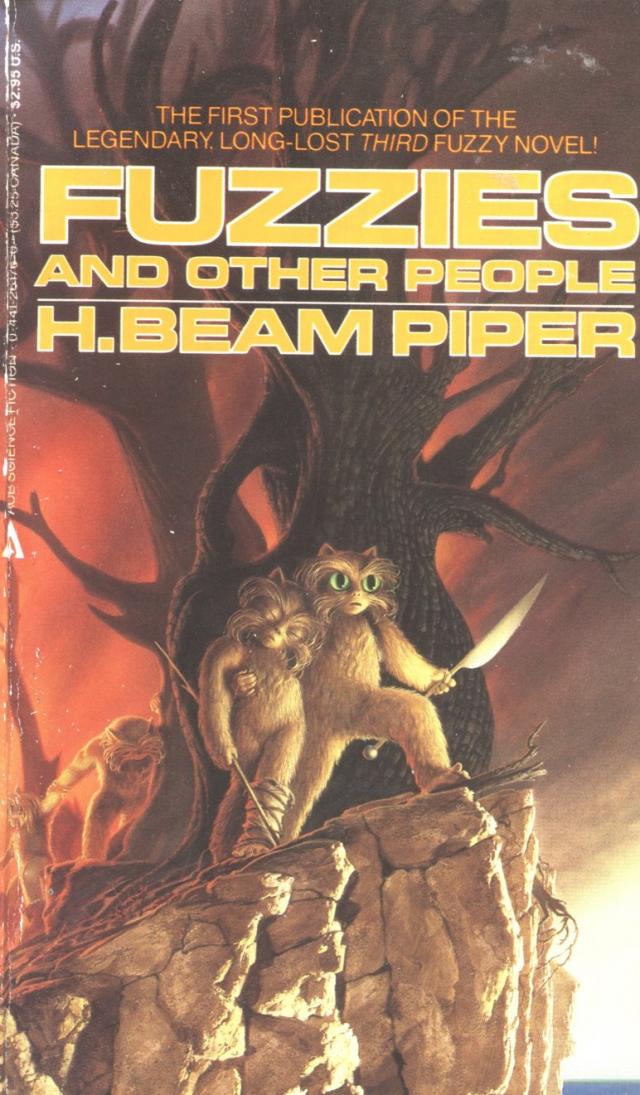


Then he stopped short and said a number of the Big Ones’ angry-words, but even that didn’t make him feel better. In front of him the ground dropped off in a cliff, as high as one of the big metal houses at Wonderful Place. Beyond he could see flat ground full of trees and bushes and tangled vines, with water everywhere. There was a small stream at the foot of the cliff, and it spread out all over everything. This was a bad sunnabish not-go-through place; he would have to go up the little stream to get around it. How far up the river it went he had no idea. He looked at his compass again, saw that the small stream went almost due north, and started up along it.
The sun was out brightly now, and there were many big blue places in the sky and the clouds were white instead of gray. He walked steadily, looking about for things to eat and looking at his compass. Finally he came to where the stream ran over stones, and the water-everywhere place had stopped.
He crossed over and went west, looking often at his compass and remembering which way the big river was. He heard noises ahead, and stopped to listen, then was very happy because it was the noise of goofers chewing at tree-bark. He went forward carefully and came upon five of them, all chewing at trees. He picked out the plumpest of them, drew back his arm, and threw his spear; it was not a very good throw because it caught the goofer through the belly, just back of the hips, from one side to the other. As he ran forward to finish it, another, frightened, ran straight at him. He hit it between the eyes with the axe; it died at once. He hadn’t meant to kill two goofers, but a frightened goofer would attack a person. Then he finished the one he had wounded with his spear and pulled the spear out. The other goofers had all run away.
He gutted both of them, took out the livers and hearts and kidneys, and spitted them on sticks he cut with his knife. Then he built a fire. When he had a good bed of red coals he propped the sticks against stones and weighed them with other stones and sat down to watch that the meat didn’t burn. It was very good.
He cut off the head of one goofer and made a pack of the carcass, as he had the one he had killed the day before. The other he skinned and cut up and wrapped the hind legs and the back-meat in the skin and tied that to the whole one. This was going to be a heavy load, but he thought he could manage it. He started off again. He didn’t bother looking for good-to-eat things anymore; he had already eaten, and he had a whole goofer and the best meat of another. Even if he had seen a land-prawn, he wouldn’t have bothered with it. He turned south; now he had the sun, and didn’t need to bother getting out his compass.
Then, in front of him, he saw a splash of blood, and then places where the dead leaves were scuffed and more blood, and goofer-hairs With it. Somebody had been going in the direction of the river, dragging a dead goofer. That meant that there was a band of People about who had split up to hunt and would meet again somewhere. People hunting in a band would never drag a dead goofer; they would eat it where they had killed it. He went forward along the drag-trail, and then stopped.
“Heyo!” he shouted, as loudly as he could, then remembered that that was a Big One word, and these People had never seen a Big One. He had also been putting his voice in the back of his mouth, to make talk like a Big One. “Friend!” he shouted naturally, as he always had before he had been taught. “You want make talk?”
There was no answer; they were too far ahead to hear. He hurried forward, following the trail as fast as he could. After a while, he shouted again; this time there was an answering shout. He could see the big river through the trees ahead, and then he saw three People beside it. He hurried to them.
They were two males and a female. They all had wooden weapons, not the paddle-shaped prawn-killers the People in the south carried, but heavy clubs knobbed on one end and pointed on the other. One of the females also carried three small sticks in her hand. On the ground was a dead goofer, the hair and skin rubbed off the back where it had been dragged.
“Friend,” he greeted them. “You make friends, make talk?”
“Yes, make friends,” one of the males said, and the other asked, “Where from you come? Others with you?”
He swung the load from his shoulders, the whole goofer and the meat of the other, beside the goofer they had, to show that he would share and eat with them, and untied the strings and put them in his shoulder bag. The others looked at these things and at his weapons intently, but said nothing about them, waiting for him to show and explain about them. The female said, “You carry all that? You strong.”
“Not strong; just know how,” he replied. “Alone. Come from far-far place, sun’s left hand. Four dark-times, fall in big river.” Then he remembered that river was not a Fuzzy word. “Big-big moving-water,” he explained. “Catch hold of tree floating in moving-water, hold onto. Moving-water take me far to sun’s right hand before I can get out. Walk back to place where can cross. What place you come from?”
One of the males pointed northward. “Come many-many days,” he said. “Band all come together.” He held up a hand with five fingers spread, then lowered and raised it with three fingers extended. Eight of them. “Others hunt, some this way, some that way. Come back here, all eat together.”
“We call him Wise One,” the female said, pointing to the one who had spoken. “He called Fruitfinder,” she introduced the other male. “Me Carries-Bright-Things.” She held out the three sticks. “Look, bright-things. Pretty.”
On the end of each stick was a thing he knew. They were the things that flew out when Big Ones shot with rifles. Empty cartridges. One was the kind for the rifles the blue-clothes police Big Ones had; Pappy Gerd had a rifle like that too. The other two cartridges were from a rifle like one of Pappy Jack’s.
“Where you get?” he demanded, excited. “Are Big One things. Big Ones use in long thing, point with both hands. Pull little thing underneath, make noise like thunder. Throw little hard thing very fast; make dead hesh-nazza. You know where Big Ones are?”
“You know about Big Ones?” Wise One was asking just as excitedly. “You know where Big One Place is?” “I come from Big One Place,” he told them. “Hoksu-Mitto, Wonderful Place. 1 live with Big Ones, all Big Ones my friends.” He began naming them over, starting with Pappy Jack. “Many Fuzzies live with Big Ones, can’t say name for how many. Big Ones good to all Fuzzies, give nice things. Give shoddabag, like this.” He displayed it. “Give knife, give trowel for dig hole bury bad smells. Teach things.” He showed the axe and spear. “Big Ones teach how to make. I make, after get out of big moving-water. And Big Ones give Hoksu-Fusso, Wonderful Food.”
There was shouting from up the river. The male Fuzzy who was called Fruitfinder, examining the axe, said, “Stabber, Big She come.” Wise One began shouting, “Make hurry fast! Wonderful thing happen!”
Two more Fuzzies came out of the woods, dragging another dead goofer between them—a female with a club like the others’ and a male with a sort of spear-stick. Carries-Bright-Things and Fruitfinder ran to help them, jabbering in excitement.
“Is somebody from Big One Place,” Carries-Bright-Things was saying. “Is Big Ones’ Friend. Knows what bright-things are.”
The male with the spear-stick immediately began shouting at the female with him, “You see? Big Ones good, make friends. Here is one who knows. Wise One right all time.”
“You show us way to Big One Place?” Wise One was asking. “Big Ones make friends with us?”
“Big Ones friends for all Fuzzies,” he said, and then remembered that that was another Big One word. There were so many Big One words these Fuzzies did not know. “Fuzzy what Big Ones call all People like us. Means Fur-All-Over. Big Ones not have fur, only on head, sometimes on face.” He decided not to try to explain about clothes; not enough words. “Big Ones very wise, have all kinds of made-things. Big Ones very good to all Fuzzies.”
Three more came in. They had two zarabunnies and two land-prawns. Everybody was excited about that, and cried, “Look, two zatku!” Land-prawns must be very few in this place. It took a long time to tell these new ones, and the others, about the Big Ones and about Wonderful Place. He showed all the things he had in the shoulder bag, and the spear and axe he had made. Stabber seemed to think the spear was especially wonderful, and they all thought the shoulder bag itself was the most wonderful thing he had—“Carry many things; not have to hold in hand; not lose,”—but there were so many wonderful things to look at that none of them could think of any one thing long. He had been like that when he had first come to Wonderful Place, when Wonderful Place had been little and nobody but Pappy Jack had been there.
There was arguing among them, and he listened and thought he understood how things had been in this band. Wise One and Stabber had wanted to find the Big One Place and make friends with the Big Ones, and Big She and Fruitfinder and Stonebreaker had been afraid. Now everybody was siding with Wise One and mocking Big She, and even she was convinced that Wise One had been right, but didn’t want to admit it. Finally, they all squatted in a ring, passing all his things around to look at, and he told them about the Big Ones and Wonderful Place.
What he wanted to know was how these people had found out about the Big Ones in the first place. It was hard to find this out. Everybody was trying to talk at once and not telling about things as they had happened. Finally Wise One told him, while the others kept quiet, at least most of the time, about the thunder-death that had killed the three gotza, and finding the tracks and where the aircar had been set down, and the empty cartridges. That had been Pappy Jack and Pappy Gerd; they had been to the north on a trip, and everybody at Wonderful Place had heard about the shooting of the three harpies. And they told about the flying thing, the aircar. That would have been Pappy Vic’s friends or some of Pappy George’s blue-clothes police people.
All the time, the sun was getting lower and lower toward its sleeping-place; soon it would be making colors. Finally, about Big Ones’ koktel-drinko time, everybody realized that they were hungry. They began talking about eating, and there was argument about whether to eat the land-prawns first or save them for last.
“Eat zatku first,” Stabber advised. “Hungry now, taste good. Save for last, not hungry, not taste so good.”
Wise One approved that, and Big She agreed. Wise One cracked the shells and divided the meat among everybody. That showed how scarce land-prawns were here. In the south, nobody did that. Everybody killed and ate land-prawns for himself; there were enough for everybody. He told them so, and they were all amazed, and Stabber was shouting. “Now you see! Wise One right all the time. Good Country to sun’s left hand, plenty everything!” Even Big She agreed; there was no more argument about anything now.
After they had eaten the zatku—he must remember to use only Fuzzy words, till he could teach the Big One words—they were ready to eat the hatta-zosa and the ho-todda. When they saw how he skinned and butchered with his knife, they wanted him to prepare all of them; all they had was one little stone knife.
“Not eat right away,” he told them. “Cook first.”
Then he had to explain about that, and everybody was frightened, even Wise One. They knew about fire; lightning sometimes made it, and it was a bad thing. He remembered how frightened he had been when he had first seen it in Pappy Jack’s viewscreen. He decided, with all the meat they had, to make barba-koo. They watched him dig the trench with his trowel and helped him get sticks to put the hatta-zosa on and gather wood for the fire, but when he went to light it they all stood back, ready to run like Big Ones watching somebody making ready for blast.
But when the barba-koo was started, they came closer, all exclaiming at the good smells, and when the meat was done and cool enough to eat, everybody was crying out at how good it was. Little Fuzzy remembered the first cooked meat he had eaten.
By this time the sun was making colors in the west, and everybody said it was good that the rain was over. They all wanted to go find a sleeping-place, but he told them that this would be a good enough place to sleep, since the rain was over and if they kept a fire burning all the big animals would be afraid. They believed that; they were still afraid themselves.
He got out his pipe and filled and lighted it, and after a few puffs he passed it around. Some of them liked it, and some refused to take a second puff. Wise One liked it, and so did Lame One and Other She and Carries-Bright-Things, but Stabber and Stonebreaker didn’t. They built the fire up and sat for a long time talking.
He needed this band. With eight beside himself, they could build a big raft, and with eight and himself to hunt they would not be hungry. He had to be careful, though. He remembered how hard it had been to talk the others into going to Wonderful Place after he had found it and come back to get them to come with him. They would make him leader instead of Wise One, but he didn’t want that. When a new one came into a band and tried to lead it, there was always trouble. Finally he decided what to do.
He took the whistle out of his bag and tied a string to it long enough to go around the neck, and made sure that it was tied so that it would not come loose. Then he rose and went to Wise One.
“You lead this band?” he asked.
“Yes. But if you can take us to Big One Place, you lead.”
“No. Not want. You lead. I just show how to go. Others know you, not know me.” He took the whistle —Wise One had learned how to blow it by now—and hung it around his neck. “I give; you keep,” he said. “You leader; when band riot together, want to call others, you blow. When somebody lost, you blow.”
Wise One blew piercingly on the whistle. A Big One would have said, “Sank-oo,” for a gift like this. Fuzzies did not say such things; everybody was good to everybody.
“You hear?” he asked. “When I make noise like this, you come. That way, nobody get lost.” He thought for a moment. “I lead band, but Big Ones’ Friend know better than Wise One; he very wise Wise One. Wise One listen when he say something. All listen when Big Ones’ Friend say anything, do as Big Ones’ Friend say. That way, we all come to Big One Place, to Hoksu-Mitto.”
xix.
Gerd van Riebeek dropped his cigarette butt and heeled it out. A hundred yards in front of him a blue and white Extee Three carton stood pin-cushioned with arrows and leaking sand. There were almost as many arrows sticking in the turf around it, most of them very close. The hundred-odd Fuzzies were enthusiastic about it. “Not good,” he told them. “Half not hit at all.” “Come close,” one of the Fuzzies protested.
“You hungry, come close not give meat. You not put come-close on stick, put over fire, cook.”
The Fuzzies all laughed; this was a perfectly devastating sally of wit. A bird, about the size of a Terran pigeon, flew across the range halfway to the target. Two arrows hit it at once and it dropped.
“Now that,” he said, “was good! Who did?”
Two of them spoke up; one was his and Ruth’s Superego, and the other was an up-to-now nameless Fuzzy who had come in several weeks ago. Robin Hood would do for him. Then he looked again. No. Maid Marian.
That was with half his mind. The other half was worrying about Jack Holloway. Jack seemed to have stopped giving a damn after he came back from Yellow-sand. If it only hadn’t been Little Fuzzy. Any of the others, even one of his own family, he’d just have written off, felt badly about, and gotten over. But Little Fuzzy was something special. He was the first one, and besides that, he had something none of the others had, the something that had brought him into Holloway’s Camp alone to make friends with the strange Big One. Ruth and Pancho and Ernst Mallin hadn’t gotten a dependable IQ-test for Fuzzies developed yet, but they all claimed that Little Fuzzy was a genius. And he was Pappy Jack’s favorite.
And now Jack was drinking, too. Not just a couple before dinner and one or two in the evening. By God, he was drinking as much as Gus Brannhard, and nobody but Gus Brannhard could do that and get away with it. Gerd wished he’d gone along with Jack to Mallorysport, but George Lunt hadn’t been away from here since right after the Fuzzy Trial, and he was entitled to a trip to town; and somebody had to stay and mind the store, so he’d stayed.
Oh, hell, if Jack needed looking after, George could look after him.
“Pappy Gerd! Pappy Gerd!” somebody was calling. He turned to see Jack’s Ko-Ko coming on a run. “Is talk-screen! Mummy Woof say somebody in Big House Place want to make talk.”
“Hokay, I come.” He turned to the Protection Force trooper who was helping him. “Let them go get their arrows. If that carton doesn’t fall apart when they pull them out, let them shoot another course.” Then he started up the slope toward the lab-hut, ahead of Ko-Ko.
It was Juan Jimenez, at Company Science Center. He gave a breath of relief; Jack hadn’t gotten potted and gotten into trouble.
“Hello, Gerd. Nothing more about Little Fuzzy?” he asked.
“No. I don’t think there is anything more. Jack’s in town; did you see him?”
“Yes, at the grand opening of the Fuzzy Club yesterday. Ben and Gus want him to stay over till the convention opens. Gerd, you were asking me about ecological side effects of harpy extermination and wanted me to let you know if anything turned up.”
“Yes. Has anything?”
“I think so. Forests & Waters has been after me lately. You know how all those people are; they get little, manageable problems, and never bother consulting anybody, and then when they get big and unmanageable they want me to work miracles. You know where the Squiggle is?”
He did. It was along the inside of the mountain range on the lower western coast. It wasn’t really a badland, but it would do as a reasonable facsimile. Volcanic, geologically recent; a lot of weathered-down lavabeds covered with thin soil; about a thousand little streams twisting every which way and all flowing finally into the main Snake River from the west. Flooded bank-high in rainy season and almost dry in summer, doing little or nothing for the water situation on the cattle ranges at any season. For the last ten years, since the Company had been reforesting it, it had gotten a little better.