The frozen planet and ot.., p.19
The Frozen Planet and Other Stories (v1.0),
p.19


I just don’t give a damn. You cannot allow pressure groups to form your policy.”
“You are talking now, of course,” said Garside, “about the Ravenholt affair.”
“Chris,” said Snell, enthusiastically, “you hit it on the button. Here is a chance to really sell the public on us. I don’t believe we’ve really sold them. We are dealing in something which to the average man seems to smell of magic. Naturally he is stand-offish.”
“More to the point,” said Hawkes, impatiently, “if we turn down this project—this …”
“Project God,” said Spencer.
“I’m not sure I like your phrasing.” i
“Think up a name yourself,” said Spencer calmly. “That is what we call it.” ^ .
“If we fail to go ahead with it, we’ll be accused of being atheists.” f;j
“How would the public ever know that we turned it down?” asked Spencer.
“You can be sure,” Snell said bitterly, “that Ravenholt will make a point of making known our turning down of it.”
Spencer smashed his fist upon the desk in sudden anger. He yelled, “I told you how to handle Ravenholt!”
“Hal,” Garside told him quietly, “we simply cannot do it.
We have our dignity.”
“No,” said Spencer, “I suppose you can’t. But you can sell out to Ravenholt and whoever’s backing him. You can rig the survey of religious origins. You can falsify reports.”
The three of them sat in stricken silence. Spencer felt a twinge of momentary wonder for having dared to say it.
It was not the way one was supposed to talk to brass.
But he had to say one more thing. “Chris. You are going to disregard the report I made and go ahead with it, aren’t you?”
Garside answered with smooth urbanity: “I’m afraid I’ll have to.”
Spencer looked at Hawkes and Snell and he saw the secret smiles that lurked just behind their lips—the sneering contemptuous smile of authority ascendant.
He said slowly, “Yes, I guess you will. Well, it’s all in your laps now. You figure out the answers.”
“But it’s your department.”
“Not any more, it isn’t. I’ve just quit the job.”
“Now see here, Hal,” Garside was saying, “you can’t do a thing like that! Without any notice! Just flying off the handle! We may have our little differences, but that is no excuse…”
“I’ve decided,” Spencer told him, “that I somehow have to stop you. I cannot allow you to go ahead with Project God. I warn you, if you do, that I shall discredit you. I shall prove exactly and without question everything you’ve done. And meanwhile, I am planning to go into business for myself.”
‘Time travel, perhaps.”
They were mocking him.
“I had thought of it.”
Snell grinned contemptuously. “You can’t even get a license.”
“I think I can,” said Spencer.
And he knew he could. With a brand new concept, there’d belittle trouble.
Garside got up from his chair. “Well,” he said to Spencer, “you’ve had your little tantrum. When you cool down a bit, come up and talk to me.”
Spencer shook his head.
“Good-bye, Chris,” he said.
He did not rise. He sat and watched them go.
Strangely, now that it was over—or just beginning— there was no tenseness in him. It had fallen all away and he felt abiding calm.
There was money to be raised, there were technicians and engineers to hire, there were travelers to be found and trained, and a whole lot more than that.
Thinking of it all, he had a momentary pang of doubt, but he shrugged it off. He got up from his chair and walked out into the office.
“Miss Crane,” he said, “Mr. Cabell was supposed to come back this afternoon.”
“I haven’t seen him, sir.”
“Of course not,” Spencer said.
For suddenly it all seemed to be coming clear, if he only could believe it.
There had been a look in young Cabell’s eyes that had been
most disturbing. And now, all at once, he knew that look for exactly what it was.
It had been adulation!
The kind of look that was reserved for someone who had become a legend.
And he must be wrong, Spencer told himself, for he was not a legend—at least not at the moment.
There had been something else in young Cabell’s eyes. And once again he knew. Cabell had been a young man, but the eyes had been old eyes. They were eyes that had seen much more of life than a man of thirty had any right to see.
“What shall I say,” asked Miss Crane, “if he should come back?”
“Never mind,” said Spencer. “I am sure he won’t.”
For Cabell’s job was done, if it had been a job at all. It might have been, he told himself, a violation of the ethics, a pure piece of meddling, or it might have been a yielding to that temptation to play God.
Or, he thought, it might have been all planned.
Had they somewhere in the future worked out that formula he’d spoken of to Cabell—the formula that would allow legitimate manipulation of the past?
“Miss Crane,” he said, “would you be kind enough to type up a resignation for me? Effective immediately. Make it very formal. I am sore at Garside.”
Miss Crane did not bat an eyelash. She ran paper into her machine.
“Mr. Spencer, what reason shall I give?”
“You might say I’m going into business for myself.”
Had there been another time, he wondered, when it hadn’t gone this way? Had there been a time when Hudson had gotten in to see him and maybe had not died at all? Had there been a time when he’d handed over the Hudson concept to Past, Inc., instead of stealing it himself?
And if Cabell had not been here to take up the time, more than likely he would have gotten around to seeing Hudson before it was too late. And if he had seen the man, then it was more than likely that he would have passed the concept on through proper channels.
But even so, he wondered, how could they be sure (whoever they might be) that he’d not see Hudson first? He recalled distinctly that Miss Crane had urged that he see him first.
And that was it, he thought excitedly. That was exactly it! He might very well have seen Hudson first if Miss Crane had not been insistent that he should.
And standing there, he thought of all the years that Miss Crane must have worked at it—conditioning him to the point where he’d be sure to do exactly opposite to what she urged he do.
“Mr. Spencer,” said Miss Crane, “I have the letter finished. And there is something else. I almost forgot about it.”
She reached down into a drawer and took out something and laid it on the desk.
It was the portfolio that belonged to Hudson.
“The police,” said Miss Crane, “apparently overlooked it. It was very careless of them. I thought that you might like it.”
Spencer stood staring blankly at it. ’
“It would go so nicely,” said Miss Crane, “with the other stuff you have.”
There was a muted thumping on the floor and Spencer spun around. A white rabbit with long and droopy ears hopped across the carpet, looking for a carrot.
“Oh, how cute!” cried Miss Crane, very much unlike herself. “Is it the one that Mr. Nickerson sent back?”
“It’s the one,” said Spencer. “I had forgotten it.”
“Might I have it?”
“Miss Crane. I wonder…”
“Yes, Mr. Spencer?”
And what was he to say?
Could he blurt out that now he knew she was one of them?
It would take so much explanation and it could be so involved. And, besides, Miss Crane was not the sort of person that you blurted out things to.
He gulped. “I was wondering, Miss Crane, if you’d come and work for me. I’ll need a secretary.”
Miss Crane shook her head. “No, I’m getting old. I’m. thinking of retiring. I think, now that you are leaving, I shall just disappear.”
“But, Miss Crane, I’ll need you desperately.”
“One of these days soon,” said Miss Crane, “when you need a secretary, there’ll be an applicant. She’ll wear a bright green dress and she’ll be wearing these new glasses and be carrying a snow-white rabbit with a bow around its neck.
She may strike you as something of a hussy, but you hire her. Be sure you hire her.”
“I’ll remember,” Spencer said. “I’ll be looking for her. I’ll hire no one else.”
“She will not,” warned Miss Crane, “be a bit like me. She’ll be much nicer.”
“Thank you, Miss Crane,” said Spencer, just a bit inanely. “And don’t forget this,” said Miss Crane, holding out the portfolio.
He took it and headed for the door.
At the door he stopped and turned back to her.
“I’ll be seeing you,” he said.
For the first time in fifteen years, Miss Crane smiled at him.
THE END
THE MACHINE DECIDED
WHO WOULD LIVE
AND WHO WOULD DIE.
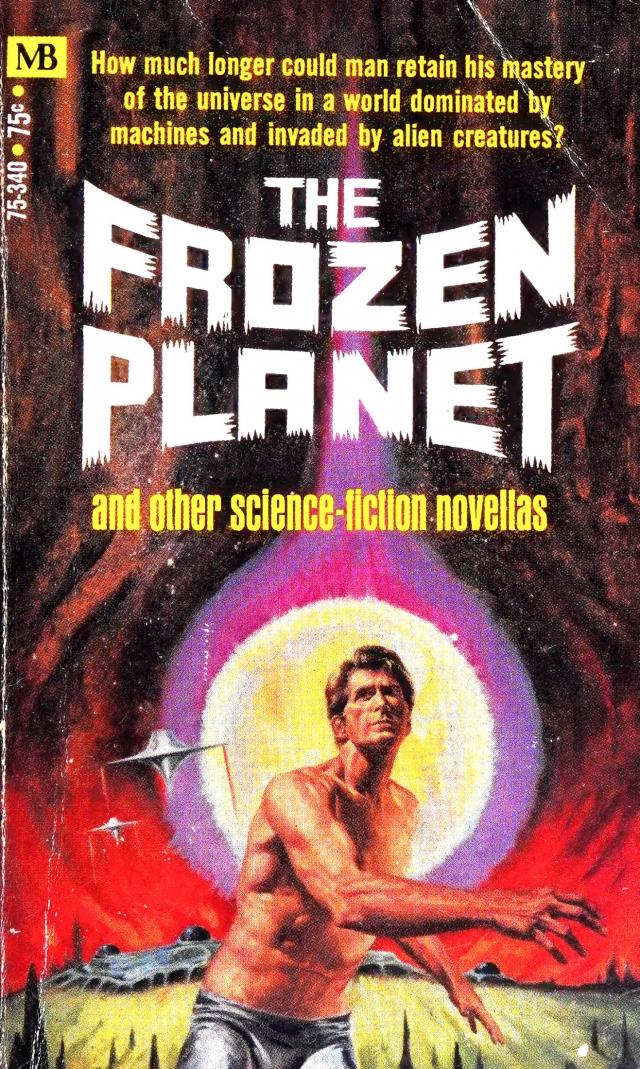
It provided food from mechanized plants. It enabled people to travel to distant planets, or to go backward and forward in time. The only thing in the universe it had not yet changed was man.
Here is a world in which new problems and new dangers have replaced the familiar ones-but man continues his age-old battle to retain mastery over the machines he has created.
A MACFADDEN-BARTELL BOOK
PRINTED IN U.S.A.
Cover Pointing! Jack Faragasso
Unknown Author, The Frozen Planet and Other Stories (v1.0)