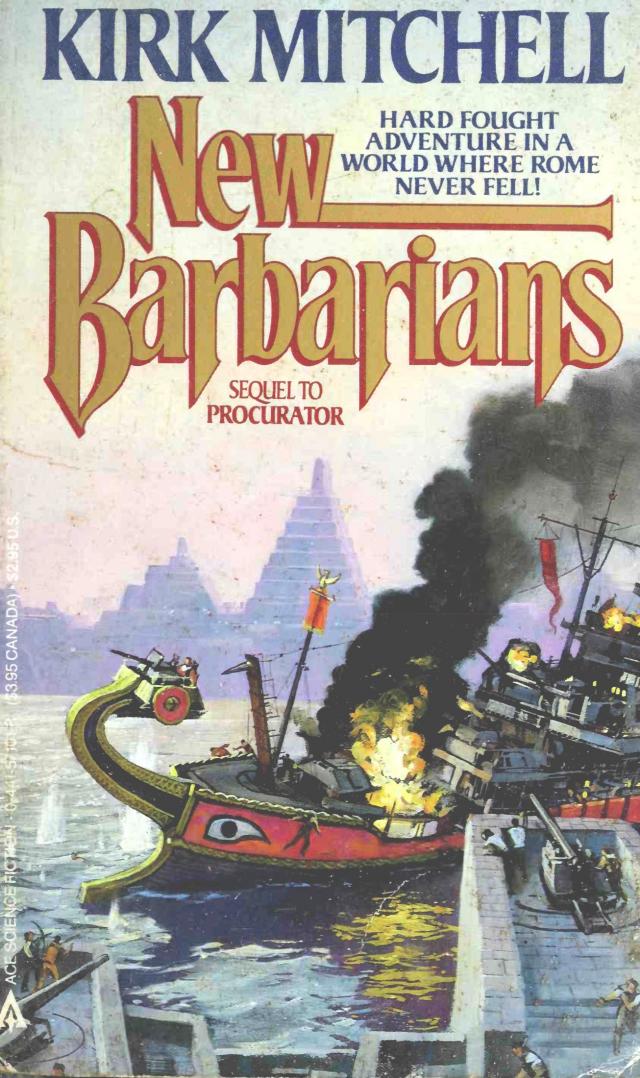
New barbarians 1986 by k.., p.23
New Barbarians (1986) by Kirk Mitchell,
p.23


He was on the verge of summoning Belgius to draft a missive to Maxtla proposing a truce when Alope’s face flashed through the light and shadow of his mind as it had with arresting beauty that afternoon on the holy mountain of the In-dee.
He had been wrong before—and now prayed that his deepest, most incisive instincts were deceiving him. He could not stand the thought of such appalling desperation in someone who had lain so tenderly in his arms.
All at once, the resolve that had made him sit upright to do business was gone, and he slumped back before drawing a servant near with a weary flick of his fingers. “A cup of wine.”
“Wine, Caesar?” the man asked in astonishment. It was the first time he had ever heard such a request from the emperor.
“To dip my bread in,” Germanicus muttered. “It’s stale.”
“But we baked fresh this morning—”
Germanicus cut him short with a glare. But when the cup was nestled in his palms, the vintage rocking in a purple tide from lip to lip, he suddenly growled and flung the wine out. “Bring me vinegar!”
Before this new request could be filled, he bolted up off his couch and climbed the ladder to the main deck of the sand-galley, where he stood for several seconds, face pinched against the sting of the rain, and gazed all around in search of a glimpse of buckskin. Then he ducked down a hatch to his cabin and began tearing through his possessions, dumping the contents of his kit onto his bunk, rummaging through leather satchels and soiled tunics. He had just overturned the thin mattress when a roar rattled through the iron plates of the sand-galley. It continued unabated for five minutes, a seamless explosion hammering the earth. When it abruptly ceased, his ears were ringing so fiercely he found it difficult to understand a flustered Gaius Nero, who was shouting from the passageway.
“What?” Germanicus growled.
“The Aztecae hurl themselves at our lines, Caesar!” Germanicus appeared to be unaffected by the report. “What do you make of this?” He was pointing at a small hide pouch and four blue gemstones neatly arrayed on the iron pallet that supported his mattress. There was also a sprinkling of leaves that had been crushed into fine flakes. Germanicus knew by the gray-green color that this is all that remained of the sprig of olive he had intended to give Maxtla in the name of peace.
“Good Mars, Caesar,” the prefect said at last, “these are the trappings of sorcery!”
Germanicus nodded absently as he opened the pouch and examined its powdery contents.
“Wasn’t Alope carrying one of those aboard the Aeneas!” Germanicus ignored the question and tasted the golden substance with the tip of his tongue.
“Uncle, please—that might well be noxious.”
“Do you really think so?” Germanicus’s eyes seemed unusually large and moist.
Gaius Nero laid his hand on Germanicus’s forearm. “I know that she’s left you.”
“Did anyone see her depart?”
“No. She must’ve gone under the cover of darkness.”
“Yes... she can move like a ghost.”
“Truly, uncle, I’m sorry for you. But permit me to say that I never trusted the woman.”
“Not once did she speak poorly of you.”
“I’m surprised—but not flattered.” The prefect reached for the pouch. “I want to preserve these banes for examination.” “No, nephew.”
“Surely you’d want to know if they’re poisonous!”
“I do not.” Germanicus opened the porthole and inverted the hide so that the powder was borne away in a dusty billow.
Gaius Nero could be heard sniggering, and Germanicus turned back toward him, eyes flashing.
“Forgive me, uncle, but something keeps occurring to me.” “What?"
His nephew’s smile slowly faded. “There isn’t a man in the world who wouldn’t trade places with you. Yet you always seem so grave. So unhappy. Never once have I seen you enjoy your imperium”
“And you would delight in being emperor?”
“Yes,” the prefect said quietly, “I would delight if it fell upon me. That is the Roman way: to find pleasure in adversity, to accept what the gods give us.”
“If we are fortunate, the gods grant us power only after we’ve lost our taste for it.” Germanicus saw that Rolf was lingering in the passageway.
Gaius Nero winked as he tilted his head toward the centurion. “I understand, uncle, that your man has been visiting my praetorians assigned to the stockade.”
“I must give Rolf leave now and again. His is a solitary posting. He has no comrades with whom he can share the annoyance I must cause him.”
“Well,” Gaius Nero said, “I know how that can be remedied: have him transferred to the praetorian guard. I welcome a man of his experience.”
Germanicus looked to Rolf. “What do you say about becoming a praetorian, as you once were?”
“I be satisfied with my status.”
“Which is?” Gaius Nero asked with a complacent grin.
“On detached service from my legion in Anatolia, prefect.” Germanicus shrugged. “There you have it, nephew, from the man himself. He’s content.”
“A blessing, I’m sure. But the offer remains open, centurion.”
“I thank the prefect.”
Gaius Nero listened to the distant cacophany of pili reports, then saluted. “Very well, Caesar, I shall check on the progress of the battle. Hail and be well.”
Germanicus waited until he was well down the passageway, then motioned for Rolf to step inside the cabin and seal the hatch behind him. “What did you learn at the stockade?”
“These praetorians be tight-lipped.”
“No Germans among them to gossip with you?”
“Nay, and the new guardsmen be gladiators.” Germanicus’s face darkened: it had never boded well for the I
emperor when his praetorian prefect had started enlisting his troops from the arena. The foremost loyalty of such men was to gold. “Are you certain?”
“I recognize one who once be called the Aquitanian—a retiarius. Many did die inside his net.”
“Are they still holding Aztecan prisoners there?”
“For a bit. Then they be transported north as ordered.”
“I want you to keep an eye on praetorian activities for the next several days.” Germanicus noticed that Rolf was grasping a slip of parchment in his hand. “What’s that?”
“It be in my kit when I come back from the stockade just now. From Alope for you.”
Germanicus seized it from him. The uncial Alope had mastered at the lyceum was elegant and feminine; it reminded him of Crispa’s.
My Great Friend,
Nothing is possible where there is distrust.
Only one man inside your camp knows the face of the traitor. He is the guilty one himself. But Tizoc and his lords will know who this one is. One tongue can keep a secret. But many tongues cannot.
Soon I will be with you always,
Alope of the Indee
Germanicus drifted past Rolf, his face stunned.
In the next three days, as he ambled around the rust-brown hull of his sand-galley or stood gazing southward from its highest deck, he refused to relinquish the piece of parchment. It became as soft as kidskin from the oil of his fingers. He referred to it time and again with a bewildered expression as if it were some ambiguous Delphic poem he was helpless to decipher.
Finally, on the third evening, he glanced up from an aromatic fire of juniper wood to see a Raramuran messenger hesitating outside the praetorian perimeter. Germanicus ordered the captain of the guard to let the runner approach.
The new barbarian handed Germanicus a sweat-discolored wad of rawhide, then trotted back into the darkness. It resisted unfolding after being clutched over so many miles, but when Germanicus had pried its corners flat he could see a single word painted in uncial upon its wrinkled surface—a praenomen. Quickly, as if afraid of being discovered with the missive in his grasp, he flung it down into the hottest cove of flames and appeared to breathe again only after it had shrunk and twisted into a black cinder. “The sorrow comes from being only half-surprised,” he whispered to himself.
“Lord Caesar!”
Germanicus started, his hand flashing to the hilt of his short sword before he fully realized who had hailed him. “Yes, Tora-san, what is it?”
“The Aztecan message that came through lines this day—” “Yes?”
The Nihonian paused, then lowered his face to show his discomfiture. “I have translated: it is another list.” Germanicus found it painful to form the words: “Who now has been sacrificed?”
“No one, Lord Caesar.”
“No one?”
“They are being saved for Ceremony of New Fire. Their blood will be used to renew sun.” Tora still had not lifted his eyes from the muddy ground, and Germanicus at last learned why: “Your physician, the woman Alope—they will die.” Germanicus’s head was jarred as if he had been struck: it had been a shudder he’d been able to control until it reached his neck. “When?”
“Twenty-five days, Lord Caesar.”
“Dear Jupiter, however can I do it?” Germanicus’s eyes, frenzied, almost hysterical, lit upon the Nihonian’s wretched expression. “However can I take Tenochtitlan in that time?” He spun on his heels toward the sand-galley. “Rolf!”
The centurion’s face shot over the railing. “Kaiser?” “Assemble my officers!”
“Aye.”
Germanicus lowered his voice: “And then see me in private.” It was more than an afterthought.
Rolf hobbled his pony on the dark side of the ridge, then hurried through the bright starshine to the crest and concealed himself in the cleft of a great boulder that had split in two. He swept his optics up to his eyes and brought the distant stockade into focus. He waited.
From afar came a soft and deep rustling sound the centurion recognized at once: Roman legionaries on the move.
Within the hour, he had been listening to Germanicus exhorting his officers to finally break through the Aztecan resistance: “Five cohorts of the Third Legion and one of Novo militia shall advance and outflank the enemy from here ...” Germanicus had hammered the map with his fist at a fording on the seasonal river ten miles west of the camp. “The men must quick-march noiselessly and with no more light than that of the stars. Can they do this, my legatus?"
“They can, Caesar,” Gaius Nero answered, not taking his eyes off the place Germanicus had thumped on the serpentine streak of blue that indicated the river.
“Are there any prisoners in the stockade?”
“One—he was captured at dusk.”
“We cannot afford an escape on the eve of our attack.”
“Of course, Caesar.”
“Very well, Gaius Nero. I want you to command the cohorts at the fording. That way, I can rest assured that all will go smoothly there.”
“An honor, Caesar—and 1 will personally attend to the removal of the prisoner before I march.”
Germanicus had nodded, smiling warmly at his nephew. Then he’d fervently clasped his hands together. “Forward to the shores of Lake Texcoco, my sons!”
Now, glimpsing sudden movement in the darkness below, Rolf strained to distinguish silhouette from shadow. Soon, a squad of a dozen praetorians marched out of the night and into the fan of dim torchlight that issued from the portal of the stockade. It was Gaius Nero and his retinue of former gladiators, who promenaded rather than tramped forthrightly like soldiers. Bringing up the rear was a figure in a fur toga, a Novo militiaman, who entered the compound with the cautious steps of a feline and stood by restlessly until an Azteca, wrists bound behind him, was herded up the steps from an underground bunker. The captive was addressed by the prefect, and the Novo appeared to translate, but Rolf could hear nothing of what was being said. Visibly, in the gradual sloping of his shoulders and the unraveling of his fists, the Azteca began to relax, and by the time his bindings were cut away by a praetorian the warrior was grinning.
“These be merry foes,” Rolf muttered.
Then the Azteca was invited to share the rear bench of a lorry with a pair of guardsmen, which he did without hesitation. Two more praetorians leaped aboard, and one of them i steered the vehicle out of the stockade. The cones of light from its prow lanterns swept across the dingy tents of the castrum and eventually aligned with the ruts of the northbound trace.
The guardsmen passed through a sentry post without being challenged.
Scrambling down the slope, Rolf swung up onto the pony’s j back and urged it with sharp kicks to the top of the ridge, which paralleled the road. Laboriously, the lorry was churning over its ribbon of ooze no faster than Rolf’s mount was ' negotiating the game trail that meandered along the lip of the bluff. He felt no thrill of pursuit; there was a vague taint of dishonor on this detail he had accepted. In his brief moment 1 alone with Germanicus, the centurion had argued, “If Kaiser be aware of the guilty one, arrest him. Otherwise, this be a test of the daughter Alope!” Wearily, Germanicus had rubbed his eyes with his fingers before speaking: “Yes, it’s a test. Most men can completely trust those whom they love. Emperors are not so fortunate.”
Rolf now halted and raised up from his saddle.
Ahead, in a shadowy vale, loomed a sand-galley, so like a ship riding at anchor on the black waters of a lagoon it seemed to bob slightly. This was no ordinary armored craft: sitting , astride its main deck was a huge figure of Charon, pulling on brass oars and scowling over his shoulder for a glimpse of the benighted shore of the Styx. A chimney jutted up out of his head and from it spewed a panicle of orange sparks, a continuous swarm of fireflies that skittered far up into the darkness before winking out.
A half dozen priests had ringed a brazier with their couches, their white togas appearing saffron-colored in the amber lamplight. At any given moment, one of them was either giggling or hoisting his cup for it to be filled by a dwarf.
Rolf spat on the ground.
Prior to the Emperor Fabius’s reign, there had been no special caste of Jovian priests. All Romans had been charged with nurturing the mutual trust between the gods and men.
But Fabius, in order to spare himself the endless ritual that went along with being pontifex maximus, had struck a bargain with the Senate: The imperial treasury would support an order of holy men so that the House of Jupiter would not be neglected while Caesar concerned himself with other matters.
This priesthood soon became a patrician dumping ground for dull or dissipated sons. Rolf had never had any time for Jovian priests. On campaigns, they usually stayed aboard “Libitina’s Barge,” as their funerary galley was called, and wiled away the days in debauchery.
The glow from their lantern spilled across the ground and illuminated row upon row of lifeless legionaries. The cloaks of the soldiers had been unhitched and draped over their faces. Working among these silent ranks were three slaves, two bearing a litter and the third lighting their way with a torch.
“This citizen has been surrendered to death!” the torch-bearer cried as soon as his comrades had picked up another corpse. “For those who find it convenient it is now time to attend the funeral!” The little procession shuffled to a halt beneath the afterdeck. All three stared upward, waiting.
After several moments, a priest grumbled up off his couch and pitched three handfuls of Italian earth down onto the deceased, pelting the slaves at the same time. Then, without even a brief prayer, he plodded back to the warmth of the brazier.
“That be no way to honor a legionary,” Rolf whispered. Then he realized that the praetorian lorry was lumbering toward the sand-galley, but with its prow lanterns extinguished. He rode farther along the ridge until he was within earshot of the priests’ conversation, which concerned a Roman courtesan with shameful talents.
The slaves laid the body at the foot of a flickering seam in the hull of the galley, then swung open two iron doors to reveal a conflagration that twisted and crackled up through a heap of bones and skulls. They had just ripped a pendant from the dead legionary’s neck and were prying open the man’s mouth to fish out the coin placed there by his bereaved comrades to pay the Styx ferryman for the crossing when two praetorians strolled up from their lorry, which they had left some distance back in the darkness.
The torchbearer hid the plunder behind his back. “Hail Caesar!”
“Hail. We’re searching for a friend of ours. He’s been missing since yesterday, and we fear the worst.”
“We’ve fed no guardsmen to the flames,” the torchbearer said.
There was movement somewhere out in the dusky field, and Rolf saw that the two other praetorians—their indentity betrayed by the cut of the Attic crests on their helmets—were dragging a corpse back to the lorry. The Azteca could still be seen on the rear bench, unguarded, patiently awaiting the return of his Roman captors. The guardsmen loaded the body onto the vehicle, then hurried back through the low brush to snatch another fare from Charon.
But, from the afterdeck, the priests took no notice of this theft. One of them bawled drunkenly at the slaves, “Do not permit these praetorians to depart until they have been thrice sprinkled with holy water and thus purified!”
“You’ll not put spots on my brass!”
The priest unsteadily approached the railing and glowered down at the offending guardsman. “Shame—time was when praetorians were held up to the citizenry as examples of devotion.”
“Time was when the same was said of priests—before they went on the dole.” Laughing, the guardsmen turned on their heels and marched back to their lorry, where their comrades were already seated, flanking the Azteca once again.
With lanterns blazing, the lorry continued north, faster now that the ground was higher and less muddy, forcing Rolf to goad his pony into a gallop. He was compelled to keep his attention on the dim luminescence of the game trail, especially where it threaded across slopes of scree, and so it did not surprise him when he glanced up after a particularly hazardous stretch and failed to see the lorry. He expected the glow of its lanterns to show any instant around some bend in the narrowing chasm below. But, after several minutes, the centurion became alarmed. He dismounted and stood away from the labored breathing of his pony so he could listen to any sounds carried his way by the slight breeze.