The silver fleet the com.., p.1
THE SILVER FLEET: THE COMPLETE SERIES (The Silver Fleet Series),
p.1
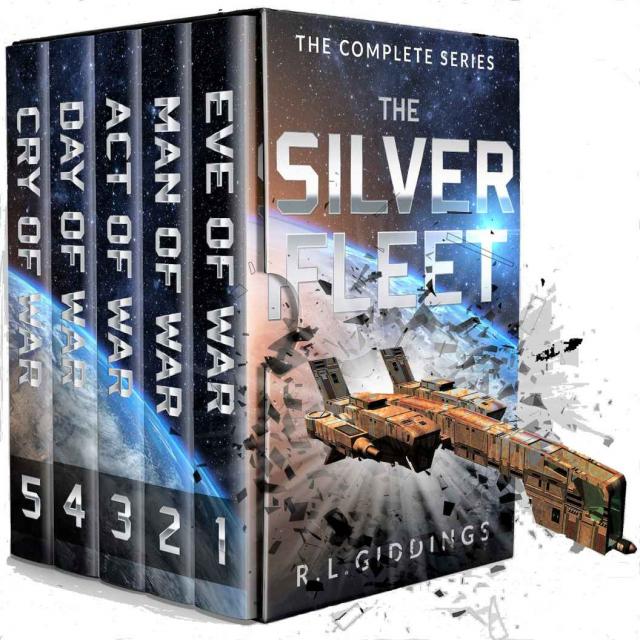


THE SILVER FLEET SERIES
(COMPLETE)
R.L. GIDDINGS
©R.L. Giddings
BOOK 1 – EVE OF WAR
BOOK 2 – MAN OF WAR
BOOK 3 – ACT OF WAR
BOOK 4 – DAY OF WAR
BOOK 5 – CRY OF WAR
EVE OF WAR
BOOK 1
R.L. GIDDINGS
© R.L. Giddings
CONTENTS
CHAPTER ONE
CHAPTER TWO
CHAPTER THREE
CHAPTER FOUR
CHAPTER FIVE
CHAPTER SIX
CHAPTER SEVEN
CHAPTER EIGHT
CHAPTER NINE
CHAPTER TEN
CHAPTER ELEVEN
CHAPTER TWELVE
CHAPTER THIRTEEN
CHAPTER FOURTEEN
CHAPTER FIFTEEN
CHAPTER SIXTEEN
CHAPTER SEVENTEEN
CHAPTER EIGHTEEN
CHAPTER NINETEEN
CHAPTER TWENTY
CHAPTER TWENTY-ONE
CHAPTER TWENTY-TWO
CHAPTER ONE
Morton sat back in her seat and tried to relax. The thin suit they had given her was far too big and kept ballooning around her middle. She gently patted it down, knowing that it was only a matter of time before it would ride up again. It had been something of a crazed sprint to get herself to this point and so now it felt just a little unnatural sitting here doing nothing.
Or was there something else that was worrying her?
Perhaps it was the presence of Corporal LaCruz Jackson, the woman in the seat behind her. Jackson would be posing as her medical orderly for this trip, a small but necessary deception which unsettled Morton to no end. She’d rather not have had Jackson along if truth be told, there was no room for slip-ups here. But if she had to take a minder along then Jackson would have to do.
The woman was uncommonly short for a Marine but that didn’t diminish her in any way and, as Morton’s father had been quick to point out: it was the short ones you had to watch. She wondered how many people had underestimated this young black woman in the past, only to live to regret it.
Sitting at the rear of the shuttle, Morton had enjoyed a good view of the planet Thalia as they’d started their approach and had lost herself staring at the swirling colours of the gas giant. Blood reds, vivid purples and tawny oranges intermingled endlessly. The colours swimming before her eyes, expanded rapidly until they reached some pre-determined point from which they swiftly started to dissipate. It was beautiful to watch, so beautiful in fact that she hadn’t thought to look for Dhanza the prison station they were heading to until they were ready to start the docking procedure and by that point it was too late. Not to worry. She’d be seeing inside the place soon enough.
The pilot’s voice filled the passenger compartment.
“Sorry about this, doctor. They’re scanning us again. Doesn’t normally take this long.”
But then, this was hardly a ‘normal’ situation.
Normally, a team of diplomats would be on hand for this kind of procedure but the Yakutians had been very clear about their access requirements. Only two medical staff would be permitted on-board the facility, and with good reason. In all the documentation that Morton had been privy to in the past few weeks this procedure had always been referred to as a Medical Emergency.
A Medical Emergency that had been twenty years in the making.
Every few years an appeal would be lodged with the Yakutian government for the release of Captain Faulkner. And in all the paperwork Morton had been privy to he had been referred to as a political prisoner. This particular approach had been exhausted long ago and so the diplomats at USDC headquarters had decided to adopt a softer approach and try and broker a leniency plea. But, in this case, they had gone to the very top: they had appealed to the Emperor himself. Only he had the power to cut through the internecine bureaucracy at the heart of the Yakutian government.
This first approach had been made nine long years ago but, after an initial rush of excitement, it had all come to nothing and expectations of a satisfactory outcome had been significantly adjusted downward. Two subsequent attempts at reaching an agreement had likewise become mired in controversy. A group of diplomats had actually made it as far as the station on one occasion but, after a search of the prison’s records it was determined that the prisoner in question was no longer detained at Dhanza and they would have to look elsewhere.
Morton wondered if her own mission might be similarly doomed. It wasn’t every day that a celebrated war criminal walked free from a Yakutian jail. Morton imagined that, even now, the Yakutian administrators would be checking and re-checking their paperwork, ever cognizant that a last-minute glitch might scotch this release before it even started.
As the shuttle began its final approach, Morton checked her medical kit one last time. As well as her usual equipment, she’d packed a spare thin suit in the unlikely event that their mission might prove successful.
“Everything good with you?” LaCruz looked up from examining a box of medical equipment.
“Everything’s fine,” she lied. “Though I’ll be a lot happier when we’ve got the patient and are heading back.”
“If this guy truly is who they say he is. Twenty years is a long time. I don’t expect we’ll recognise him from the mug shots.”
LaCruz did have a point. It wouldn’t be the first time the Yakutians had tried to pass someone off as someone else.
“Then you’ll be pleased to know that I’ve done my homework.”
She brought up the patients details on her tablet and then angled the screen so that LaCruz could see the unique double helix pattern.
“I’ve spent the last few weeks trying to track down a viable source of DNA for comparison. We usually rely on a sample from a relative but we couldn’t track one down in this case.”
LaCruz indicated the screen. “So where did you get that from?”
“Our subject was seriously wounded at the Battle of Casimir. I know the surgeon who operated on him. He was very helpful.”
“Like I said: where did you get that. Cell samples?”
Morton wrinkled her nose. She hadn’t expected this level of cross-examination.
“It was from a sample of lung tissue that was removed at the time.”
But LaCruz wasn’t to be discouraged. “But they throw that stuff in the incinerator, don’t they?”
“Not in this case. The surgeon had it frozen.”
“Like some kind of keepsake? Cos he was a hero?”
“Something like that.”
“That’s got to be twenty years old. Older.”
“Yes. It had denatured slightly but there enough DNA markers in it for my purposes.”
LaCruz got out of her seat and came over to stand behind her while she looked at the screen. Morton slowly scrolled down so that she could see the whole thing. She couldn’t help feeling uncomfortable at such close proximity and disliked herself because of it.
“What should I call you?” Morton asked. “Under the circumstances, I can’t keep referring to you corporal.”
The woman gave her a hard stare.
“Fine. You can call me LaCruz. But don’t get any ideas. It don’t mean we’re buddies or nothing.”
A minute later, the shuttle shuddered as it docked against the station. There was a squeal of metal as the two came together as if protesting the idea of two conflicting technologies being forced to mate.
They waited patiently while the air pressure of the shuttle was adjusted to match that of the station. Only then could the doors be opened.
There was no one waiting for them on this side of the pressure door, just a sealed walkway leading into the prison proper. Technically, if things went smoothly there was very little for them to do. The Yakutians would no doubt prefer it if they just signed for the prisoner and left, but she had no intention of signing anything until she was sure they had the right man.
At the pressure door, Morton stopped and turned to LaCruz. “Mind if I ask you a question?”
“Long as it’s nothing personal.”
“They’re bound to have security through here. Weapon scans, that sort of thing.”
“You want to know if I’m armed?”
“I suppose I do, yes.”
“I take it that’s a scalpel in the bag.”
The scalpel was in a sealed container.
“That’s right.”
“Then, yes. I’m armed.”
They were met on the other side by the warden and three of his staff. The warden greeted them stiffly in Coptic and then led the way down through the main body of the prison. Morton felt as though she had to keep readjusting her vision. The lighting frequencies were markedly different from what she was used to, as if the power sources on-board were struggling to cope. Colours appeared murky and indistinct. After a few minutes, she could feel herself starting to develop eye strain. She’d been offered a pair of chromatic lenses back on the ship and while she had declined, the Marine had accepted. Obviously, LaCruz had known something she hadn’t.
They followed the warden through the narrow, dimly lit corridors. All the while Morton was aware of them walking downwards on a constant slope, an odd sensation when you were used to the uniform flatness of most spaceships. They stopped outside a grey
, utilitarian security gate.
“You will please to wait here,” the warden said in his peculiarly flattened vowels.
He and his staff went through the door and they were left alone. Every so often, they heard the sound of doors slamming in the distance.
There was a bench set back in the alcove to their right. LaCruz didn’t even acknowledge its existence, maintaining parade rest throughout. Morton decided to stay standing. The place smelled of damp and mortality. There were signs of institutionalised disorder all about them. Boxes filled with discarded equipment were stacked everywhere, the light directly overhead kept flickering and through the wall there came the sound of voices raised in anger.
“Done this type of thing before?” Morton asked.
“I’m afraid I’m not at liberty to say,” LaCruz said. Then she relaxed, “Once or twice.”
“Do you know much about him? About Faulkner?”
“Other than his sequenced DNA?”
Morton regarded her. Trying to determine whether the other woman was being terse or just plain unfriendly. It was difficult to tell.
“You must have heard of him: The Butcher of Tsvengir? He’s been all over the newsfeeds.”
“I try and avoid those if I can.”
“No interest in the war then?”
“The Long War? I know what happened to the Marines at Haltavera and Balin. I know all about those.”
I bet you do, Morton thought. And yet, you’re still here.
She didn’t know what to make of this woman. LaCruz was meant to be supporting her but she came across at times as being openly hostile. But if things were to go badly out here, if everything went to the wall out here, she thought she might be glad to have this woman on her side.
She felt hemmed in and was aware of voices in the background calling out to her. There was an urgency about them which was only intensified by the fact that she couldn’t understand what they were saying.
It was suddenly as if the whole weight of the prison was pressing down on her, making it difficult to breathe. In response, she stroked the stud on her bracelet and a soothing flood of pheromones began flooding her system.
It took a moment to take effect and she stood there, letting the sensation flow through her until she was completely calm again.
After that, the air felt cooler, fresher, the light perhaps a little softer. The voices were still out there but now they were less distinctive, less troubling.
She watched the door, willing it to open. Hoping that he’d appear so that they could be gone.
“Do you think it’s true?” LaCruz said. “What they say about him?”
So, she did know who he was.
“He’s never been formally charged by either side,” Morton pointed out. “So it’s difficult to know what to think.”
“No. I meant about how he managed to survive in this place for so long. While all the others …”
“Yes. Remarkable. To have survived the war and then have to endure all this. Remarkable. But, it’s over now. For him at least.”
At least, she hoped it was.
*
One of the warden’s auxiliaries appeared a few minutes later and ushered them into a side office. The room was small and unremarkable. The warden sat behind an ugly metal desk on which he had taken the trouble to lay out all the necessary documentation.
The warden listened while the staffer read through a long list of legal waivers in Coptic. The bead in Morton’s ear struggled to make sense of it all and, after a while, Morton just stopped listening. Then, the man beckoned for her to approach the desk. Pulling out a yellow document he pointed at the two places where he wanted her to sign.
When Morton protested that she had yet to see her patient, the man ignored her, merely pointing to the document again. Throughout this exchange, the warden said nothing. He was too busy signing papers of his own.
Morton took the pen and signed, embarrassed by her own clumsy signature. She repeated the process on the other documents.
With that formality out of the way, the warden stood up and bowed. Any previous animosity seemed to leave him at this point and the mood in the room changed along with it. Suddenly, the man was almost affable, as though he himself was pleased to bring this whole interlude to an end –to be finally getting rid of this prisoner.
The warden rifled through his desk drawer and when he stood up again he was holding a heavy green bottle. Closer examination revealed it to be Calzec, a liqueur much favoured by the Yakutians. Her husband had once brought home a bottle. It was excessively sweet and tasted of plums, if her memory served her.
Morton was momentarily at a loss how to proceed. Was she meant to provide a gift in return? Why hadn’t anyone warned her about this?
In the end, LaCruz stepped forward, gave a passable bow and took the bottle from him.
The warden seemed satisfied with this and strode out of the room and down the corridor, challenging them to keep up as he wended his way down a series of gloomy passages.
They came at last to a large waiting area with various guard rooms leading off of it.
A number of prison warders had gathered around what transpired to be the door to the main elevator. They spoke quietly, their rifles aimed at the ground. They used low energy projectiles, the kind that were designed to be used in pressurised environments. The men were sporting a number of invasive neural upgrades: an enhanced eye socket here, a completely re-configured jaw there. One of them even had a robotic arm. Most of them sported some kind of skull implant, which would no doubt have been state of the art when they’d been fitted but now looked bulky and crude.
This reliance on mechanical enhancements had been at the heart of the Yakutians conflict with the Confederation going back a long time. The idea of direct connection, being able to instantly access the thoughts and emotions of others had been anathema to those who had valued the sanctity of personal thoughts. That, and their growing reliance on unregulated AI technology had eventually led to the rift between the two sides and from what she was seeing now, it didn’t look as if much had changed.
The prison doctor stood apart from the warders, only looking up when the warden himself appeared. The doctor said something out of the side of his mouth prompting the men to shuffle into a line.
The warden introduced him as Doctor Zlatan. The man was very precise in his movements, almost birdlike. When the man raised a hand in acknowledgement, Morton glimpsed a hint of metal at his wrist.
He spoke directly to Morton, “Will you be looking after him?”
His English was very clear. Morton nodded.
“You will take good care of him.” It was a statement, not a request.
“That was my intention.”
He regarded her critically. “You’ve had experience, I take it? With his condition.”
“PTSD? Yes. I was a field surgeon before I specialised.”
“Then I wish you every success,” he looked with disdain at the warden, who wasn’t even listening to their conversation. “He has not been well used here.”
The warden was explaining something to the others. There was some small talk and then a couple of sly looks directed at LaCruz. They appeared to be debating something. Then one of the men laughed.
It was not a nice laugh.
Morton was wondering just how LaCruz might react to this when the elevator doors pinged.
As the doors opened, everyone’s attention shifted.
Inside the elevator was stick thin figure, with a shaven head and a thick grey beard which seemed too big for his body. But it wasn’t his physicality that drew everyone’s attention, it was his eyes. Morton had never seen such glowering intensity.
He looked like he intended to consume the whole area with flames.
When he stepped out of the elevator he raised his wrist restraints in the direction of the warden. But the warden stayed just where he was and it was one of the other men who approached the prisoner with the keys.
“Captain Faulkner?”
Morton stepped forward but the man with the keys made to block her. Faulkner deftly side stepped him.
“It was very good of you to come,” Faulkner’s voice was paper thin.
The guard carefully removed the restraints and shuffled back, clutching them to his chest.
Faulkner rubbed at his wrists. Straightened.
Something had changed in the room and they could all sense it.
Morton indicated for LaCruz to step closer.