Robert weinberg the bl.., p.1
Robert Weinberg - The Black Lodge,
p.1
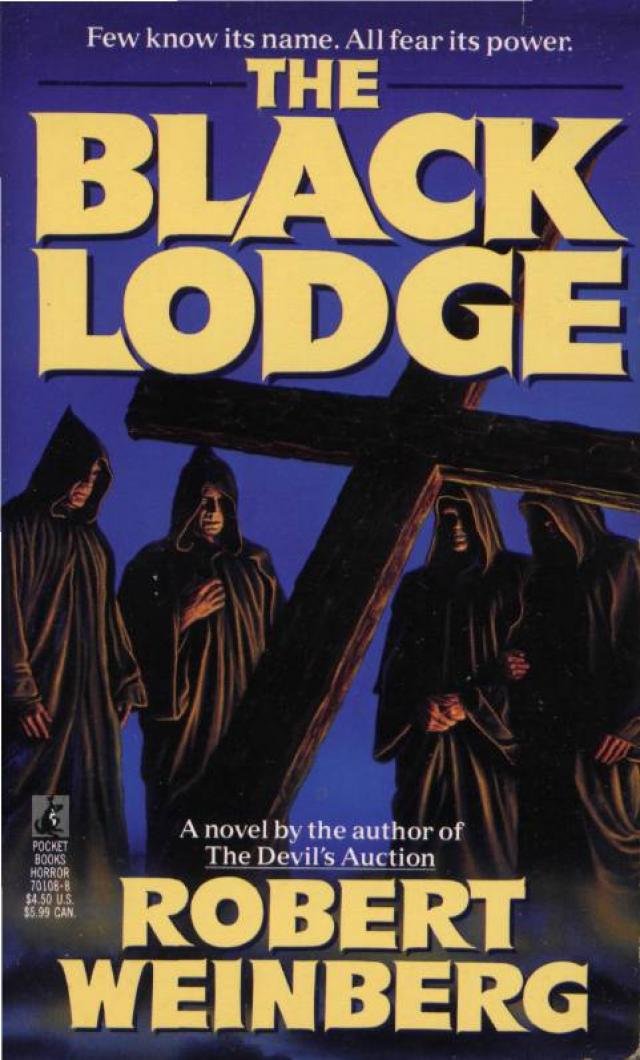


* * *
CONTENTS
1 2 3 4 5 6 7 8 9 10 11 12 13 14 15 16 17 18 19 20 21 22 23 24 25 26 27 28 29 30 31 32 33 34 35 36 37 38 39 40 41 42 43 44 45 46 47 48 49 50
* * *
He Belonged to the Night, to the Darkness ...
LeVar drew in a deep breath and exhaled slowly. His whole body shook with uncontrollable tremors. It was the first time he ever wasted anyone and he didn't like the feeling. The gun dropped from his fingers, numb from the recoil.
That mother had been a genuine, absolute psycho, LeVar thought. "He done scared me white," said LeVar, trying to laugh away the shakes. And then the laughter turned to screams.
On the far side of the room, the Dark Man rose to his feet. The gun blasts had blown away much of his coat and knocked off his hat, but he seemed otherwise unharmed. For a bare instant, LeVar caught a glimpse of a face that was not a face—a flat, featureless blank, unbroken by nose or mouth, like a pane of dark frosted glass. Eyes burning like red coals glared at LeVar with unblinking intensity. In one hand, the giant clutched a meat cleaver. With his other hand, he reached out and extinguished the candle.
"My turn," said the Dark Man . . .
Most Pocket Books are available at special quantity discounts for bulk purchases for sales promotions, premiums or fund raising. Special books or book excerpts can also be created to At specific needs.
For details write the office of the Vice President of Special Markets. Pocket Books. 1230 Avenue of the Americas, New York, New York 10020.
* * *
* * *
This book is a work of fiction. Names, characters, places and incidents are either the product of the author's imagination or are used fictitiously. Any resemblance to actual events or locales or persons, living or dead, is entirely coincidental.
An Original Publication of POCKET BOOKS
POCKET BOOKS, a division of Simon & Schuster Inc. 1230 Avenue of the Americas, New York, NY 10020
Copyright © 1991 by Robert Weinberg
All rights reserved, including the right to reproduce this book or portions thereof in any form whatsoever. For information address Pocket Books, 1230 Avenue of the Americas, New York, NY 10020
ISBN: 0-671-70108-8
First Pocket Books printing November 1991
10 9 8 7 6 5 4 3 2 1
POCKET and colophon are registered trademarks of of Simon & Schuster Inc.
Cover art by David Fishman Printed in the U.S.A.
* * *
To Peter M. Spizzirri—"Opener of the Way"
To attain the sanctum regnum, in other words, the knowledge and power of the magi, there are four indispensable conditions ... TO KNOW, TO DARE, TO WILL, TO KEEP SILENCE ... —Eliphas Levi,
The Doctrine and Ritual of Magic
* * *
1
LeVar Bailey felt good—real good.
Softly humming a bit of soul music, he slowly stepped out from the doorway of the abandoned barbershop on the corner of Seventeenth and State. Swinging his head from side to side, he carefully checked the area for suspicious characters. No other figure stirred in the dim amber glow cast by the solitary streetlight located only a few feet away. LeVar grunted his approval. He liked empty streets when he visited his "main base."
He set off at a brisk clip, his studded leather boots beating a sharp tattoo on the broken sidewalk. From time to time, he swept the area with quick, sharp glances. He didn't expect any trouble, but years of experience in this deadly business had taught him the value of staying alert.
Fortunately, this part of Chicago's South Side resembled a bombed-out wasteland. Only a few ramshackle buildings broke the stretch of weed infested lots. There wasn't a bus stop within ten blocks. No reason to exit here. Surrounded by major expressways and through streets, this section of the once "great street" saw little traffic after the evening rush hour.
Normally, LeVar made two trips a night to his stash hidden deep inside the old railroad building. There he deposited the loot, his "bank," that he collected during the first part of the evening and broke out a new supply of crack for his anxious customers. Tonight, he suspected, he might make three visits, maybe even four, to satisfy the demand on the street. The geeks wanted the stuff bad and he was their main man.
Up ahead, music bellowed from the jukebox in Christy's tavern. LeVar sucked in several deep breaths, preparing himself for the unlikely chance a violent drunk might try something stupid.
He prided himself on being ready for anything. These days, it never hurt to be too careful. Stuffed inside the front of his shirt, hidden by the heavy folds of the thick leather jacket he wore even during the hottest days, was nearly a thousand dollars in small bills.
Not even a bug stirred inside the tavern as he casually strolled past the open doorway. The regular group of grizzled old black men sat huddled at the bar, nursing their beers and shots, impervious to the blaring music that surrounded them. No one who valued his hearing drank at Christy's. Crazy Charlie, the latest owner of the place, was nearly deaf and played the jukebox twice as loud as necessary. Everyone within a mile radius of the place knew when the saloon was open for business.
Complaints about the noise did little good. No politician dared criticize Christy's. Nearly a hundred years old, the tavern was a Chicago landmark. Al Capone had been a regular. So had Mayor Anton Cermak. The bar had survived wars, the Depression, Prohibition and several recessions. A prominent newspaper columnist once called Christy's the last holdout of Chicago's colorful past. Most everyone else in Chicago, including LeVar, considered the dump a major eyesore long overdue for demolishing.
Breathing a sigh of relief, LeVar walked a little faster. An early trace of summer weather embraced Chicago this late April evening, holding temperatures to the low seventies. Inside his silk shirt, soiled bills clung to his skin like leeches. Little beads of sweat trickled down his back, adding to his discomfort. Once he made it inside the warehouse, he could strip off his coat, open his shirt and bundle up the cash. Until then, the money stayed in place, sweat or no sweat.
A thin trace of fog drifted across the street, rolling in from Lake Michigan. Thick clouds covered the moon and stars. Only the glow from the downtown city lights broke up the darkness on the street.
Up ahead, LeVar spotted the Fifteenth Street viaduct. His pace quickened.
"Hey, boy—where you running?"
The question cut the night air like a knife. For an instant, LeVar hovered on the edge of panic. Then reason took over. Stickup boys never asked questions. Only cops.
Calming himself, he turned to a police car at the curb. The blare of the jukebox had covered the approach of the vehicle. Two policemen sat inside the roller, staring at him. The one by the window, a big black man with a scruffy thin mustache and narrow, suspicious eyes, held a flashlight pointed directly at LeVar's face.
The cop kept the bright light in LeVar's eyes, turning everything into a white blur. LeVar suspected the officer held a burner, probably one of those big .357 Specials, pointed right at him just below the window, waiting for any sort of suspicious movement. The "Robocops" played tough in this neighborhood. Time for him to turn innocent, LeVar thought.
At five ten and a hundred and fifty pounds, LeVar cut less than an imposing figure. Slender and thin boned, he looked like a strong wind could blow him away. He was twenty-two, but his youthful features and the Cubs baseball cap he wore took five years off his age. Unlike most of his friends, he wore no earrings, gold chains or wrist bands. LeVar looked the very model of an innocent teenager, an image he worked hard to cultivate.
"Where you goin', kid?" asked the policeman for a second time. Now, having gotten a good look at LeVar, the officer sounded more bored than suspicious.
"I'm meeting my woman downtown, bro," answered LeVar, his high-pitched voice sounding slightly ridiculous. He recited the lines he'd practiced a hundred times. "I'm late already."
The policeman snorted in disbelief but remained seated in his car. "Walking to the Loop down State Street? Not many people crazy enough to do that anymore. You live around here, boy?"
"Yes, sir. I live at the Temple on Twenty-Second Street." He let just a little of the annoyance he felt creep into his voice. "Don't got no money for the El, sir. Gonna be late for my woman if I don't hurry."
"The Temple? You belong to that Children of Danbal-lah organization that's been on the news so much lately?"
"Yes, sir," said LeVar, proudly, pulling out his Temple ID card. He waved it at the squad car.
The big cop shrugged his shoulders and then shut off the spotlight. "These are mean streets, boy. People 'round here will break your legs for pocket change. No more midnight strolls after this one. You borrow some money from 'your woman' and take the El back to your Temple tonight." The officer chuckled, a deep throaty sound. "Unless, of course, you get lucky and spend the night."
"Yes sir, yes sir," said LeVar with a laugh. He nodded pleasantly to the police as the car rumbled away. "Sure got to be careful around here, sir. Gotta watch out for all those nasty dope dealers makin' the rounds, sir."
Sucking in a deep breath, LeVar continued down the street. The encounter with the Rollers left him shaken but equally elated. The fools never once suspected him of being anything more than he claimed. They stayed clear of Danballah's flock. The last time they had hassled one of the Disciples, the story had made the national news. The word was out on the street. Leave the Children alone.
"Religious per-se-cu-t
ion," said LeVar, letting the words roll slowly off his tongue, trying to sound solemn but not succeeding. The Bocar manipulated the media with a skill born from years of political confrontation.
Clout meant everything in Chicago. And these days, clout depended almost entirely on TV exposure. The local news broadcasts always gave the most air time to the most dramatic political figures. What they said didn't matter—it was how they said it.
The cameras loved the Bocar and he knew it. He spoke with a passion and fire. No one dared challenge him publicly—not the mayor, not the district attorney, and definitely not the cops on the beat.
Meanwhile, the Children of Danballah provided a perfect cover for dope dealing. The organization offered a safe base of operations, a steady source of crack and a perfect alibi when necessary. All the Bocar demanded in return was a thousand off the top of every night's take.
Sometimes LeVar barely managed to break even. Crack was cheap and plentiful these days. There was no such thing as customer loyalty among the mainliners. The geeks came to town looking for action. If you missed connections, they found another hustler.
From his office in the doorway of the abandoned barbershop, LeVar ran his operation much like a news vendor selling newspapers in the Loop. The geeks drove up in their big cars, leaning on their horn for some action. A quick dash into the street, an exchange of money for crack, and the deal was made—all in a few seconds.
Like any high-profit business, there were risks involved. Sometimes the geek turned out to be an undercover cop, looking to make a quick bust. Or it could be a hotshot punk, a "stickup boy," looking for an easy mark. The dangers came with the territory.
Tonight, LeVar had scored big with some wealthy teenagers from the 'burbs. They had bought out the store, necessitating this early run for more Rock. Not that LeVar minded. Twenty bucks more and he started flying. With the whole evening ahead of him, he could easily return to the Temple with a pocketful of C-notes.
He ran as fast as he could through the Fifteenth Street viaduct, crossing the wide street as he did so. The underpass spooked him, especially at night. It was too dark in the center and he disliked the thought of traffic over his head. He never felt safe until he reached the other side.
Suddenly, as he took his first step onto the dirt path leading through the tangled underbrush, LeVar knew he was not alone on the street. Heavy footsteps echoed in the tunnel—sounds coming from the dark underpass.
LeVar stopped moving, waiting cautiously to see who emerged from the blackness. The sounds grew louder and louder, setting his body trembling. The steps were slow and methodical—unhurried and steady even through the absolute blackness of the viaduct. A patch of darkness darker than the night, emerged from the underpass—a giant figure, nearly seven feet tall, striding into the dim light of the city. A black blot of a man with vast shoulders and gorillalike arms. The stranger looked about for a moment, as if getting oriented, and then, spotting LeVar, started toward him.
Running seemed futile. Gripped by a nameless dread, LeVar could only stand and wait as the giant approached. Little by little, as the man drew closer, LeVar realized that the stranger was no supernatural bogey but an ordinary man the size of a professional football lineman. The darkness exaggerated his size and menace. Still, the man's actual appearance did nothing to alleviate LeVar' s worst fears.
The Dark Man. The name came unbidden into Le-Var's thoughts as he awaited the stranger. The giant wore only black—pitch-black garments that covered him from head to toe. No skin showed. The Dark Man—he belonged to the night, to the darkness.
A heavy black overcoat, buttoned tight across his massive chest, covered the man from neck to ankle. Odd garb for such a warm evening, but LeVar never thought to question. A thick wool scarf snaked around the giant's upturned collar, shielding most of his lower face. An oversize, wide-brimmed cowboy hat sat on his head, pulled down tight to shade his features. Leather gloves covered huge hands with fingers the size of sausages. Old-fashioned work boots, steel tipped and laced up the ankle, completed the picture.
"What's goin' down, bro?" said LeVar, summoning up courage he never knew he possessed.
"I've been looking for you, LeVar," answered the Dark Man, with a voice as smooth as honey. "I've been looking for you all night. You've got what I need, and I'm willing to pay good money for it."
"Yeah," said LeVar, wondering how the Dark Man knew his name. He was suddenly quite conscious of all the money stuffed inside his shirt. "What you talkin' 'bout, dude? Who done told you 'bout me?"
"Friends, LeVar, friends," said the giant, casually reaching into the pocket of his overcoat.
LeVar tensed, expecting the man to pull out a gun or a police badge. Instead, his hand emerged holding a crumpled bill. He offered it to LeVar.
"Go ahead, take it," said the Dark Man, with a laugh. "A gift to you with my compliments. Consider it the first payment in a long and lasting relationship. Go ahead," he urged, "it won't bite."
Tentatively, still fearful of the stranger's huge bulk, LeVar reached for the money. With a lunge, he grabbed the bill and immediately jumped back, out of the Dark Man's reach. The giant remained stationary, chuckling softly. LeVar felt like a fool.
He looked at the bill then looked again. "A C-note. You just givin' me this? What kinda jive you handin' out, man?"
"No jive," said the Dark Man. He lowered his voice to a whisper. "Just cold cash for fine coke—for crack."
"I got the best rock around," said LeVar, the juices starting to flow. The Dark Man was talking his language now. "Stuff comes straight from Bolivia to Chicago, with no stops in between. You hear what I'm saying— straight from Bolivia."
"The best cocaine in the world," said the Dark Man, nodding his head in agreement. "I'll buy all the crack you've got. Money's no object."
LeVar couldn't believe what he was hearing. No matter what the price these days, his customers demanded a break. Crack was cheap on the street and competition was tough.
"Twenty bucks a hit?" he said cautiously, ready to drop the price immediately if the Dark Man protested.
"Deal," replied the stranger without hesitation. "On one condition. I need the stuff tonight. Now."
LeVar paused only for a second. He disliked revealing the location of his stash, but this was big money. He fretted that if he let the Dark Man out of his sight, even for a few minutes, the stranger might have a change of heart, or the cops might come cruising back this way and scare him off, or a hundred other disasters might occur.
Besides, LeVar kept a surprise in with his stash in case anyone ever tried any tricks. If the Dark Man planned a sharp move, LeVar would have the last laugh. The comforting thought of his "burner" hidden away with his crack swept away any remaining jitters.
"Follow me," said LeVar, "and stay close. No lights inside but I know the way."
The interior of the old railroad warehouse was a shambles of rotted wood and rusted metal. Parts of the flat roof had collapsed from the weight of snowstorms over the years. Smashed beams and jagged bits of shingles littered the floor. The gaping holes in the ceiling let in enough light for LeVar to make his way through the wreckage.
LeVar knew every nook and cranny of the deserted building. The railroad had gone bankrupt back in the early 1960s. Changing demographics and the urban decay of the inner city made potential buyers wary of the property. The city aggravated the situation by demanding any purchaser pay back taxes on the land and building as well. So for over twenty years, the lot remained unused and the old structures fell into ruin.
Only children were foolish enough to enter the deserted warehouse. Adults knew better. For a decade, the huge old railroad barn served as shelter for teenage runaways from all over Chicago. Then flower power ended and gang warfare hit the ghetto. After several rapes and two murders took place in the isolated depths of the building, the street people abandoned the warehouse. Even the bag ladies and winos avoided the place. It was left free and clear for the pushers and dope dealers.