Stalking, p.5
stalking,
p.5
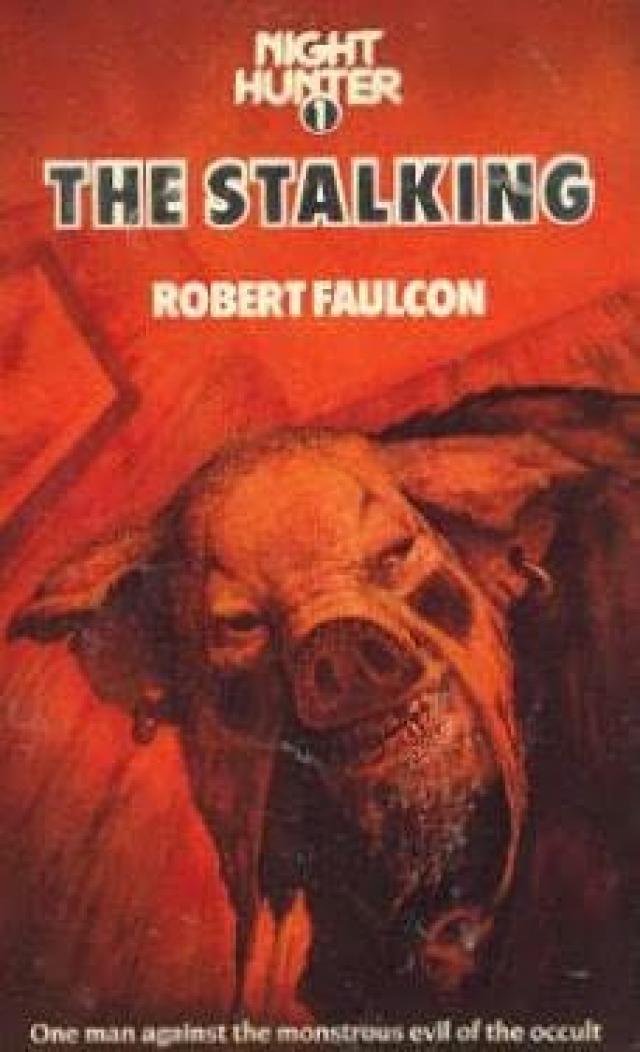


He fetched the step-ladder from under the stairs and set it up against the tree, climbing to the top so that he could rescue the several yards of tinsel which appeared to have been flung at random across the lop-sided plastic fairy that surmounted the giant fir. Dominick appeared in the room, freed of his winter clothing, and began to hang Christmas cards from the lengths of twine that Alison had already slung across the barer parts of the walls. Alison herself sat down by the fire, with a great basin of chestnuts, and began the laborious task of peeling them, ready to make stuffing for the turkey.
The log fire burned high and hot, and the warmth reached out and encompassed Brady, giving him a cosy feeling of being at home, and without worry, and without care . . .
Outside, a brisk winter wind rattled the windows, and sent the flames in the grate roaring up the chimney.
'What's Marianna up to?' Brady asked, as he laced the tinsel carefully through the branches of the fir tree.
Dominick didn't answer, and Alison looked up and said to him. 'Dom? Where's Marianna . . .?'
'How should I know?' said Dominick quietly, without looking up from what he was doing.
Brady felt instantly uncomfortable. Alison was staring at her son, then she looked round and up at her husband, her face creasing into a frown of puzzlement. Brady said, 'Did she come in with you?'
'Nope.' Dominick sensed that something was wrong; his whole manner was that of one who knows he should have exerted more responsibility. He added, 'There was a man out there. She was talking to him . . .'
Alison jumped to her feet. 'A man . . .?'
Brady said, 'Calm down, Alison. It's probably a neighbour, coming to visit. I'll go and fetch her in . . .'
He stared at Alison, and realized that the two of them were exchanging a gaze of terror. He frowned. His heart started to pump with noisy energy. The room swam. Alison stepped towards him, all blood draining from her face. And in that instant, they were aware of it, sensing the danger, sensing the tragedy. They moved towards each other, but the room had slipped away, the fire dimmed, the warmth draining away into a more primal chill. Brady said, 'Marianna . . . Oh God . . .'
He heard her call. She was outside the french windows, and he turned to face her, and saw her standing there, a tiny, fragile form, all swathed in winter clothing.
'Daddy . . . Daddy, I'm cold . . .'
'Marianna!' he screamed, and began to run towards the french windows.
With an explosion of glass, and a howl like some supernatural wind, the french doors burst inwards. Marianna's body was flung at Brady, knocking him down. Above the roar of wind, he heard three unearthly screams, and recognized the voices of his family. He tried to see them, to shout their names, but a dark shape struck him in the face, and a second figure kicked out at him, taking the breath from his body with a sickeningly painful blow to his stomach. The lights in the room, already dim, were extinguished completely. The glow from the fire, and an eerie glow from the shattered doorway, were the only light by which Brady could witness the sudden madness in the room.
The noise abated. There was a muffled crying and the sound of desperate struggling. Shapes moved all about, dark men in dark robes, their faces the hideous reflections of animals, a leering goat, a glitter-eyed hawk, the dull, frightened features of a cow, the wide grinning features of a frog.
Despite the pain in his body, Brady struggled to his feet, madness and anger giving him tremendous strength, panic and fear immunizing him against hurt. He lurched towards one of the shapes and tore back the hood, screaming, 'Stop this! Bastards! Bastards/'
A fat, white face stared at him, the head bald, the eyes tiny and piggish. The lipless mouth stretched into a quick smile, while the flared, almost flat nostrils, snorted in breath, a sound that was not laughter, but was intended to be. The face was the real face of a man, no mask, but its awful appearance shocked Brady, and though he reached out to scratch and beat at the pallid jowls, his blows were tempered.
He felt hands drag him back; he felt blows to his body, then his arms tied behind his back, manacled; his feet were tied together, then his thighs; his legs were bent at the knees, and a rope stretched from his neck to his ankles, so that he was trussed like a piece of dead meat. He was lifted and flung against a wall, his nose bursting against the marble edge of the fireplace, and his head cracking, the dull sensation of pain masked by the nausea and muscle-spasm of shock. When he fell to the floor he rolled so that he gazed into the room again, at the whirling, confusing darkness, the men who had attacked him.
Helpless, unable to even cry out, he watched as Alison's naked body was flung between two of the robed figures, then forced to the floor.
'Mark her.'
Her arms, locked above her head, showed the strain of muscles almost bursting in their struggle for freedom; a large ball of cloth had been rammed into her mouth, and her head was held quite still as her legs were pulled apart. Brady's heart threatened to burst as he struggled against his bonds, but he could do nothing, and watched the hideous abuse of the woman he so loved with tears in his eyes, and a pain in his belly that threatened to rip him in two.
It seemed to go on for ever. Wind howled in through the french windows, and the fire guttered and then dimmed. By its dying light he could see the glistening gold and red object that had been used to "mark" Alison ... it had the twisted head of an animal, and its shaft was marked with grooves and patterns. The details stayed in Brady's mind almost as powerfully as the shattered, bleeding shape of his wife, who was dragged from his sight.
The Christmas tree fell with a crash, baubles and tinsel scattering across the carpet. The shapes moved about the room, their robes sending wind across Brady's face, their footfalls making the floorboards vibrate with an almost rhythmic pattern.
He saw Marianna, then, her tiny body, clad only in her baggy print dress, arms behind her back, legs locked together, raised in the air. It was a vision of madness, a horrific, incomprehensible sight. Unsupported, she was dangled six feet from the ground, her head almost touching the ceiling. Her eyes streamed tears, her mouth moved as if she were struggling to open it and scream. Her body twisted in the air, and moved, then dropped and bent double, as if unseen hands were passing her between them and had finally flung her across an invisible arm. Folded like a limp rag, her hair covering her face as she twisted in this unseen grasp, she was carried through the french windows and into the frozen night.
A moment later Dom's inert body was carried out by one of the robed figures, then Alison, wrapped in a rug, her hair tied back behind her head so that Brady could see that she was unconscious. As she was carried into the garden her head struck the edge of the door with a sickening thud, a final cruelty to end her torment and violent abuse.
All passion fled from Brady's body; he felt cold on the surface, and ice inside. There was a great clarity in his head, an adrenalin-induced alertness that made him aware of every sound, every murmur, every footfall. He lay quite still, too horrified to really cope with what he had seen, too frightened to move, aware only that he must hear everything that was said.
Three figures stripped the room, taking ornaments, fragments of carpet and chair covering, placing a candle in the middle of the floor and lighting it. Brady smelled something acrid, then something sweet, incense burning, he thought, and giving off an aroma so potent that it could penetrate his blood-filled nostrils. He heard a woman's voice: she was young, she had authority. He saw a man bend towards him, the mask that covered his face that of a pig, its cheeks marked with dark circles, saliva glistening at the mouth. An amulet dangled at the neck: a silver chain, a polished stone head, severed at the neck, the mouth opened in a silent scream.
'He's still alive.'
The man's voice was young, unsure; it was sibilant, almost animal. He straightened and moved away. A second shape approached and kicked at Brady, who winced. 'He's not wanted.' The voice was cold, more experienced. On the dark robes Brady could see the form of a convoluted labyrinth, patterned in dull grey.
'What do we do?'
A pause; a thought; a consideration; then: 'Bring the fetch again.'
'Are you sure? Is Wickhurst a strong enough source?'
'Then kill him yourself.'
'That's forbidden for me.'
Irritably: 'Then bring the fetch. He's half dead already. Quickly. Magondathog is a long way.'
They moved across the room. The words stayed with Brady, the strange words, the sound of the voices, the callous discussion. They moved away, dark shapes in a dark room, extinguishing the candle as they went. They moved away, framed in the doors for a moment, then the sound of them stepping across the garden, their voices a low murmur.
Brady lay in the sudden, unnatural silence. There was no wind. The fire was almost dead, but suddenly embers slipped from the grate and the branches of the fallen tree began to ignite, the flames creeping across that side of the room. He lay staring at the smashed french windows, just able to see the elm trees, outlined against the dark sky. He was still unable to make a sound, although he wanted to scream for help, or with anger, or with agony ... or with grief.
The broken edges of the door rattled, and glass, strewn across the floor, was kicked aside. But nothing had come in. A moment later Brady cried in his throat as scaly, rough hands gripped him round the neck, half lifting him from the floor as the fingers dug into his windpipe, bending his head back with relentless strength, seeking to snap the bones of his neck. He struggled and twisted, tearing his hands against the rope that secured him, aware of the burning tree and the flames reaching further into the room. His eyes bulged, his mouth, sewn tight with thread, he thought, stretched until he thought his lips would tear; he snorted blood and mucus into his lungs, and began to drown on his own wounds. The fingers pressed harder and his body was shaken from side to side. He thought his eyes would burst, the pain in them, and the colour, and then the darkness as the pressure built up.
Death came quickly, then, consciousness ebbing away as his body starved of oxygen, the bones in his neck cracking. The last thing he knew was that he slipped from his body and looked down upon it, and saw it lying there, all broken and twisted, its eyes bulging like billiard balls, the skin flushed red, the fingers tied by no rope that he could see, wriggling in a last, frantic attempt to free themselves.
A shape bent over this body, its black hands squeezing and squeezing, its monstrous back arched with effort. He couldn't see the face of the creature, and could only glimpse it as an intangible presence above his corpse. But as he floated away, as he abandoned his body to death, he reached down and began to scrabble at the gigantic fists that were closing around the dying man.
3
* * *
The best part of the night, and yet in many ways the worst part, was that time between two and five in the morning. Almost as if they were responding to a signal, the patients on King George Ward fell silent at about two a.m., their coughing, muttering, snoring and general restlessness fading away into an occasional murmur, and the faintest of wheezes.
On a good night - and most nights were good - there was nothing for the on-duty nurse to do save check each bed once an hour, and sit at the desk, in the light of a single lamp, and read, or write letters, or study for exams. On those rare nights were one patient needed constant supervision, the nights passed rapidly.
Nurse Mai-li Baker much preferred a night without complications, but she had great difficulty in keeping awake when she read, or tried to write, and it was those restful three hours that caused her the most problems.
To remain alert she settled into a routine; a walk round the ward every half an hour, followed by fifteen minutes reading, a glass of milk, or cup of coffee, then a brisk check through the toilets, wash-rooms and supply rooms. She was only twenty-one, a small girl with her mother's Chinese features strongly represented in her face, and in the brisk, slightly curve-legged way she walked. Her father was dead, had died at sea, in fact, not far from the colonial island off the coast of Mainland China where he and Mai-li's mother had met. Mai-li, the sole offspring of that short marriage, had never known her homeland. She was quite English to talk to, to listen to, and in her likes and loves; English, in fact, in everything but looks.
She was an attractive, quite shy girl, and very popular with medical students and male nurses. If she used the silence of the dead hours of morning for any sort of critical thought it was to consider her various suitors, to try and decide which would be her best course of action in the matter of her heart, and in the direction of her affection.
At three in the morning she interrupted her idle contemplation of the young, slightly aristocratic medical student, Paul Boyd (who was, perhaps, the keenest of the students on her at the moment) to make her routine check around the ward. As she passed the rest-room she stepped inside and switched on the kettle. It would be nicely boiled by the time she had completed her round.
King George Ward contained sixty beds, arranged in small rooms of four or six, each room open to the corridor. The corridor ran in a square with the utility rooms in the middle. The intensive care patients, or those who needed special medication on a regular basis, were grouped in four open bays opposite the nursing station where the night nurse would sit. Ten private rooms were grouped on the right of the station; a lounge area, in which visitors and patients could meet more comfortably than by the bedside, stretched away to the left.
Mai-li paced round the corridor, stepping into each small room in turn and looking at each patient just long enough to establish that they were peacefully asleep. When she reached the ten private rooms she simply peered through the door, checked the system of lights above the beds, and ascertained that there was nothing more than peaceful slumber occurring within the cell. She opened the door to Mr Arthur and checked the drip feed that stood by his bed. He was a very old man, quite strong in spirit, but was still unable to take solid food after an operation upon his stomach. In the next room was the young car crash victim, John Spencer, his head still bandaged, his limbs in plaster. He was well recovered from the accident, but given to fits of screaming in the middle of the night. No audio link was necessary to the nursing station; his yelling was always clearly audible.
There were two appendicitis recoveries, private patients, both business men of sorts. They had little time for the ordinary niceties, preferring to be woken at five and provided with the financial papers which they studiously read through most of the day. They were unaware of each other's existence; the nursing staff had nicknamed them tweedledee and tweedledum; the names were quite appropriate, since both men showed the obvious trouser belt strain of too many business lunches.
In room number six was Mister Mystery.
Nurse Baker stared through the window at the peacefully sleeping man. He lay on his back, his arms outside the covers, a drip-feed in place. She could just make out the rise and fall of his chest.
She opened the door and crept inside, lifted the man's wrist and felt his pulse. Leaning over she raised his eyelid slightly and checked his pupil response by the light of a small pen torch. She placed the arm back down and shone the torch onto the stubbly face.
By looking hard, she could just make out the remnants of the bruising on his throat and face. His body had fought long and hard to repair the damage to his tissue and bones, but the battle was nearly won. The battle for his mind was another matter.
Mai-li had heard stories about the man's arrival. He had been in a coma, the same coma that imprisoned his reason at the moment. By rights, she had been told, he should have been dead: his windpipe had been crushed, the neck bones cracked and splintered, and on the verge of severing the spinal cord. His throat, face and shoulders had been black and blue with bruising. He had bled into his lungs from the nasal mucosa, and from perforations of his peritoneal cavity caused by splinters from his fractured ribs.
The man's injuries were concomitant with a crash, with being crushed or having fallen ... all save the bruising on the neck. It was still possible to see the marks of the huge fingers that had caused that!
Strangled, beaten, crushed . . . left for dead. He had been found in the badly burned lounge of his house. The flames had been doused by the hidden sprinkler system in the walls, otherwise - Mai-li had heard - the house would have burned to the ground, and the evidence of the brutal assault (obviously intended to be a murder) with it.
Some inner strength, some awesome power of spirit, or of soul, had kept the man alive. When he had been brought to the hospital his hands and feet were locked together as if they had been tied. The skin of his wrists and ankles showed the marks of a thin cord, but no cord had bound him, even though his body continued to believe itself tied.
Over the first few weeks that rigid posture had relaxed. He had been fed intravenously, massaged daily, exercised and encouraged to return to consciousness, even as his bones were healed, and his neck operated upon to reduce the danger of his vertebrae snapping through completely. When Mai-li Baker had taken up her position on King George Ward, the man called Daniel Brady was simply known as an enigma, a man to be washed, cleaned, turned, exercised, spoken to, and checked every hour on the hour for the slightest sign of a return to consciousness.
Tonight, two months after he had been brought into the hospital, there was no change whatsoever in his condition, a fact that the nurse noted quickly on the chart at the end of the bed. As she pocketed her pen, however, she stopped, sniffed, and sniffed again. It was there, stronger than before. A smell like burning wood, but scented wood; a very strange odour that might well have been drifting in from outside the hospital. . . except that she never noticed it anywhere but in this one room.
With a quick glance round to satisfy herself that nothing was burning, Nurse Baker left the room, haunted by that tenuous aromatic, recognizing something about it, yet not really recognizing it at all.
She finished her round and went to the tiny kitchen area, where her kettle had boiled, gone off the boil, and needed a little re-heating. It was as she heaped coffee into her personal mug that she heard the swing doors at the Victoria end of King George Ward open and shut again, then bang open three times, very noisily.