The fragile threads of p.., p.34
The Fragile Threads of Power,
p.34
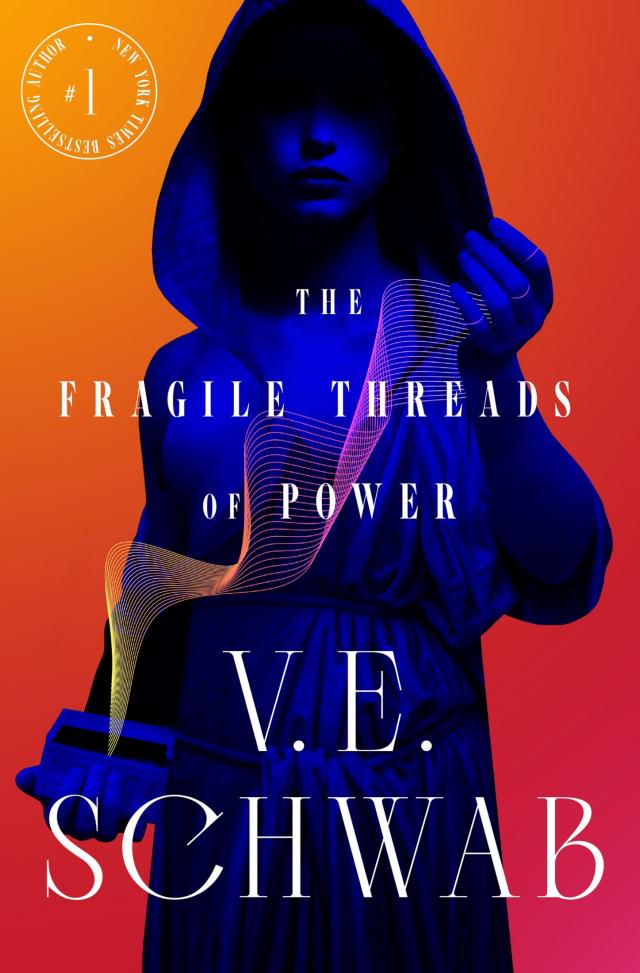


Kosika tried to manage a smile, but it fell short. “Go back down,” she told Nasi, nodding at the stairs. “Enjoy the feast. Make sure the Vir don’t go mad with power in my absence.”
“You should eat,” said her friend, and Kosika bristled, even as her stomach growled in protest, full of nothing but sugared buns and cider.
“Fine,” she said. “Send something up.”
She turned, only to feel Nasi’s hand catch hers, then the weight of something pressing into her palm.
“Happy birthday,” said Nasi, leaning in to kiss her cheek, and Kosika let herself blush, only a little, before she looked down and saw what the gift was: a marble figure, like the ones on the kol-kot board in the corner of her room. Kosika knew the rules now, had even beat Nasi half a dozen times. The figure was modeled on the game’s most important piece. The single faceless king.
Only this wasn’t a faceless king.
It was a queen.
It was her.
From the white cloak to the braided crown to the eyes cast in gemstone, one light brown, the other solid black. Her spirits lightened as her fingers curled over the token. She looked up to thank Nasi, but the girl was already vanishing down the spiral steps, toward the noise and revel of the feast.
Kosika turned the talisman in her hands as she continued up to her room, past the second landing and the third to the royal tower, past the two guards posted outside her door.
At last, in the quiet, she shrugged off the bloodstained cloak and pulled the jeweled pins from her hair, leaving the finery laid out like a ghost on the bed. She passed the silver ash tree that grew in the center of her room, brushed her fingers against the bark on her way to the game board that waited as it always did on its low, round table.
She sank onto a cushioned stool. The game was set, each king with a wall of soldiers in front, a set of priests behind. Kosika took up the silver-and-white king, faceless beneath his crown, then dropped it in the drawer, and set her own piece in its place. Her fingertips were tracing her stone features when something—someone—moved in the room behind her.
“Kosika,” said a voice, low and smooth.
She turned, and there he was, dressed in charcoal, one hand on the post of her bed and the other on the stained cloak, his long fingers as graceful as they’d been when she curled them around the single sugar cube in the Silver Wood.
“Hello, Holland.”
Part Seven
THE HAND THAT HOLDS THE BLADE
I
Red London
The city was full of pleasure gardens.
Some made the most of the long summer nights, and others burned away the winter chill, some were intimate and others grand, and all were dazzling in their own way.
But few held a candle to the Veil.
Like the rest, it catered to a wealthy clientele, and was known not only for its luxury but also its discretion, welcoming patrons with a wall of polished masks, to don as they came in. But unlike the others, it had no grounds, no walls, no roof, no roots. Instead, the Veil descended on a different house each night, and only its most devoted members knew where it would bloom.
Thus, its size and shape varied with the nature of its grounds—that was indeed part of its appeal. Sometimes the venue was large enough to host a ball, other times it was little more than a network of narrow rooms and curtained alcoves. It was a traveling circus, a fluid festival of fine wine and scented smoke, and every day, by dawn, it was gone.
The staging changed, but the rules stayed the same.
The servants of the Veil were set apart by golden masks, while the patrons wore ones that were either solid black, or solid white. It was a sea of faceless faces, and while most were engaged in one form of debauchery or another, some stood apart, choosing to watch without the fear of being watched, while others enjoyed the privacy the Veil afforded.
It wasn’t strange to pass a set of figures on the stairs, their covered faces bowed close in talk instead of want. Or a handful seated around a table, discussing forbidden magic or foreign trade. Or a room reserved not for plotting one’s enjoyment, but the downfall of a king.
A gold mask was hung on the door to show that it was being used, and in the space beyond, two guests sat waiting for the third. One’s mask was black, the other’s white.
“He’s late,” said the first, his features hidden behind the onyx guise, his scarred knuckles shining as they tightened on a pipe. There was a pale mark around his thumb, where a piece of jewelry had been removed. He was a large man, and when he reclined, his broad shoulders filled the high-backed chair.
The mouth of the pipe vanished beneath his black mask and a moment later, smoke plumed around its edges. “Remind me again why we bother with him?”
The second guest, her own face hidden behind a bone-white mask, inclined her head. She was slight, her body curving with the contours of the chair in which she lounged. “All tools have their uses.” She crossed her legs. “Speaking of, where is this persalis of yours?”
“On its way.”
Behind the white mask, she pursed her lips. “The next meeting is tomorrow night. If you don’t have it by then, the Hand won’t be able to—”
“I’m aware of how time works,” he warned. He had the kind of voice that pressed down, made most flinch, or look away. The woman did neither, only shrugged.
“It is your plan,” she said. “If you’re not ready, we can move on to mine.”
He shook his head. “The Long Dark Night is weeks away.”
“Too much time is always better than too little.” She always spoke like that, it seemed, in sculpted phrases, her tone as smooth as river stone.
The man said nothing. His gaze flicked to the clock against the wall. It would make no sound until the Veil drew shut at dawn, which was still hours off, but time’s hands were slipping silently down the right side of its face.
“Insolent brat,” he muttered, drawing on the pipe, only to find the fire had gone out. The woman held out her hand, producing a delicate tendril of flame, but he ignored it, rising to his feet to approach a lamp instead.
As he inhaled, the door flung open on its hinges, and the third member of their party strolled in, more a tumble than a stride, though it was hard to tell if he was drunk, or simply in good spirits. His gold mask shone, from the pointed chin to the spokes that curled into his burnished hair, but his clothing was rumbled and askew, as if it had been abandoned for some time, and only recently resumed.
“Apologies,” he said, a bottle in one hand and three glasses in the other. “I was detained a moment on the stairs. Business, you understand,” he added, gesturing to the room, and the Veil, which both belonged to him.
The Master of the Veil filled the glasses and handed them to his guests. The man in the black mask took the drink. The woman in the white waved it away. The Master shrugged, and poured the contents into his own. Then he drew the golden mask up just enough to tip it back, exposing a strong jaw, the line of his cheek. They knew each other’s faces well by now, and yet, the first and second kept their own masks down.
“Are we all set,” asked the third, refilling his glass, “for tomorrow night?”
“No,” said the second, as the first answered, “Yes.”
The host’s eyes danced behind his golden mask. “Dissent already? What did I miss?”
“He doesn’t have it,” said the woman.
“I will,” growled the man, in a tone as dark as his mask.
The Master of the Veil took his seat. “Let’s pretend for a moment that you do.” He turned his attention to the woman. “And you are able to put the key inside the palace.”
“The king trusts me,” she assured him, unsmiling behind the white mask.
“And look at what that trust will get him.”
She considered her hands and said, “All that lives must die.”
“I heard the king cannot be killed,” goaded the man in gold.
“Then he will be removed,” she said.
“We can say he fled, and left his family to the wolves.” The humor in his voice was clear. “I do wish I could be there. It is only so much fun to watch.” He rolled his empty glass. “I take it no one should be spared.”
At that, the man in the black mask spoke up again. “Let them do what they want with the queen and heir, but the consort is mine.”
“It would be cleaner,” began the woman, “to let them—”
“I don’t care,” he cut in, fist clenching. “The persalis will carry them beyond the palace wards. They will slaughter the household, incapacitate the king, and bring Alucard to me.” He turned on the last member of their group. “Are we clear, boy?”
The Master of the Veil sat back in his chair, his eyes hidden behind the glinting gold mask. “You mistake your host for a servant.”
“A servant would be useful.”
The man in the gold mask rose, and as he did, the spritely humor melted like candle wax, revealing something hard beneath.
“Do not forget, old man, the persalis might be your idea, but the Hand were my invention. You make plans that crumble under weight, but I make weapons that will hold. And they may be blunt, but they are ours to wield. They will cause their havoc. They will take the credit, and the blame. And when the Maresh are all dead, and the throne is empty, and the city is reeling, looking for guidance—” Their host spread his arms. “—we will be there to guide them. We will hunt down the vile servants of the Hand, deliver them in the name of justice. And then we will not have to take the throne. It will be given to us. And when that happens, I want you to remember which of us was most useful.”
He tossed a coin onto the table, like a patron paying for a drink. It was an ordinary lin, or so it seemed, but on its edge, an address was etched—the following night’s address. “In case you forget where you are going.”
He gave a sweeping bow.
“In the meantime, enjoy the Veil.”
And with that, their host was gone, out into the hall, vanishing into the cloud of music and laughter that spilled through the house. The man in the black mask watched the door as it swung shut. In his scarred hand, the glass splintered, the contents leaking through the cracks.
“I will not sit on a throne beside him,” he said under his breath.
The woman in the white mask sighed and rose from her chair. She went to him, resting her hand on his sleeve. On someone else, the gesture might have read as gentle, even warm. But her touch was a passing breeze, meant only to get his attention.
“Fight over the corpse when it is dead,” she said, and then she, too, was gone.
The man in the black mask stood, silent and still, until the door swung shut, until he knew he was alone. Then he cast the broken glass aside, shards littering the plush rug of the borrowed house. He tore off his mask, and flung it onto the table, scraping a hand through his dark hair. He went to the lamp, and lit his pipe a final time, smoking until there was nothing left, and he trusted his temper to hold. Then he tucked the pipe back into his coat, and went to the table.
He plucked up the coin, and held it to the light, though he knew the words printed on its edge: 6 Helarin Way—Eleventh Hour. Still, he pocketed the altered lin, swept up the black mask, and settled it back over his face before leaving the room.
He descended the stairs, into the foyer of black and white masks, and returned his to the wall like any other patron, then stepped out into the night. A handful of carriages dotted the street, their patrons still inside. He walked past them to his own, a block away, and as he neared, he drew a silver ring from his pocket and slid it back over his thumb. Two horses stood lashed before his carriage, pale as cream. He ran a hand along one’s side, and as he did, the lamplight caught on the grooves in his ring. The edge was uneven, the band not a band at all but the impression of a feather.
The driver stepped down and opened the carriage door.
The interior was a lush and midnight blue.
“Where to, my lord?” asked the driver, and Berras Emery’s hand fell from the horse’s flank.
“Home,” he said, climbing up into the dark.
* * *
SEVENTEEN YEARS BEFORE
Everything hurt.
As the carriage rolled along, every rattle and bump made his body tense, his muscles cringe. Berras Emery sucked in a breath, let it out through his teeth. He could feel the bruises blooming across his chest, along his ribs, the ache taking shape at his jaw, in his skull.
The worst of it, at least, was hidden beneath the tunic, with its high collar and long sleeves. A noble’s garments hiding a fighter’s form. Only his hands showed the damage. His knuckles were raw, blood seeping through the bandages that wrapped them. He had won the fight.
These days, he won them all.
Nineteen, and they roared his name when he entered the ring. Of course, there were no arenas constructed for matches like these, no tournaments attended by vestra and kings. Not in Arnes, where the greatest insult one could show a fellow man was to strike him, not with fire or ice, but one’s own hand.
It was base, they said. Brutal.
And they were right.
These were not element games, graceful bouts adorned with magic. The very use of magic was forbidden, the buildings warded to keep it out. As it should be. A man did not choose his magic. It was a gift, a luck-made thing. But a man chose what to do in its absence, when they were nothing but flesh and bone and brute force. The will to get back up, to keep going.
That was a different kind of strength.
The carriage pulled through the gates of the Emery estate, and Berras took a last, low breath, steeling himself. A servant opened the door and he stepped down and crossed the stone drive, his back straight and his head up.
He would not let the pain show.
And he didn’t, not as he climbed the steps, not as he slipped inside, not as he peeled off his coat and tossed it to a servant and strode down the hall. There were tonics and balms, he knew, to smooth the cuts and ease the ache, but they would soften the skin as they healed it, and the next time he struck, or was struck, it would hurt just as much. No, better to let the skin harden, the tissue scar.
The study door stood open, a handful of voices spilling out. His father, clearly holding court. Berras didn’t dare stop, but he slowed enough to pick up pieces as he neared.
“… eight years old, and not a drop of magic…”
“… the Antari follows him like a pet…”
“… Maxim should be ashamed…”
“… a son so weak…”
And then Berras was passing the door. He saw three men with their backs to him, but his father sat as he always did, facing out. Reson Emery didn’t pause his speech, but his eyes latched onto Berras. They dropped to his hands, before cutting away, his attention returning to his guests.
Berras kept walking, the pain replaced by something worse.
He was tall and broad, the picture of strength, while his father was old, sinew on a shrinking frame, and yet, Reson could still make him feel small with a single blue-eyed glare. In that moment, he missed his mother, dead six years, missed her cool touch, her gentle voice. It was a weak thought, small and soft, and he clenched his fists until the injured knuckles wept, and continued down the hall.
Quiet laughter trickled out of the sitting room.
There was a fire in the hearth, and before it sat Alucard, his back against the sofa and an empty pitcher at his side. He was holding out one hand, upturned, and in the air above, a tendril of water twisted and curled into the shape of a dragon. It coiled and danced, the water catching the firelight.
Berras watched, his mood darkening.
He was not without magic, like the prince, but his power lacked refinement. He could draw up a wall of earth, or bring it down, but the gestures had all the nuance of a butcher’s cleaver, while his younger brother had been handed a surgeon’s blade. It did not matter how much Berras tried, how much he trained, he still ended up with a pile of dirt.
Alucard’s lips moved, his fingers twitched, but otherwise, he didn’t even seem to be trying. It came so easily to him, and he treated it like nothing but a parlor trick.
Their little sister, Anisa, knelt on the cushions behind him, braiding his hair as she called out different things for him to conjure.
“A boat … a cat … a bird!”
“Alucard.” Berras’s voice cut through the room. The water, now a hawk, faltered in the air, a few beads dripping from its feathers as he turned his head.
“Yes, brother?” he said without rising.
“Come here.”
The water hung suspended, then reversed its curl, returning to the pitcher as Alucard stood and came toward him. He looked ridiculous, two half-finished braids in his shoulder-length hair. At fourteen, he was a full head shorter than Berras, and had to look up to meet his brother’s gaze. When he did, Berras saw that Anisa had painted his eyes, gold dust smudging his lids.
Berras scowled. “Have some dignity.”
Alucard flashed an impish grin. “Sounds dull.”
“You look like a fool.”
“Yes, well, you look like you got your ass kicked—”
Berras’s fist slammed into Alucard’s stomach. He heard the ribs crack, felt them splinter as his brother sank to his hands and knees, retching.
Anisa screamed, and rushed forward, throwing her small body over Alucard’s, saying “No, no, no,” the table and chairs rattling with the force of her displeasure. Six years old, and already flush with magic. The sight of it made Berras bristle.
Alucard dragged in a breath of air and said, “It’s all right. I’m all right.” He put a shaky hand on her small shoulder. “Go upstairs now.”
Anisa’s wide eyes flicked between her brothers.
“Go,” barked Berras, and Anisa fled the room, bare feet pounding down the hall.
Alucard was still on his hands and knees, trying to catch his breath. Berras waited, watching as he dug his fingers into the floor and rose, slowly, blood slicking his teeth. He swallowed. “Do you hate me so much?”