

The lone wastelander a p.., p.1
The Lone Wastelander : A Post-Apocalyptic Military Progression Fantasy Adventure,
p.1
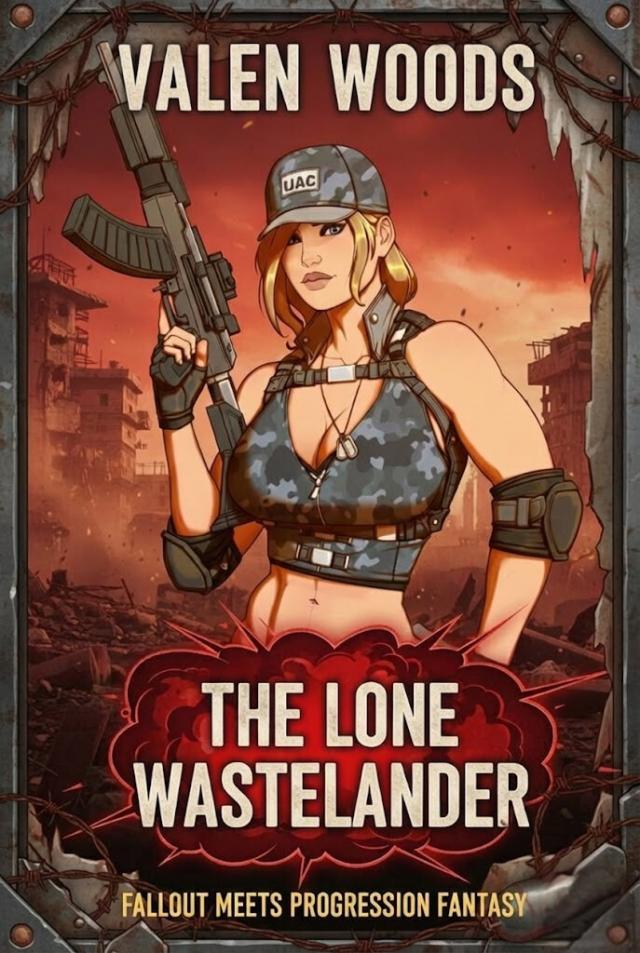


The Lone Wastelander
A Post-Apocalyptic Progression Fantasy Adventure
Valen Woods
Copyright © [2026] by [Valen Woods]
All rights reserved.
No portion of this book may be reproduced in any form without written permission from the publisher or author, except as permitted by U.S. copyright law.
Contents
1. WHEN LIFE GIVES YOU LEMONS
2. YEAR 2225
3. CYLOPEAR
4. FORT DC
5. BACK TO THE BASICS
6. BACK TO THE BASICS II
7. BACK TO THE BASICS III
8. BETTER RUN THROUGH THE WASTES
9. OUTPOST BLUES
10. ON THE ROAD AGAIN
11. WHAT IS IT GOOD FOR? ABSOLUTELY NOTHING.
12. WHAT IS IT GOOD FOR? ABSOLUTELY NOTHING. II
13. LIFE AND DEATH
14. YOUT GET SOME REDZ40 AND YOU GET SOME REDZ40
15. BLUES CLUES
16. HOMEBOUND
17. UAC AINT NOTHING TO FUCK WITH
18. UAC AINT NOTHING TO FUCK WITH II
19. UAC AINT NOTHING TO FUCK WITH III
20. GETTING STRONG NOW
21. MAKING MY WAY
22. WAR NEVER CHANGES
23. WAR NEVER CHANGES II
24. WAR NEVER CHANGES III
25. A LITTLE BIT OF R&R
Chapter one
WHEN LIFE GIVES YOU LEMONS
JJungle humidity was a full-body fever. The moss-caked air smothered even the insects, every exhale sticking to the back of Kevin Moore’s throat like an aftertaste of old blood. The only things moving at a human scale were him and the seven locals ghosting behind him: four men, two women, plus the kid, Paolo, who’d insisted on carrying an actual machete for style points and was now two paces left-rear, cursing softly as he tripped on roots Kevin had warned him about.
Kevin moderated his pace, signaling with two fingers to halt, scan, and look up. The column froze. He felt their boots stomp on the ground even before he heard it; these weren’t soldiers. They were farmers. Cousins. Ex-petty criminals drafted at machete-point and turned into insurgents by a Green Beret with three months’ patience and no illusions about the afterlife. Still, they moved as one organism because Kevin said so, and that was more than you could say for most of the old US Army in 2075.
Up ahead, the land fell away into a muddy embankment, giving Kevin a low-angle sightline on the Chinese-occupied dockyard below. A mile of rusted ships canted in the brown delta, their decks repurposed as barracks or relay points for whatever the Coalition still called "logistics." Metal sheeting served as walls. Watchtowers were capped with gunmetal domes. Guard routines were so clockwork Kevin could predict the shift changes down to the minute. He had done exactly that every night for the last week, watching, timing, and tattooing the landscape onto the inside of his skull.
Now the switch was about to flip. He gestured again: spread out, eyes up, no chatter. It was overkill. His people never talked during action, not even the kid, who had finally shut up in the face of this hot, ozone-tasting hour before sunset.
He turned to assess the line. Three of the fighters, including the women, were already invisible in the undergrowth, eyes reflecting nothing but discipline. The oldest, a retired dockworker with half a jaw, watched Kevin for the next command and nothing else. Paolo waited with bright eyes, as if Kevin might suddenly ask him to recite the plan from memory. He gave the boy the "go" signal and a quick eyebrow flick. Paolo flashed a thumb and vanished forward, moving low and tight along the edge. Kevin suppressed a smile. In three weeks, the kid had gone from wannabe narco to a half-decent ghost.
The last two, twins by the look of them, covered their corners and waited. Kevin wondered, not for the first time, if anyone in this jungle had survived childhood without a sibling dying of cholera, bullets, or just a lack of calories. He shook it off. Compartmentalize, always. He was a knife, not a therapist.
They reached the kill-line at the top of the embankment. Kevin knelt, his knees sinking two inches into spongy moss, and swept the target zone below. Dusk bled into the horizon; the east perimeter tower was shadowed out, just as he’d hoped. A single sentry, an old AK cradled against his ribs, blinked and yawned in the half-light. Down by the river, two more uniforms slouched behind a mesh barrier, passing a cigarette. None of them were expecting anything tonight, not after three weeks of zero contact.
In their defense, nobody expected Kevin either. The US Army had written him off six months ago. He was supposed to be dead.
He verified the twins’ position; the left flank was covered. The dockworker on the right was already setting up his next move. Paolo crept in parallel to the river, almost catlike. Kevin calculated the distances, the angles, and the minutes of sunset, then glanced at his watch. He liked analog; it didn’t break when the jammers went up.
Seventeen minutes until everything went to hell.
He rolled his shoulders to loosen the scar tissue. Sweat dripped off his nose, stinging the old Redz40 rash on his left cheek, but he kept his face neutral. Even now, with his personal death clock down to days, the discipline held.
He signaled the final "move" to his team, then snapped off his own suppressor from his belt pouch and screwed it onto the ancient Glock. It was a joke of a weapon, mass-manufactured in Poland during the "Last Stand" era, but Kevin had tuned it himself. He honed the slide, filed the feed ramp, and kept it clean. He’d killed a man with a rock before, but there was something beautiful about an ugly gun that just fucking worked.
He melted down the embankment, boots finding silent purchase in the mud, and felt the whole unit slide with him as one ripple rather than seven individuals. By the time the sentry in the tower looked up, Kevin already had the bead. One suppressed cough of noise, and the sentry’s head snapped sideways like a marionette cut loose. He slumped over the railing, leaking life into the jungle’s indifferent mouth.
Kevin kept moving. No hesitation. If you stopped to admire your own violence, you died.
The next two guards never saw the twins. One came up behind and looped a garrote around his throat, jerking back so hard the skin split under the wire. The other pivoted, got one syllable of surprise out before a blade punched under his jaw and sent blood in a neat arc across the mesh. Kevin nodded in approval but didn’t stop to watch the finish. There was work to do, and they were on the clock.
He crept onto the dock, motioning for the rest to hold the perimeter, then slipped past the prefab barracks toward the waterline. A dozen rusted cargo hulks loomed in the brown current, chained together by makeshift gangplanks and topped with comm arrays or anti-air guns. The closest ship, a black-hulled behemoth, listed five degrees off true, but still floated. The New People’s Army painted its sigil, a yellow-on-red stylized star, on the ship's flanks. Kevin resisted the old reflex to spit. Symbols were just fertilizer for the dead.
Scurrying across the open lane, he reached the hull. Behind a stack of blue plastic barrels, he knelt, checking for cameras, and found none. Unzipping the waterproof rucksack he held, the mission's core was revealed: C-4, detonators, and a remote. He set the first charge against the hull, right at the waterline, then wired the next three along the main superstructure, each two meters apart. He worked fast, sweat soaking the collar of his shirt, but his hands didn’t shake. They never did, not for this.
He verified the connections, then pressed the magnets tight and snapped the arming switch on all four. Red lights glowed under his palm, steady and calm, like miniature sunsets. He didn’t smile, but he felt the old, private satisfaction. It was the impossible made possible by the oldest trick in the book: outwork, outwait, outbleed.
Kevin looked up, surveying the dockyard. The twins had already dragged the bodies to the water and let the current take them. The old dockworker was on overwatch, keeping eyes on the perimeter, and Paolo was crouched just inside the shadow of the next cargo hulk, watching Kevin for his next move. Total trust was present in the kid. It was a kind of violence in itself.
Kevin wiped sweat from his brow, consulted his watch, saw nine minutes remaining, and gave the exfil sign. The team regrouped at the rendezvous point, a collapsed shipping container half-swallowed by vines. Paolo was last in, huffing but smiling, knife blade still wet. Kevin squeezed the kid’s shoulder and got a wild grin in return.
They moved. No chatter, just the sound of old boots and the sweet, almost-taste of coming freedom.
Halfway up the embankment, Kevin paused, knelt, and did a full sweep. He trusted his people, but he trusted entropy more. It never hurts to be sure.
He looked down at the dockyard one last time. The guards would be missed within twenty minutes, tops. The sabotage would be blamed on a rival faction. Either way, this would buy the local cell a full month of breathing room, maybe more. It would buy the kid a chance to survive another day.
Kevin felt the weight of that knowledge settle onto his shoulders. Not the mission; never that. He knew that every minute he kept these people alive, he was borrowing against a debt that would always come due. From his vest, he pulled out his field notebook to jot down a quick note about each of these people. He flipped it shut.
He motioned for the squad to get down and stay put, then crawled to the highest point of the ri
dge, where the view stretched all the way to the city ruins. He unslung the remote detonator, confirmed the signal, and waited for the red "good to go" light.
Five seconds.
He counted down in his head. Four. Three. Two.
He didn’t pray. He’d stopped believing in gods after the second chemical burn. Instead, he thought of the faces: the kid, the twins, and of his own people back in Virginia, waiting for news from a world that still made sense.
He pressed the button.
The world split open.
First, a sharp, mean ripple of concussion. Then a bloom of white fire as the C-4 atomized a ten-meter hole in the hulk. The blast caught the next three charges in a textbook daisy-chain, and the entire midsection of the cargo ship peeled away in a sheet of orange and black, vaporizing every living thing above deck. Metal shrieked as it bent, the sound hitting Kevin in the chest like a punch. Then came the aftershock. Glass shattered and concrete buckled in a thunderclap of pressure that felt like God finally opening his mouth and screaming.
Kevin blinked away the afterimage and saw fire, real fire, climbing up into the sky. He saw the twins whoop silently, saw the old dockworker’s toothless grin, saw Paolo’s wide eyes, luminous and shell-shocked and alive. Kevin locked eyes with the kid, gave him a hard nod, and felt a pulse of what must have been hope for a second, no more.
The kid nodded back, trust absolute, and Kevin knew, even then, that was what would hurt the most.
The next thing Kevin saw was the blinding flash as the secondary munitions dump ignited.
Then nothing.
Waking up after an explosion should’ve felt like birth. It should have been a new world, new senses, or maybe a chance at absolution. Instead, Kevin’s first awareness was the taste of salt in the back of his throat and the slow, stubborn burn of oxygen at the bottom of ruined lungs.
His vision didn’t work right at first. The ceiling above him was a wet smear, all blue halos and blinking afterimages, as if someone had painted a siren across the inside of his eyelids. He blinked, attempted to shield his face with a hand, and realized someone had strapped him in at the wrists, elbows, and chest. Old instincts kicked in, and his body tensed for a break, except nothing moved. Not even his legs. He panicked, then remembered. He’d been dying long before the explosion.
A wall of glass curved just inches from his face, dotted with tiny bubbles and hairline cracks. On the other side of the glass, something cold and blue pressed against his cheek. It was viscous as hair gel, and he realized he was floating. He was not in water, not exactly, but in a fluid so sterile it hurt his gums. He coughed, then gagged, then coughed again. Each spasm rattled up his spine and triggered a migraine in his occipital lobe, like somebody hammering the inside of his skull with a railroad spike.
Above the pod, lights flickered on the instrument panel, their meanings unreadable. Everything was labeled with six-digit codes or slashed with "FOR MEDICAL USE ONLY" in block letters. Somewhere in the far corner, a voice murmured in Mandarin, filtered through static and cheap speakers, before fading away to be replaced by canned military jazz.
Kevin blinked again, and this time, his vision resolved into a wider picture. He was underground. The room was cinderblock and poured concrete, painted a color that used to be white. It stank of formalin, ammonia, and desperation. The only warmth came from the body-heat of others. They were military staff, all of them, pacing or leaning over consoles or pretending not to stare at the man in the Medpod.
He recognized none of them. But they all recognized him. They had that look: "Here’s the dead guy who won’t die."
He tried to move to be more comfortable but he winced, and failed. His head felt like it was filled with lead solder, his arms were numb, and his tongue tasted like the inside of a gun barrel. He looked down at himself. He first noticed how thin his own arms were. The second thing was that his hair was falling out, not in patches but in a soft, even drift, like autumn leaves on a windshield. The third thing was something he barely wanted to check. It was his left hand, which trembled uncontrollably against the glass with every heartbeat.
He reached with his bound hands and just barely tapped the pod’s surface. Cool, curved, seamless. Real.
He tried to say something, but it came out as a slurred "Fuck." He tried again, managed a wheezy "Where am I?"
A shadow moved at the corner of his vision. He saw black combat boots, medical greens, and latex gloves. A technician, maybe Filipino, maybe American, leaned over and pressed a button on the panel. The blue suspension receded a centimeter. Air hissed in, and for a second Kevin thought he’d been cut loose. Instead, the pod locked back down with a soft thud. His face was dry now, but the rest of his body still floated in the serum.
He watched the technician scribble a note on a digital pad, then step back. No eye contact. No words.
Kevin shifted his attention to the ceiling, then to the slow pulse in his left temple. It was bad, and getting worse. The same tumor that had started in his occipital lobe was now spreading to his cerebellum. It was a hitchhiker he’d picked up in the chemical fallout at Mindanao. "Stage Four" was the phrase, but the specialists at Bethesda had called it "terminal velocity." Meaning: you might slow it, but you’d never steer out.
He laughed or tried to. It came out as a damp, choking rattle. The pod didn’t care.
He let his mind wander. He didn’t know how much time he had, so he killed it with memory. The last thing he remembered clearly was the taste of jungle air and the cold, baked-metal weight of a detonator in his hand. After that, a sequence of noises: explosion, fire, someone screaming, water closing in around his boots, then silence. Then this.
He must have been blacked out for days. Or weeks. Or years.
He drifted, letting memory slide in sideways. Not the war, not the killing. Those were easy to forget. The part that stuck was what happened after the wars, when the military stuck a gold star on your jacket and a radiation badge on your chest and told you to "enjoy retirement." He’d made it all the way to thirty-two, which was longer than most. Long enough to accumulate a short stack of medals, a fat file of reprimands, and a discharge so honorable they sent a priest to sign it. He remembered the look on the general’s face. It was pity, not respect.
Six months after the jungle, the headaches started. Three weeks after that, the scans lit up like a Christmas tree. There was no cure, not for Redz40-induced brain cancer. They told him to get his affairs in order, as if he’d had any to begin with.
The government offered him a choice. He could take palliative care in some airless hospital, or a place in a "long-term medical trial." They called it Project Red Lazarus, because why not? Kevin said yes for one reason: It beat dying slowly and softly in a VA ward with daytime TV for company.
He didn’t remember the actual day they took him. There was a lot of paperwork, a lot of "we’re doing all we can" and "you’re a hero, Officer." The night before, he met with the only person he still called "brother." This was Daryl, the last of his old Green Beret team, who’d somehow survived the Philippines minus a spleen and three toes.
Daryl brought a bottle of bootleg whisky and two folding chairs, and they sat out on the motel balcony, watching the cars fly over the Interstate.
"They’re gonna ice you like a fucking steak, you know," Daryl said, voice gone thick.
Kevin shrugged. "At least I’ll keep."
Daryl gave him the look. It was the one that tried to say, "You don’t have to do this," without making it a question.
"Do me a favor," Kevin said. "If I come out of this a zombie, shoot me. Don’t let the doctors get creative."
Daryl laughed and then punched him in the arm. "It’d be an improvement."
They drank until the sun came up, then hugged like it was a funeral, because it was. In the morning, a convoy of white vans took Kevin and four other "volunteers" out of the city. Daryl watched from the curb, hands in pockets, face blank. Kevin didn’t look back.
The drive to the Virginia bunker took three hours. Kevin spent most of it watching the scenery. He watched stripped cornfields, rusted gas stations, and endless billboards selling future drugs. The driver didn’t talk, didn’t even blink, just followed the GPS through the checkpoints and out to the old missile silo where the government still pretended it was in charge.


