

The classic childrens li.., p.153
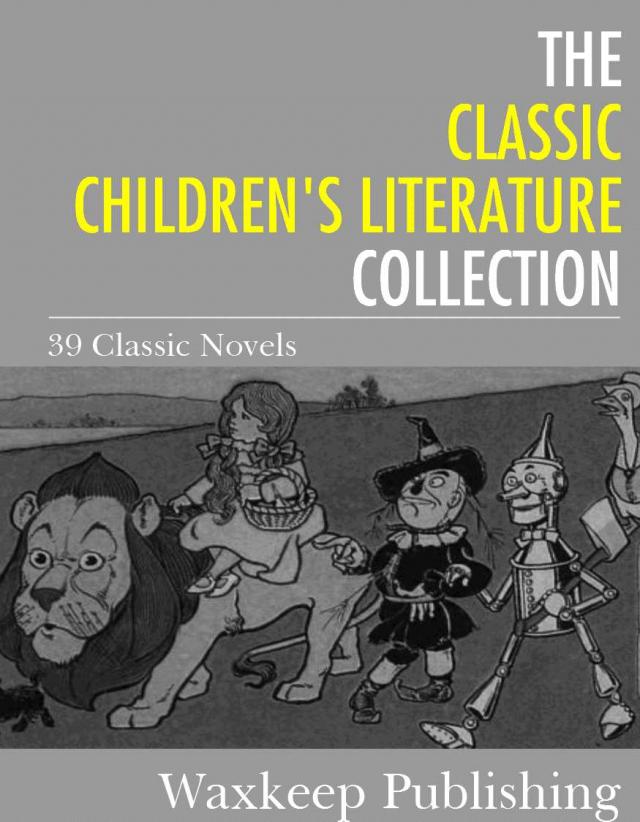
The Classic Children's Literature Collection: 39 Classic Novels,
p.153


“Oh!” cried Dorothy, in an anxious voice, “I’m sure Uncle Henry isn’t getting any better, and it’s because he is worried about me. Ozma, dear, I must go to him at once!”
“How can you?” asked Ozma.
“I don’t know,” replied Dorothy; “but let us go to Glinda the Good. I’m sure she will help me, and advise me how to get to Uncle Henry.”
Ozma readily agreed to this plan and caused the Sawhorse to be harnessed to a pretty green and pink phaeton, and the two girls rode away to visit the famous sorceress.
Glinda received them graciously, and listened to Dorothy’s story with attention.
“I have the magic belt, you know,” said the little girl. “If I buckled it around my waist and commanded it to take me to Uncle Henry, wouldn’t it do it?”
“I think so,” replied Glinda, with a smile.
“And then,” continued Dorothy, “if I ever wanted to come back here again, the belt would bring me.”
“In that you are wrong,” said the sorceress. “The belt has magical powers only while it is in some fairy country, such as the Land of Oz, or the Land of Ev. Indeed, my little friend, were you to wear it and wish yourself in Australia, with your uncle, the wish would doubtless be fulfilled, because it was made in fairyland. But you would not find the magic belt around you when you arrived at your destination.”
“What would become of it?” asked the girl.
“It would be lost, as were your silver shoes when you visited Oz before, and no one would ever see it again. It seems too bad to destroy the use of the magic belt in that way, doesn’t it?”
“Then,” said Dorothy, after a moment’s thought, “I will give the magic belt to Ozma, for she can use it in her own country. And she can wish me transported to Uncle Henry without losing the belt.”
“That is a wise plan,” replied Glinda.
So they rode back to the Emerald City, and on the way it was arranged that every Saturday morning Ozma would look at Dorothy in her magic picture, wherever the little girl might chance to be. And, if she saw Dorothy make a certain signal, then Ozma would know that the little Kansas girl wanted to revisit the Land of Oz, and by means of the Nome King’s magic belt would wish that she might instantly return.
This having been agreed upon, Dorothy bade good-bye to all her friends. Tiktok wanted to go to Australia; too, but Dorothy knew that the machine man would never do for a servant in a civilized country, and the chances were that his machinery wouldn’t work at all. So she left him in Ozma’s care.
Billina, on the contrary, preferred the Land of Oz to any other country, and refused to accompany Dorothy.
“The bugs and ants that I find here are the finest flavored in the world,” declared the yellow hen, “and there are plenty of them. So here I shall end my days; and I must say, Dorothy, my dear, that you are very foolish to go back into that stupid, humdrum world again.”
“Uncle Henry needs me,” said Dorothy, simply; and every one except Billina thought it was right that she should go.
All Dorothy’s friends of the Land of Oz—both old and new—gathered in a group in front of the palace to bid her a sorrowful good-bye and to wish her long life and happiness. After much hand shaking, Dorothy kissed Ozma once more, and then handed her the Nome King’s magic belt, saying:
“Now, dear Princess, when I wave my handkerchief, please wish me with Uncle Henry. I’m aw’fly sorry to leave you—and the Scarecrow—and the Tin Woodman—and the Cowardly Lion—and Tiktok—and—and everybody—but I do want my Uncle Henry! So good-bye, all of you.”
Then the little girl stood on one of the big emeralds which decorated the courtyard, and after looking once again at each of her friends, waved her handkerchief.
“No,” said Dorothy, “I wasn’t drowned at all. And I’ve come to nurse you and take care of you, Uncle Henry, and you must promise to get well as soon as poss’ble.”
Uncle Henry smiled and cuddled his little niece close in his lap.
“I’m better already, my darling,” said he.
Dorothy and the Wizard in Oz L. Frank Baum
To My Readers
It’s no use; no use at all. The children won’t let me stop telling tales of the Land of Oz. I know lots of other stories, and I hope to tell them, some time or another; but just now my loving tyrants won’t allow me. They cry: “Oz—Oz! more about Oz, Mr. Baum!” and what can I do but obey their commands?
This is Our Book—mine and the children’s. For they have flooded me with thousands of suggestions in regard to it, and I have honestly tried to adopt as many of these suggestions as could be fitted into one story.
After the wonderful success of “Ozma of Oz” it is evident that Dorothy has become a firm fixture in these Oz stories. The little ones all love Dorothy, and as one of my small friends aptly states: “It isn’t a real Oz story without her.” So here she is again, as sweet and gentle and innocent as ever, I hope, and the heroine of another strange adventure.
There were many requests from my little correspondents for “more about the Wizard.” It seems the jolly old fellow made hosts of friends in the first Oz book, in spite of the fact that he frankly acknowledged himself “a humbug.” The children had heard how he mounted into the sky in a balloon and they were all waiting for him to come down again. So what could I do but tell “what happened to the Wizard afterward”? You will find him in these pages, just the same humbug Wizard as before.
There was one thing the children demanded which I found it impossible to do in this present book: they bade me introduce Toto, Dorothy’s little black dog, who has many friends among my readers. But you will see, when you begin to read the story, that Toto was in Kansas while Dorothy was in California, and so she had to start on her adventure without him. In this book Dorothy had to take her kitten with her instead of her dog; but in the next Oz book, if I am permitted to write one, I intend to tell a good deal about Toto’s further history.
Princess Ozma, whom I love as much as my readers do, is again introduced in this story, and so are several of our old friends of Oz. You will also become acquainted with Jim the Cab-Horse, the Nine Tiny Piglets, and Eureka, the Kitten. I am sorry the kitten was not as well behaved as she ought to have been; but perhaps she wasn’t brought up properly. Dorothy found her, you see, and who her parents were nobody knows.
I believe, my dears, that I am the proudest story-teller that ever lived. Many a time tears of pride and joy have stood in my eyes while I read the tender, loving, appealing letters that came to me in almost every mail from my little readers. To have pleased you, to have interested you, to have won your friendship, and perhaps your love, through my stories, is to my mind as great an achievement as to become President of the United States. Indeed, I would much rather be your story-teller, under these conditions, than to be the President. So you have helped me to fulfill my life’s ambition, and I am more grateful to you, my dears, than I can express in words.
I try to answer every letter of my young correspondents; yet sometimes there are so many letters that a little time must pass before you get your answer. But be patient, friends, for the answer will surely come, and by writing to me you more than repay me for the pleasant task of preparing these books. Besides, I am proud to acknowledge that the books are partly yours, for your suggestions often guide me in telling the stories, and I am sure they would not be half so good without your clever and thoughtful assistance.
L. FRANK BAUM
Coronado, 1908.
1. The Earthquake
The train from ‘Frisco was very late. It should have arrived at Hugson’s Siding at midnight, but it was already five o’clock and the gray dawn was breaking in the east when the little train slowly rumbled up to the open shed that served for the station-house. As it came to a stop the conductor called out in a loud voice:
“Hugson’s Siding!”
At once a little girl rose from her seat and walked to the door of the car, carrying a wicker suit-case in one hand and a round bird-cage covered up with newspapers in the other, while a parasol was tucked under her arm. The conductor helped her off the car and then the engineer started his train again, so that it puffed and groaned and moved slowly away up the track. The reason he was so late was because all through the night there were times when the solid earth shook and trembled under him, and the engineer was afraid that at any moment the rails might spread apart and an accident happen to his passengers. So he moved the cars slowly and with caution.
The little girl stood still to watch until the train had disappeared around a curve; then she turned to see where she was.
The shed at Hugson’s Siding was bare save for an old wooden bench, and did not look very inviting. As she peered through the soft gray light not a house of any sort was visible near the station, nor was any person in sight; but after a while the child discovered a horse and buggy standing near a group of trees a short distance away. She walked toward it and found the horse tied to a tree and standing motionless, with its head hanging down almost to the ground. It was a big horse, tall and bony, with long legs and large knees and feet. She could count his ribs easily where they showed through the skin of his body, and his head was long and seemed altogether too big for him, as if it did not fit. His tail was short and scraggly, and his harness had been broken in many places and fastened together again with cords and bits of wire. The buggy seemed almost new, for it had a shiny top and side curtains. Getting around in front, so that she could look inside, the girl saw a boy curled up on the seat, fast asleep.
She set down the bird-cage and poked the boy with her parasol. Presently he woke up, rose to a sitting position and rubbed his eyes briskly.
“Hello!” he said, seeing her, “are you Dorothy Gale?”
“Yes,” she answered, looking gravely at his tousled hair and blinking gray eyes. “Have you come to take me to Hugson’s Ranch?”
“Of course,” he answered. “Train in?”
“I couldn’t be here if it wasn’t,” she said.
He laughed at that, and his laugh was merry and frank. Jumping out of the buggy he put Dorothy’s suit-case under the seat and her bird-cage on the floor in front.
“Canary-birds?” he asked.
“Oh no; it’s just Eureka, my kitten. I thought that was the best way to carry her.”
The boy nodded.
“Eureka’s a funny name for a cat,” he remarked.
“I named my kitten that because I found it,” she explained. “Uncle Henry says ‘Eureka’ means ‘I have found it.’”
“All right; hop in.”
She climbed into the buggy and he followed her. Then the boy picked up the reins, shook them, and said “Gid-dap!”
The horse did not stir. Dorothy thought he just wiggled one of his drooping ears, but that was all.
“Gid-dap!” called the boy, again.
The horse stood still.
“Perhaps,” said Dorothy, “if you untied him, he would go.”
The boy laughed cheerfully and jumped out.
“Guess I’m half asleep yet,” he said, untying the horse. “But Jim knows his business all right—don’t you, Jim?” patting the long nose of the animal.
Then he got into the buggy again and took the reins, and the horse at once backed away from the tree, turned slowly around, and began to trot down the sandy road which was just visible in the dim light.
“Thought that train would never come,” observed the boy. “I’ve waited at that station for five hours.”
“We had a lot of earthquakes,” said Dorothy. “Didn’t you feel the ground shake?”
“Yes; but we’re used to such things in California,” he replied. “They don’t scare us much.”
“The conductor said it was the worst quake he ever knew.”
“Did he? Then it must have happened while I was asleep,” he said thoughtfully.
“How is Uncle Henry?” she enquired, after a pause during which the horse continued to trot with long, regular strides.
“He’s pretty well. He and Uncle Hugson have been having a fine visit.”
“Is Mr. Hugson your uncle?” she asked.
“Yes. Uncle Bill Hugson married your Uncle Henry’s wife’s sister; so we must be second cousins,” said the boy, in an amused tone. “I work for Uncle Bill on his ranch, and he pays me six dollars a month and my board.”
“Isn’t that a great deal?” she asked, doubtfully.
“Why, it’s a great deal for Uncle Hugson, but not for me. I’m a splendid worker. I work as well as I sleep,” he added, with a laugh.
“What is your name?” said Dorothy, thinking she liked the boy’s manner and the cheery tone of his voice.
“Not a very pretty one,” he answered, as if a little ashamed. “My whole name is Zebediah; but folks just call me ‘Zeb.’ You’ve been to Australia, haven’t you?”
“Yes; with Uncle Henry,” she answered. “We got to San Francisco a week ago, and Uncle Henry went right on to Hugson’s Ranch for a visit while I stayed a few days in the city with some friends we had met.”
“How long will you be with us?” he asked.
“Only a day. Tomorrow Uncle Henry and I must start back for Kansas. We’ve been away for a long time, you know, and so we’re anxious to get home again.”
The boy flicked the big, boney horse with his whip and looked thoughtful. Then he started to say something to his little companion, but before he could speak the buggy began to sway dangerously from side to side and the earth seemed to rise up before them. Next minute there was a roar and a sharp crash, and at her side Dorothy saw the ground open in a wide crack and then come together again.
“Goodness!” she cried, grasping the iron rail of the seat. “What was that?”
“That was an awful big quake,” replied Zeb, with a white face. “It almost got us that time, Dorothy.”
The horse had stopped short, and stood firm as a rock. Zeb shook the reins and urged him to go, but Jim was stubborn. Then the boy cracked his whip and touched the animal’s flanks with it, and after a low moan of protest Jim stepped slowly along the road.
Neither the boy nor the girl spoke again for some minutes. There was a breath of danger in the very air, and every few moments the earth would shake violently. Jim’s ears were standing erect upon his head and every muscle of his big body was tense as he trotted toward home. He was not going very fast, but on his flanks specks of foam began to appear and at times he would tremble like a leaf.
The sky had grown darker again and the wind made queer sobbing sounds as it swept over the valley.
Suddenly there was a rending, tearing sound, and the earth split into another great crack just beneath the spot where the horse was standing. With a wild neigh of terror the animal fell bodily into the pit, drawing the buggy and its occupants after him.
Dorothy grabbed fast hold of the buggy top and the boy did the same. The sudden rush into space confused them so that they could not think.
Blackness engulfed them on every side, and in breathless silence they waited for the fall to end and crush them against jagged rocks or for the earth to close in on them again and bury them forever in its dreadful depths.
The horrible sensation of falling, the darkness and the terrifying noises, proved more than Dorothy could endure and for a few moments the little girl lost consciousness. Zeb, being a boy, did not faint, but he was badly frightened, and clung to the buggy seat with a tight grip, expecting every moment would be his last.
2. The Glass City
When Dorothy recovered her senses they were still falling, but not so fast. The top of the buggy caught the air like a parachute or an umbrella filled with wind, and held them back so that they floated downward with a gentle motion that was not so very disagreeable to bear. The worst thing was their terror of reaching the bottom of this great crack in the earth, and the natural fear that sudden death was about to overtake them at any moment. Crash after crash echoed far above their heads, as the earth came together where it had split, and stones and chunks of clay rattled around them on every side. These they could not see, but they could feel them pelting the buggy top, and Jim screamed almost like a human being when a stone overtook him and struck his boney body. They did not really hurt the poor horse, because everything was falling together; only the stones and rubbish fell faster than the horse and buggy, which were held back by the pressure of the air, so that the terrified animal was actually more frightened than he was injured.
How long this state of things continued Dorothy could not even guess, she was so greatly bewildered. But bye and bye, as she stared ahead into the black chasm with a beating heart, she began to dimly see the form of the horse Jim—his head up in the air, his ears erect and his long legs sprawling in every direction as he tumbled through space. Also, turning her head, she found that she could see the boy beside her, who had until now remained as still and silent as she herself.
Dorothy sighed and commenced to breathe easier. She began to realize that death was not in store for her, after all, but that she had merely started upon another adventure, which promised to be just as queer and unusual as were those she had before encountered.
With this thought in mind the girl took heart and leaned her head over the side of the buggy to see where the strange light was coming from. Far below her she found six great glowing balls suspended in the air. The central and largest one was white, and reminded her of the sun. Around it were arranged, like the five points of a star, the other five brilliant balls; one being rose colored, one violet, one yellow, one blue and one orange. This splendid group of colored suns sent rays darting in every direction, and as the horse and buggy—with Dorothy and Zeb—sank steadily downward and came nearer to the lights, the rays began to take on all the delicate tintings of a rainbow, growing more and more distinct every moment until all the space was brilliantly illuminated.


