The sword of abram, p.1
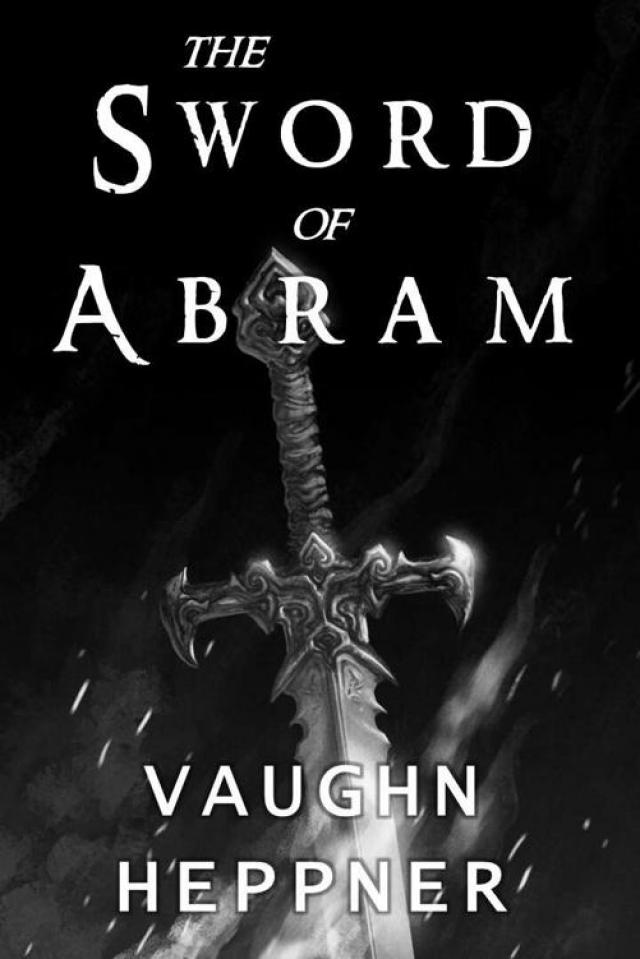
The Sword of Abram,
p.1


Historical Novels by Vaughn Heppner:
THE ARK CHRONICLES
People of the Ark
People of the Flood
People of Babel
People of the Tower
HISTORICALS
The Great Pagan Army
The Sword of Carthage
The Rogue Knight
The Sword of Abram
Visit www.Vaughnheppner.com for more information.
The Sword of Abram
The Manuscript of Damon the Athenian,
Relating His Experiences with the Giants of
Canaan and with Sodom and Abram
Vaughn Heppner
Copyright © 2023 by the author.
This book is a work of fiction. Names, characters, places and incidents are either products of the author’s imagination or used fictitiously. Any resemblance to actual events, locales or persons, living or dead, is entirely coincidental. All rights reserved. No part of this publication can be reproduced or transmitted in any form or by any means, without permission in writing from the author.
INTRODUCTION
In the summer of last year, our team made a fantastic and perplexing discovery. In the hills outside Jerusalem, in a previously hidden burial cave, we found ancient bones preserved in the Minoan fashion. Beside the moldering bones was a fighting dagger forged from asteroidal iron, its style reminiscent of Early Bronze Age daggers used well before 2000 B.C.
If that wasn’t enough of a mystery, stacked neatly beside the ancient bones were hundreds of clay tablets like those found in Ur of Mesopotamia. Instead of Sumero-Akkadian Cuneiform as one might logically expect to find with such tablets, there was what one expert called “a precursor to Linear A Minoan writing.”
That produced much debate among us. Had a traveler from Early Bronze Age Crete come to Jerusalem—it would have been called Salem in those days. Had he died in Salem and beforehand instructed them in Minoan burial practices? Why would they have accommodated him in such a thing?
I took pictures of all the writing on the clay tablets and brought them along when I visited the West Coast of the United States the next month. In particular, I showed them to an expert in the University of California system. The person in question desired to remain anonymous for reasons that will soon become apparent.
He pored over the ancient Minoan script in delight. It was all he could do after dinner. The next day, we met again at his house and he told me that he’d recognized certain symbols. One meant “priest-king.”
“Is that important?” I asked.
His face split into a wide smile. “Given the probable dates of your find, I believe it’s critical.”
“Can you tell me why?”
The smile departed and he became nervous, fidgeting with his hands. “I know you might mock me for this, Steven, but I’m certain the priest-king refers to Melchizedek of Salem.”
“You mean the Melchizedek spoken about in the Bible?”
“In Genesis fourteen, in particular,” he said.
I had to think a moment. “You’re talking about the passage where Abram the Patriarch meets with Melchizedek and also bargains with the king of Sodom? It’s the year the four kings battle the five kings of the Vale of Siddim.”
“Exactly,” he said.
A warm feeling worked through my gut. This would be a find indeed. Many in the secular world contested the truth or reality of Abram. Others argued hotly as to what time-period he appeared in Canaan. If we’d found inscriptions with Melchizedek of Salem of Genesis fourteen fame—
I forced myself to breathe deeply and calm down. “Tell me why you think the priest-king in question is Melchizedek.”
“Right,” he said.
We were in his study. He’d blown up many of the photos I’d taken of the clay tablets. They hung on the walls.
“Notice this symbol here,” he told me, pointing at it.
I moved closer and looked at a number of lines in an odd shape, and shrugged.
His smile became huge again. “I believe it means ‘Him Most High.’”
I shook my head.
“Don’t you understand, Steven? It was the name for God that Abram used, or the writer of Genesis claimed that Abram used.”
This time, a chill worked down my spine. The pieces seemed to be coming together. Even I could see that.
He stepped to a different photo, pointing at it. “This dagger and the method of burial…” He turned to me with a stark look, the smile gone again.
“The dagger bothers you, why?” I asked.
“The burial is odd, too. The indications…”
“Go on,” I said.
He bit his lower lip, looking down. Then, he looked up at me sharply. “Do you mind if I study the photos longer, for several weeks, perhaps, before I make any assertion?”
I looked at the photos on the walls. There were hundreds more. Would he blow them all up? Did he think to understand the precursor Linear A Minoan script? What kind of assertion did he want to make?
I was curious. I also knew I’d get nothing more out of him tonight. My friend was eccentric and brilliant. If he wanted a go at this—
“Be my guest,” I said.
I left him the next day, and the West Coast three days after that. Several months later, I was back in Israel on another archaeological dig near Joppa. In truth, I’d forgotten all about my discussion with the doctor.
Sometime after that, he called and started with “I’ve done it.”
“Done what?” I asked, bemused.
“Deciphered the ancient pre-Linear A Minoan script,” he said excitedly.
I blinked several times, and then it struck me. “How is that possible?”
He became quiet.
I used his name, which I’ll not write here, asking him the same question.
“I’d prefer to keep that to myself for now.”
“Fine,” I said, exasperated, my former curiosity about the find stirred again. He could be most secretive. I’d learned to suffer that with grace instead of endlessly pestering him.
“Steven, I have a usual request.”
“Oh?” I asked.
“I’d like you to publish what I found.”
“Me? Why?”
“I don’t mean you in particular. You have a writer friend, you said before.”
I thought about whom I could have said. “Do you mean Vaughn Heppner?”
“Yes, that’s the one. Have him publish it.”
“That’s ridiculous. He’s a fiction writer.”
“I understand. The clay tablets tell a story about an assassin named Damon. Heppner can publish it as fiction. For now, I think that’s the right way to go. Let him take the credit as well.”
“I don’t understand.”
“The story,” he said. “I want the ancient story to gain access in the public mind.”
“Why?”
“You can read it and see for yourself. I believe you’ll understand then.”
I thought a bit. It was an unusual request. There might be a few problems as well. “I’m not sure Mr. Heppner would agree to that. He wouldn’t want to take credit for something he hadn’t written.”
My friend was silent for several seconds. “You can write an introduction then, explaining the situation.”
“You’re really serious about this?” I asked.
“I am.”
“Fine,” I said. “I’ll speak to Heppner tonight and see if he agrees.”
“Thank you, I appreciate this, I really do.”
“Heppner hasn’t agreed yet.”
“You’ll let me know if he does?”
“I will,” I said.
“This is important, Steven. Try to get him to do it.”
“I’ll let you know one way or another.”
“I won’t be able to sleep until I know.”
“I’ll call him today, I promise.”
“Thank you, Steven. Thank you.”
***
I—Vaughn Heppner—received the call from Steven. He asked me not to use his surname. I said I’d have to read the manuscript before I could agree to anything. After reading it, I agreed, with the proviso of the introduction as my archeologist friend had suggested.
Here then, is the strange story of Damon the Athenian, the agent of the Minotaur, in the year Chedorlaomer invaded the land of Canaan, when the four kings fought the five and Abram entered history as a warrior. It also explains how the manuscript came to lie where it did.
I hope you enjoy the tale as much as I did the first time reading it. And I wish here to thank my archeologist friend and the eccentric genius in the California University system who deciphered the ancient tale and allowed me the privilege of relating it to the reading public.
Vaughn Heppner
Gardnerville, Nevada
February 2023
“Twelve years they served Chedorlaomer, and in the thirteenth year they rebelled. And in the fourteenth year came Chedorlaomer.”
-- Genesis 14:4-5
Chapter One
This is my book, the book of Damon the Athenian, taken in his early manhood to the city of Knossos, the crown jewel of Minos the Sea King.
There I was trained in the arts of observation and assassination. Using the first, and surviving by the second, I will recount what I saw in the land of Canaan, that region between the Kingdom of the Pharaohs and the Lords of the Hittites. Herein, I shall speak of the Campaign of the Four Kings as they marched through history and tell what I saw at the great
city of Salem and its majestic ruler, Melchizedek.
I grew to manhood in the city of Athens. There, I learned the ways of my fathers with the knife, spear and shield. I learned to fight honorably and to act so as to bring honor to the city of Athens.
However, in the Year of the Boar, the Sea King sent black-sailed galleys to Athens. They came to avenge the assault against his trade ships the year before. Some of our people had robbed those traders after they crashed and wrecked in a storm upon the shores of Piraeus.
They demanded tribute, tribute Athens paid—seven young men and seven fair maidens to serve Minos the Sea King in his faraway land. The war leader of the galleys chose me, among others. Thus, with the others, I boarded the galleys and bid Athens goodbye.
I journeyed to fabled Knossos. There, for the next nine years, I learned lore from the priests. I learned more of the knife, spear and shield from hoary slayers. And I learned observational skills from the king. I became a superb warrior and went on several sea-voyages as I honed my skills of surveillance in order that I could report to my master. The Sea King used spies such as I, those whom he called his “ears,” to hear the truth from secret places so he had the knowledge to make proper judgments.
I rose in trust and rank in the service of the Sea King, learning much for such a young man.
At the end of the ninth year, the Sea King learned of a new development in the land of Canaan, that region between the Lords of the Hittites and the Great Pharaohs of Egypt. In that year, as the leaves began to sprout upon the olive trees, Minos summoned me to his palace, one of the wonders of the world.
I entered through the small gate, heading into the antechamber of his palace. There, the Sea King rested upon cushions.
He was a man in his middle years with iron-gray hair. Though he was short, there was no fat upon his frame. His eyes were piercing and his mouth small but firm. He beckoned me to approach.
He informed me I was to go to the far eastern coast and observe because there was a rebellion against a great warrior-king of the East. He wished to know how the rebellion fared and if there were opportunities for the merchants of Crete in the various seaports.
Before the rebellion, those in the lands of Canaan sent much tribute east so gold and silver flowed there. Now, perhaps, gold and silver could flow to Knossos. I must observe and remember, returning to report.
This was an honor and the prospect delighted me. I would have several attendants, and though I would not go in state, I would go heavy with coin.
Then the Sea King informed me I would first go below into the Maze and there speak to the Dark One, who also had a mission for me.
I feared to do this, but bowed low.
Though I’d served nine years in the court of the Sea King and gone on important missions, I yet honored the gods of Athens, those who live upon Mount Olympus. I believed in the virtues of courage, telling the truth and acting as a warrior.
The Dark One…
I trembled.
The Sea King ruled in Knossos, and his galleys enforced his writ upon the Great Sea. But there was another power emanating from Knossos. I knew something of it but was still ignorant in many respects, as it was a secret and occult power. To my limited knowledge, the power wasn’t witchcraft as practiced by wild hags in the forest, nor did I think it came from the throne room of the gods above us. It was a peculiar wizardry deriving from the Dark One of the Maze below the palace.
Of course, I’d heard the rumors of cannibalistic rites and dark spells that took place in the Maze. Few who entered there ever came out. I knew that on occasion Minos received word from the Dark One. Most sinister of all, men said he’d resided down there for over eighty years.
Fantastic as it seems, rumors said that the Dark One was born after one of the gods came to Earth and had congress with a sister of a former Minos. The child possessed supernatural power and was larger and more cunning than a normal man. Some claimed he had the shape of a powerful bull. Thus, one of his names was Minotaur. None said this openly, but whispered it in secret.
Minos had ordered me to go below into the lair of the Minotaur. As I backed away from the Sea King, three cowled priests with staring eyes awaited me.
“Go with them,” Minos said.
I had no choice, and thus consented when one priest gripped my left arm and another the right. The third led the way, as I followed like a prisoner down great marble steps into the depths where candles flickered few and far between the twisty corridors.
The chief priest threaded his way right, right, left—the corridors narrowed and twisted more so I became confused. Alone, I’d never be able to retrace my steps back to the world above.
A fog of confusion and dread came upon me as we solemnly progressed through the Maze.
After a certain turn, I began to feel… a radiance. I dare not call an evil radiance, for I served Minos and therefore the Minotaur. I knew with grim certainty that he was the great power behind Knossos and the galleys plying the wine-dark sea.
We came into an open area so I no longer saw brick walls around me. A lone candle danced, providing a circle of light.
The two holding my arms released me, turned and departed.
After their footfalls faded, the chief priest regarded me. I finally noticed his form. He was bigger, brawnier and more muscular than those of Knossos. Instead of dark hair, he had red hair and blue eyes. He stared into my eyes, and I perceived that he was drugged or drunk, although he spoke in an even voice.
“You will abase yourself and wait upon the Dark One. Do not speak until spoken to. When he is finished with you, he will summon me. We will lead you back into the land of the living…if you meet his requirements. Pray now. Pray that you have courage. Pray that the spittle does not drain from your mouth, leaving you tongue-tied. Honor him, and do not look upon him lest he slay thee.”
With that, the chief priest backed away and departed.
I stood alone in a circle of candlelight deep below the Earth in the Maze of the Minotaur. My fear became overpowering. If felt as if weights were upon me, dragging my limbs until my knees buckled. I crashed onto my knees and then abased myself on the cold, dark tiles. There I lay face down, waiting with dread.
As I waited, I heard the thud of a slow drumbeat as though holding cadence for rowers on a galley of the Sea King. The drumbeats changed as I listened, becoming like the footsteps of a giant approaching closer and closer.
My dread caused me to shiver and shake. It seemed as if my tongue clove to the roof of my mouth. This was more than I could bear.
My heart began to thud in time to the awful drumbeats. Something approached—
“Worm,” a heavy voice tolled, “why are you here?”
I tried to speak, but only babbled.
“Enough,” he said in a voice deeper than a human could utter. It was as if a lion had spoken. “Be still.”
Although the dread was still upon me, I no longer shivered. I regained a semblance of wit and strove to use the courage taught by the spear masters and knifemen of Athens.
“What is your name?” he asked.
I pried my tongue from the roof of my mouth. I raised my head minutely from off the tiled floor. “I’m Damon the Athenian.”
“You’re to go on a mission for Minos?”
“Yes.”
“Yes,” he said, “you’re to seek trade and trade routes, so our ships may bring greater wealth to the coffers and extend our territory.”
I waited: knowing there had to be more.
“I have another mission for you, a greater mission. It is the real reason you’re going to the land of Canaan. Are you ready to hear what I have to say?”
“I am, Great One.”
“I’m the Minotaur, the one you know as the Dark One. Yet, I have brothers across the sea, those who are like me. I’ve perceived them and wish to know more about them.”
“Great One?”
“You’ll recognize them. Men of great stature and strength. Who some call giants. They will know dire arts and be able to make men fear and fall before them. You’ll seek them out and give them a message from me. That is the lesser mission. The greater will be to seek out the acolyte of one I call a strange god. The acolyte will have great pretentiousness. He would attack our ways and destroy the power of our spells and might. This bearded man also claims to have great faith. I want you to seek and find him.”