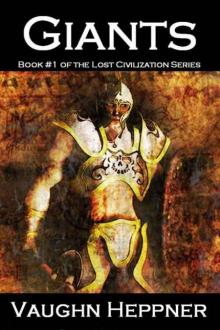
Sleeper ship the travele.., p.1
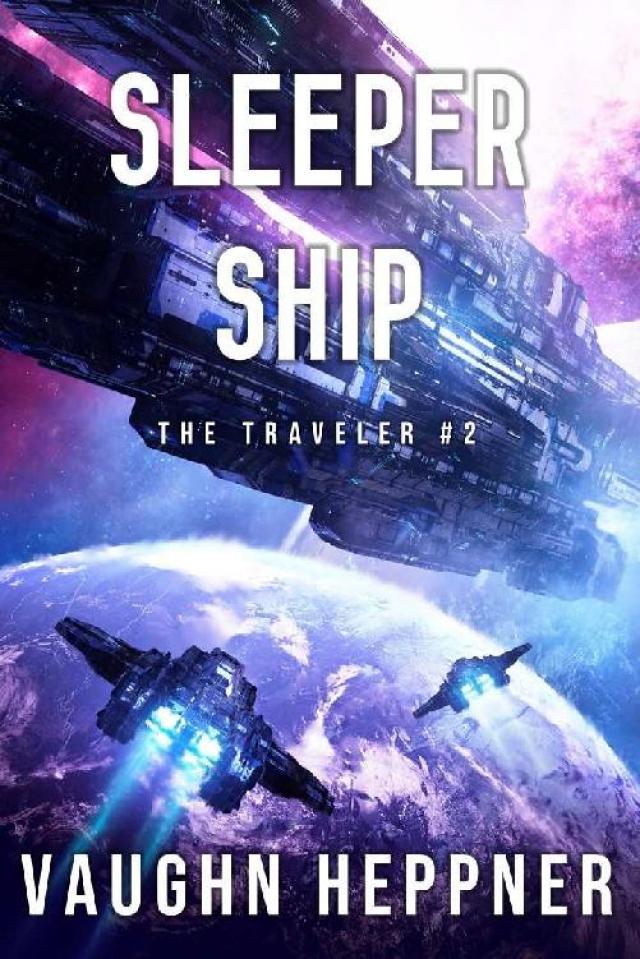
Sleeper Ship (The Traveler Book 2),
p.1


SF Books by Vaughn Heppner
THE TRAVELER SERIES:
Galactic Marine
Sleeper Ship
EXTINCTION WARS SERIES:
Assault Troopers
Planet Strike
Star Viking
Fortress Earth
Target: Earth
THE SOLDIER SERIES:
The X-Ship
Escape Vector
Final Odyssey
Visit VaughnHeppner.com for more information
Sleeper Ship
(The Traveler #2)
by Vaughn Heppner
Illustration © Tom Edwards
TomEdwardsDesign.com
Copyright © 2022 by the author.
This book is a work of fiction. Names, characters, places and incidents are either products of the author’s imagination or used fictitiously. Any resemblance to actual events, locales or persons, living or dead, is entirely coincidental. All rights reserved. No part of this publication can be reproduced or transmitted in any form or by any means, without permission in writing from the author.
-1-
We crashed 57 miles from the South Pole at one fifteen A.M. in winter.
I’d been sleeping most of the trip, my dreams turning into a nightmare. I remember a knife flashing at my face—in the dream—and my head jerking up as my eyes opened to reality.
There was disorientation, confusion. What had happened to the creature wielding the knife? He’d been lunging at me…
I rubbed my eyes, looked around and finally realized I’d been dreaming. There was no knife-wielding creature. I was exactly where I supposed to be—inside a loud, vibrating, cargo hold of a LC-130H Hercules. They were eighteen of us secured to seats, one side of the plane facing the other, with the cargo hold between us.
My name is Jake Bayard, lately a sergeant in the United States Marine Corps. I’d gained my honorable discharge seven months ago, almost the same time I’d left Antarctica with Colonel McPherson.
Few planes, incidentally, flew over the bottom continent, and if they did, they seldom came this close to the South Pole and never in winter. The average winter temperature—it was August 3—was a high of -67 Fahrenheit to -82. That was crazy cold, and if a snowstorm hit—well, we’d likely all die.
We might have been crazy to do this, but an exceptionally well-paid crazy, as the sixth richest man in North America had funded the expedition and was paying us accordingly. None of us were military anymore but security specialists, what in the old days they would have called mercenaries, guns for hire.
I craned my head suddenly, staring at a shadow, thinking I saw a glint from a big, serrated knife held by a scaly hand. A moment later, I realized the glint came from the rearview mirror of a small snow-cat aboard the 130.
I exhaled with relief even as I realized the nightmare had been a warning of approaching danger. I’d had such things happen to me during my combat duty in Bhutan, a tiny landlocked country in the Eastern Himalayas sandwiched between Tibet and India. My tour there had ended almost three years ago now.
I unhooked my restraints, surged up and hurried across the deck for the cockpit. It was off-limits to us door-kickers, but I had to warn the pilot and navigator of the danger I felt if we were going to survive the coming threat.
I checked my watch. The glowing green symbols showed 1:14 a.m. I could feel myself running out of time.
My pace increased as I neared the hatch, as my stomach knotted and the feeling of threat became certain and unbearable. Breathing too fast, turbulence making the deck shift under my feet, I grabbed the handle to steady myself. With a yank, I turned it and opened the cockpit hatch.
Normality reigned within as a panel of indicators lit the pilot and navigator, who talked quietly as they leaned toward each other. The pilot must have noticed the opening hatch in his peripheral vision. He looked back and raised his eyebrows.
I remember a number on a panel indicator: -57 90*S, showing us to be 57 nautical miles from the South Pole.
The navigator turned to me, his bearded face full of expectation. When he saw who it was, he shouted, “You’re not supposed to be in here.”
I ignored him. The C-130 flew lower than I’d expected, as through the windshield, I could see looming mountains and a gap between them. I don’t think either the pilot or navigator saw what I did next because they were looking at me. Through the windshield, a bright wink caught my attention. In a second, the wink turned into a bar of light. It must have been a military-grade laser. Intense light threw shadows into the cockpit. By then, it was probably already too late for us.
The 130 dipped sharply to the left, the same direction the laser had just passed. Had it just sheared off a wing?
The sounds of our flight changed abruptly as the pilot and navigator shouted in terror.
I’d like to tell you what happened next, but all I remember was my body hurtling toward a bulkhead. My head slammed against it, rendering me unconscious while we were still airborne. Undoubtedly, that saved my life, as I went limp. That must have allowed my battered body to go with the flow—in this instance, through a shattered windshield without receiving any major cuts, slashes or breaking any bones…
The next thing I remember was lazily swimming up toward a distant surface, an unhurried return to consciousness. Finally, I raised my fuzzy-feeling head.
Things had changed dramatically. I was lying prone, staring between my boots at fiercely burning wreckage. The flames revealed endless snow in all directions. For some reason, I couldn’t hear the crackling of the fire.
Then, I swore with understanding, and I levered up to a sitting position. My muscles felt weary, sick with fatigue. I’d been thrown clear of the crashed plane, and I seemed to have tumbled for a considerable distance. The 130 had tumbled farther still. How long had I been unconscious? How long had the plane been burning?
With slow and deliberate movements, I worked up to my feet, swaying, with my head throbbing. I felt awful. Then, I vomited onto the snow. I must have a concussion. The right thing would be to play it safe.
My face screwed up. How could I play it safe with my teammates burning to death? With a croak of despair, I staggered toward the inferno—it exploded with a roar as the flames jumped higher into the freezing night sky. The blast knocked me down, so I lay in the snow staring up at the stars. I was vaguely aware of pieces of metal flashing overhead.
I groaned. The C-130 was gone, and everyone aboard was surely dead. I wanted to mourn my teammates. This was a catastrophe. I would have to inform their wives, girlfriends or possibly their parents. I—
I wasn’t going to do shit. I was wearing a leather jacket, pants and boots, but not a parka for this nightmare land. Unless I could find a parka, I would soon die from exposure. I had to act this instant. If I couldn’t feel the cold, it might be because I was already freezing to death, too numb to know better.
The idea drove me upward. As I stood there panting, seeing white mist spew from my mouth, feeling icy prickles everywhere, I remembered the military grade laser fired at us. Given the nature of our mission—
I started to stagger toward the flames. I could hear them burning. I needed better clothing to survive the next few minutes, maybe a survival suit, thermal blankets, anything. Away from the fire, it had to be something like -70. Even with a parka, I would not last long, although without one I’d last even less. Maybe someone else had tumbled clear, someone who no longer needed his parka.
I might not have been in my right state of mind. The concussion, confusion and a growing sense of dread must have created hallucinations. Because what I saw next—floating through the night sky—struck me as impossible.
-2-
Five weeks before the crash near the South Pole, I was with Colonel McPherson in training on a small Indonesian island.
I wore a white t-shirt, shorts and running shoes, sprinting after her on a dirt road as she drove a Jeep. Perspiration soaked me, and I panted as tropical air burned into my lungs. My side ached and salty sweat stung my eyes.
I am big and brawny, not the sort to indulge in long-distance running and more like a charging hippo when I tried to sprint. I’m not saying I am fat. I’m not, but I’m an unusually large tight-end-type. Unfortunately, McPherson had me training like a top-tier boxer getting ready for a championship bout.
She’d insisted I needed to be at my best if I hoped to reach an alien planet again, especially if I was going to take another stab at Saddoth to see if it was possible to insert a team there. The Ophidians or serpent men on Saddoth kept Neanderthal herds for meat. One of the Neanderthals had become my blood brother.
Colonel McPherson was tall for a woman and quite lean. She didn’t wear a uniform today, but rather a sleeveless t-shirt, shorts, gun-belt, holster and sidearm and boots. It turned out she was in her early thirties, had more substantial breasts than I’d first realized when meeting her in Antarctica those many months ago, had a fine butt indeed and long legs that—
Uh, let me try that again, as I might be giving you the wrong impression. While McPherson had the goods, she wasn’t that kind of woman. She had brunette hair to her shoulders and clear skin without any hint of wrinkles, and dark brown eyes. She always had a deadly serious look with thin lips and a thin nose. She was a no-nonsense officer and “witch-hunter” extraordinaire.
I should probably explain what I mean by witch-hunter. In the old days when people rode horses or wagons as high-tech travel and used
swords and lances, many had believed in vampires and werewolves. Such creatures could supposedly shape-shift, and needed special items or means to kill. A wooden stake to the heart could slay a vampire, for instance, while one needed silver weapons to slay a werewolf.
It turned out that while there were no such things as vampires and werewolves, there were shape-shifting aliens among us. I’d discovered that in Antarctica six months ago. There were not a lot of these aliens on Earth, mind you, but enough to screw with the human race. The name for the aliens was Krekelen, or Krekelens, plural. They could change or shift shape so they looked human, but they could not alter their demonically red eyes, and they had hot skin and extraordinary strength. A few times, Krekelens had shipped human psi-masters onto Earth, people with psionic or telepathic abilities.
Old-time people had thought of the psi-masters as witches or warlocks, understandably so, given what they could do.
It turned out that the Hegelian idea of thesis and antithesis had seemed to apply, on Earth. In this instance, the hidden Krekelens were the thesis, and the humans who knew about them and fought back were the antithesis. The secret war had been going on for a long, long time.
As I sprinted after the Jeep, my left boot hit a divot in the dirt road. I flailed, almost went down, but managed to keep my feet under me. I cursed silently, flung my head to the left, flinging sweat, and chased the bouncing Jeep. Maybe I should rough McPherson up a bit, see how she liked the treatment. This was grueling training—she’d said I needed it as a Traveler.
That was something else I’d discovered six months ago in Antarctica. Deep in a subterranean complex near the South Pole was an obelisk, one that could transmit or teleport anyone with the right set of genes. Because of my human or human-seeming father born on a different planet, I had such genes, making me a Third-Rank Traveler.
Six months ago, a trio of Krekelens and Psi-Master Spencer had sought to use me in their efforts—we hadn’t learned exactly what they had been attempting. We did learn that a Traveler was a trailblazer of sorts, and others who knew how could follow him from one planet to another.
I’d traveled to a planet in the Epsilon Eridani System and to a planet called Saddoth, which had been twenty-six light-years from Earth. I’d also learned that dead Krekelens dissolved after an hour or so, one of the reasons few people knew about them.
Our agenda was simple, and by our, I meant McPherson, Suvorov and me. They were part of the secret group fighting Krekelens on Earth. The group had voted against accepting me, and McPherson and Suvorov believed the others wrong and were going to prove them so. We would prove this by my gaining more data of other planets I could reach through the subterranean obelisk.
The only problem was that the President had declared the Antarctica base camp as off-limits to all U.S. military personnel. In the past, McPherson and Suvorov had used their positions in the U.S. military to go where they liked.
Anyway, all this reminiscing came to an abrupt end as the Jeep’s squealing brakes caused the vehicle to swerve and shoot dirt into the air. Unfortunately, I didn’t see the braking until I slammed against the back of the Jeep, folding forward, grunting painfully and sliding down onto my butt on the dirt road.
I gasped, with sweat gushing through my pores onto my skin, soaking my clothes even worse than before.
“Bayard,” McPherson shouted. “Where are you?”
“Here,” I said between gasps.
I heard a Jeep door open and slam, and McPherson’s boots crunch across the dirt and gravel. I looked up. She had her hands on her hips, staring through mirrored sunglasses at me.
“Why’d you stop so suddenly?” I asked.
“Did you run into the Jeep?”
“No.”
Her eyebrows arched high.
“Maybe,” I said, climbing to my feet, leaning against the tailgate. “Is that it for today? Are we done?”
McPherson said nothing, just continued to stare at me.
“You got a problem?” I asked.
“Yes,” she said, “your lousy physical condition. You’re in no shape to go on a mission.”
“Okay…”
“I stopped because Suvorov—bah!” McPherson said, throwing up her hands and shaking her head.
“Suvorov what?” I said. “Can he get me to the South Pole this coming summer?”
“In five weeks, a team is going to the base camp.”
“What team? Has the President changed his mind?”
McPherson shook her head again. “Our group has access to an American billionaire that someone has convinced to send an expedition to the base camp.”
I did some mental computations. “Wait,” I said, aghast. “That’s in winter. It’s crazy to go to Antarctica in winter.”
“Crazy, yeah…but because it’s crazy, it’s an opening, and there have been rumors—from Qiang, I think—about a Krekelen expedition.”
Six months ago, Qiang had been with McPherson, Suvorov and me at the base camp in Antarctica. Qiang had been along when I’d taken out the new Krekelens and psi-masters that had landed on Earth, having come out of their stasis capsules.
I don’t want to brag, but McPherson had said I’d slain more Krekelens during that outing than their secret group had in centuries. If that makes me sound like a badass, well, if the truth fits, wear it or accept it. I had a few gifts, and one of them was fighting.
Anyway, Qiang hadn’t liked me, had voted against me joining their secret group, and had probably become a blabbermouth to this rich American, or enough to whet his curiosity to spend money on an expedition to the interesting base camp, but in the dead of an Antarctica winter instead of summer when sane people went there.
If I sound vague on some of this, it was because I only knew a little. McPherson was a big believer in compartmentalization. My specialty was the actual traveling to an alien planet. I was the tip of the spear in all this.
“Qiang believes Krekelens are sending an expedition to the base camp,” McPherson said. “Winter might be the best time as it will be the hardest time for the U.S. or other militaries down there to interfere with us.”
“Yeah,” I said, “because no one is stupid enough to roam around deep Antarctica in winter.”
“Exactly,” McPherson said, ignoring my sarcasm. “Our team is sending a counter-expedition. I think we can slip you among them. But if you’re afraid of doing this…”
“Yeah, yeah, yeah,” I said, “your reverse psychology is working like a charm. When does the expedition leave?”
McPherson stared at me as if I were a moron.
“Oh, right,” I said, “in five weeks. I’m still winded, you know?”
“And that’s my main point against you going,” she said. “You’re too out of shape.”
“What are you talking about? I’m in the best shape of my life.”
“We don’t want to rely on luck, Bayard, but on skill and preparation.”
“You saying I got lucky before?”
“Oh, yes,” she said, “without a doubt.”
“Well, you know what they say: ‘Better lucky than good.’”
“That fits you to a tee.”
I shook my head, flinging sweat, some of it reaching her.
She jumped back, her distasteful expression complaining about the sweat.
I grinned.
“You really think you’re ready to try this again?” she asked.
“I’m ready. I’m just not sure going in winter is smart.”
McPherson turned around, staring into the distance at tropical trees, shaking her head. Turning back to me, taking off her sunglasses—she really did have nice eyes.
“I might be able to get you on the expedition,” she said. “You’d have to act the part of a mercenary.”
“That would be easy.”
She pursed her lips, studying me. “If you reached the obelisk, where would you try to go?”
“Saddoth for another look-see,” I said, “or if that’s blocked, my dad’s home planet.”
“I’ll need to call Suvorov again to find out more details.”
“Whatever you think best,” I said. “But let’s go to town and have some beers. This running is for the birds.”