Interstellar assault, p.1
Interstellar Assault,
p.1


SF Books by Vaughn Heppner
THE TRAVELER SERIES:
Galactic Marine
Sleeper Ship
The Zero Stone
The Institute
Neanderthal Planet
The Science of Mu
THE SOLDIER SERIES:
The X-Ship
Escape Vector
Final Odyssey
EXTINCTION WARS SERIES:
Assault Troopers
Planet Strike
Star Viking
Fortress Earth
Target: Earth
Visit VaughnHeppner.com for more information
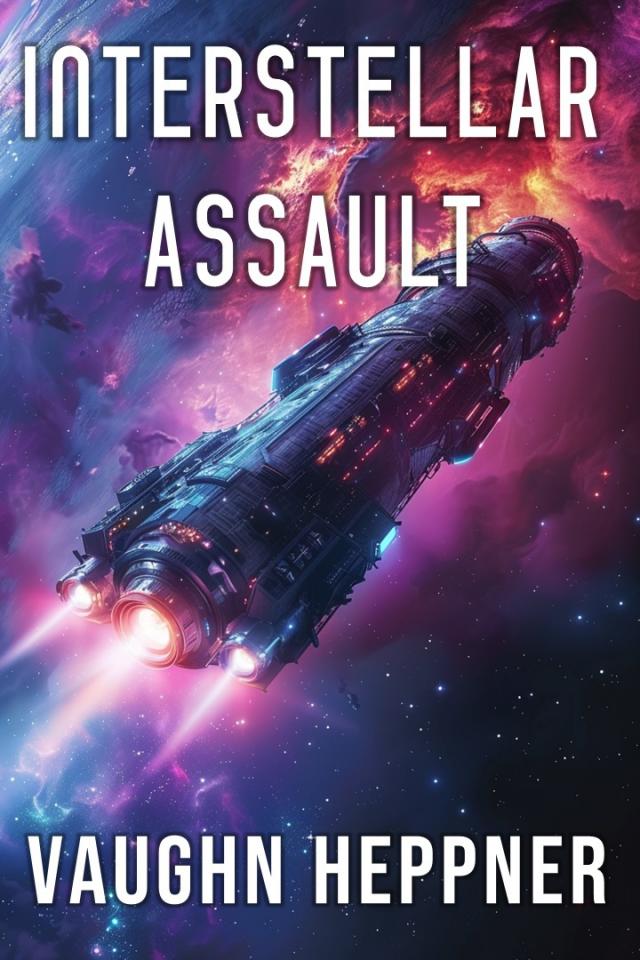
Interstellar Assault
by Vaughn Heppner
Copyright © 2024 by the author.
This book is a work of fiction. Names, characters, places and incidents are either products of the author’s imagination or used fictitiously. Any resemblance to actual events, locales or persons, living or dead, is entirely coincidental. All rights reserved. No part of this publication can be reproduced or transmitted in any form or by any means, without permission in writing from the author.
Author’s Note
I’ve written many a space opera with warp drives, hyperspace, and jump points, faster than light travel, in other words. I’ve often wondered how an interstellar war would take place without such fanciful technology. As far as we know, traveling faster than light is impossible. Would such a war make any kind of sense under that restraint?
Interstellar Assault imagines such a situation with hard science as the basis. That means there are no light sabers, warp drives or psionic powers. I limited myself to using only technologies that we know are possible. Here is one scenario, then, that could theoretically happen.
-- VAUGHN HEPPNER
Minden, Nevada
Introduction
History is the story of humanity, how things happened in the past. If one wants to know what might happen in the future, a sound method is to see what happened in the past.
As the old saying goes, “What goes around comes around.” Some historians also tell us that history doesn’t repeat, but it rhymes.
In the ancient era, the Chinese fought against horse nomads known as the Hsiung-nu. Some scholars believe they went west in time and became the Huns of Attila fame. Several generations before Attila went on his rampage, the approaching Huns arrived out of Central Asia and forced German tribesmen out of the Ukraine, some of whom fled against the Eastern Roman Empire. Some of those were Visigoths and Ostrogoths who won the famous battle of Adrianople in 378 A.D. against the dreaded Roman legions.
The point is someone pushed the Huns, the Huns pushed the Germans and the Germans then confronted and defeated the resisting Romans.
What does any of that have to do with science fiction? Perhaps the idea of one set of aliens pushing another, who flees for survival and fights anyone in their way, including Earthlings, has a ring of reality to it. The reason it does is that we’ve seen it happen before on Earth in the past.
Recall the saying: “What goes around comes around,” maybe even in the vast reaches of interstellar space.
Phase One: The Flight
-1-
48.7 LIGHT YEARS FROM EARTH
256 YEARS AGO
With considerable trembling, Chief Analyzer Sargon studied the data from the long-distance scanners. He worked in dim red lighting aboard the Interstellar Voyager Akkad—the last starship of his People.
The Akkad was a vast cylindrical-shaped vessel that slowly rotated on its long axis to provide pseudo-gravity for its passengers. It was a generational ship. Those who had begun the voyage thirty years ago in their shattered star system would not live to see the end of the journey. Their grandchildren or possibly great-grandchildren would do that, provided the ship had truly escaped the terrible enemy.
Sargon furrowed his broad forehead as he studied the sensor readings.
Drones at the far edge of their abandoned star system scanned inward, sending the readings outward to the Akkad. Those signals—moving at the speed of light—already took several days to reach the generational ship. The data-gatherers had been watching the old star system for thirty long years now, terrified of finding a sign of their remorseless enemy.
The first year had been the worst as the Akkad painfully gained velocity. During the second year, the giant vessel deployed a magnetic scoop, gathering the minute particles found in space, funneling them like a ramjet toward the engines.
The great fusion engines could not use the particles as fuel. The particles were of the wrong type of matter for that. Even if the engines could have used the collected debris as fuel, such a system would not work in perpetuity. The drag from the vast magnetic scoop would be greater than any thrust created solely from the gathered particles. Instead, the engineers used the collected debris as reaction mass or propellant. The Akkad accelerated, spewing the massed particles from the exhaust port, increasing the vessel’s speed.
Slowly but relentlessly, the great ship gained yet more velocity. In the years to come, it would approach twenty to twenty-one percent light-speed. That would allow the Akkad to cross the void between star systems in a reasonable amount of time. The Elders had estimated the journey would take five hundred years, with a three percent margin for error.
In the dim red light of his chamber, Sargon became increasingly agitated, the trembling in his hands becoming outright shaking. He compared the new data to facts painfully gathered during the bitter war against the Vims, their name for the terrible, predatory aliens.
Sargon’s stomach knotted at what he discovered. There was no doubt about it. This was horrible.
He rubbed the back of his neck, thinking through the implications for those aboard ship. Finally, he tapped his console and looked up at a screen.
A woman appeared. She had stately features, dark eyes and a rigid crest of hair. The ten-star badge on her left shoulder indicated her exalted rank.
“This is Ship Commander Anat,” the woman said.
“This is the Chief Analyzer, I have…I have grim news. The—”
“Wait,” she said, interrupting. “Does this refer to…to them?”
“Yes, Ship Commander.”
Commander Anat stared at him, and for a moment, it felt as if a reptilian slithereen focused its unblinking eyes on him.
“I will come down to your station,” Anat said at last. “I want to see this in person.”
Sargon barely checked his surprise. Such an act was against ship protocol. Reluctantly, he nodded. The commander must have a reason for her action, and she wielded the high authority. It was best to obey her in these matters.
“I await your presence, Commander,” he said.
Anat dissolved the connection in what seemed like undo haste.
Sargon swiveled about. That had been strange, unexpected even. His eyes widened in alarm. Could the commander be a secret Suppressionist? Could the heresy have spread that high? His uniform suddenly seemed too tight and the air too hot in here.
Swiveling back to the console, Sargon’s fingers moved across the controls. He created a memory pulse. It took time to set it up correctly. His undergarments became damp with perspiration as his hindbrain estimated how long it would take Anat using the turbo-lifts to reach his office. The tension built as he hustled. Sargon blotted his forehead with a sleeve. There! The memory pulse was on a timer. How long should he wait? He typed quickly. In twenty-five ahn, the new data would stream to each Elder unless he entered a desist code.
He barely finished the program when the hatch slid up. Sargon swiveled around as his heart rate accelerated. A second later, he lurched to his feet in honor of the Ship Commander.
Incredibly, three soldiers moved into the chamber. Seeing them was like a slap to the face. Ship Law forbade soldiers entering this area of the vessel.
Sargon trembled anew. He was not a particularly brave man. With an effort of will, he forced himself to stop shaking. He needed his wits and maybe a little boldness.
Each musclebound soldier stood at attention. Each gripped a long-barreled shredder. Sargon imagined the soldiers aiming the weapons at him and riddling his body with flechettes.
Commander Anat entered the dim chamber. Like him, she was smaller than the soldiers, and like him, she had a larger cranium, indicating heightened intelligence. She wore a scarlet uniform and gave him a cold scrutiny.
“Show me your analysis,” she said.
This was too much. Even if she meant him ill, he was still the Chief Analyzer. She shouldn’t order him like this but make polite requests instead.
Anat continued to watch him, her manner becoming colder by the second.
Sargon cleared his throat, but found he couldn’t speak. Twisting to the primary console, he moved his fingers stiffly, bringing up a holoimage. With several taps, he increased magnification, highlighting the former planets of their old star system. Each planet was a mass of rotating rubble. In the rocky mass nearest the star, a bright flare of light appeared.
Sargon dared to glance sidelong at the Ship Commander in order to gauge her reaction.
Her head swayed as her lips moved soundlessly.
Sargon glanced at the nearest soldier.
The big man leaned forward, his eyes bulging in obvious fear.
That was interesting. The soldier understood the significance of the image. Sargon hadn’t thought them intelligent enough.
“Explain what I’m viewing,” Anat said in a harsh tone.
Sargon bowed his hea
d as his training took over. He spoke in a crisp manner. “I am eighty-seven percent certain we are witnessing an accelerating missile as it begins an interstellar attack run.”
The commander glared at the holoimage. Sargon had set it on a recurring loop.
“What type of missile is it?” she said.
“I am seventy-one percent certain it is an Annihilator Type Four Missile.”
Anat turned to him in a predatory way. “Have you estimated the missile’s target?”
Sargon nodded solemnly. Why else did she think he had called her?
“Do not play games with me, Chief Analyzer. Is Akkad the target?”
It felt as if his heart skipped a beat, hearing someone say it. “I give that a ninety-four percent probability.” He did not like the squeaky tone of his voice, but at least he kept his outer demeanor calm.
“What is the estimated time of the missile’s arrival?” she asked.
“That is difficult to assess. It appears to have an antimatter drive just as a Vim Nova Ship does. Therefore, the missile can accelerate faster than we can.”
“Give me a number,” Anat demanded.
Sargon’s stubborn streak finally asserted itself. “It would be a low probability estimate,” he said.
Anat watched him even more closely than before.
Sargon noticed that the soldiers also watched him more intensely. It made his skin crawl. One of the soldiers fingered his shredder in such a way that Sargon believed the man was ready to aim and fire at him. That seemed unbelievable, against every tenet of the Compact.
“I doubt the missile will reach us in our lifetimes,” Sargon said slowly. “I cannot see it taking more than four hundred years, though.”
Anat continued to focus on him as she ingested the news. Finally, she inhaled, looking away. It took several seconds before she spoke again:
“Our voyage will take four to five hundred years,” she said.
“That is the latest estimate,” Sargon agreed.
“It is clear, then. The missile will destroy us before we can complete the voyage.”
“We might destroy the missile before it could do that.”
Anat looked up at the low ceiling. “Do you believe a new Nova Ship has entered our old star system?”
“Yes.”
“Do you think the Nova Ship will fire more than one missile?”
In his thoughts, Sargon had been avoiding the question. Now, he starkly examined the possibility. The answer was obvious.
“From what we know about the Vims,” Sargon said, “the Nova Ship will fire three missiles.”
“What is the probability the missiles will destroy the Akkad?”
“Given that my other estimates are correct, I have assessed that as a ninety-eight percent probability.”
Anat regarded him. Her manner was colder than ever and much more formal. “Soldiers,” she said, as if ready to give a distasteful order.
“Commander,” Sargon said in a rush. “I have taken the liberty of sending the data to the Elders.”
Anat stared at him before saying, “That is against all protocol.”
Sargon chose his words with care as he spoke delicately, as if finding the words painful. “I have taken your own actions as precedence, Ship Commander.”
Color reddened her cheeks. She was human after all and could know shame. A moment later, she laughed.
“You are a cunning creature, Chief Analyzer. It appears you have anticipated me. That shouldn’t surprise me, I suppose. You are gifted at analysis. I had not anticipated such swift action from one like you, though. I will not make that mistake a second time.”
Sargon decided that silence was his wisest option.
“We will have to make a decision,” she said, as if to herself. “I will have to assemble a consultation. The Vims have found the Akkad. Why otherwise would a Nova Ship fire on us? We had thought to slip away and save our People. Now, we will have to revise the plan.”
Sargon couldn’t help himself as the question squeezed out of him. “Do you believe we will decide on an alternative destination?”
“You tell me, Chief Analyzer. What is the likely outcome from this event?”
With his mind awhirl, Sargon studied the loop holoimage, the brightening dot that indicated a Nova Ship-launched missile. Soon, three giant missiles would chase them through the interstellar void. In time, the missiles would reach the generational vessel. The best solution would be to destroy the missiles, but he doubted the Akkad possessed the firepower to destroy all three. Therefore, they needed a star system full of planets. The best option would be to decelerate in time and hide behind one of the planets. It was doubtful a Type Four Missile would decelerate. Thus, if they could hide in time, the missile would have a choice: slam into the planet in an effort to blow it away so the second or third missile could annihilate them or overshoot the planet and detonate, hoping to kill the ship within the gigantic blast radius.
“I give it a ninety-two percent probability that we will choose a new destination,” Sargon said.
Commander Anat rubbed her forehead before turning abruptly. Without another word, she snapped her fingers and marched out of the chamber.
The soldiers followed, the hatch closing behind them.
Trembling, Sargon slumped into his chair, the realization hitting him hard—the Ship Commander had come perilously close to ordering his execution. After a few heartbeats, he eyed the holoimage.
A new Nova Ship had found them. They had destroyed the old one, but not before it had smashed each of the planets and almost committed genocide against the People. The new Nova Ship had launched at least one missile. By doing so, it had changed the destiny of everyone aboard the Akkad.
A pall of doom now hung over the generational vessel. The maddening thing was that he would never know the outcome. By the time the missile reached the ship—if the missile ever did—he, Anat, and the present Elders would be long dead. Their grandchildren or great-grandchildren would face the ultimate fate. Yet that fate most likely rested on what the commander and Elders decided in the next few months.
Sargon dearly hoped they decided wisely.
-2-
Chief Analyzer Sargon sat in the front row of advisors along with the ship’s Chief Engineer, Chief Habitat Warden and Chief Astronavigator. Other lesser-ranked technical personnel sat behind them, ready to answer any questions.
The seven Elders sat in marble curule chairs facing the Ship Commander and her officers. The speaking dais was between them, presently empty. There were no soldiers in the Audience Chamber, as Ship Law forbade it, and Anat dare not break such a solemn edict in the presence of the Elders.
Three weeks had passed since Sargon informed Anat of the accelerating Type Four Annihilator missile. Another missile had been launched a day ago. Given Vim habits, a third should launch in several weeks from the waiting Nova Ship.
Chief Elder Eshmun now cleared his throat, rose to his feet and shuffled toward the speaking dais. Eshmun wore a long blue robe, indicating his preeminence. He had sagging facial features and a bald, liver-spotted dome, his hair having long ago fallen out. Eshmun was frail and failing. By law, no one could help an Elder onto the dais during a meeting. If the Elder failed to make it, he would lose his status. If he tripped and fell to his knees onto the dais, the others would have to drag him off and eject him from the chamber in shame.
Climbing unaided to the speaking dais was an ancient custom. Anyone unable to do so was clearly unfit to suggest plans to the populace.
Sargon watched Eshmun closely. The frail Elder was the strongest minded of the Survivalist School, a fierce individual despite his frailty.
It felt as if everyone in the chamber held his or her breath as Eshmun approached the dais. Three years ago, he’d hopped onto the dais to show the others his supposed youthful prowess. It had been a rhetorical trick in a way, as the Chief Engineer had fitted Eshmun’s legs with a special agility harness.
Eshmun wore no such harness today, such a thing decreed illegal since then.
Using his liver-spotted hands, Eshmun clutched his blue robe and pulled up, revealing horribly blemished and shriveled ankles and shins. It was a wonder he could walk at all. Inhaling, Eshmun lifted a shaking left foot, scraping it against the dais edge. He could barely reach the dais floor with it, but managed after a fashion. With a heave, he thrust up, dragging his right foot against the dais edge. As he did so, he stumbled.