Neanderthal planet the t.., p.8
Neanderthal Planet (The Traveler Book 5),
p.8


-12-
I saw a silvery glint in the air, hovering. The whine clearly came from it.
“Don’t move,” Krull said. “It might not see us.”
That didn’t make sense. If that was a First Folk craft, surely it had thermo-imaging and could see us plainly through the swirling snow.
As to prove my thought, a wide green beam emanated from it toward us.
I reacted instantly and grabbed the rope that tied us—there’d been a blizzard earlier, although it had died away. I yanked Krull out of the way, as I dove to the ground.
Even so, part of the green beam caught him. His heavy lidded eyes fluttered. He’d taken off his woolens and snow glasses. His eyelids fluttered as if he was falling asleep.
As quick as I could, I un-knotted the rope from around my waist and scrambled away. The whine intensified once more. I looked up and—another green ray emanated from the craft, this time at me. I dodged a second time.
I didn’t think I would a third, as the silver disc slid through the snowy sky toward me.
I clawed out my phasor; put it at its highest setting: click, click, click, and before the disc could fire again, I aimed and depressed the trigger. My beam hit the silvery disc.
I heard a hissing, electronic sound. The disc flew up at an astonishing speed, disappearing into the swirling sleet.
That seemed to throw a weather switch. Abruptly, the wind stilled, and in moments, the swirling snow and ice settled onto the ground.
I spied the silvery disc in the distance. It was a flying saucer moving fast. Sparks flowed from the phasor-made hole. The saucer tilted at a sharp angle down, sliding for the ground. Now I could see a bubble canopy in the center of the craft. It looked as if a single pilot was under the clear canopy.
The canopy blew away and the entire seat with its pilot strapped in ejected. The saucer righted itself then so the seat and pilot shot into the air. If he was a Homo habilis, I couldn’t tell. He wore a flight suit and helmet with a black visor. The flying saucer continued down. The seat and pilot rose until a parachute blossomed. Then the seat and pilot began to descend softly.
“Got you, you creep,” I said.
I looked back.
Krull had risen to his knees. He gripped the mallet in a gloved hand. Yet, he looked bewildered, as if he didn’t know what to do.
Should I run down the possible First Folk pilot who’d ejected from this single-person flying saucer? He hadn’t landed yet, but he would soon. The saucer crashed a distance away. It didn’t explode or do anything spectacular, although it plowed a furrow in the snow and dirt before it came to a halt.
My second choice was to stay and help Krull. How would I find Krull if I raced away and the wind started the snow swirling again?
With my phasor in hand, I scanned the sky for another flying saucer. I cursed myself as an idiot, digging out the special glasses. Putting them on, I scanned again.
Ah! There, in what I assumed was the direction of the valley, were three flying saucers heading our way.
I scanned the terrain.
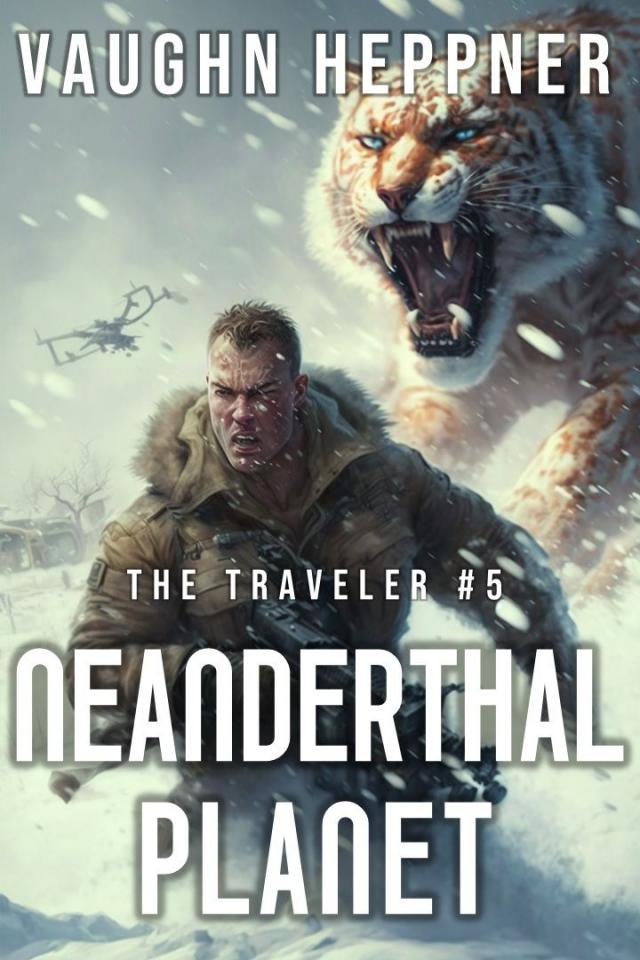
“Oh, crap,” I said. Five Smilodons raced in their lumbering, hyena-like gait toward us.
I tucked away my phasor and special glasses, racing to Krull. I helped him to his feet.
“You’ve got to wake up,” I shouted.
He mumbled incoherently.
I grabbed a fistful of snow, smearing it over his face. He shook his head, snarling weakly. I did it again. Nothing helped, so I grabbed him and bodily shoved him down into the snow. I pressed his face down.
Finally, Krull shook me off with a renewed burst of energy. He staggered up, and he raised his mallet with rage in his eyes.
“How dare you, treachery!”
“No, you idiot,” I said, “I’m trying to wake you up. They must have used a knockout beam against you. We have to get out of here.”
Krull stared at me. Then he looked in the direction of the valley. I don’t know if he saw the flying saucers. He certainly couldn’t see the five great cats heading for us. He groaned, however, perhaps in understanding. He slipped the iron-headed mallet into its loop, put up his hood and pulled the strings.
“You’re right. You’re right. I’m sorry, my friend. It was your difference. You’re so different from me that sometimes it’s hard for me to trust you.”
“I understand,” I said. “Let’s get out of here.”
We took off across the snow. Unsurprisingly, Krull grew weary fast, laboring and panting, his breath streaming from his mouth.
“It’s no good,” he said. “They’re going to find us. They have tracking devices.”
“Then why did you tell me to stand still earlier?”
Krull shook his head. “It was instinctive foolishness. We must think. You’re more a creature of intellect, me of instincts.”
How he’d come to such a conclusion during our short time together, I had no idea, but he was right.
“We need some kind of outcropping,” I said. “Do you know where there are boulders?”
“Do you think me a magician?”
I didn’t, but I had a piece of technology I could use. I slipped the glasses back on and scanned in one direction—
“That way,” I said. “Come on. It’s two miles off.”
“How can you see that far so clearly in this sleet?”
The wind had increased incrementally, swirling some snow again.
I didn’t bother answering. We headed away, but Krull was moving too slow. I grabbed one of his arms, forcing him to run.
We needed to reach the boulders. They’d give us some protection from the green knockout ray. They’d also give us a place to put our backs in case the great cats came upon us.
We ran. I hoped the flying-saucer guys would take time to pick up the survivor. If the flying saucers were one-man craft, though, where would they put the one who’d escaped his wrecked disc?
We ran, and soon little else filled my mind but for the pain of running and pulling an increasingly resistant Krull. Then I heard the familiar whine and knew the saucers were close.
The boulders were only four hundred yards off—four football fields away. The boulders were maybe four or five times bigger than we were.
“Run!”
I released Krull, and began to sprint.
I heard the emission of a ray and looked back. The wide green beam struck Krull. This time, he collapsed onto the snowy ground.
During that time, however, I was able to gain the boulders, even as the flying saucer rose higher in the air, coming for me.
-13-
I crawled under and around boulders, positioning myself, finding a spot where some rock was over my back. Would that protect me from the green knockout beam? I hoped so.
I stared out at Krull. He’d been hit twice in quick succession. He was unmoving as particles of ice swirled around him.
A flying saucer hovered near him as red light swept back and forth from it over Krull.
Bastards, I thought to myself.
I put on the special glasses, touched the button to give me targeting data and raised the phasor.
The pilot behind his bubble canopy fiddled with controls. Was he a Homo habilis? Could it be Philip, or a Philip, out there?
I fired.
The beam drilled through the canopy and burned into the pilot. He jerked violently.
The saucer didn’t crash as I expected but shot straight up, screaming and disappearing from view.
Two other saucers swept forward, flying over the prone Krull. A shimmering hardly visible field surrounded each craft. Those fields hadn’t been there before. Could that be a science fiction force field, electromagnetic energy protecting them?
With a snarl on my lips, I targeted the nearest. My phasor beam burned and stopped short of the saucer.
When I quit firing, the magnetic force field dropped. A drill of laser-like energy shot from it at me.
I ducked behind a rock. I could hear the laser hitting the rock. There was bubbling, hissing. I shuddered. If the beam burned through the rock—
Abruptly, the ray quit.
I looked up.
The saucer flew back, away. The other was already much farther back.
My eyes bulged.
Krull was gone. The second bastard must have picked him up while the first attacked. Had the saucer used some kind of tractor beam to lift Krull? Damn the little Homo habilises, these Philips, these First Folk—how I hated them.
What were they going to do to Krull?
From the corner of my left eye, I spied another saucer.
I brought up my phasor.
No. It wasn’t a saucer but a drone. I drilled it, as a Marine should in the midst of combat.
The thing went down.
From higher up above a beam burned. Did I sense it a moment before it struck? Was there an extra-sensory perception in me?
I dived. There was sizzling of laser burning rock, perhaps piercing it. Abruptly, the ray quit.
I sprang up from where I hid and looked around. Then, I put on my glasses.
The saucer was fleeing, maybe hurrying after the others.
I scanned the skies. The ice and snow flurries had stopped again. I had a great panorama view. Except for the one, the other saucers had disappeared. Did they use some kind of camouflage gear?
I saw the five Smilodons on the ground. They were closer than before, maybe half the distance of where I’d seen them previously. They continued to lope in their ungainly rather ugly manner toward this place.
I hadn’t realized how late in the day it had become. The star, or sun, was heading for the horizon. That was why the flurries had stopped. They did before and during twilight.
How much time had passed since the first saucer sighting?
I scanned, looking everywhere. There was no sign of the flying saucers or their damned drones.
Gingerly, I climbed out of my boulder fortress, checking. I saw melted rock like lava where the laser rays had hit. Those beams had burned hot indeed. If I hadn’t had the little fortress for protection, the saucers surely would have drilled me with their laser beams, to say nothing of their green knockout beams.
Still, they’d taken Krull, my friend.
“My friend,” I said aloud.
A dread sense of loneliness filled me. I was all by myself again.
“God, help him, please, and please help me if You can hear me on this faraway planet.”
I didn’t know why God couldn’t hear me, but that was what I prayed.
Afterward, I tucked away my phasor and special glasses, put the mittens back on, the woolens over my face, and set out.
This wasn’t the place to stay. The Smilodons were coming to kill me, maybe to devour me.
Did the great cats communicate with the flying saucers, using their antennae to do so? Had the cat who’d fled the ziggurat reported on what had happened the first time?
That seemed preposterous.
How intelligent would the great cats really be? The idea of real intelligence was a frightening possibility. Was that why the First Folk had successfully squashed every Neanderthal rebellion? Had intelligent great cats been the Homo habilis ace card in controlling Garm?
I didn’t know that the beasts were intelligent, but the antennae, enlarged braincases, and what Krull had told me—the Smilodons went to the Institute so the First Folk could work on them.
I pondered the dilemma as I trudged through the growing gloom.
Would the five great cats find me in the middle of the night? Or would they hunker down to rest?
That was when I noticed Krull’s sack attached to my belt. How had I gotten hold of it?
I stopped and opened the sack. It had rations and the special thermo-blanket.
Had it snagged onto my belt when we’d been running? That seemed unlikely. The only other way was for Krull to have hooked it there while we ran.
What did that imply?
I scowled. What was going on? Krull had told me things, and yet, why did I have the feeling he hadn’t told me everything or that he’d kept some things back? Why, in other words, had he given me the thermo-blanket and remaining rations? Did he know the saucers would catch him?
Krull hadn’t struck me as a pessimist. Given what he’d done, he had struck me as a fantastic optimist.
“Well, I’m not quitting,” I said to myself. The thermo-blanket would help me survive.
I shook my head. It was time to put distance between the big cats and me.
I’d march all night if I had to.
I’d read this blog once by a fellow who hadn’t worked at all as he traveled between cities. He’d been a bum, but he’d had a free existence. He’d been a kind of a knight-errant, but with no duties to perform. I remember what he’d written. Even if it was raining, and he didn’t have a coat, if he kept walking, he stayed warm enough even at night. Walking kept him warm. If he’d holed up, he would have possibly have frozen to death.
I nodded to myself, deciding that the ungainly Smilodons, the intelligent ones with their antennae, perhaps able to communicate over a distance, would have to work to catch me. Yes, I was a civilized Homo sapiens, but I had Marine training and other training from the Terrans, the former witch hunters. I determined that I was going to trudge all night if I had to and put as much distance as I could between us.
So, suiting my thought to action, I began to trot. Sure, I couldn’t keep that up for long, but I could for a time, and it would keep me warm. Whenever I felt myself getting cold, I would break into a trot and then slow down and recuperate at other times by walking.
“All right, Bayard,” I said to myself, “it’s time for a nighttime education. It’s time to start working. It’s time to be a man.”
“Yeah,” I said with a laugh, “it’s time to be a Marine and show these aliens what we Earthers are made of.”
As I continued my journey, I couldn’t help but wonder what secrets this strange planet held, what other challenges I’d face, and whether I’d ever be able to save Krull. Despite the uncertainty and the dangers ahead, I felt a renewed determination to keep going, to keep fighting, and to show both the First Folk and the Smilodons that I was not one to be easily defeated.
-14-
The night was long, so long and cold, and I was tired, forcing one foot ahead of the other.
I could feel the Smilodons coming after me, could feel the pressure of their hatred. I don’t think I felt any emanations from their minds, from the antennae in a direct sense, but their emotions.
Could emotions transmit through an antenna? Might that be its purpose?
I scooped up snow during the night, stuffing it in my mouth, letting it melt so water trickled into my throat.
I refused to quit, refused to go down, tapping a reservoir of fierceness. I could run to the ends of Garm if I had to, though I wasn’t running now. I walked, staggering.
Hours had passed, the night moving slowly, gusts blowing into my face, at times trying to stand me upright.
No matter, I continued shoving one foot ahead after the other one more time.
Did the wind die down? Did a moon pass I hadn’t seen? I’d only witnessed the stars a few times. There seemed to be more stars in the sky than what I remembered on Earth. How far was Garm from Earth?
A gust swirled, putting particles of sleet in my eyes. I blinked furiously and jerked up my head.
Had I been sleeping on my feet?
I muttered, squeezed my eyelids closed and then opened them wide.
The wind had picked up again. The swirl of snow ahead was gray instead of black. Was daylight near? Had I truly trekked all night?
I laughed. It came out hoarse sounding.
How far had I traveled? Twenty miles? I shook my head. Surely, I’d gone farther than that. It must have been more like forty or even fifty miles. I’d come a long way across the windswept steppe. I was going to keep going, too.
Abruptly, as it often did here, the wind died down. Minutes later, the main star rose above the horizon, casting light everywhere. I saw far into the distance—
I squinted.
That was a line rising on the horizon.
I dug out the special glasses. Oh. That was a mountain range. Did that imply a valley over there behind the mountains?
I rubbed my face, having unwound the woolens.
If it was a valley, might there be a community of wild ones as Krull had wished to meet?
I nodded. Who could live on this desolate tundra? I recalled the patches of greenery and blue in the first valley. It hadn’t been ice blue but lake blue. Maybe it had been a fresh-water lake with fish.
The Neanderthals and First Folk had to eat something. If Smilodons thrived on Garm there had to be mastodons, woolly mammoths or other big-game meat sources. For the herbivores to survive, they needed grass. Maybe this was the worst part of winter. Perhaps it became pleasant in summer, however short the summer might be.
I looked back, using the special glasses. Five beasts of prey lumbered like hyenas but had saber teeth. They were close, perhaps less than a half mile from me. They looked ragged and angry.
One of the antennae sparked. Did that mean the Smilodon communicated back to base about me?
I scanned the sky in every direction looking for flying saucers.
Seeing nothing, I started walking again. I used the glasses, searching for boulders, for any kind of defensive position I could take against the Smilodons.
A cloud had covered the main star or Garm sun. The cloud drifted away so the full glory of the star blazed upon the white tundra.
I tore off the special glasses and put on my Eskimo sunglasses. The reflection off the ice and snow was too much otherwise. Man, but it was bright this morning.
I put the special glasses in their case and tucked them away in my parka.
It was warmer this morning than yesterday.
I put away the woolens, took out a ration, and devoured it as I scurried. I wanted to run. I wanted a lot of distance between the great cats and me.
I knew what it felt like being prey and hated the feeling desperately.
I looked back.