

To clutch a razor, p.10
To Clutch a Razor,
p.10
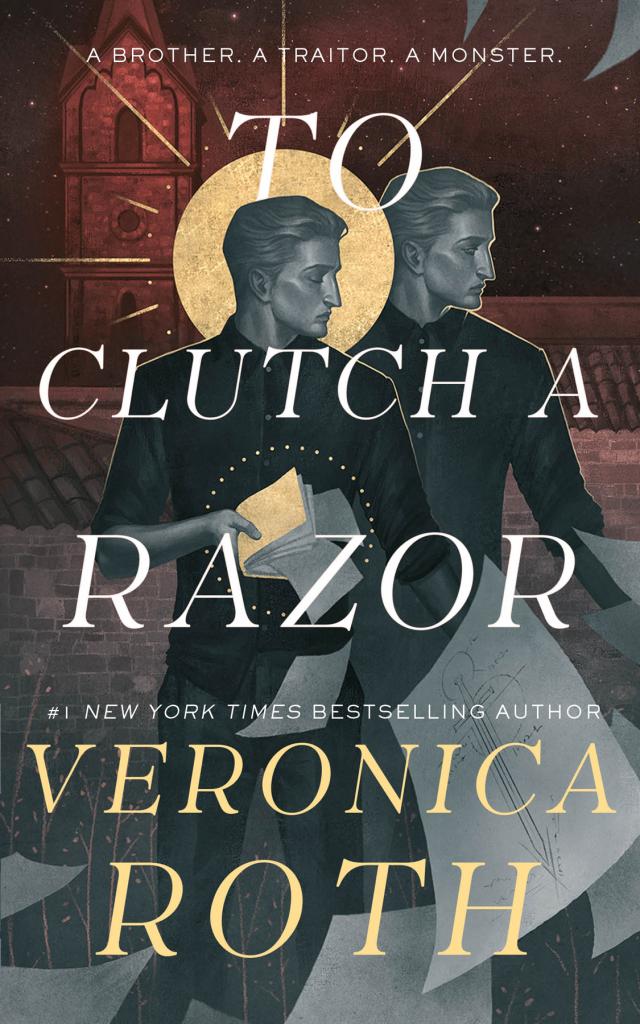


She feels a pang, thinking of a younger Dymitr keeping everything he thinks, everything he feels, inside his own head because it’s not safe to say out loud. Even in the memory she shared with him, she saw how honesty was punished with penance. Ten times, his grandmother instructed him, and Ala is sure that means he had to hurt himself—in exactly what way, she doesn’t know. But it makes sense, now, why it’s so easy for Dymitr to ignore the ache of his missing sword. His life has been replete with pain.
Ala opens the door an inch to peer into the hallway. She needs to make sure the coast is clear before she leaves the room.
“Filip picked off one of the younger members of the German clan and left an invitation in its place,” says a cold, clear voice, faint enough that Ala can barely make sense of it. “Come alone, he wrote, and you can have your youngling back alive.”
Ala recoils. She’s seen so many horrors inflicted by Knights. Children murdered in their beds, or made to watch as their parents died. She thought she was desensitized to it. But the way this Knight speaks, it’s not as if she’s talking about animals. A Knight hunting creatures believing they’re like animals would, in some ways, be understandable—humans hunt animals all the time.
But no—this Knight sounds like she knows exactly what she’s hunting.
And she doesn’t care.
* * *
In the next room, just a few voices sing the hymns to keep the evil spirits at bay, their voices low and creaking.
“Filip picked off one of the younger members of the German clan and left an invitation in its place. Come alone, he wrote, and you can have your youngling back alive. He knew, of course, that Athene would never come to him alone. But he went to the Black Forest, where the trees are so dense that sunlight hardly penetrates to the ground below, and he laid false trails for Athene to follow. Then he waited by the edge of the forest to watch the clan arrive, Athene among them.”
Elza glances at Dymitr, who looks just as rapt as the others, his eyes fixed on his mother’s face. Only his face is drained of color, despite the warmth in the little house. He looks almost … afraid. And no wonder: his mission is to kill Baba Jaga, a far more dangerous target than Filip’s. Filip’s death must be a sobering reminder of just how vulnerable they all are.
“Filip followed Athene through the woods and drew his sword once he was under the cover of trees.” Marzena holds her hands behind her head, as if she’s about to draw her own bone sword; Elza remembers it well, a saber, a little curved, the blade bright white. “I followed his trail of blood deep into the woods, and there I found his body. Only there was something peculiar around the body—the feathers of an owl, of course, but two sets of footprints instead of one.”
The young cousins are staring now, wild-eyed.
“For a long time I puzzled over this,” Marzena says. “One set of footprints leading through the woods, with Filip’s behind. One set of footprints leading away from his body. But two distinct sets surrounding him in the clearing where he was killed. How did two strzygas appear where there was only one, before? And how could I determine which set of tracks to follow out of the clearing?”
“You looked at the tread of the shoes?” Elza prompts her.
“Someone is eager to race ahead,” Marzena says, disapproving, but she’s smiling. “Yes, I looked at the tread of its shoes, and found them to be identical—another oddity. But then I realized they weren’t actually identical. In one set of footprints, the tread was worn all the way down in the heel, but only on the left foot. In the other set, the tread was worn just the same way, but in the right foot. One strzyga was the mirror image of the other.”
“She doubled herself,” Dymitr says quietly.
All eyes swivel toward him, including Elza’s. She shouldn’t be surprised at this point. Dymitr has always been best at understanding the monsters’ magic, at sensing it and tracing it and identifying it. He’s the one who told her never to give her name, when she could help it, and who explained the missing teeth and fingernails on the fresh body they discovered, once, while tracing a rusałka through the plains south of here. Teeth and fingernails are useful, he said, as if she should have known it already.
So she wasn’t surprised, the way Kazik was, when their grandmother made Dymitr curse-bearer, the keeper of a Knight’s holy rituals. The rituals are like magic, and Dymitr understands magic.
Marzena’s eyes glitter a little as she looks at her youngest son. “Yes, she did.”
Until then she didn’t realize that Dymitr called the strzyga “she,” like it was a person. But that, too, is typical. It’s what their grandmother said a few minutes ago: this is the flaw in Dymitr’s heart that he must do penance to correct. And he has. Elza has never known a Knight to submit himself to more penance than Dymitr did in the months before he left for Chicago. Steeling himself for what was to come.
And despite how good his instincts are, Elza didn’t trust him to do his mission alone. She’s the reason he has to start over from scratch. She feels the ache of guilt, and wishes she’d apologized to him, instead of the other way around.
“There were two strzygas in that clearing,” Marzena says. “One a mirror image of the other.”
* * *
Ala prepares an illusion in her mind, like loading a gun: Dymitr, as he was this evening when he set out: dark pants, worn at the knee; a black shirt with the sleeves rolled up to his elbows, creased here and there from packing, and fraying at the cuffs. Dark circles under his eyes. His hair curling a little at the ends, too long.
Holding that image in her head, just in case, she slips out of Dymitr’s room. In the hallway, it’s easier to hear the hymns sung in reedy voices over the body, and the cold, urgent voice speaking over it.
“One a mirror image of the other,” the voice says, and Ala’s steps falter as she thinks for one horrible moment that she’s been spotted, Dymitr’s own mirror image prowling through the back of the house. But the voice continues.
“Time for you to go,” Ala says, to the dybbuk on her back.
For a moment, she worries the dybbuk will break its promise, and keep clinging to her. But with a click of its teeth and a flutter of dark fabric, its weight lifts, and it disappears. She doesn’t know where it will go, which of the Knight cousins it will attach itself to, but she hopes it chooses wisely.
It strikes her as a little funny, in a dark way. The Knights going to all this effort to keep a spirit from invading them, possessing them … but none of their rituals will prevent the dybbuk from doing just that.
* * *
“Mirroring is a strange sort of magic, beyond the capabilities of a strzyga, so it must have consulted a witch somewhere along its path.” Marzena sits back in her chair. “After that, I matched the footprints that walked into the clearing with the set of tracks that walked out. I followed the strzyga back out of the forest to a little hotel close to the big road. But it was nowhere to be found. The hotel manager had seen it, though he didn’t know what it really was, but he couldn’t say where it had gone. So I did what I always do.”
She looks at Łukasz, who’s resting his chin on his hand, his elbow propped up next to a plate of bread.
“You paid the hotel manager off,” he supplies, when prompted.
“I paid the hotel manager off,” Marzena agrees. “He let me into the room the strzyga used and there, I found all I needed.” She reaches out and tugs at the young cousin’s dark blond braid. “A strand of its hair.”
At the end of the table, André gasps. At first Elza thinks it’s just a reaction to the story—and a melodramatic one, at that. But André hunches over his plate, breathing hard. Krystyna puts an arm across his shoulders, speaking softly to him and touching a hand to his forehead.
“How did you find it with hair?” the cousin asks, pulling her braid free of Marzena’s grasp. The question draws everyone’s attention back to the story, to Marzena, as Krystyna ushers André into the kitchen.
“I didn’t,” Marzena says. “I called the dogs.”
She tugs up her left sleeve, revealing a bandage down the length of her arm, from wrist to elbow. Elza has a similar wound on her own left arm, which she used to summon a murder of crows—at the time, she thought she was helping Dymitr escape a pack of strzygas, though now she knows she did more harm than good.
What Marzena summoned wasn’t “dogs,” of course, but wolves. A pack of them, with otherworldly strength and focus. Despite their size, they’re easier to call forth than crows, which are faster and resist control by their very nature. Wolves are pack animals, used to following a single leader. Of all the Knights Elza knows, Marzena calls the strongest, most fully realized wolves. She has a way with dogs, their grandmother says. Always has.
“I offered the hair to the wolves, and they led me to the strzyga. It was wounded, so it hadn’t gone far. It was limping along the road.” She tilts from side to side to mimic the strzyga’s gait. “It didn’t even warrant the drawing of my sword. I sent the wolves ahead of me, and watched them overtake it. When they were finished with it, there wasn’t much left. Some entrails and some feathers.”
She reaches into the inner pocket of her jacket, and takes out a single feather. It’s brown, and dotted with white at regular intervals, like it was dabbed with paint. A pretty little thing, to belong to such a monstrous creature as a strzyga.
Elza sees Dymitr’s hands in his lap, clenched so hard it looks painful.
“We will bury my brother with this small trophy,” Łukasz says, his voice solemn and quiet. “So he knows that he’s avenged.”
Marzena adds, “And then you and I will finish what he started, and pick off the rest of Athene’s strzyga clan.”
“Hear hear,” Elza’s grandmother says, thumping the table with a fist. Then she raises her wineglass to Marzena. All around the table, everyone picks up their glasses, even the young cousins, who have only kompot or apple juice. As one, everyone drinks.
And then Marzena’s spell is broken. A few others go into the next room to join the singers who watch over Filip’s body. Marzena takes the feather in there with them, to slide it into Filip’s clasped hands, beneath the beads of the rosary. Everyone else helps to clear the table of the dirty plates.
It’s not until Elza is piling up the napkins that she realizes: she didn’t see Dymitr toast their mother for her victory.
* * *
“When they were finished with it,” Ala hears from the dining room, “there wasn’t much left. Some entrails and some feathers.”
A shiver crawls down Ala’s spine. She hurries into the bathroom and closes the door behind her. Dymitr told her the book of curses was hidden under the bathroom sink. She opens the cabinet doors there and sees, in the back of the door, two names drawn on the wood in waxy crayon. On one side: ELZA. On the other side: DYMEK.
Under the sink, she finds a scrub brush and a bottle of bleach, a few spare rolls of toilet paper, a stack of washcloths. But Dymitr explained the hiding spot to her carefully: she has to feel along the cabinet’s left side, because there’s a false wall there. She feels it give way a little under the pressure of her fingers, and slides it to the side, expecting to run her fingers over the dark blue leather cover of the journal his grandmother handed to him in the memory.
She feels nothing.
Alarm prickles over the back of Ala’s neck. She runs her fingers all along the cabinet wall. Then she taps along the false panel she slid back to see if the book got stuck there somehow. She uses her phone’s flashlight to peer inside the cabinet itself, moving the washcloths to the side, feeling along the pipes, knocking over the stack of toilet paper rolls.
There’s nothing. The book isn’t there.
And there are footsteps coming right toward her.
13
A SONG FOR THE DEAD
The next song is “Zegar bije, wspominaj na ostatnie rzeczy,” and Elza feels the familiar tune prickling over the back of her neck. The clock is ticking, the droning voices from the living room say to her, remember the last things.
She remembers the last time Filip spoke to her—doubling back to the house before he left on this mission that brought him only death, he asked her if she’d seen his wallet. She rolled her eyes and reached into his left jacket pocket to produce it. “You know me best,” he said to her. “More a teacher than a student from the start.”
Remember the last things, she thinks, and she leaves the chaos of the kitchen to get just a moment alone. She walks down the narrow hallway and around the corner to the part of the house she shared with Dymitr and Kazik, growing up. After Kazik moved out, it was just her and Dymitr, their doors facing each other, a cramped bathroom perpendicular to them both.
She steps into her room and runs her hands over the clothes in her closet without turning on the light. She feels scratchy tulle and stiff brocade and soft cashmere and sturdy wool. She lets a tear fall, and then another, thinking of the lonely clearing in the woods where Filip fell, owl feathers all around; and thinking of sitting across the chessboard from him as he bit down on the top of a pawn—he was always chewing while thinking, her uncle Filip.
She hears a creak in the hallway outside, and says, “Dymek?” And she wipes her cheeks and nudges her bedroom door open with the toe of her boot. Sure enough, Dymitr is standing in his bedroom.
“Got tired of washing up?” she says to him.
“Just needed a break,” he says. “You?”
His tone is off. Gruff. Like he’s angry about something. She wonders if it’s the same thing that’s making her angry.
“I hate funerals,” she says. “I know, I know—who likes them? But I really hate them.”
Another tear falls, and she hardly feels it. She leans into her doorframe, and he leans into his, so they’re across from each other.
“Do you ever think…” His brow furrows in a way that looks new to her, though she’s seen every expression his face is capable of. “Do you ever think about what sort of people we are, that we celebrate a murder like this?”
It takes her a moment to understand. They’re not here to celebrate, after all. But maybe that’s how it feels to him—like a feast. So she nods. “No one has shed a tear for him. He was murdered by a monster and all we do is cheer about the monster being dead.”
His face is passive.
“I know, I know,” she says. “You don’t like when I call them monsters. You never have.”
A twitch of a smile. “I suppose I prefer specificity.”
“You prefer compassion, even when you have to repent of it.”
“Repent of it.” He looks a little startled.
“Don’t tell me all those hours of penance have slipped from your memory.”
“No, no. Of course not.” His smile doesn’t quite spread to his eyes.
Unease surges inside her like the swell of a wave. She’s been dismissing Dymitr’s odd behavior all night. His fearful expression as he listened to Marzena’s story, his insistence on calling the strzyga “she,” and now this.
“Did something happen in Chicago?” she says.
“No. Why?”
“No reason.” She smiles. “Hold on, I need some lip balm.”
She steps back into her dark bedroom and fumbles in the drawer of her bedside table, keeping an eye on the hallway. As she pretends to search the drawer with one hand, she curls her fingers into her palm with the other, her fingernails cutting into the skin. Knight magic floods her body, hot and prickling, and she looks back at Dymitr, her heart racing.
But there’s no strangeness in him, no shadow. Just her brother.
She lets the magic fade before she goes back into the hallway.
“Do you remember our hiding place?” he asks her.
It’s the feeling of their names drawn on the cabinet door that comes to mind first. DYMEK on one side, ELZA on the other, scribbled on the wood in crayon. If their parents—or even their grandmother—had found out about it, they would have both been punished for the defacing, but no one ever had, not even Kazik.
It was how they passed notes, even after they had both started their training as Knights. Maybe especially then. Because complaining wasn’t allowed, and the punishment for it was too severe to risk anyone overhearing, so their best chance at an honest conversation was to write it down, fold it up small, and tuck it into the corner of the bathroom cabinet, just above the bottle of bleach.
“Under the sink? How could I forget?”
“I just wondered if you’d checked it recently.”
She feels suddenly aware of her heartbeat. “Why, did you leave me something?”
Before he can answer, she hears the sound of broken glass in the kitchen, and trades an alarmed look with him. She walks down the hallway to see what broke, and finds one of the vases of chrysanthemums shattered on the floor, the water spreading out from the point of impact, and the flowers scattered everywhere.
And on his knees, picking up the biggest pieces of glass one by one … is Dymitr.
Elza looks over her shoulder, but she doesn’t see the Dymitr she was just speaking to behind her. She thinks of the strzyga mirroring herself with magic. Her breaths come faster and shallower, but her mind is quiet. She walks across the kitchen, sidestepping the young cousins and walking into the room where Filip’s body waits with a feather and a rosary tucked into his palms.
She touches her grandmother’s elbow to get her attention.
And at that moment, the front door opens for a second time that evening. The singers, Krystyna included, falter in their hymn for just a moment, and her grandmother gestures for them to continue. Kazik steps into the house, breathless, and says:


