

When among crows, p.12
When Among Crows,
p.12
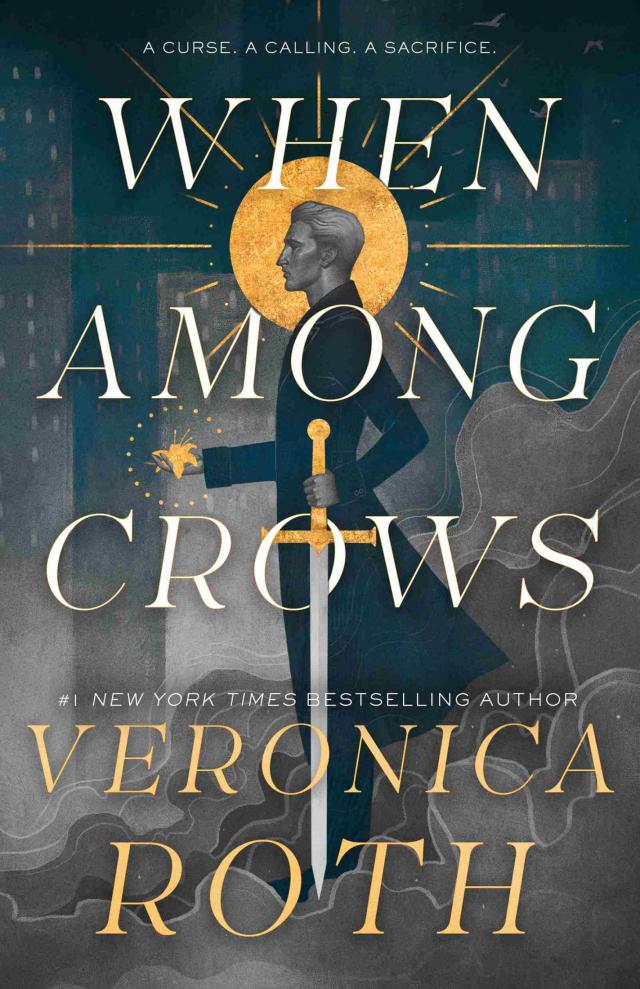


“This is a book of curses,” she says.
“Curses? Like a witch’s curses?”
“No,” she snaps. “Not like a witch’s curses. These are the curses of a Knight.”
He raises his eyebrows.
“Some of our number know how to forge our weapons; some keep the grimoires of knowledge about our enemies; some keep the texts of our names and histories throughout the ages; you will keep our curses.” Her eyes glitter. “Our magic.”
“I … didn’t know we could do magic, Babcia,” he says to her, feeling uneasy. “Isn’t that what monsters do?”
“Did you think the splitting of the soul was not done through magic, boy?” She shakes her head, and a strand of white hair escapes her braid. She tucks it behind her ear with clumsy fingers. “Our magic is not like their magic. It is not offered in repayment of debts; it is costly, righteous, and bloody. It is one of our most important weapons in fighting back the forces of darkness that threaten to claim our world.”
He stares down at the journal in his hands. It suddenly feels too heavy to hold.
“Listen,” she says, and he so rarely receives this kind of focus from his elders that he can’t look away from her. “We are long-lived, and we are strong. But we do not have the same innate power as the monsters we fight. With this book, I can not only summon stronger weapons to fight my enemies—I can make those fights unnecessary. I can turn their powers against them; I can create wounds that do not heal; and I can even, on occasion, attach a curse to their blood that will wipe out their entire family line. All I need to give…” She runs a finger along the outside of her forearm, where he can see the dark line of a scar. “… is a little pain.”
He’s heard of his mother summoning crows, his father summoning wolves, of a trail of blood that can bewitch a single sigbin or an entire pack of upiór, of pain that lights fires and rends flesh and muffles screams. But he’s never heard of the kind of magic that warps a creature’s powers or creeps through their blood. He wonders how many times she’s used it; he wonders what, exactly, she’s done.
“Our task as Knights is to step closer to the dark so that other humans, humans less suited to bear its influence, don’t have to. And these curses … these curses are even closer to the dark than most Knights dare to go,” she says. “None of my children had the disposition for it, so I withheld it from them. But I believe you can bear this burden, Dymitr. You can be our curse-bearer.”
She lays a cold, dry hand against his cheek.
“Before you sleep, you must do penance for your fear,” she says. “Ten times, to root it out from your heart before your ceremony tomorrow. Understand?”
He suppresses a shudder.
“Yes, Babcia,” he says, clutching the book to his stomach.
11
A PROMISE KEPT
When he surfaces from the memory, he’s on his knees in the dark blood he and Ala spilled on the carpet, his hand still clutched in Ala’s with the ribbon binding them together. She looks at him with an expression he can’t name. She lifts her free hand like she’s going to touch his face, and then she doesn’t—she lets it drop back into her lap instead.
“The petal,” she says to him.
She reaches into her pocket for the brown paper, and offers it to him. He unwraps it as carefully as he can, given how hard he’s trembling. The fern flower rests inside it, almost as fresh now as the day he picked it, which feels like it happened in another life. It looks almost like a lily, with big, thick petals that taper to an elegant point, symmetrically arranged around a central labellum. He pinches one of the petals and breaks it away from the flower. It doesn’t feel like it’s as powerful as it is, but maybe that’s just how powerful things are—like the zmory, like Baba Jaga herself, they don’t always need to declare themselves.
He puts the petal in his mouth, and chews it. It tastes like green, there’s no better word for it—like grass, or leaves, with just a hint of sweetness. He swallows, and as he swallows he can feel the petal carving a line of heat down his esophagus and into his stomach.
Pain comes again, but this time it’s less focused, and more of a burning that envelops his entire body at once, as if he’s been thrust into a fire. Heat swallows him up, and he can tell by Ala’s whimper, across from him, that she suffers the same thing; they reach for each other at the same time with their free hands, and clutch each other, the ribbon straining around their knuckles.
Their eyes meet, and the pain disappears. He sits back on his heels, panting, the fern flower fallen to the carpet by his ankle.
Baba Jaga bends over them and cuts the ribbon with the paring knife. But they don’t release each other right away.
“It was her,” she says to him in a whisper, like it’s a secret.
“It was,” he says. “And she chose me as her successor.”
He says it bitterly, because he knows what it means: that she saw in him the same capacity that she feels in herself. He peels his fingers away from her hand. They’re tacky with blood.
“But you aren’t,” she says to him. “You came to me instead.”
But he can’t look at her, can’t possibly bear her mercy now.
* * *
The smell of this place is familiar to Niko. All witch houses seem to smell the same, like lavender and smoke and salt. And now blood, of course, the combined blood of Ala and Dymitr staining the rug between their knees. As they pull their hands apart, Niko is relieved to see their bleeding has slowed, the wounds returned to normal. They come to their feet, and Niko bends to pick up the ribbon that fell between them. He knows Baba Jaga too well to leave her with such a token; there’s a lot she could do with it.
He tucks the ribbon in his pocket. He wouldn’t have said, before, that you could see the curse on Ala … but he can certainly see its absence. She stands straighter, and her eyes are brighter. He doesn’t know much about the visions that haunted her, except—It was her, she just said to Dymitr, and he seemed to understand. Something strange has passed between them, something Niko can’t comprehend.
Baba Jaga is waiting. Niko can tell by the restless shift of her bare feet. Her toes are red with Ala’s and Dymitr’s blood. Her eyes lift to meet his, and for a moment he sees a spark of light there, like a child’s delight. It’s a feat for a woman who has seen and done so much, to still find room for wonder.
“And now we come to the main event, I think,” Baba Jaga says, when Dymitr turns to face her, Ala and Niko at his back. She leans against the table behind her, jostling some of the jars with the heels of her hands. Teeth clatter together in one of them; live moths flap their wings against the glass in another.
“Make your request, Knight,” Baba Jaga says to Dymitr.
“I’d like you to destroy my sword,” he says to her. “So the powers and the oaths of my kind are beyond my reach.”
“You wish to hobble yourself,” Baba Jaga says. She tilts her head a little as she regards him, and it’s easy to see the strzyga buried deep in her blood, this way. Baba Jaga is neither strzyga nor zmora nor mortal nor wraith, yet she’s collected bits and pieces of so many things in her long years that she can, at times, resemble every one of them.
“Why?” she asks him.
“I have done wrong,” Dymitr says, and he sounds exhausted, just as he did in the foyer.
“And you were taught that pain is penance,” Baba Jaga says.
Dymitr receives this in silence. Niko looks at Ala, who is biting down on her lip almost hard enough to draw blood. The look she gives him carries a question. He suspects it’s something like, Are we really going to let him do this? And if Niko didn’t believe so much in letting people make their own choices, perhaps the answer would be no. But he does.
Doesn’t he?
“Very well,” Baba Jaga says. “I have heard that the longer you go without drawing that blade, the more difficult it is to unsheathe. Is that true?”
Dymitr nods.
“How long has it been?”
“Over a year.”
“Then I suggest you kneel.”
Dymitr looks at his hands, and Niko looks with him. His right pinkie is taped to the finger beside it and wrapped in gauze—the fingernail he gave to Lidia. His palm is cut from taking Ala’s curse. His fingertips are bright red, irritated from the bowstring.
Dymitr takes off his jacket and tugs his shirt over his head. Niko swallows a gasp.
He can see the sword buried in Dymitr’s spine. It’s a longsword, the hilt flat against his shoulders, but so deeply submerged in his flesh that Niko can only see a sliver of it where it catches the light. He knows from experience that the blade itself is bone white, but he can’t see it; it’s inside Dymitr’s body, and he’ll need to pull it free with his bare hands.
He holds the jacket and shirt out to Ala, and she takes them, her eyes wide. Dymitr glances at Niko.
“Might not want to watch,” he says to Niko and Ala.
“If you have to feel it, the least I can do is see it,” Niko replies, sharp.
Dymitr turns away, and kneels at Baba Jaga’s feet. He draws a deep, slow breath, then brings his hands up to the back of his neck. For a moment they hover there, trembling.
“Dzierżymy miecz,” he says softly, “i znosimy jego ból.”
We bear the sword, and we bear the pain of the sword.
Then he digs into his own flesh. A shudder travels through Niko’s entire body. Beside him, Ala presses a palm to her mouth, as if to stifle a scream. Blood spills down Dymitr’s back, around his fingertips. He digs still deeper, harder, and makes a strangled sound, something between a whimper and a scream.
Niko steadies himself. Everything in him wants to launch himself at Dymitr and pull his hands away from his back—to save him from this unnecessary agony. But he won’t, and it’s too late now, besides.
Dymitr screams into his teeth, and plunges his hands into his flesh to wrap them fully around the hilt, which is lifting away from his spine now, soaked in blood and skin and muscle. Dymitr sags over his knees with a sob, but the job is not done; the blade is still buried inside him.
For a moment Niko thinks he’s given up, that he won’t be able to finish. But then Dymitr sucks in a sharp breath, and straightens, and screams again as he yanks the sword upward. It pulls free of the sheath that is his spine, and he holds it aloft for a moment, blood soaking the blade, the hilt, his hands and forearms.
The open wound in his back is already knitting together, the skin sealing where he broke it with his fingernails. He drops the sword at Baba Jaga’s feet with a clatter, and falls forward onto his hands and knees, gasping. Niko’s knees feel weak with relief. Ala closes her eyes.
Baba Jaga bends down to examine the sword. She seems unmoved by the display of pain she just witnessed; her eyes glint as she looks over the blade, the simple gold-plated hilt. The instrument of so many nightmares: the bone sword of a Knight of the Holy Order.
“Are you certain?” she says to Dymitr.
Dymitr lifts his head. He hesitates for just a moment, and that moment is all Niko needs.
“Wait!” he says, the word tearing its way out of him. Baba Jaga raises an eyebrow at him. He falls to his knees beside Dymitr, laying a hand on his bare and bloody arm and turning him to face Niko.
Niko’s hands are cold against Dymitr’s shoulders.
“Don’t do this,” Niko says to him.
“Do you know how many of your kind I’ve killed?” Dymitr says to him, his voice rough.
“No, but—”
“Neither do I,” Dymitr whispers. “I didn’t keep track. It didn’t occur to me that the number would matter. Don’t you understand? I have to do something; I have to.”
“Pain is not penance.” It’s Ala who speaks this time. She draws Dymitr’s eyes up, over Niko’s shoulder. “You hurt me, you killed people I love, but I still have no use for your pain; I still don’t want you to destroy yourself.”
“It’s not just that,” Dymitr says. His hands come up to Niko’s elbows, unbearably gentle. His gray-brown eyes are soft. “I can’t be this anymore. I can’t bear it.”
“Then be something else instead,” Niko says firmly. He looks up at Baba Jaga. “Change him.”
“You say that as if it’s simple,” she says.
“You changed me into a strzygoń,” he says. He doesn’t mean to say it. His connection to Baba Jaga is private. But then, these two already know more than anyone else does about him—when his mother died, the secret of his mortal origins, the other secrets he carries, they died with her, and he has kept them alone since then. It’s something of a relief, to share that burden.
Baba Jaga seems unfazed by his disclosure.
“You already had strzygi blood,” she says with a shrug. “I merely amplified it.”
Niko looks down at Dymitr’s hands, at the wound in his palm. He thinks of the ribbon in his pocket, stained with Ala and Dymitr’s intermingled blood.
“He already has Ala’s blood in him,” he says. “Zmora blood.”
Baba Jaga brings a finger up to tap against her lips, considering the wound just as Niko did.
“Interesting,” she says.
She pulls away from the desk, and walks on silent feet to one of the windows, pulling back the curtain to look out at the city. Niko has walked through this apartment before with all the curtains drawn; he knows its impossibilities, how it stands on the edge of the Chicago River in the Loop, but also on top of the Harold’s Chicken in Buena Park, but also overlooking Hyde Park, depending on which segment of the apartment you’re in. Still, he finds himself amazed by the line of light along the river. Chicago always reminds him of a stray line from T. S. Eliot—Unreal City, under the brown fog of a winter dawn—though he knows, of course, that the line refers to London.
Baba Jaga lets the curtain fall back across the window, and turns to Dymitr, Niko, and Ala again.
“The payment I require for changing you,” she says, “is your sword.”
Dymitr stiffens beneath Niko’s hands.
“My soul, you mean,” he says.
“A piece of it. Yes.”
“And what will you do,” Dymitr says quietly, “with a piece of my soul?”
“What I wish,” Baba Jaga says.
The back of Niko’s neck prickles. His mother was in Baba Jaga’s debt, once. She refused to tell him what the witch asked of her, but he saw its aftermath. Night after night, for a year, his mother came home with dirt caked under her fingernails and sweat curling her hair and trouble in her eyes. It’s no small thing, to be the hands and feet of Baba Jaga.
“Will you ever return it to me?” Dymitr says.
“For the right price,” she replies.
There’s that, at least. It’s a door left cracked, instead of closed and locked. Dymitr looks at Niko, and then Ala.
“Is this what you want from me?” he says. “To change?”
She crouches in front of him, and reaches for his hand. He gives it to her, and holds on.
“I want you to live,” she says. “I want you to try.”
It takes a long time, but finally, Dymitr nods.
12
A MONSTER’S DEATH
When he told his grandmother he wanted to go to America to find and destroy Baba Jaga, she considered him for a long time.
They were at the coffee shop where she’d once picked out a zmora from a crowd of strangers. He drank his coffee black, now, with honey instead of sugar. He bit down on the hard biscuit that came with it, and met his grandmother’s gaze.
“Why?” she asked him.
“Why keep fighting foot soldiers when we can take out a general?” he said. “You told me, once, that you believed I would do things that none of our people have managed. Do you still believe that?”
His grandmother sipped from her cup of coffee. He could see the stiffness in her shoulders that came from leaving the bone weapon sheathed. She was too old to draw it now, her long life finally coming to its close. But her mind was sharp as ever, and for a moment, he was afraid that she would see right through him.
“Perhaps I do,” she said, with a small smile.
* * *
Baba Jaga picks up a jar of teeth and tips one into her palm, then grinds it to dust in the huge mortar she keeps on the table. She’s stronger than she looks, her bicep bulging in her sleeve as she presses down with the pestle.
“Niko, dear,” she says, without looking up. “Be a good boy and fetch me a dried thistle.”
Niko moves around the table to search the shelves behind Baba Jaga, and Dymitr frowns. He’d gotten the impression, before they arrived here, that Niko had only met Baba Jaga once before. She was the one who turned him from mortal to strzygoń, but he seems to know this place with more than a passing familiarity.
Babcia, he called her, when they arrived.
Niko plucks a jar from one of the shelves and takes a dried thistle from within it with two fingers. He offers it to Baba Jaga, who adds it to the powdered tooth in the mortar and grinds it up.
Dymitr picks up the bone sword that he unsheathed from his body. It hums with the same feeling of rightness a person gets in their sleep when they shift into a comfortable position. He wonders if that will change, when he transforms. Will this piece of his soul ever feel like his again?
He expected to feel relief when he came to this decision not to live a half-life, to spare himself the pain of his unmaking. Even a Knight plagued by guilt is a human being, driven by the desire to spare himself annihilation, isn’t he? But he feels regret instead. He knows how to bear pain, has been diligently instructed in the art of it since he was a child. Penance, before he took his oaths, and the splitting of his soul that accompanied them, and the unsheathing of the sword that came after, they were all ordinary to him. It would be easier, in some ways, to bear the pain of the sword’s destruction, than to embrace whatever this is.
Ala’s eyes find his.
“Foolish hope, remember?” she says to him, and some of his regret ebbs away.


